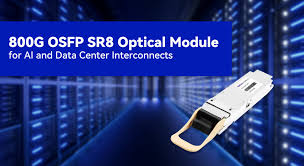
The rapid expansion of artificial intelligence (AI) workloads has fundamentally transformed the requirements of modern data center networks. Training large-scale AI models requires massive east-west traffic between GPUs, storage systems, and distributed computing nodes. To support this demand, next-generation networking solutions such as 800G QSFP-DD modules are being widely adopted across hyperscale and enterprise environments. Among them, 800GBASE-SR8 optical transceivers play a critical role in enabling ultra-high-speed, short-reach connectivity within AI Data Management Center interconnect (DCI) architectures.
As AI clusters grow in size and complexity, traditional 100G and 400G links are no longer sufficient to handle the exponential increase in data movement. High-performance computing environments now require not only greater bandwidth but also lower latency, higher port density, and more efficient cabling systems. This is where 800G SR8 technology becomes essential, offering a scalable and cost-effective solution for intra-data center connectivity.
In modern AI infrastructure, 800G QSFP-DD modules are widely deployed to connect high-performance switches, GPU servers, and AI Data Center accelerators within the same data hall. The SR8 variant, in particular, is optimized for short-reach applications using multimode fiber, making it ideal for high-density interconnects where performance and efficiency are equally important.
Understanding 800GBASE-SR8 Optical Technology
What Is 800G SR8?
800GBASE-SR8 is an 800Gbps Ethernet optical standard designed for short-reach transmission over multimode fiber (MMF). It uses the QSFP-DD form factor and delivers high-density connectivity through eight parallel optical lanes, each operating at 100Gbps using PAM4 modulation.
The SR8 designation refers to short-reach 8-lane transmission over 850nm wavelength optics. It typically supports distances up to 50 meters over OM4 multimode fiber, making it suitable for intra-rack and inter-rack connections within a single data center. The module uses an MPO-16 connector interface, which consolidates multiple fiber strands into a compact and manageable form factor.
Key Technologies Behind SR8
The performance of 800G SR8 transceivers is enabled by several advanced optical technologies. PAM4 modulation allows each lane to transmit two bits per symbol, effectively doubling the data rate compared to traditional NRZ signaling. This enables 100Gbps per lane performance while maintaining manageable signal integrity.
In addition, parallel optical transmission plays a crucial role in SR8 architecture. Instead of multiplexing multiple wavelengths onto a single fiber pair, SR8 uses eight parallel fibers for simultaneous data transmission. This approach reduces latency and simplifies optical processing, making it ideal for ultra-low-latency AI workloads.
Why SR8 Is Essential for AI Data Center Interconnect
Supporting Massive GPU Scale-Out Architectures
AI training clusters rely heavily on GPU scale-out architectures where thousands of accelerators work together to process large datasets. These systems generate enormous amounts of internal traffic that must be exchanged rapidly and efficiently across the network fabric.
800G SR8 modules provide the bandwidth necessary to support these workloads by enabling ultra-fast communication between leaf and spine switches. This ensures that GPUs can exchange gradients, parameters, and training data without network bottlenecks, significantly improving overall cluster efficiency.
Enabling Low-Latency Short-Reach Connectivity
One of the key advantages of SR8 technology is its ability to deliver extremely low-latency transmission over short distances. In AI data centers, where milliseconds of delay can impact training performance, minimizing latency is critical.
Because SR8 uses parallel optical lanes rather than complex wavelength multiplexing, signal processing overhead is reduced. This results in faster data transmission between devices located within the same rack or adjacent racks, making SR8 ideal for high-performance AI fabrics.
Advantages of 800G SR8 in Modern Data Centers
High Bandwidth with Efficient Parallel Architecture
The 800Gbps throughput of SR8 modules enables data centers to support next-generation AI applications without network congestion. By utilizing eight 100G lanes in parallel, SR8 delivers massive bandwidth while maintaining a relatively simple optical design.
This architecture ensures predictable performance, which is essential for AI workloads that depend on consistent and synchronized data movement across multiple compute nodes.
Cost-Effective Multimode Fiber Utilization
800G SR8 operates over multimode fiber (MMF), which is widely deployed in existing data center environments. This allows organizations to upgrade to 800G speeds without replacing their entire fiber infrastructure.
Compared to single-mode solutions, MMF-based SR8 deployments often result in lower installation costs and easier cable management. This makes SR8 particularly attractive for large-scale AI deployments where budget and scalability are key considerations.
Optimized for High-Density AI Networking
Modern AI data centers require extremely high port density to support thousands of interconnected devices. QSFP-DD form factor SR8 modules enable compact, high-density switch designs that maximize port utilization while minimizing space and power consumption.
This high-density capability is essential for leaf-spine architectures commonly used in AI fabrics, where every switch port plays a critical role in maintaining overall system performance.
Applications in AI Data Center Interconnect
GPU Cluster Networking
One of the primary use cases for 800G SR8 modules is GPU cluster interconnectivity. In AI training environments, GPUs must exchange large volumes of data continuously. SR8 ensures that these exchanges occur efficiently, minimizing communication delays and maximizing computational throughput.
Leaf-Spine Data Center Architecture
In leaf-spine network architectures, SR8 modules are commonly deployed between leaf and spine switches to provide high-speed, non-blocking connectivity. This architecture ensures that any server can communicate with any other server through a consistent and predictable network path.
The use of 800G SR8 in this environment allows operators to scale AI infrastructure horizontally without introducing performance bottlenecks.
Short-Range Data Center Interconnect
Within hyperscale data centers, SR8 is often used for interconnecting adjacent racks or rows of equipment. This short-range connectivity ensures that high-bandwidth applications can operate efficiently without requiring long-distance optical solutions.
SR8 in the Future of AI Networking
As AI models continue to grow in complexity, the demand for higher bandwidth and lower latency will continue to increase. While 1.6T and future optical technologies are on the horizon, 800G SR8 remains a foundational technology for current-generation AI infrastructure.
Its combination of high throughput, low latency, and cost-effective multimode fiber deployment makes it a practical choice for organizations building scalable AI systems today. In many cases, SR8 serves as the bridge between current 400G deployments and future 1.6T architectures.
Conclusion
800GBASE-SR8 optical transceivers play a critical role in enabling high-performance AI data center interconnects. By leveraging parallel 100G lanes, PAM4 modulation, and multimode fiber infrastructure, SR8 modules deliver the bandwidth and efficiency required for modern AI workloads.
As AI continues to reshape industries and drive unprecedented data growth, 800G QSFP-DD SR8 modules will remain a key technology for building scalable, low-latency, and high-density network architectures. Their ability to support short-reach, high-speed connectivity makes them indispensable in the evolution of next-generation AI data centers.
Read Also: tamildhoms.co.uk