DIY macramé projects for stylish home decor use natural cotton, jute, or hemp cord knotted in repeating patterns — primarily the square knot, the half hitch, and the lark’s head — to create wall hangings, plant hangers, table runners, lighting covers, shelf hangers, and textile art that brings the specific warmth and handmade quality of knotted natural fiber into domestic interiors. This article gives you exactly 15 ideas spanning beginner techniques, intermediate woven elements, and advanced sculptural pieces so every skill level, every room, and every budget finds a macramé project that is genuinely achievable and genuinely beautiful.
Macramé done well is not the craft fair aesthetic of the 1970s revival — it is the contemporary maker’s use of a genuinely ancient knotting tradition (documented in 13th-century Arabic decorative textile work and the sailor’s knotwork traditions of the 19th century) to produce objects that bring natural material warmth and the visible evidence of human handwork to rooms that have been smoothed and sealed and rendered anonymous by manufactured products. Here are 15 projects worth starting this weekend.
Why DIY Macramé Projects Work for Stylish Home Decor
The resurgence of macramé as a domestic craft and a commercial interior design feature — tracked in retail data from approximately 2015 onward, peaking in commercial availability around 2018–2020, and continuing as a sustained handmade maker practice rather than a passing trend — is specifically attributable to three qualities that the craft provides and that manufactured home textiles cannot replicate. First, the material: natural cotton and jute rope has a warmth, a slight irregularity, and a texture quality that reads differently in domestic spaces than any woven, printed, or felted alternative — it is simultaneously simple (a length of cord) and rich (the accumulated texture of hundreds of knots). Second, the process: macramé is a craft whose making process is entirely meditative, requiring sustained repetitive motion (tying the same knot dozens or hundreds of times across a project) that researchers in craft psychology document as producing the same cognitive benefit as meditation — a present-focused, rumination-interrupting absorption in a manual skill that produces a tangible, lasting object at its conclusion. Third, the flexibility: macramé produces three-dimensional objects of genuinely varied scale and function from the same fundamental material and the same small set of knot types, meaning that the skills learned in one project directly transfer to all subsequent projects.
The specific knot vocabulary required for the majority of domestic macramé projects is surprisingly small. The lark’s head knot (used to mount cords onto a mounting rod or ring) and the square knot (the fundamental structural knot of most macramé patterns, producing the characteristic diagonal ridges and openwork pattern of classic macramé) together are sufficient for approximately 80% of all domestic macramé projects. Adding the half hitch (a single directional knot used to create diagonal lines and curves) and the spiral knot (a continuous series of half-hitches in one direction that produces a twisted rope effect) covers approximately 95% of all contemporary domestic macramé patterns. This very small technical vocabulary is what makes macramé uniquely accessible among textile crafts — a beginner who spends two hours learning to tie a consistent square knot can immediately begin producing the majority of projects in this list.
Style at a Glance
| Element | Craft Core | Stylish Result |
|---|---|---|
| Philosophy | Simple knots, accumulated texture, natural material | Warmth and handwork visible in every piece |
| Materials | 3–5mm natural cotton cord, wooden dowel, brass ring | Jute, hemp, driftwood, ceramic bead |
| Skill Range | Single knot type to complex sculptural form |
15 DIY Macramé Projects for Stylish Home Decor
1. Classic Wall Hanging — The Foundation Project
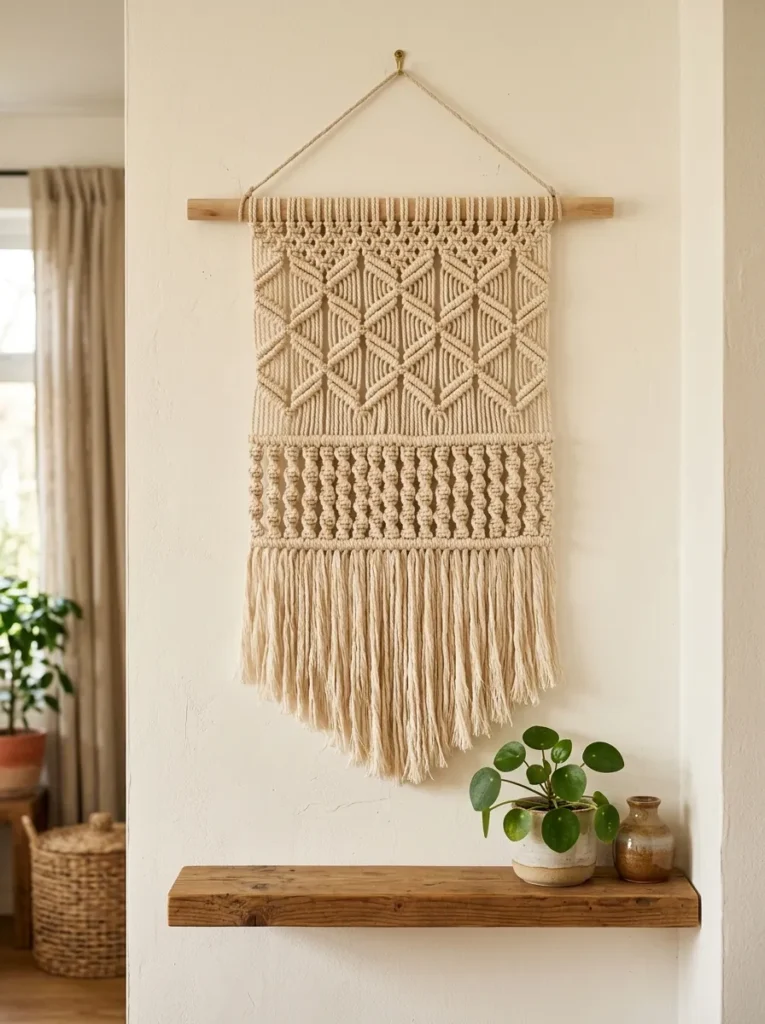
Vibe: The classic wall hanging feels like the beginning of a making practice and the most resolved version of it simultaneously — the square knot diamond pattern readable as the work of a beginner’s first afternoon or an experienced maker’s considered piece.
Why it works: A classic alternating square knot wall hanging is the foundation macramé project because it uses the minimum possible vocabulary (one knot type) to produce the maximum recognizable macramé aesthetic. The alternating square knot pattern — where knot groups are tied, then the cords crossed and retied in a new grouping — produces the classic open diamond texture that is the visual signature of macramé, readable at room distance and rewarding at close range. The brushed fringe (achieved by untwisting the rope’s plied construction and combing the individual fibers apart using a stiff brush) converts the rope’s structured end into the soft, feathery fringe base that softens the hanging’s lower edge.
Materials: 4mm 3-ply natural cotton cord, 50cm natural wood dowel, scissors, masking tape (to prevent fraying when cutting), a stiff brush (for fringe combing).
Cord calculation: For a 45cm wide hanging with 25cm fringe, cut 16 cords at 250cm each. The lark’s head mounting doubles each cord, producing 32 working strands from a 45cm mounting width.
Making time: 4–6 hours for a first attempt; 2–3 hours for an experienced maker.
How to make it: Cut 16 cords at 250cm. Fold each in half and mount on the dowel using lark’s head knots. Work alternating square knot rows: row 1 ties square knots in groups of four adjacent cords. Row 2 takes the two right cords from one group and the two left cords from the adjacent group to create the alternating offset. Continue for 12–15 rows to produce the diamond pattern. Add a row of spiral knots (12 consecutive half hitches in the same direction on each four-cord group) for the textural contrast section. Leave the remaining cord length as fringe. Brush vigorously with a stiff pet brush or stiff hairbrush to separate the plied rope into individual fibers.
Quick Win: A single-row macramé accent hanging — six lark’s head-mounted cords with one row of square knots and 20cm of brushed fringe — takes under an hour and costs under $5 in materials, providing the macramé wall accent effect at minimum commitment.
Shop The Look
| Product |
|---|
| Natural cotton cord 4mm 3-ply |
| Natural wood dowel 50cm |
| Stiff brush fringe combing |
| Masking tape cord end seal |
| Linen hanging cord thin |
Also view: 12 DIY IKEA IVAR Shelf Ideas for Modern Homes
2. Macramé Plant Hanger — Single Pot
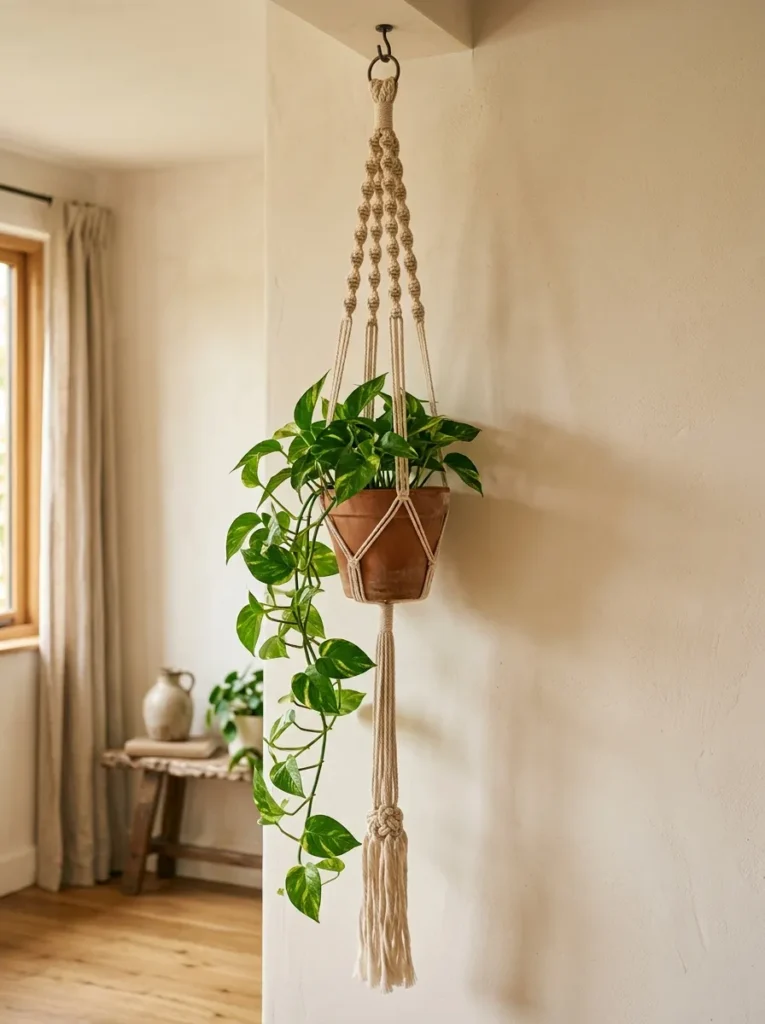
Vibe: The macramé plant hanger feels like the most natural possible suspension system for a plant — the cord wrapping the terracotta in the specific embrace of knotted fiber, the trailing fringe and trailing pothos in a considered vertical composition.
Why it works: A macramé plant hanger is the entry-point project for most macramé beginners because it is small, uses minimal cord, and produces a complete, functional object in under two hours. The plant hanger’s functional requirement — to support the weight of a pot and plant safely from a ceiling hook — provides the design logic for the structure: a gathering knot at the top collects all cords into a single hanging point, the decorative pattern section provides visual interest along the hanger’s length, and the four-strand base cradle distributes the pot’s weight evenly across four equidistant support points.
Weight safety: A standard 15cm terracotta pot with moist soil weighs approximately 1.5–2.5kg. The four-strand base cradle of 3mm cotton cord distributes this load evenly, and each individual cord is rated for significantly more than the distributed load. However, the ceiling hook or curtain rod from which the hanger is suspended must be rated for the full pot weight — use a ceiling hook fixed into a joist (rated for 5–10kg) rather than a plasterboard anchor for any plant hanger that will hold a meaningful pot.
Materials: 3mm natural cotton cord, one large wooden bead (optional), scissors.
Cord calculation: Cut eight cords at 300cm each. Fold in half at the midpoint and gather all sixteen strands, tying them together 5cm below the midpoint fold with a gathering knot (a ninth short cord wrapped tightly around the bundle and knotted).
Making time: 1.5–2.5 hours.
Shop The Look
| Product |
|---|
| Natural cotton cord 3mm single pot |
| Terracotta pot 15cm |
| Trailing pothos indoor plant |
| Ceiling hook joist-fixed |
| Large wooden bead decorative |
3. Macramé Table Runner
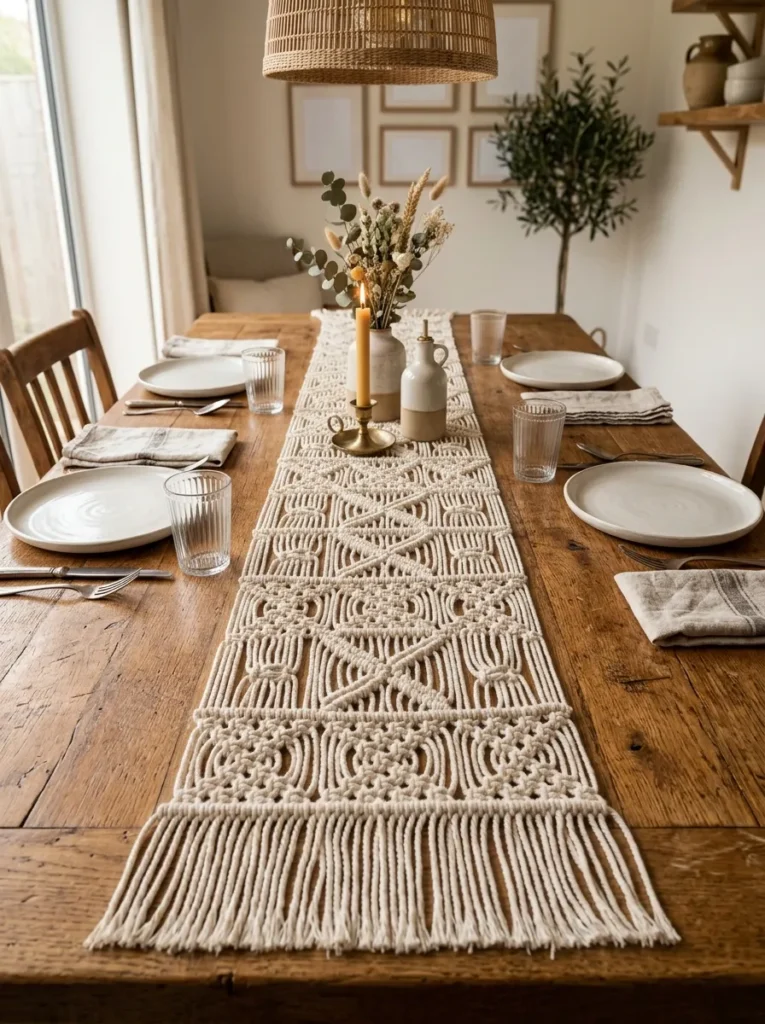
Vibe: The macramé table runner feels like a centrepiece that is also a textile — the knotted pattern providing visual interest at the table’s center without the height that a floral arrangement would impose, allowing across-table conversation.
Why it works: A macramé table runner applies the textile-as-centrepiece principle — a runner at the table’s center serves the compositional function of organizing the table setting around a central visual element while remaining low-profile enough not to interrupt the social dynamic of the dining occasion. The open alternating square knot pattern specifically suits a table runner because it is visually interesting from above (the primary viewing angle for a table runner) while allowing the table’s wood grain to read through the open knot pattern beneath, creating a layered material composition (cord over wood) that is more visually complex than either material alone.
Construction note: A table runner is worked flat rather than hung vertically, which changes the working position — the runner is knotted while pinned to a foam board or while attached to a mounting rod clamped to a table. The horizontal knotting orientation takes adjustment for makers familiar with vertical hanging projects.
Materials: 3mm cotton cord, a foam board or work surface, T-pins for securing during knotting.
Cord calculation: For a 25cm wide runner, mount 20 cords (doubled to 40 working strands) at 4× the finished length: 4 × 150cm = 600cm per cord plus 8cm fringe allowance = approximately 620cm per cord.
Making time: 5–8 hours.
Shop The Look
| Product |
|---|
| Natural cotton cord 3mm table runner |
| T-pin set foam board knotting |
| Foam board work surface knotting |
| Natural oak dining table |
| Ceramic plate set white |
4. Macramé Lampshade Cover
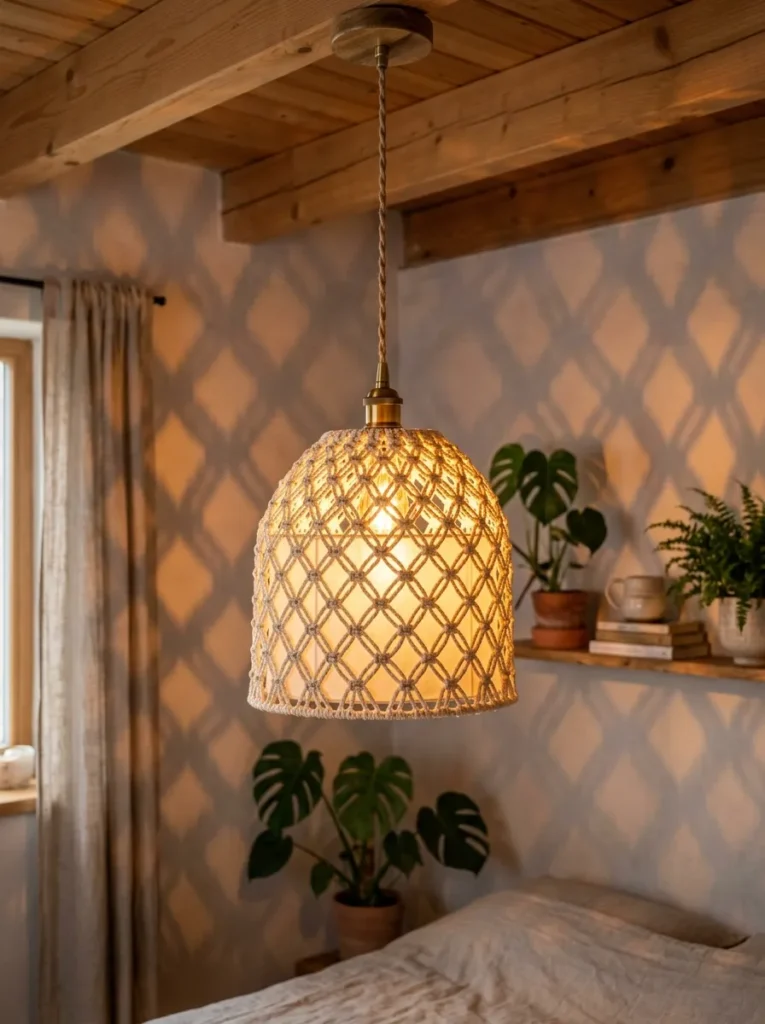
Vibe: The macramé lamp cover feels like the light learned to project pattern — the knotted net between the bulb and the room converting a simple pendant into an atmospheric lighting installation.
Why it works: A macramé net over a pendant lampshade applies the light diffusion and pattern projection principle — the macramé net’s open knotted pattern creates shadow and light variation across its surface when the lamp is illuminated, projecting a warm pattern of the net’s diamond openings onto adjacent walls and ceiling surfaces. This secondary projection effect converts the lamp from a single-source point of illumination into a room-scale atmospheric installation. The 2mm fine cotton cord specified for lampshade covers (rather than the 3–5mm cord used for structural projects) creates a finer, more delicate net pattern that allows maximum light transmission while maintaining the cord’s visual texture.
Safety note: Macramé cord on a lampshade cover must maintain a minimum clearance from the bulb — specify LED bulbs only (which produce minimal heat) and ensure that the net cord does not contact the bulb surface. The macramé net should be applied over the lampshade, not directly on the bulb, maintaining the shade’s original heat-management function.
Making time: 3–5 hours for a 30cm diameter shade.
Shop The Look
| Product |
|---|
| Natural cotton cord 2mm fine |
| Pendant shade base cover |
| LED bulb warm white 2700K |
| Ring top lampshade frame |
| Cord guide fine pattern knotting |
5. Macramé Wall Pocket — Functional and Decorative
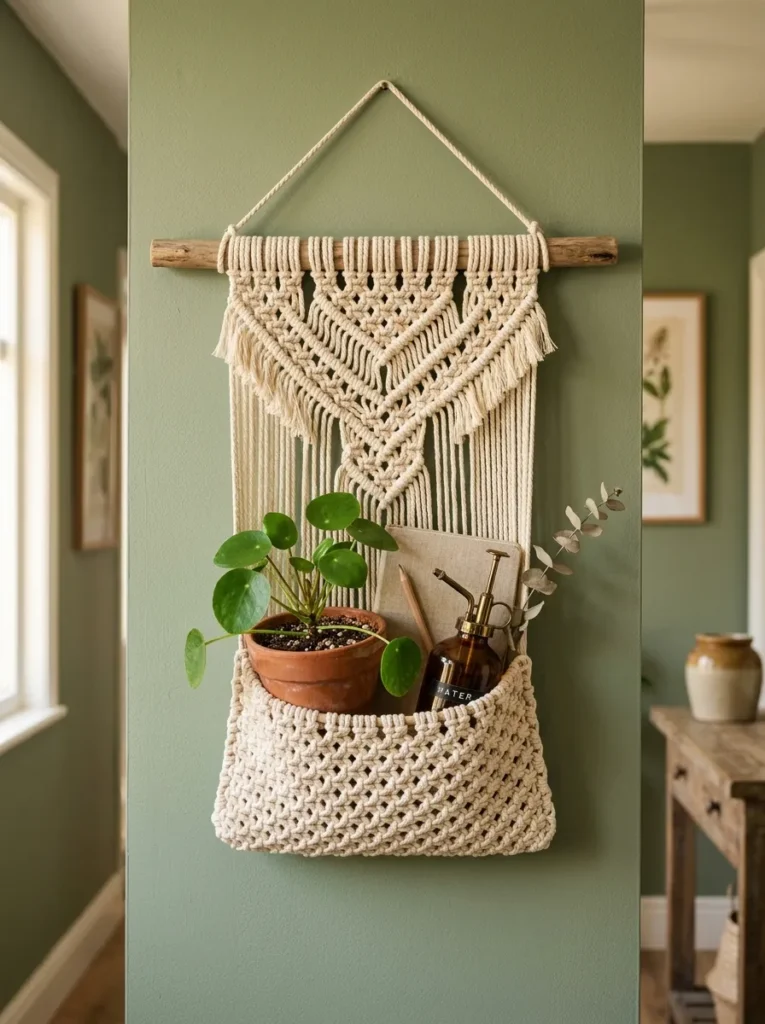
Vibe: The macramé wall pocket feels like a piece of knotted furniture — the pocket’s depth and structure making it a genuinely functional organizer that is also a textile wall decoration.
Why it works: A macramé wall pocket applies the functional decoration principle — a piece that can be shown to serve a specific use (holding a plant, organizing mail, holding kitchen herbs, storing small tools) carries different weight in a room than a piece that is purely decorative. The macramé wall pocket’s functional dimension (the genuine three-dimensional pocket created by folding up a knotted panel and securing the sides) makes it appropriate for rooms — kitchens, hallways, home offices — where a purely decorative hanging would read as peripheral rather than purposeful. The construction technique (a flat knotted panel whose lower section is folded upward to form the pocket, then the fold’s side edges whip-stitched or knotted closed) converts a standard wall hanging into a structural container.
Making time: 3–4 hours.
How to make it: Work a flat knotted panel (alternating square knots) at 35cm width to a total length of 75cm. At the 30cm mark from the base (the panel’s working base end), fold the lower section upward to create a 15cm deep pocket and a 15cm panel above the pocket. Secure the fold’s two side edges by threading a cord through the edge knots on both the front and back panels and knotting tightly at each side. The pocket opening is at the top of the folded section. Mount the upper panel edge on a wood dowel using lark’s head knots.
Shop The Look
| Product |
|---|
| Natural cotton cord 4mm wall pocket |
| Wood dowel 40cm natural |
| Small terracotta pot 10cm |
| Small plant succulent or air plant |
| Dried botanical stem small |
6. Large Statement Wall Hanging — Bedroom Headboard
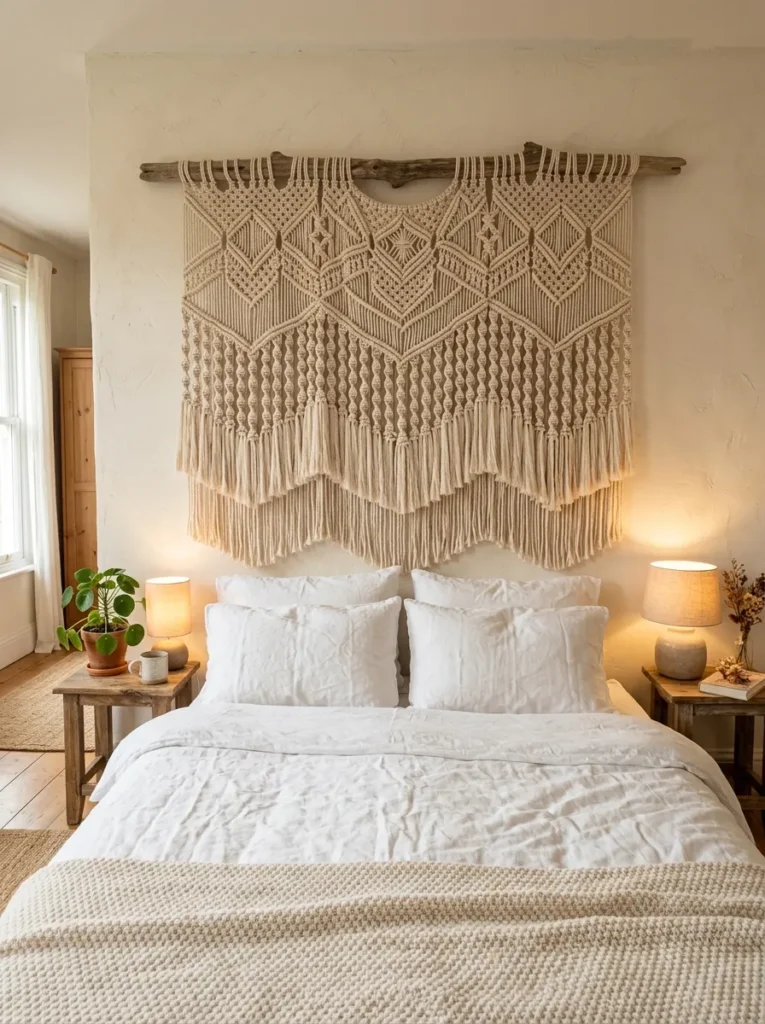
Vibe: The large headboard macramé feels like the most textured version of a bedroom wall — the accumulated density of the diamond pattern and the long brushed fringe creating a three-dimensional textile installation that reads differently at morning light than at evening lamp glow.
Why it works: A large-scale macramé wall hanging used as a headboard installation applies the architectural textile principle — at 120cm wide and 100cm tall, a macramé piece occupies the same visual space as a standard residential headboard while providing the specific warmth, texture, and handmade quality that a purchased upholstered or wooden headboard cannot replicate. The 5mm rope (thicker than the standard 3–4mm wall hanging cord) produces a larger knot scale and a more substantial visual texture that reads at the bedroom’s full viewing distance rather than only at close range. The driftwood branch mount adds a natural material element at the piece’s top that extends the botanical reference of the natural rope material.
Cord calculation: For a 120cm wide piece with a 40cm fringe, cut approximately 48 cords at 400cm each (doubled to 96 working strands). Total cord required: approximately 192 metres of 5mm rope.
Making time: 12–20 hours — this is a multi-session project.
Shop The Look
| Product |
|---|
| Natural cotton rope 5mm large |
| Driftwood branch 130cm display |
| Stiff brush fringe 40cm |
| Picture rail hook heavy weight |
| King bed linen white set |
7. Macramé Feather — Small Accent Piece
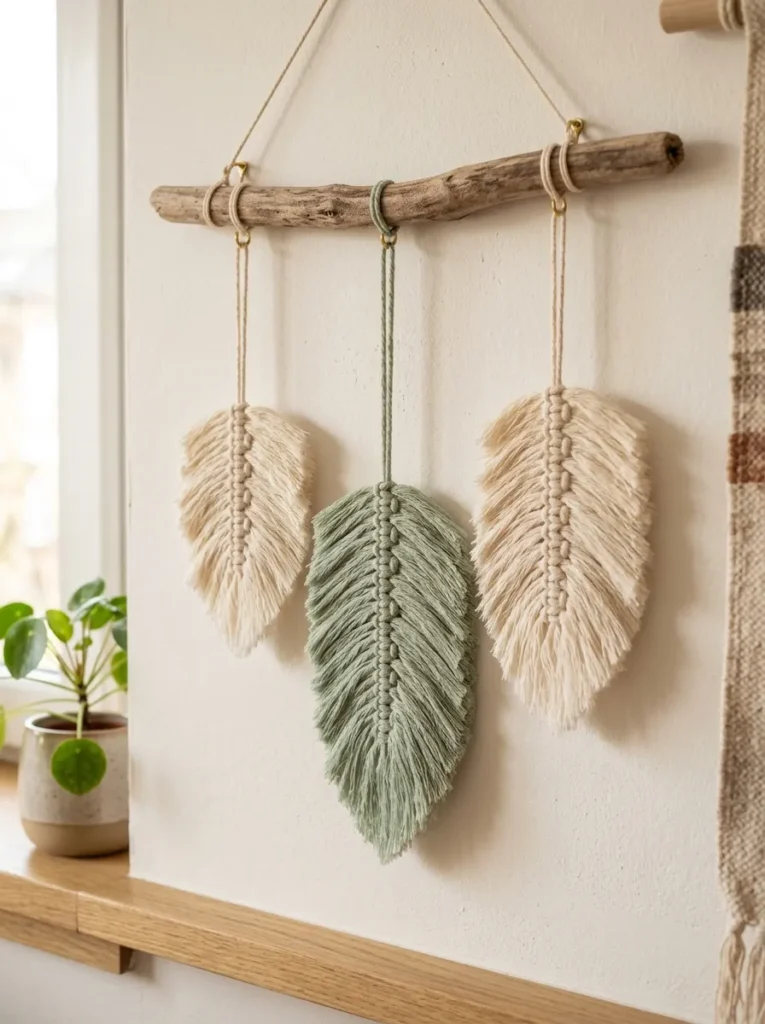
Vibe: The macramé feathers feel like the craft at its most delicate — the combed-out cotton fringe creating a form so convincingly feathery that it requires a second look to confirm it is cord rather than quill.
Why it works: Macramé feathers are the ideal small accent project because they are among the fastest macramé objects to make (15–30 minutes per feather) while producing a result of high visual refinement. The secret of the macramé feather’s realism is the combing technique — individual cotton cord strands attached to a central spine are untwisted and combed vigorously with a fine-tooth pet comb or stiff brush until the plied construction separates into individual soft fibers, replicating the delicate barb structure of a genuine feather. The result is a piece that consistently surprises viewers who initially assume they are looking at a real feather.
Making time: 15–30 minutes per feather.
How to make it: Cut one 25cm length of 3mm cord as the spine. Cut 12–15 lengths of 3mm cord at 8–12cm each as the barb cords. Using lark’s head knots, attach each barb cord along the spine, spacing them approximately 5mm apart on each side of the spine (alternating left and right sides). After all barbs are attached, use a fine pet comb or stiff brush to vigorously comb each barb cord until fully separated into individual soft fibers. Trim the barb tips in a curved feather profile. Attach a hanging loop at the quill end of the spine.
Shop The Look
| Product |
|---|
| Natural cotton cord 3mm feather |
| Sage dye cord or pre-dyed set |
| Fine pet comb or stiff craft brush |
| Driftwood branch small display |
| Lark’s head attachment cord |
8. Macramé Shelf Hanger — Two-Tier Floating Shelves
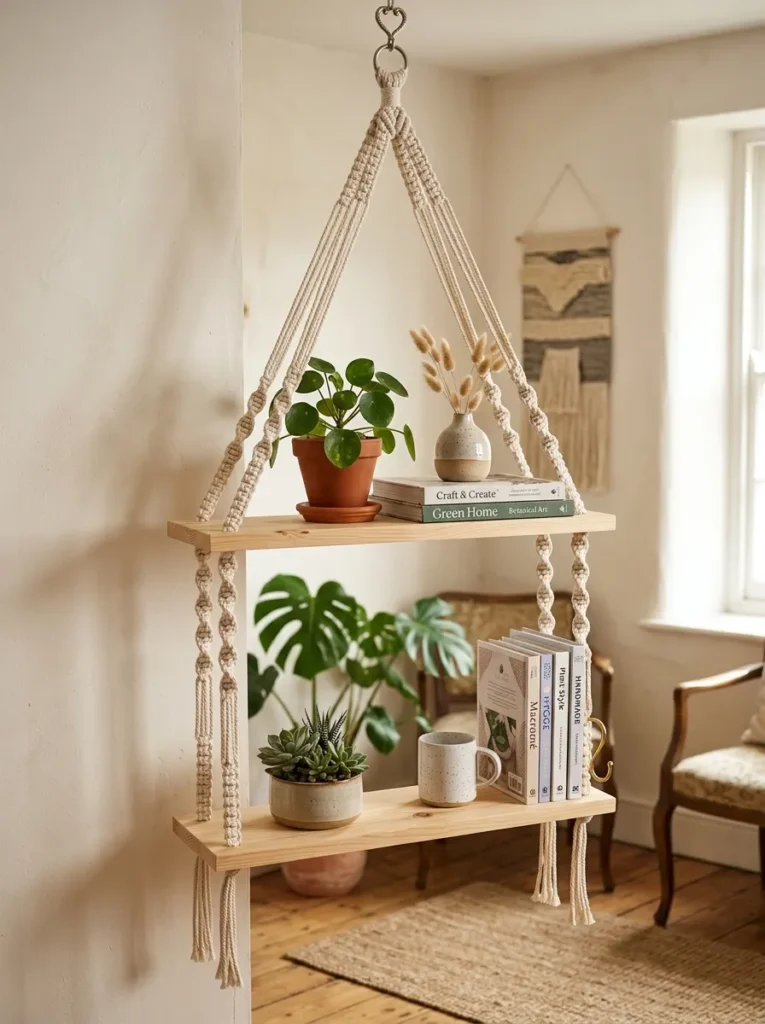
Vibe: The macramé hanging shelf feels like furniture that refuses to touch the floor — the floating shelves suspended by knotted cord creating a specific lightness that wall-bracketed or floor-standing shelves cannot achieve.
Why it works: A macramé two-tier hanging shelf applies the suspension furniture principle — shelves suspended from above by cord rather than supported from below by brackets create a floating visual quality that dramatically reduces the visual weight of the storage/display function. The macramé cord sections between the two shelf levels serve the dual function of structural support and decorative textile element, making the cord visible and celebrated rather than minimized as conventional shelf hardware is. The decorative knot sections on the between-shelf cord lengths are the design decision that most distinguishes a macramé hanging shelf from a commercial rope shelf — the pattern section communicates the handmade quality that differentiates the piece.
Weight capacity note: Macramé hanging shelves are appropriate for light display objects (small plants, ceramics, lightweight books) but are not appropriate for heavy loads. The total weight on each shelf should not exceed 3–4kg. The ceiling hook or wall anchor from which the whole system is suspended must be fixed into a ceiling joist or wall stud.
Making time: 4–6 hours.
Shop The Look
| Product |
|---|
| Natural wood shelf board 45cm |
| Cotton cord 5mm structural hang |
| Ceiling hook joist-fixed |
| Small plant display ceramic pot |
| Small ceramic decorative object |
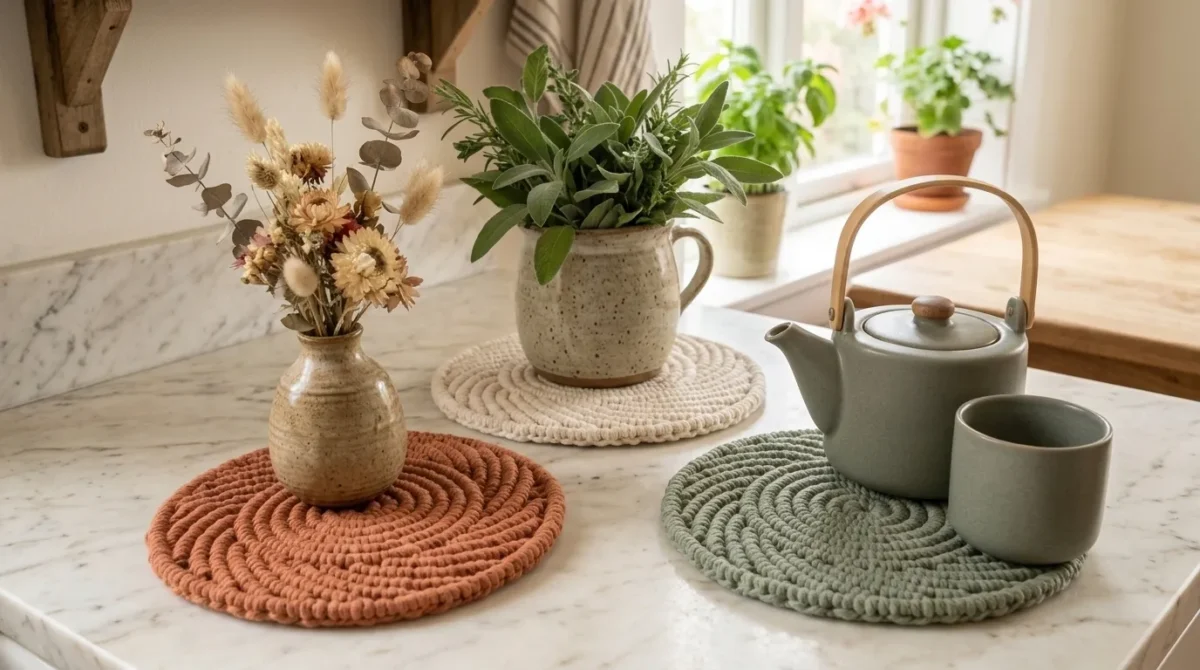
9. Macramé Trivet for Table and Kitchen
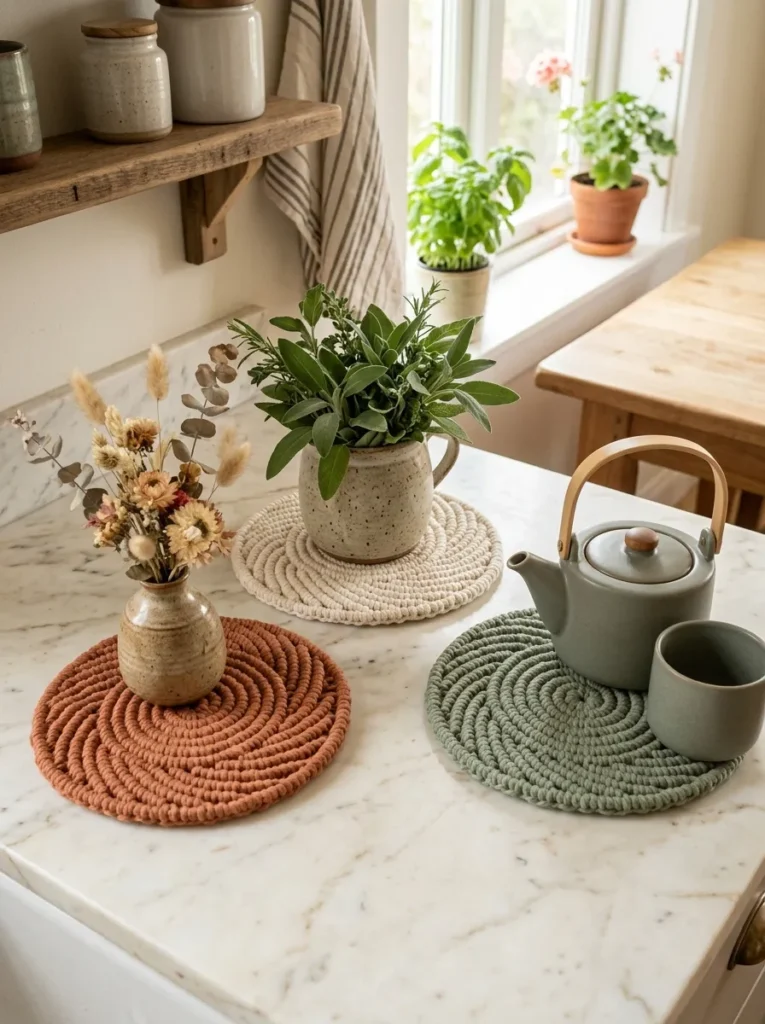
Vibe: The macramé trivets feel like functional art in the most literal sense — the radial pattern beautiful enough to display between uses and practical enough to protect a surface from heat during them.
Why it works: Macramé trivets apply the functional daily object elevation principle — a trivet is used daily in most homes but is almost universally a purely utilitarian object (silicone, cork, or plain felt) that is hidden from sight when not in use. A macramé trivet, by contrast, is beautiful enough to remain on display between uses, contributing to the kitchen or dining room’s visual warmth as a decorative textile object while fulfilling its heat-protection function when needed. The circular format (worked in a continuous radial spiral knot pattern from the center outward) produces a compact, dense textile with the thickness required for effective heat protection.
Making time: 1–1.5 hours per trivet.
How to make it: A circular macramé trivet begins at the center: cut eight 80cm lengths of cord. Fold all eight in half at the midpoint and tie the sixteen strands together at the midpoint with a single overhand knot (this forms the center). Work spiral knots (half hitch) outward in a circular pattern, expanding the diameter by adding additional short cord strands at regular intervals as the radius increases. Continue until the trivet reaches 20cm diameter. Finish the outer edge with a row of tight overhand knots and trim cord ends to 1cm.
Shop The Look
| Product |
|---|
| Natural cotton cord 5mm trivet |
| Sage dye cord pre-dyed |
| Terracotta dye cord pre-dyed |
| Ceramic pot kitchen display |
| Natural marble or wood surface |
10. Macramé Mirror Frame
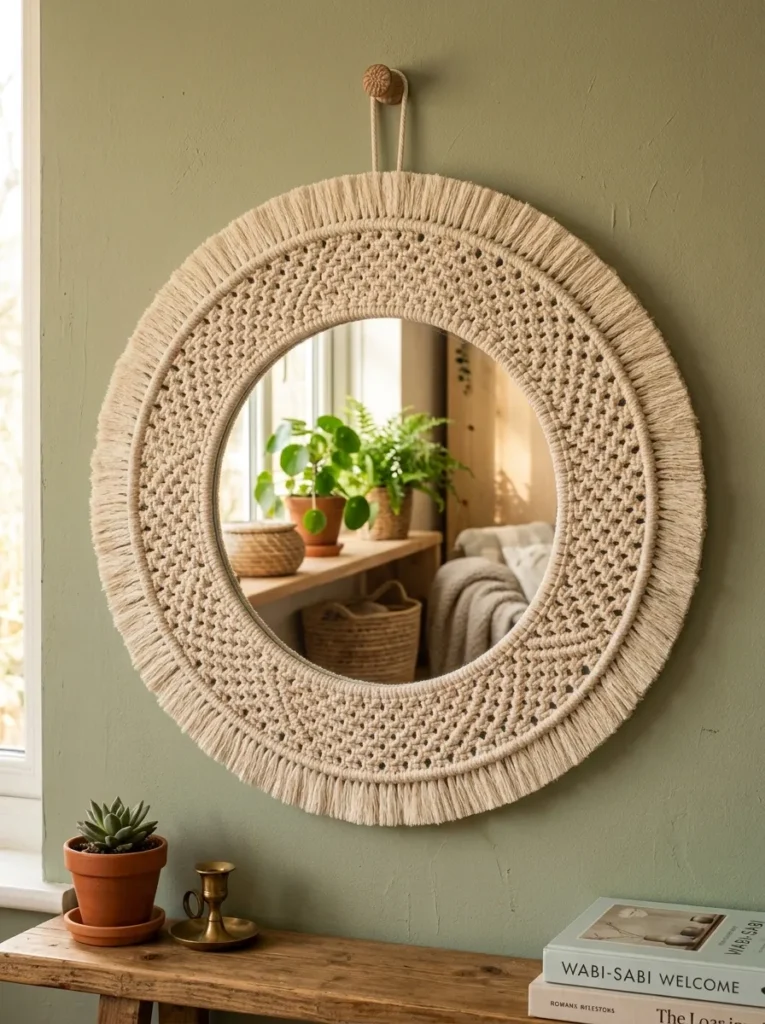
Vibe: The macramé mirror frame feels like the mirror grew a natural fiber surround — the radial knotting pattern emanating from the mirror’s edge creating a sunburst textile that reads simultaneously as a mirror frame and a wall decoration.
Why it works: A macramé mirror frame applies the textile frame principle — a plain round mirror on a wall is an effective spatial enlarger (reflecting the room, increasing apparent depth) but a visually limited object (a circle of glass, nothing more). A macramé frame mounted on the mirror’s outer circumference converts the mirror from a functional object into a textile artwork-with-mirror-center, increasing its visual interest at room distance (the warm natural fiber surround reads before the reflective center) while maintaining the mirror’s spatial function.
Construction technique: The macramé frame is worked directly from the mirror’s edge — a thin wire hoop the same diameter as the mirror is positioned around the mirror’s outer edge, and lark’s head knot cords are attached to this hoop. Knotting then works outward radially from the hoop. The wire hoop is not permanently attached to the mirror but sits in the mirror’s edge groove if using a frameless mirror, or behind the mirror’s edge.
Making time: 4–6 hours.
Shop The Look
| Product |
|---|
| Round frameless mirror 35cm |
| Wire hoop same diameter mirror |
| Natural cotton cord 3mm frame |
| Stiff brush fringe finish |
| Wall hook round mirror hang |
11. Macramé Curtain Panel — Window or Room Divider
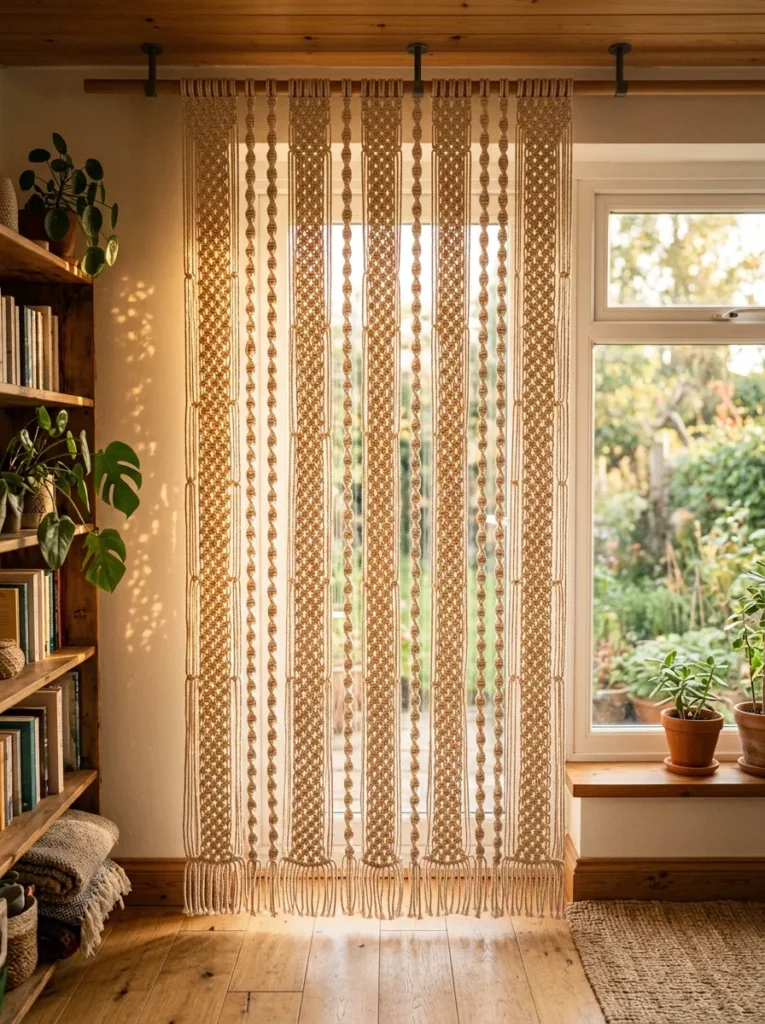
Vibe: The macramé curtain panel feels like privacy and light in the most specifically beautiful possible combination — the knotted pattern filtering the window light into warm, dappled transparency that no woven fabric panel replicates.
Why it works: A macramé curtain panel applies the translucent privacy principle — a macramé panel hung at a window or at a room division point provides visual privacy (the pattern obstructs direct sightlines through the panel) while filtering natural light through its open knot pattern, creating the specific quality of diffused, patterned natural light that solid curtains and blinds eliminate. This light quality — warm, slightly textured, shifting across the day as the sun angle changes — is among the most sought-after domestic light qualities and is available from a macramé panel at a cost (materials and time) comparable to a quality woven curtain panel.
Cord calculation: A 90cm wide panel requires approximately 48 cords at 4× the panel length: 4 × 180cm = 720cm per cord. Total cord: approximately 345 metres of 3mm cotton.
Making time: 12–20 hours — this is a significant project requiring multiple sessions.
Shop The Look
| Product |
|---|
| Natural cotton cord 3mm curtain |
| Ceiling curtain rod fixed |
| Curtain rod bracket ceiling mount |
| Knotting board long panel |
| S-ring curtain rod mount |
12. Macramé Keychain and Bag Charm Set
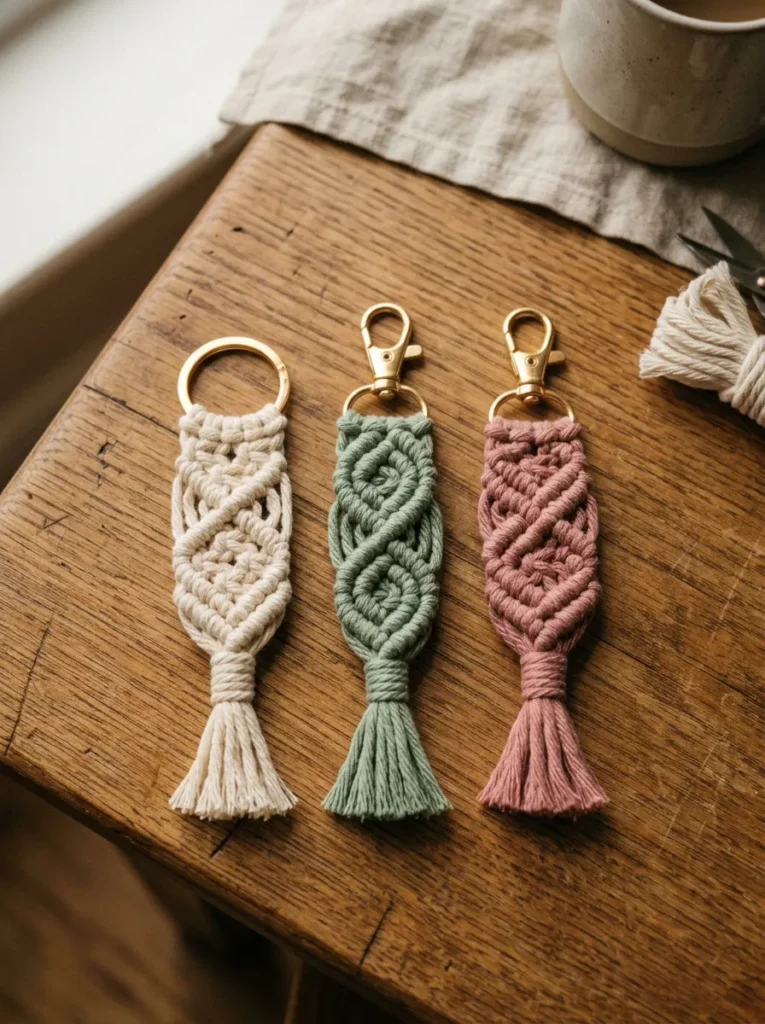
Vibe: The macramé keychains feel like the making practice at its smallest and most immediately gratifying scale — each one completed in under thirty minutes, genuinely beautiful, and a perfect gift that communicates the care of handmaking.
Why it works: Macramé keychains and bag charms apply the micro-project principle — they are the fastest complete macramé objects available (20–40 minutes per piece), use the smallest possible quantity of material ($0.50–2.00 in cord per piece), and are the ideal starting project for a beginner because each individual piece is small enough to be completed and assessed before committing to the technique at a larger scale. They are also among the most personally used and most frequently seen macramé objects — attached to a bag or keys that are handled and visible daily, they function as a continuous presence of the maker’s practice in daily life.
Making time: 20–40 minutes per piece.
How to make it: Cut four cords at 30cm each. Thread all four cords through the keyring loop, folding at the midpoint to produce eight working strands. Work 6–8 square knots using the center four cords as working cords and the outer two on each side as anchor cords (or reverse for a different texture). Finish with a gathering knot below the last square knot, leaving 5cm of fringe. Optionally trim the fringe in a diagonal or V-shape for variation.
Shop The Look
| Product |
|---|
| Natural cotton cord 2mm keychain |
| Gold lobster clasp keyring set |
| Sage green dyed cord thin |
| Dusty rose dyed cord thin |
| Scissors sharp precision small |
13. Macramé Dream Catcher — Geometric Version
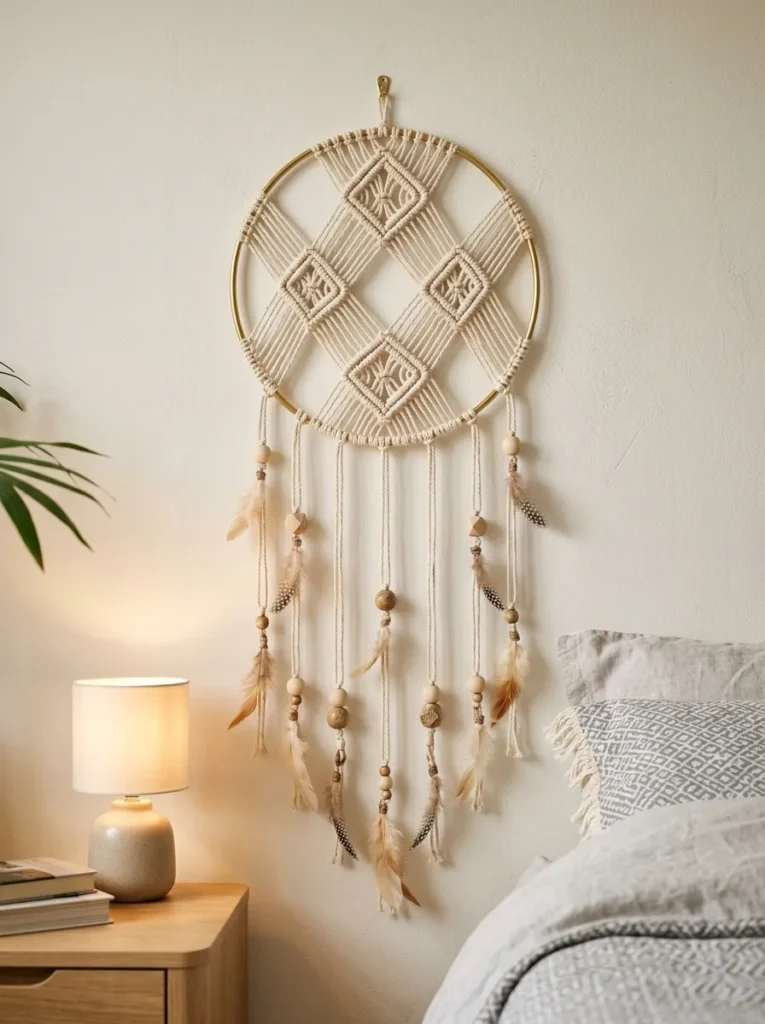
Vibe: The geometric dream catcher feels like a traditional form updated through a design lens — the geometric lattice interior replacing the original circular web with a pattern that reads as contemporary rather than reproduction.
Why it works: A macramé geometric dream catcher applies the contemporary reinterpretation principle — the traditional dream catcher form (a circular hoop with a woven web interior and hanging cord tails) has a strong cultural and design history, and the macramé interpretation replaces the woven web with a knotted geometric lattice that maintains the circular hoop format and the hanging tail elements while producing a distinctly contemporary geometric textile that reads as designed rather than borrowed. The brass ring (rather than the natural willow or wooden hoop of the traditional form) contributes the material warmth that positions the piece within the contemporary interior palette.
Making time: 3–5 hours.
Shop The Look
| Product |
|---|
| Brass ring 30cm macramé |
| Natural cotton cord 2mm fine |
| Wooden bead set natural |
| Small feather accent set |
| Thin cord bead attachment |
14. Macramé Tote Bag
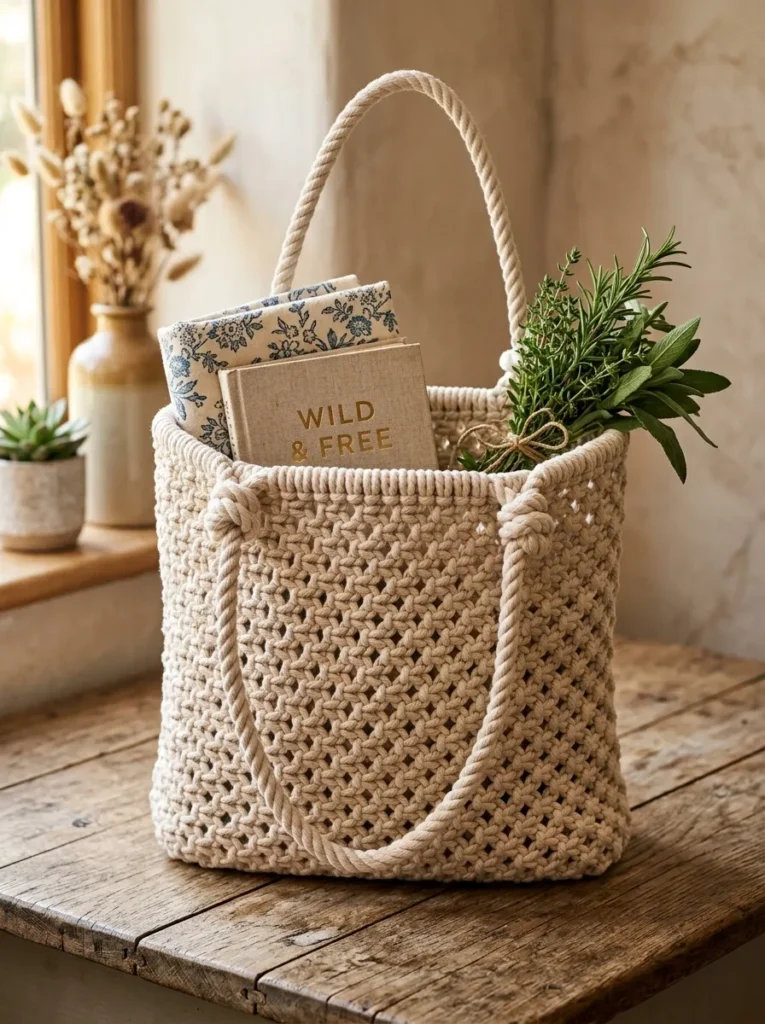
Vibe: The macramé tote bag feels like the point where craft becomes fashion — the all-natural cord construction creating a bag that is simultaneously a functional carrier and a wearable piece of textile art.
Why it works: A macramé tote bag applies the wearable craft principle — a macramé piece that travels outside the home as a bag extends the maker’s practice into daily public life, where it communicates both the personal aesthetic and the investment in handmaking more effectively than any wall-mounted piece. The tote bag’s structural requirements (it must hold objects, maintain its form under load, and be comfortable to carry) drive design decisions that translate directly to quality: the alternating square knot pattern produces a dense, structurally sound body that holds its shape; the horizontal half hitch top edge provides a firm, non-stretching opening; and the twisted rope handles (at sufficient length for comfortable shoulder carry) provide ergonomic load distribution.
Construction note: Unlike wall hangings, a macramé bag requires a flat-work setup for the base and panel construction before the bag is assembled. The two side panels are knotted flat, then seamed together using whip stitching or overhand knots at the side edges.
Making time: 8–12 hours.
Shop The Look
| Product |
|---|
| Natural cotton cord 3mm tote bag |
| Knotting board flat work surface |
| Tapestry needle seaming cord |
| Bag base card insert stiffener |
| Twisted rope handle set |
15. Advanced Sculptural Wall Installation — Multi-Panel Composition
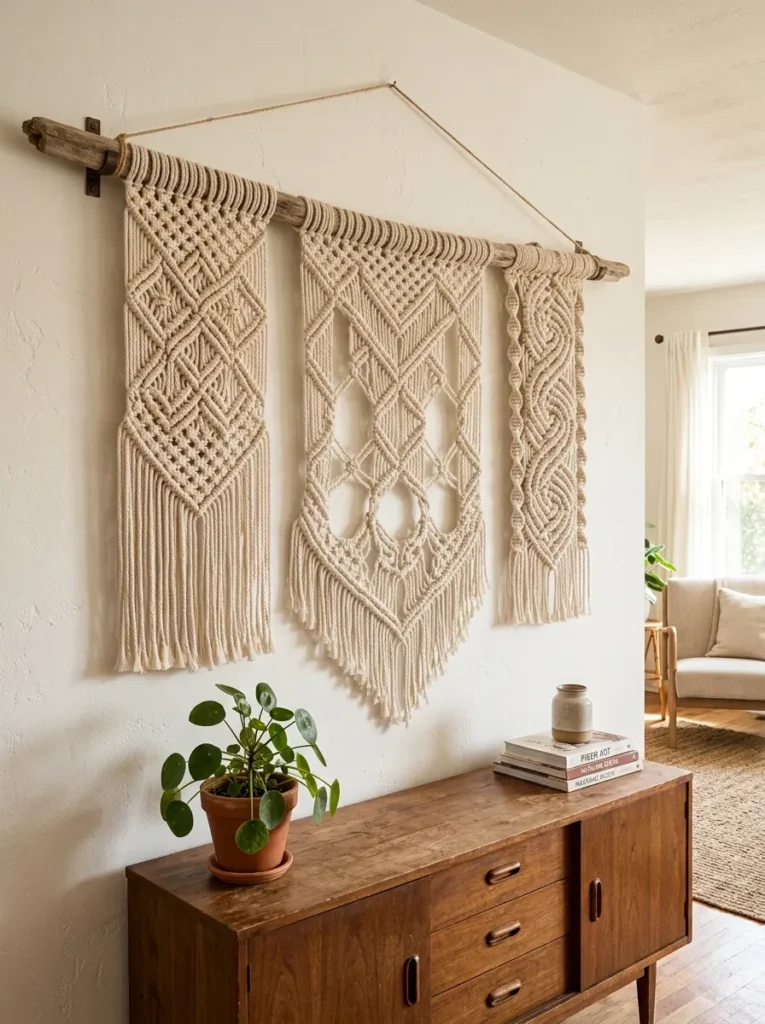
Vibe: The three-panel installation feels like a textile equivalent of a triptych — the three pieces individually complete but compositionally interdependent, the whole communicating design intention that each panel alone does not.
Why it works: A multi-panel macramé installation applies the compositional art principle — three coordinated but varied panels hung on a single mounting element create a wall composition with the visual authority of a large artwork while maintaining the textural warmth and handmade quality of individual macramé pieces. The deliberate variation between panels (dense pattern, open pattern, textural pattern — each at a different cord density, fringe length, and knot type) creates visual rhythm across the composition’s horizontal extent: the eye moves from the dense left panel through the open center to the textural right panel in a composed sequence. The single driftwood branch mounting element unifies the three panels into one installation, preventing the three pieces from reading as separately hung items.
Making time: 20–35 hours for all three panels — this is the most ambitious project in the list, appropriate for a maker with experience from several earlier projects.
Shop The Look
| Product |
|---|
| Natural cotton cord 5mm large |
| Natural cotton cord 3mm open panel |
| Driftwood branch 160cm large |
| Heavy picture wire branch hang |
| Wall anchor large installation |
How to Start Your Macramé Practice
The single best first move for any beginner macramé maker is spending one hour making nothing but practice knots on a short test length of cord — cutting a 60cm length of 3mm cotton cord, tying 20 consecutive square knots as slowly and precisely as possible, and then assessing the result. This practice session reveals three things that watching tutorial videos does not: the correct finger pressure required for a consistent knot tension (the most common first-attempt quality failure is uneven knot tension, producing irregular spacing between knots), the correct cord position for a left-facing and right-facing square knot within the same sequence (the left-facing/right-facing alternation is the fundamental motion of the square knot and must be automatic before beginning any project), and the natural cord behavior — how the 3-ply cotton twists slightly as it is worked, how it responds to being pulled taut versus left loose, and how consistent tension across the full cord width is achieved. This one-hour practice session directly improves the quality of every subsequent project.
The most common mistake in beginning macramé is starting with cord that is too thin or too thick for the project. Cord below 2mm is difficult for beginners to manage (the knots are very small and the fingers struggle with the fine material), and cord above 6mm produces knots whose scale makes pattern errors immediately visible at room distance. The 3–4mm natural cotton cord range is the ideal beginner specification: large enough to work comfortably with bare hands without tools, small enough to produce a refined final result at standard domestic viewing distances. Within this range, 3mm cord suits wall hangings, plant hangers, keychains, and small accessories; 4mm cord suits table runners, larger wall pieces, and any project where structural density is preferred over delicate openwork.
Three specific items under $25 that enable a complete beginner macramé practice: a 100m roll of 3mm natural cotton cord ($8–14 from craft retailers — sufficient for three to four beginner projects including the classic wall hanging, two plant hangers, and a keychain set); a 50cm natural wood dowel ($2–4, providing the mounting base for every wall-hung project in this list); and a stiff pet slicker brush ($5–10, which is the most effective tool for the fringe brushing technique that converts the rope’s structured ply into the soft, feathery fiber ends that define the classic macramé fringe quality). These three items combined for under $25 enable the first six projects in this list.
Frequently Asked Questions About DIY Macramé for Home Decor
What cord is best for macramé beginners?
3-ply twisted natural cotton cord in 3mm diameter is the most recommended beginner specification. The 3-ply construction (three individual strands twisted together) provides the structural consistency that single-strand cord lacks, produces clean, readable knot impressions that are visible and assessable for learning, and untwists cleanly for the fringe brushing technique that most decorative macramé projects use. Single-strand cotton cord (also called “macramé string” or “string macramé”) is appropriate for fine jewelry and keychains but lacks the structural definition for wall hangings and plant hangers. Jute and hemp provide more rustic aesthetics and are appropriate for garden and outdoor applications but are less comfortable to work with than cotton for long knotting sessions (the fibers are rougher on the hands).
How much cord does a macramé project use?
The standard cord calculation for most macramé projects is to cut each working cord at four to five times the finished length of the project, then double it at the midpoint for mounting (producing two working strands per cut cord, each two to two-and-a-half times the finished length). For projects with long fringes, add the fringe length before calculating. For beginners, rounding up to five times the finished length reduces the risk of running short — unused cord from over-estimated cuts is easily stored for the next project. Common quantities: a 45cm wide wall hanging at 70cm length requires approximately 45 metres of 3mm cord; a single plant hanger requires approximately 20 metres; a table runner at 150cm length requires approximately 180 metres.
How do you keep macramé clean and dust-free?
Natural cotton macramé collects dust more readily than most home textiles because the knotted structure creates recessed areas where dust settles and the fringe elements attract and hold airborne particles. The most effective maintenance is a monthly light vacuum using a low-suction upholstery attachment (a high-suction nozzle applied directly to macramé fringe can pull individual cord fibers loose). Spot cleaning with a damp cloth and a mild liquid detergent addresses most stains on the knotted body — dampen the cloth, apply with light circular motion, allow to air dry completely before rehanging. Full washing is possible for smaller pieces (keychains, trivets, small wall hangings) in a mesh laundry bag on a gentle cold cycle, but should be reserved for significant soiling — the natural cotton cord shrinks slightly with each washing, which can tighten the knot pattern.
Can macramé be made with dyed or colored cord?
Yes — both pre-dyed colored cord (available in most craft retailers and online suppliers in the full spectrum of colors) and naturally dyed cotton cord (where natural cotton cord is dyed at home using fiber-reactive dyes, tie-dye techniques, or natural botanical dye materials) produce beautiful results. Pre-dyed cord is the most accessible option — the same 3–4mm cotton cord used for natural projects is available in hundreds of colors from most cord suppliers. Natural dyeing at home (using plant materials including avocado skins, weld, madder root, and indigo) requires additional materials and a mordanting process but produces the specific tonal quality of natural botanical color that pre-dyed alternatives do not replicate. For beginners, starting with natural undyed cord and adding one accent color (sage green, dusty rose, or terracotta are the most commonly used accent colors in contemporary macramé) creates visual variation without the complexity of a full color project.
How long does it take to learn macramé to a decorative quality level?
A beginner who spends one afternoon (3–4 hours) learning to tie consistent square knots and lark’s head mounts can complete the first project in this list (the classic wall hanging) at a quality level that reads as genuinely beautiful in a domestic context. The transition from beginner to intermediate (capable of diagonal half hitch patterns, circular forms, and simple sculptural shapes) typically requires three to five completed projects spanning approximately 15–25 hours of total practice. Advanced sculptural macramé (the three-panel installation, complex three-dimensional forms) represents 50–100+ hours of accumulated practice. The specific quality that develops most rapidly with practice is knot consistency — the evenness of knot spacing and tension that distinguishes a confident maker’s work from a beginner’s regardless of the pattern complexity — and this quality improves most dramatically in the first 10–15 hours of practice.
Ready to Start Knotting?
These 15 projects move through every dimension of what macramé can produce — from the ten-minute keychain that proves the technique in miniature, to the one-afternoon plant hanger that demonstrates the craft’s most immediately functional application, to the multi-session large wall hanging that becomes the bedroom’s primary design statement, to the ambitious three-panel installation that is genuinely a piece of textile art. Starting with the 60-minute practice session — 60cm of cord, 20 square knots, as slowly and precisely as possible — is the beginning that makes every subsequent project better. The cord costs fifty cents. The hour is available. The knot is learnable in the first fifteen minutes and improvable for a lifetime. Order the 100m roll of 3mm natural cotton this week, cut the practice length on the day it arrives, tie the 20 knots before beginning any project in this list, and let the cord’s specific resistance and the knot’s specific tension become familiar in the hands before the making begins in earnest. Everything else follows from that first deliberate square knot pulled tight.