IKEA furniture for kids’ rooms refers to the Swedish flatpack giant’s extensive range of children’s storage systems, beds, desks, shelving, and organizational accessories — designed to be affordable, durable, adaptable, and safe for children — which parents and designers have long recognized as some of the most versatile building blocks available for creating functional, beautiful, and age-appropriate children’s spaces on realistic family budgets. This article gives you 14 smart IKEA furniture ideas for kids’ rooms that work across every age from toddler to teen, every room size from tiny shared bedrooms to generous playrooms, and every design aesthetic from colorful and playful to calm and Scandinavian-minimal.
Picture a child’s bedroom where everything has a place, the storage grows with the child, and the room looks intentionally designed rather than assembled from whatever was available and affordable at the time. Where a KALLAX unit becomes a room divider and reading nook base simultaneously. Where a KURA bed transforms a small room into a two-level adventure. Where TROFAST bins teach a toddler to put their own toys away independently. IKEA children’s furniture works at its best not when purchased piece by piece as needs arise but when planned as a cohesive system — and these 14 ideas show you exactly how to think that way. Here are 14 ideas worth saving — and stealing.
Picture a child’s bedroom where everything has a place, the storage grows with the child, and the room looks intentionally designed rather than assembled from whatever was available and affordable at the time. Here are 14 ideas worth saving — and stealing.
Why IKEA Furniture Works So Well for Kids’ Rooms
IKEA children’s furniture succeeds in kids’ rooms because it is designed from a fundamentally different premise than most children’s furniture — rather than creating themed, age-specific pieces that become obsolete as children grow, IKEA’s core children’s range (particularly KALLAX, TROFAST, KURA, STUVA, and HEMNES) prioritizes adaptable systems that can be reconfigured, combined, extended, and restylyed as the child’s needs, interests, and physical scale change. This design philosophy draws from Scandinavian functional design tradition — the belief that well-designed objects serve their users efficiently across their full lifecycle rather than requiring replacement as circumstances change.
The materials that define IKEA children’s furniture are honest and practical: particleboard and MDF in white, birch effect, and natural wood finishes that paint easily for customization, powder-coated steel frames that handle climbing and rough use, polypropylene bins in primary and neutral colors, and solid pine in the natural and painted ranges that age gracefully with years of child use. The hardware — the IKEA-standard cam locks, Allen key bolts, and dowel joints — is designed for repeated assembly and disassembly, meaning furniture can be reconfigured as the room’s functional requirements change without damage to the structural integrity.
The IKEA hacking tradition — the practice of customizing, combining, and modifying IKEA furniture beyond its intended configuration — has produced an enormous body of knowledge about what IKEA furniture can become when approached as a design material rather than a finished product. The KALLAX unit has been transformed into kitchen islands, record storage systems, and children’s reading nooks by the global community of IKEA hackers. The KURA bed has been extended into full playhouse loft beds with slides and climbing walls. The KALLAX, TROFAST, and STUVA systems have been combined into walk-in wardrobe and storage systems that rival custom cabinetry at a fraction of the cost.
Even the smallest children’s bedroom — a 7×9 foot room shared by two children — can be transformed into a functional, organized, and visually considered space using IKEA systems. The key is planning the room as a complete system before purchasing individual pieces, so that the TROFAST bins, KALLAX shelves, KURA bed, and FLISAT table all relate to each other spatially and functionally as an integrated environment rather than accumulating as independent purchases over time.
Style at a Glance
| Element | Trait 1 | Trait 2 |
|---|---|---|
| Philosophy | Adaptable systems over themed pieces — furniture that grows with the child | Scandinavian functional design — beauty through simplicity and honest materials |
| Materials | Particleboard, MDF, solid pine, powder-coated steel, polypropylene | White, birch effect, natural pine — paintable and customizable surfaces |
| Color Palette | White, natural pine, birch effect neutral | Primary color TROFAST bins, sage green, dusty rose, matte black accents |
1. KALLAX as Room Divider and Storage Wall
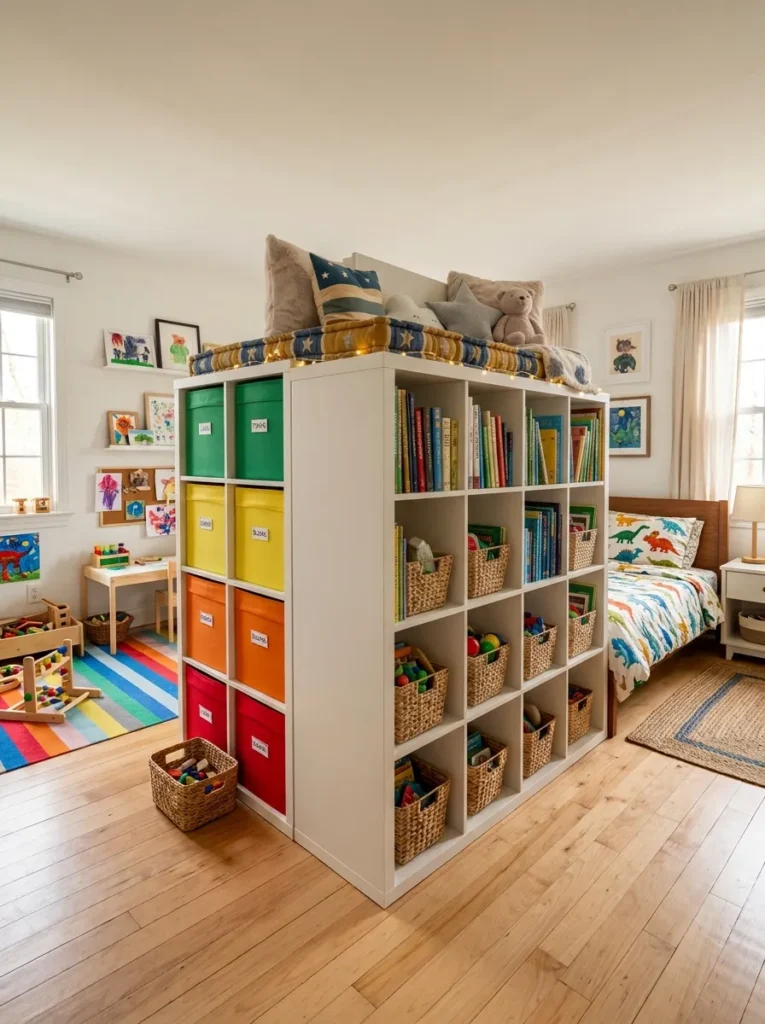
Vibe: Organized and functional — the furniture piece that does the work of two walls without requiring either one.
Why it works: Using a KALLAX 4×4 unit as a freestanding room divider applies the spatial design principle of zone definition without enclosure — the KALLAX creates two distinct functional zones (sleeping and playing) within a single room without the permanent commitment or cost of a structural wall, while the open-back configuration of the unit allows light to pass between zones and maintains the visual connection between the two areas that makes a small room feel larger than its actual dimensions. The base squares of the sleeping-side KALLAX serve as the structural support for a reading nook seat, meaning the divider simultaneously defines zones, provides storage, and creates a functional seating alcove — three spatial functions from a single IKEA purchase.
How to get it: Anchor the freestanding KALLAX to the ceiling using the IKEA FIXA wall fastening kit modified for ceiling attachment — safety-fastening a freestanding KALLAX that serves as a room divider is non-negotiable where children are present, as an unsecured unit can tip under climbing pressure. Fill the top-facing squares (those above 36 inches) with lightweight objects only — heavy bins at height increase tip-over risk. Build the reading nook seat by placing a cut-to-size 4-inch foam cushion directly on the KALLAX top surface on the sleeping side, secured with hook-and-loop fabric dots.
| Product |
|---|
| KALLAX shelf unit 4×4 white IKEA |
| DRONA box set colorful fabric IKEA |
| KALLAX insert with door white IKEA |
| Wall fastening kit IKEA FIXA |
| Custom cushion foam 4 inch cut to size |
Aslo view: 12 DIY IKEA IVAR Shelf Ideas for Modern Homes
2. KURA Loft Bed as Play and Sleep Zone
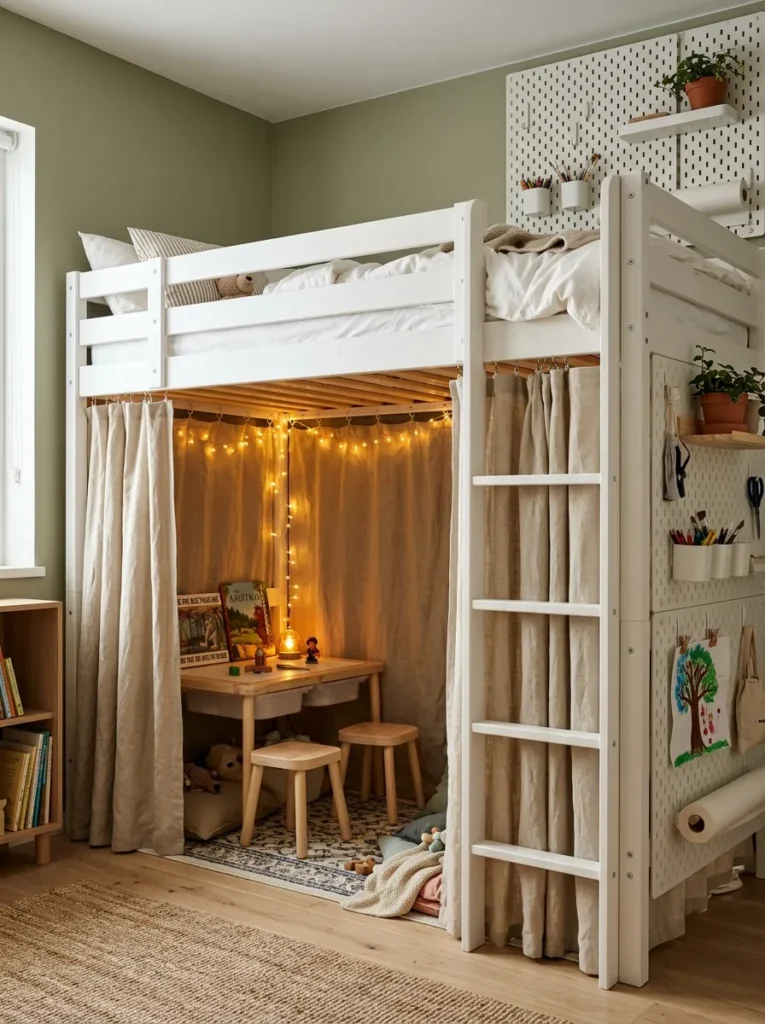
Vibe: Magical and functional — the bed that gives a small room a second floor without requiring construction.
Why it works: The KURA loft bed’s most valuable design property is the spatial gift it creates beneath the elevated sleeping platform — approximately 5 feet of clear height in a footprint of 90x200cm that becomes the most coveted space in any child’s room. Enclosing the underbunk space with linen curtains tied to the KURA frame side rails creates a play cave that satisfies the fundamental childhood desire for a private, enclosed territory within the family home — a space that belongs entirely to the child and can be entered and exited on their own terms. The FLISAT children’s table inside the cave provides a dedicated creative surface within the enclosed play space.
How to get it: The KURA is designed to be reversible — it can be used as a low bed or a loft bed, and the reversible configuration is the primary purchasing advantage. Install as a loft bed and hang linen curtain panels from the frame’s side rails using clip-on curtain rings that attach to the frame bars without drilling. Add battery-operated LED fairy lights along the interior ceiling of the play cave using adhesive clips — battery operation avoids any electrical cable running through the play space. Install a pegboard panel on the wall immediately beside the KURA for art supply and small tool storage accessible from both inside and outside the cave.
Quick Win: Two IKEA ENJE roller blinds installed on the KURA’s two open sides (instead of curtain panels) create a cleaner, more easily opened and closed play cave enclosure — roller blinds can be raised fully for open play and lowered completely for enclosed cave mode in a single pull.
| Product |
|---|
| KURA reversible bed white IKEA |
| FLISAT children’s table IKEA |
| FLISAT children’s stool IKEA |
| Battery LED fairy lights warm white |
| Natural linen curtain panel clip rings |
3. TROFAST Wall-to-Wall Storage System
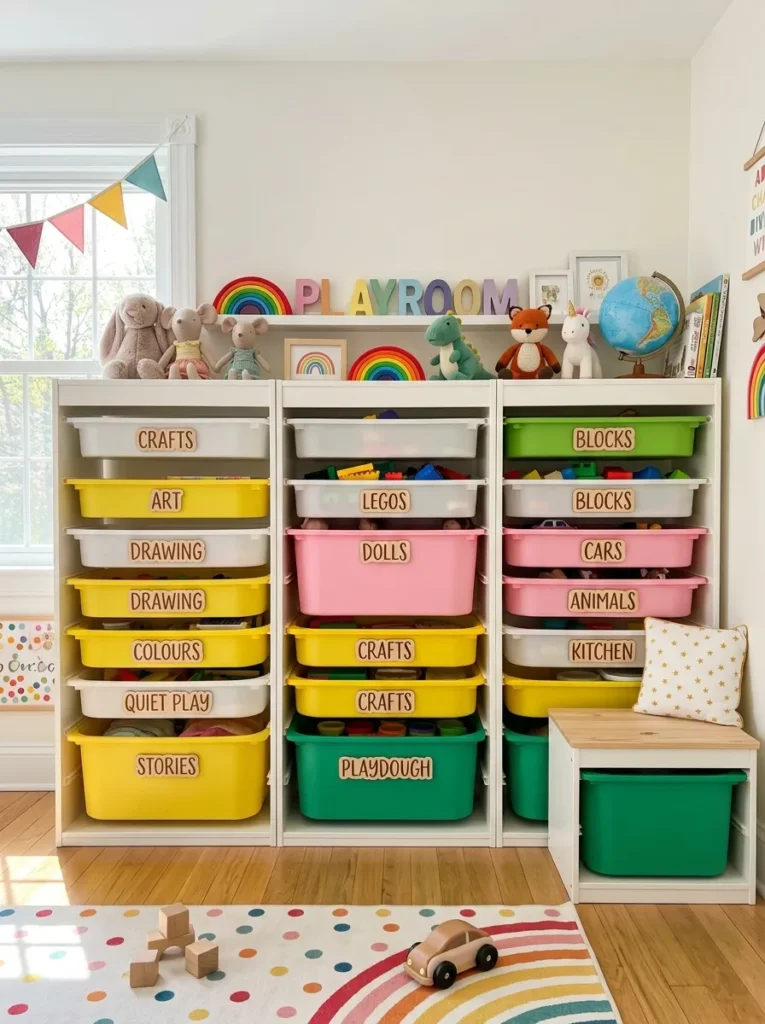
Vibe: Organized and colorful — the storage wall that a child can actually use independently from the first day it is set up.
Why it works: A wall-to-wall TROFAST system applies the Montessori principle of accessible, categorized, child-scale storage — every bin in a TROFAST system sits at a height a child can reach, see into, and independently retrieve from and return to, which makes the storage system self-maintaining through the child’s own daily actions rather than requiring parental tidying enforcement. The open-bin design (no lids required to access contents) removes the friction of opening and closing that makes lidded storage fail with young children — a toy in an open-top bin is accessible in zero motions, which means it is accessible enough to be both retrieved and returned by a child under five. Three frames side by side create a storage capacity equivalent to a large custom wardrobe at a fraction of the cost.
How to get it: Mount all TROFAST frames to the wall through the pre-drilled mounting holes in the frame back — the frames must be wall-anchored when used as a full wall system, as side-by-side units gain collective stability from wall attachment. Assign specific bin colors to specific categories and maintain that color assignment consistently — color-coding is the organizational system most reliably used by children under seven, who identify by color faster than by text label. Place the lowest bins (floor level) with the heaviest or most frequently used toys; reserve upper bins for less-frequently accessed items.
| Product |
|---|
| TROFAST frame white large IKEA |
| TROFAST bins assorted colors set IKEA |
| TROFAST lid for bin seat conversion IKEA |
| TROFAST bin with lid white IKEA |
| Wall anchor kit for TROFAST IKEA |
4. STUVA Loft Bed with Integrated Desk and Wardrobe
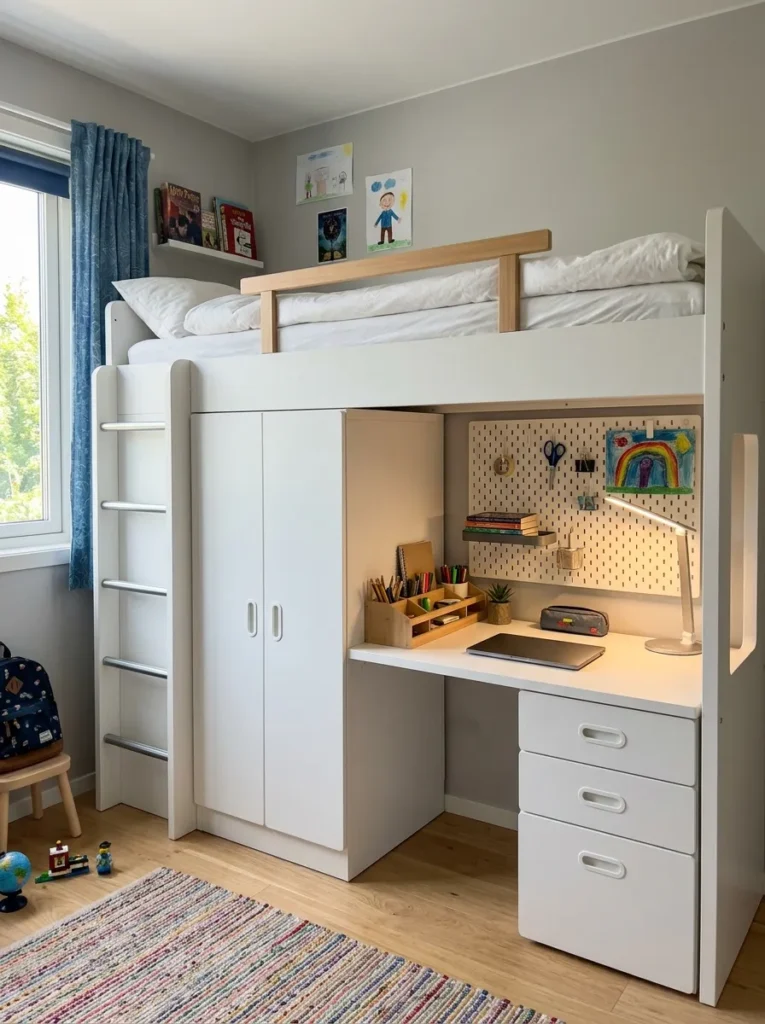
Vibe: Organized and efficient — the system that turns a small bedroom into a complete living, sleeping, studying, and storage environment.
Why it works: The STUVA loft bed system applies the principle of vertical space stacking — sleeping, studying, storage, and dressing all occur within the same floor footprint by distributing the functions vertically rather than across the room’s floor area. For a child with a small bedroom, the STUVA system can genuinely contain all the room’s functional requirements (sleeping, studying, clothing storage, school supply organization) within a single modular unit, freeing the remaining floor area for unstructured play space — the most developmentally important spatial requirement for school-age children. The integrated desk at the right side of the loft structure provides a study zone that is spatially adjacent to (but visually separated from) the sleeping zone, supporting the focused study behaviors that require a defined dedicated territory.
How to get it: The STUVA loft bed is sold as a system of modular components — the loft bed frame, under-bed desk extension, wardrobe cabinet, and drawer unit are purchased separately and combined according to the room’s specific requirements. Measure the room carefully before purchasing — the full STUVA system in its largest configuration (loft bed, desk, wardrobe, and drawers) requires a floor footprint of approximately 200x150cm. Add a pegboard panel on the wall above the desk section for school supply organization that keeps the desk surface itself clear.
| Product |
|---|
| STUVA loft bed frame white IKEA |
| STUVA desk extension for loft bed IKEA |
| STUVA wardrobe module white IKEA |
| STUVA drawer unit for loft bed IKEA |
| LED desk lamp adjustable arm white |
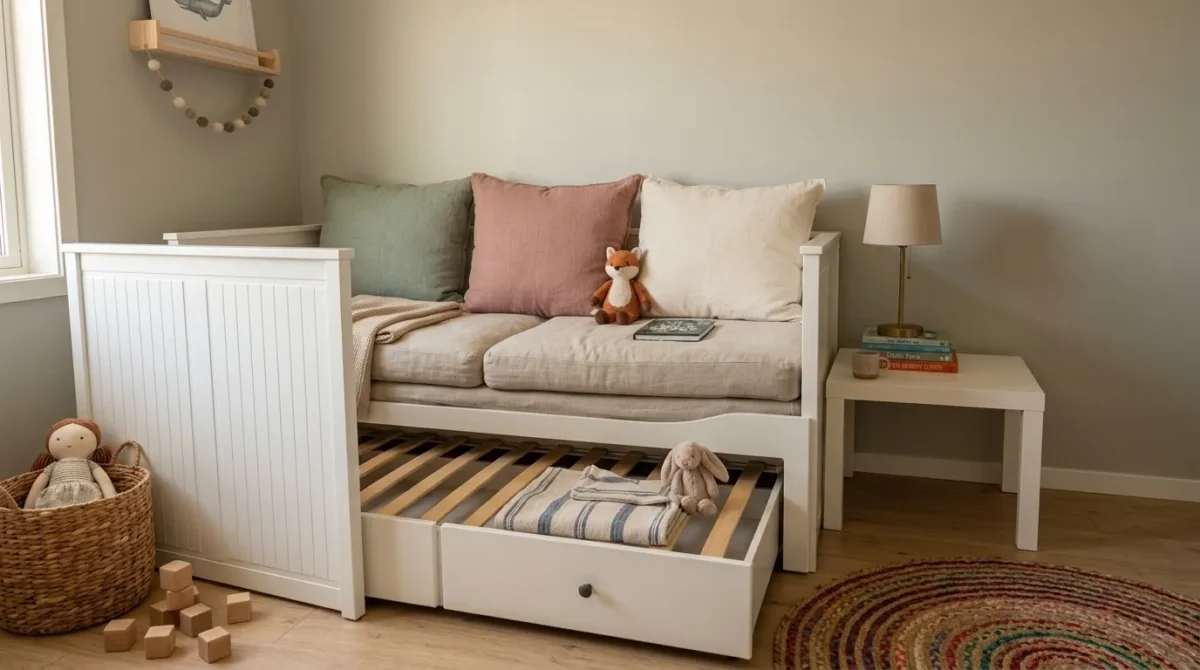
5. HEMNES Daybed as Sofa and Guest Bed
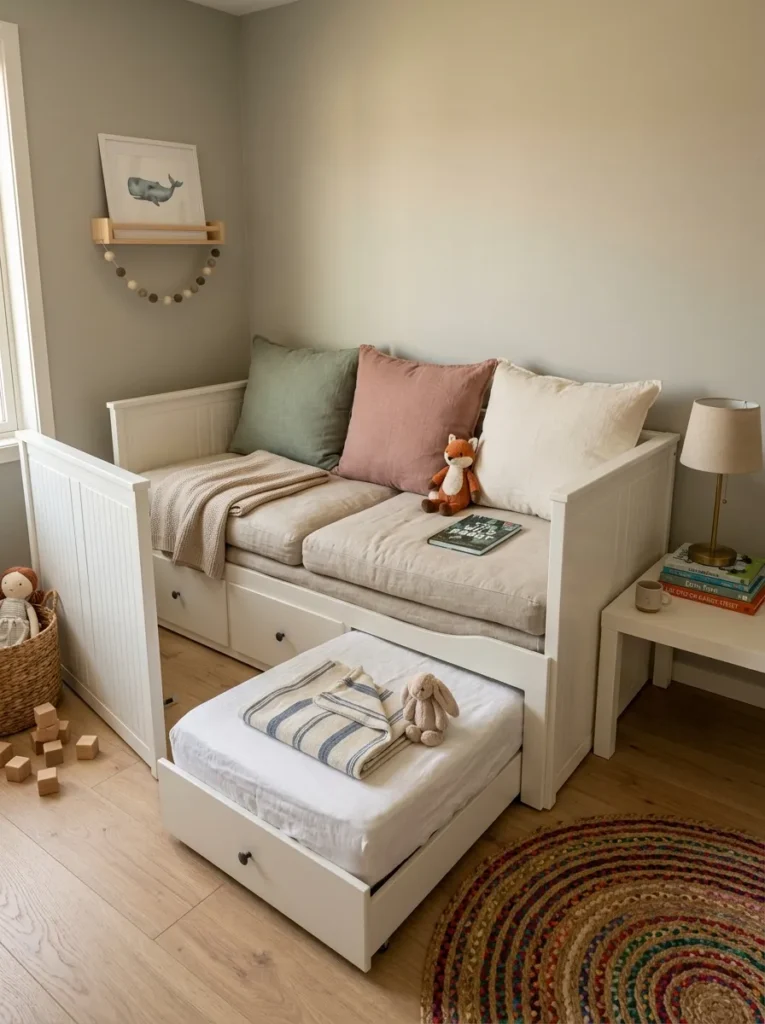
Vibe: Warm and flexible — the bed that gives a child’s room a social function and a guest function without occupying additional floor space for either.
Why it works: The HEMNES daybed with trundle applies the principle of temporal space multiplicity — the same piece of furniture serves as sofa during daytime social use, single bed during sleep, and double sleeping accommodation when the trundle is deployed for sleepovers or guests, all within the same wall-adjacent footprint. This is particularly valuable in children’s rooms because the social dimension of a child’s bedroom — the space where friends sit during playdates, where siblings pile together for movie nights — is as important to the room’s function as the sleeping dimension, and most standard bed configurations provide no sofa-mode option. The HEMNES daybed’s high back and side rail create the three-walled enclosure that makes it read as a sofa from the room rather than as an unmade bed.
How to get it: Purchase the HEMNES daybed with its matching pull-out trundle for the full dual-function configuration — the trundle slides under the main bed frame on castors and deploys quickly for sleepover use. Style the daybed-as-sofa using two seat cushions across the full seating area and three back pillows leaning against the wall behind the bed frame — the cushions are not IKEA products but should be purchased in sizes that fit the daybed’s 80cm width. Install a LACK side table at the same height as the bed frame at one end for the lamp, drink, and book surface that makes the sofa function usable.
| Product |
|---|
| HEMNES daybed frame white IKEA |
| HEMNES daybed mattress set twin IKEA |
| LACK side table white IKEA |
| Linen cushion cover set sage green dusty rose |
| Small bedside lamp warm light |
6. FLISAT Table with TROFAST Bin Insert
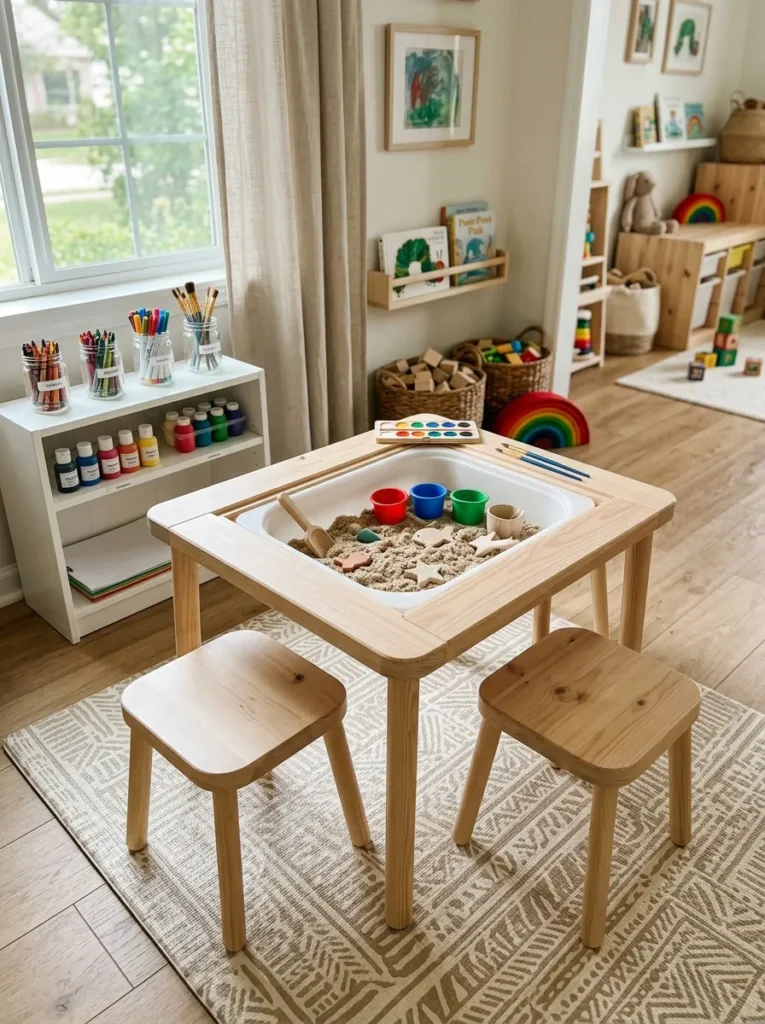
Vibe: Playful and practical — the children’s table that invites messy play and contains it simultaneously.
Why it works: The FLISAT table’s central hole — designed to accept a TROFAST bin insert — is one of IKEA’s most clever children’s product design details because it converts a standard children’s table into a contained sensory play station: the TROFAST bin holds sand, water, kinetic sand, small world play materials, or art supplies within a defined container that sits flush with the table surface, eliminating the boundary between the table’s play surface and the bin’s play material. This containment principle reduces the cleanup radius of messy play activities from the full room to the table’s footprint — a child playing with kinetic sand in a TROFAST bin on a FLISAT table with a waterproof mat beneath generates almost no floor mess, making sensory play achievable in carpeted rooms or in rooms where floor mess is problematic.
How to get it: The FLISAT table accepts standard TROFAST small bins as inserts — purchase the table and bin separately and confirm the TROFAST small bin size (42x30x23cm) fits the table’s central hole opening before purchasing. For water play use, apply a thin bead of waterproof sealant around the bin rim where it meets the table surface to prevent water seeping between the bin and table edge. Place a waterproof vinyl or silicone mat beneath the table before any wet or messy play session — the mat defines the play zone and catches any material that escapes the bin.
| Product |
|---|
| FLISAT children’s table natural wood IKEA |
| FLISAT children’s stool set IKEA |
| TROFAST small bin white IKEA |
| Waterproof silicone play mat under table |
| Kinetic sand sensory play material |
7. KALLAX Hack Reading Nook with Cushion
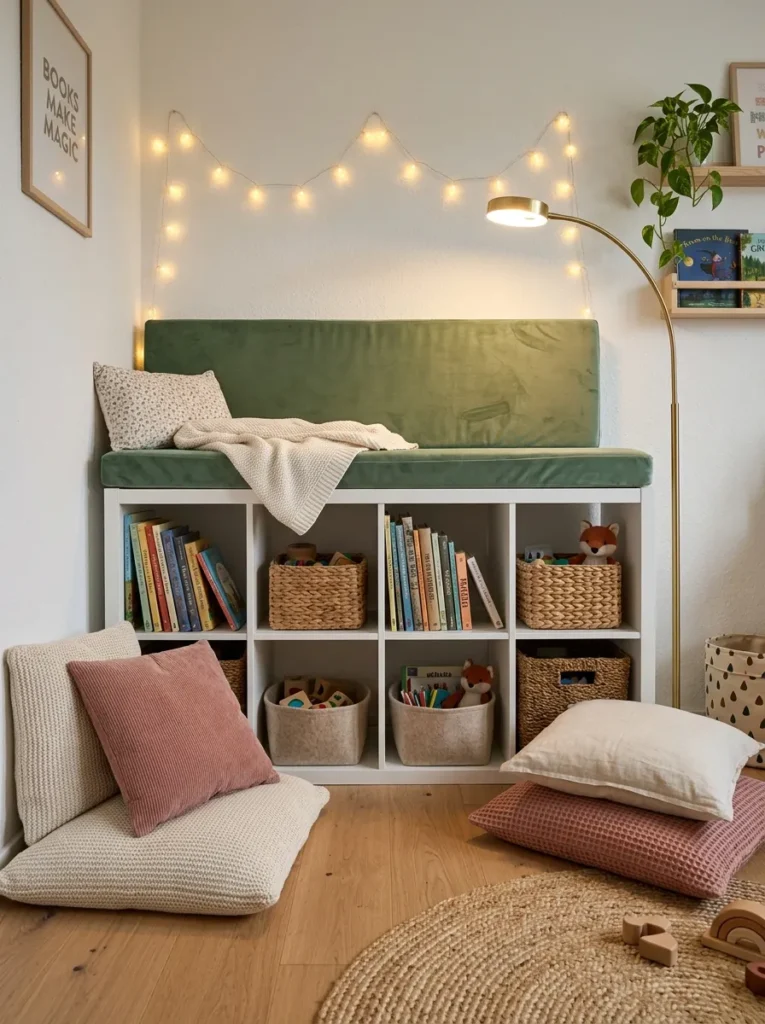
Vibe: Cozy and inviting — the reading corner that a child returns to every day because it feels genuinely theirs.
Why it works: A KALLAX 2×4 unit rotated to its horizontal position and fitted with a cushion applies the design principle of furniture repurposing through reorientation — the same unit that stands vertically as a shelving system becomes a low bench-height reading nook base when placed on its side, with the squares now functioning as side-accessible book and basket storage accessible from the seated position on the cushion above. This reading nook configuration is the single most effective use of the KALLAX for creating a defined, intimate reading zone within a larger children’s bedroom or playroom because it creates a genuine spatial threshold — the reading nook feels enclosed and separate from the rest of the room without any construction or additional furniture.
How to get it: Lay the KALLAX 2×4 on its side (so the long dimension runs horizontally) and anchor to the wall through the back panel using appropriate wall anchors — a horizontal KALLAX used as a bench seat must be wall-anchored as a safety requirement. Order a custom foam cushion cut to the top surface dimensions (approximately 147x39cm for a KALLAX 2×4) from an online foam cutter and cover with a removable velvet or performance fabric cover for the most durable and cleanable reading nook surface. Add fairy lights and a simple arched floor lamp to define the nook’s lighting zone distinctly from the room’s ambient lighting.
| Product |
|---|
| KALLAX shelf unit 2×4 white IKEA |
| Custom foam cushion cut to size 4 inch |
| Velvet cushion cover removable sage green |
| Large floor cushion set cream dusty rose |
| Battery fairy lights warm white string |
8. ALGOT or PAX Wardrobe Configured for Children
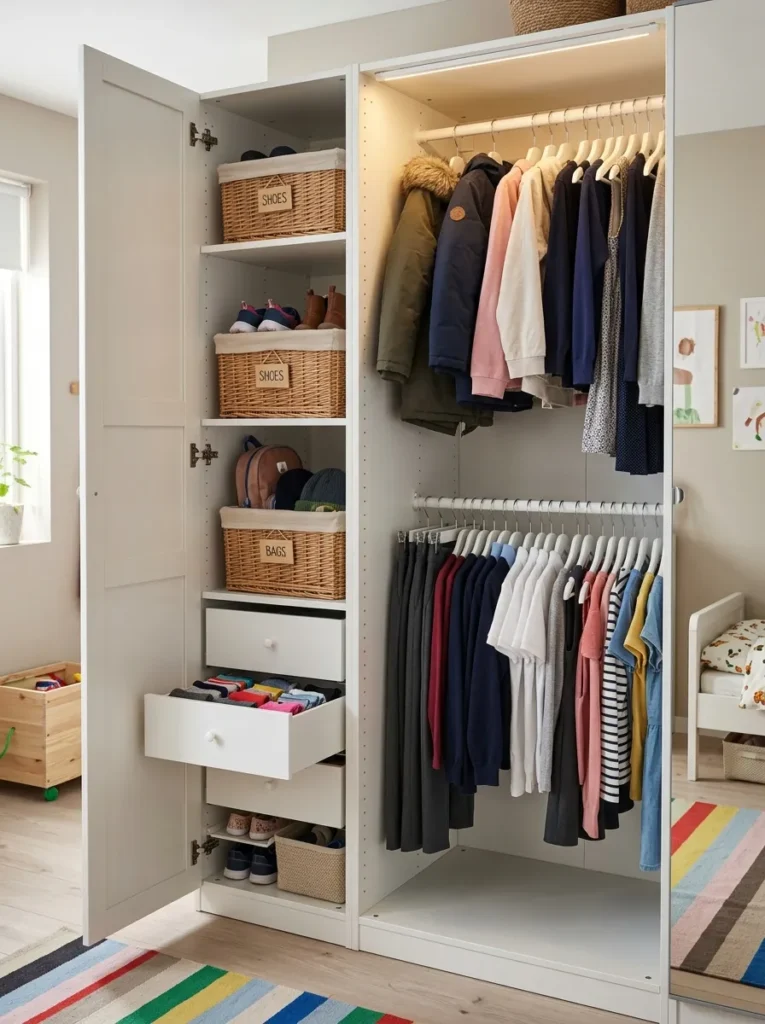
Vibe: Organized and accessible — the wardrobe interior that a child can independently navigate from their first day of school.
Why it works: Configuring a PAX wardrobe interior specifically for a child’s independent use applies the Montessori principle of child-accessible prepared environment to a standard wardrobe system — by setting the lower hanging rod at child shoulder height (approximately 90cm for a 5–7 year old, adjustable upward as the child grows), every hanging item becomes independently retrievable and replaceable without adult assistance. The PAX system’s fully adjustable interior — every rod, shelf, and drawer can be repositioned within the frame — means the wardrobe configuration can be updated in 20 minutes as the child grows, rather than requiring furniture replacement. The pull-out IKEA drawer units (KOMPLEMENT series) within the wardrobe floor create a dedicated zone for folded small items accessible at a child’s standing height.
How to get it: Order the PAX frame in the size appropriate for the available wall space — a single 100cm wide PAX is adequate for one child, two 50cm PAX frames side by side allow the interior to be divided between two children sharing a room. Specify the interior configuration in the IKEA PAX planner tool before purchasing to verify that the lower rod, upper rod, and drawer unit combination fits within the chosen frame height. Install the lower rod at the child’s shoulder height measured at the time of installation — note this height and plan to raise the rod by 5cm increments as the child grows.
| Product |
|---|
| PAX wardrobe frame white IKEA |
| TYSSEDAL wardrobe door white IKEA |
| KOMPLEMENT pull-out drawer unit IKEA |
| KOMPLEMENT clothes rail adjustable IKEA |
| Slim white velvet hanger set 50 pack |
9. SKADIS Pegboard for Desk and Art Organization
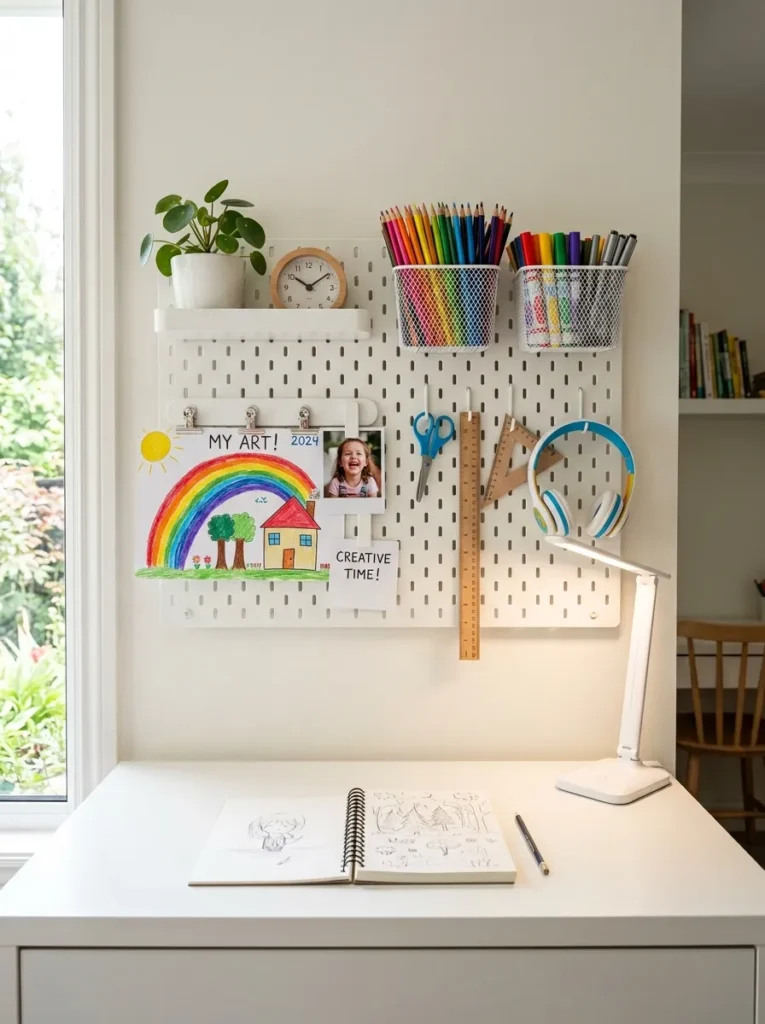
Vibe: Organized and creative — the desk setup that keeps supplies accessible and the work surface clear simultaneously.
Why it works: The SKADIS pegboard mounted above a child’s desk applies the same surface-to-wall organizational transfer principle as the studio pegboard systems used by professional designers and makers — by moving all supply storage from the desk surface to the wall above it, the desk surface remains clear for active work while all supplies remain within arm’s reach from the seated position. The SKADIS system’s proprietary accessories (wire baskets, shelf additions, memo clips, and hooks) are designed to fit the SKADIS board’s specific hole pattern and provide the range of storage formats needed for a child’s desk — upright storage for pens and brushes, flat storage for rulers and scissors, display storage for current artwork, and shelf storage for the clock, plant, and reference objects that make a study area feel personally inhabited.
How to get it: Mount the SKADIS directly to the wall above the desk using the included wall anchors — the board must be wall-mounted rather than resting against the wall surface, as the accessories apply lateral force to the board when loaded. Begin with the SKADIS starter kit (board plus a basic accessory set) and add accessories as specific storage needs become apparent through use — buying a large accessory set upfront often results in having accessories for storage categories the child does not actually need while lacking the specific format needed most.
| Product |
|---|
| SKADIS pegboard white IKEA |
| SKADIS accessory set complete IKEA |
| SKADIS wire basket set IKEA |
| MICKE desk white IKEA |
| LED desk lamp adjustable white |
10. BESTA as Toybox and Display Surface
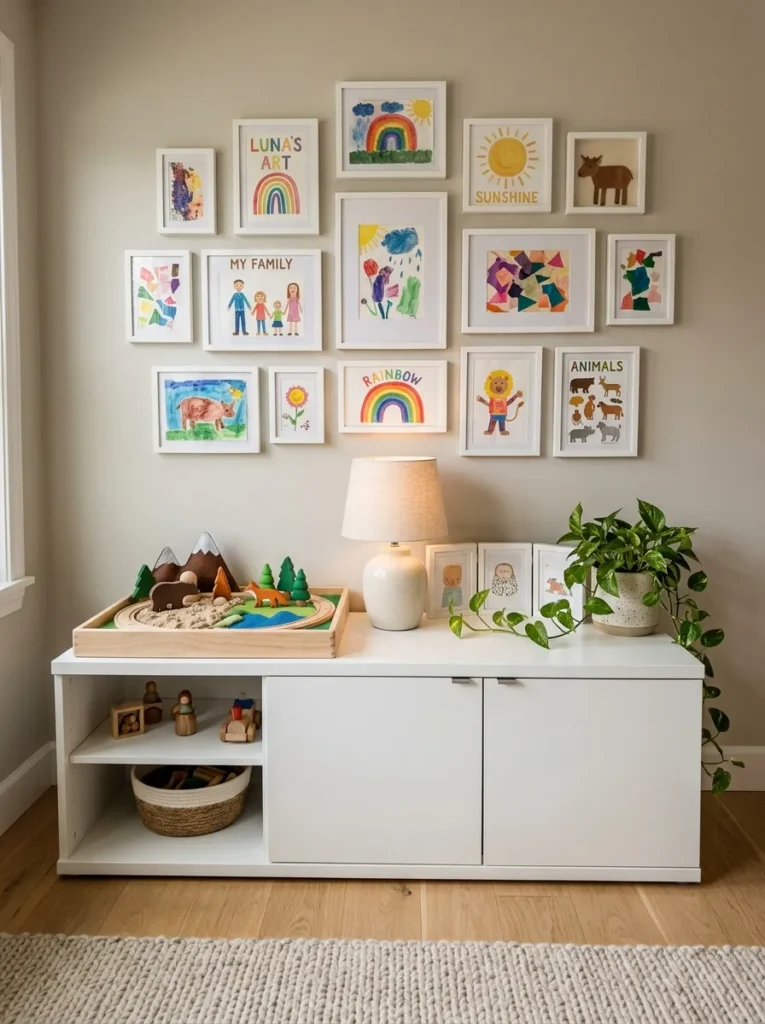
Vibe: Warm and considered — the toy storage that makes a children’s room look like it was designed by someone who cared about both the child and the space.
Why it works: Using a BESTA unit as a children’s toy box applies the principle of concealed categorical storage at child-accessible height — the two cabinet doors hide the room’s most visually chaotic category of objects (toys) within a furniture piece whose exterior reads as clean, designed, and integrated with the room’s aesthetic. The BESTA’s low profile (approximately 64cm high in the standard configuration) positions the cabinet doors at a child’s comfortable reach height while creating a flat top surface at the ideal height for small world play, display, and the ceramic objects and plants that make a children’s room feel warm and considered rather than purely functional. The gallery wall above the BESTA is the detail that elevates the whole arrangement — framing the child’s own artwork in simple white frames and displaying it at adult eye level communicates genuine respect for the child’s creative output.
How to get it: Choose BESTA doors with soft-close hinges rather than standard hinges — children’s use of cabinet doors is vigorous, and soft-close hardware extends the life of the hinges and prevents the door-slamming that standard hinges accumulate wear from quickly. Add a non-slip mat inside the cabinet to prevent toy bins from sliding when the door is opened. Style the BESTA top surface with a balance of functional elements (the small world tray or activity surface) and decorative elements (the lamp, plant, and leaning prints) — a top surface that is only functional reads as utilitarian; one that is only decorative reads as inaccessible to the child.
| Product |
|---|
| BESTA storage unit with doors white IKEA |
| BESTA door with soft close hinge IKEA |
| Small world play tray natural wood |
| Simple white picture frame set children’s art |
| Small trailing pothos plant ceramic pot |
11. VITTSJO or LACK Shelves as Art Display Ledges
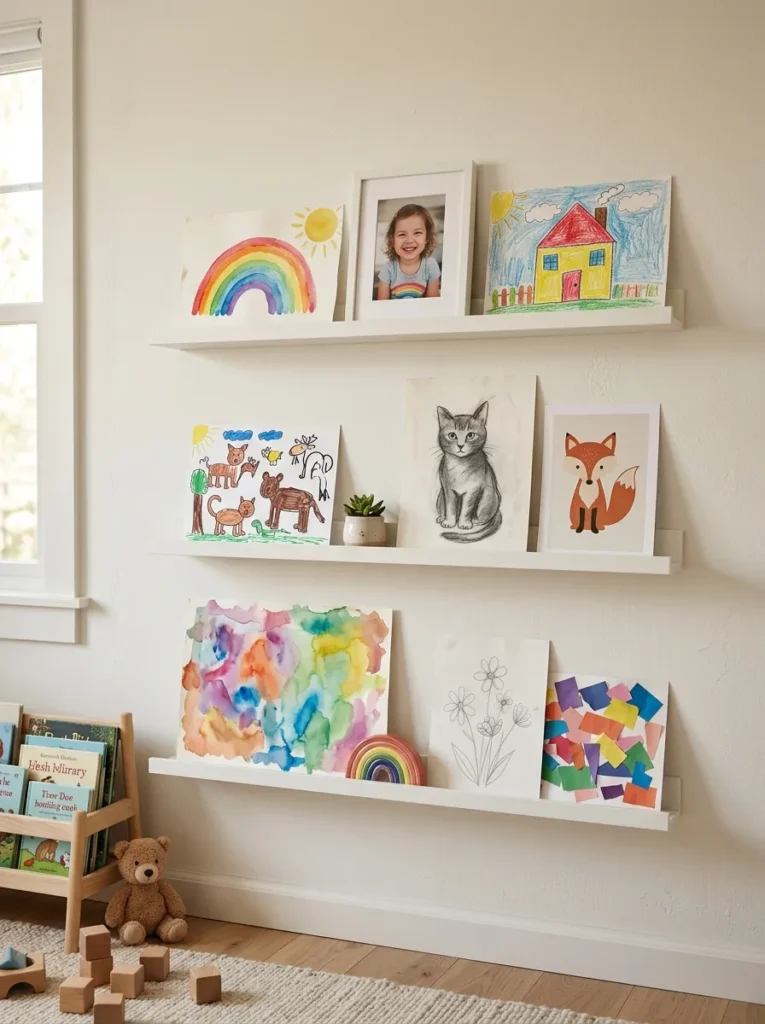
Vibe: Warm and celebratory — the wall system that makes a child’s artwork feel like it belongs in a gallery.
Why it works: IKEA MOSSLANDA picture ledges (sold as the MOSSLANDA rail in IKEA’s range) as a children’s art display system apply the design principle of flexible curation — unlike frames with fixed artwork that requires tools and wall damage to change, picture ledges allow artwork to be swapped, rearranged, and updated in seconds, which is the functional requirement for displaying a child’s art output that changes weekly or more frequently. The staggered arrangement of three ledges at different heights creates a multi-level gallery composition that accommodates works of different sizes simultaneously and creates visual rhythm across the wall surface. Displaying a child’s own artwork on a dedicated wall system communicates to the child that their creative output is valued, which research consistently links to increased creative output and creative confidence.
How to get it: Mount MOSSLANDA ledges at heights that place the displayed art at the child’s eye level — the lowest ledge at approximately 80–90cm from the floor for school-age children, with subsequent ledges at 30cm increments above. Use at least three ledges to create the gallery depth that single ledges cannot — three ledges allow the simultaneous display of a body of work rather than a single piece. Rotate artwork weekly or bi-weekly, storing removed pieces in a flat portfolio folder to create a seasonal archive of the child’s creative development.
| Product |
|---|
| MOSSLANDA picture ledge white set IKEA |
| RIBBA picture frame set white IKEA |
| Small ceramic object set children’s display |
| Flat portfolio folder for artwork storage |
| Level and pencil for ledge installation |
12. MICKE Desk with Drawer Tower for Homework Zone
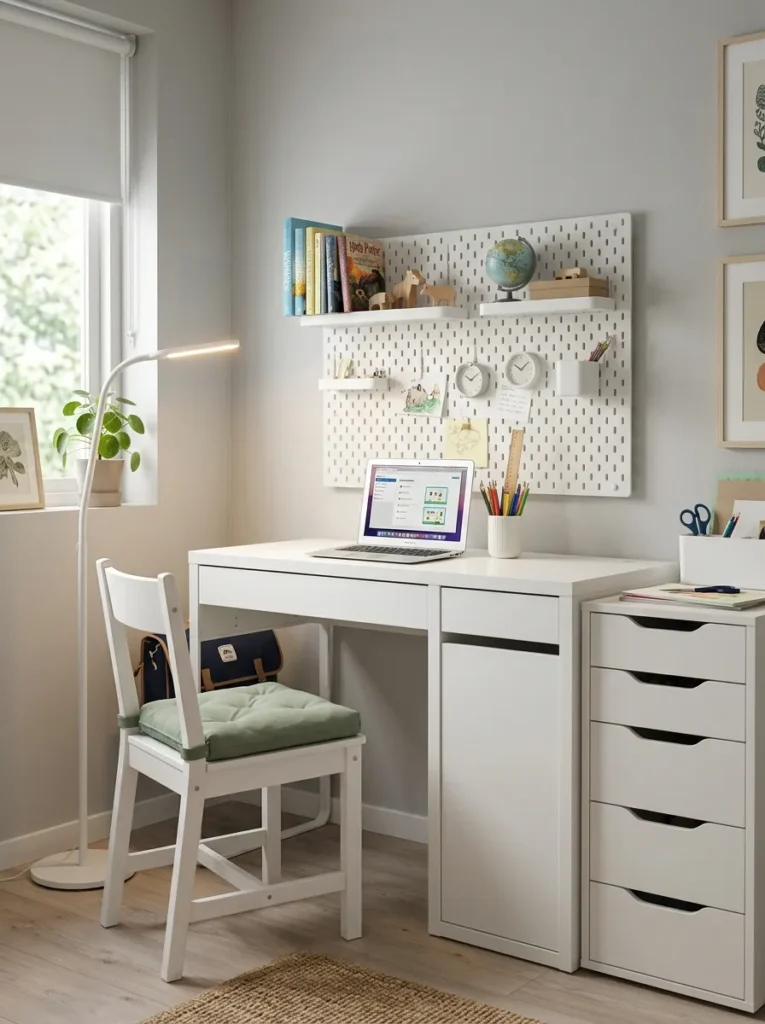
Vibe: Calm and study-ready — the homework zone that makes sitting down to work feel natural rather than effortful.
Why it works: The MICKE desk system — specifically the combination of the MICKE desk with the MICKE add-on unit and the separate MICKE drawer tower — applies the principle of modular study zone construction, allowing a comprehensive study environment to be assembled from individual IKEA pieces that share a design language and physical dimensions, creating a unified, purposeful study zone within a children’s bedroom without the cost of custom furniture. The MICKE desk’s built-in cable management holes and simple, undecorated surface make it one of the most study-appropriate children’s desks available at its price point — it reads as a serious work surface rather than a play table, which subtly but meaningfully influences the child’s behavioral association with the zone.
How to get it: Position the MICKE desk perpendicular to or beside the room’s primary window rather than facing it — a window directly in front of the seated position causes glare on screen and paper surfaces; a window to the left side (for right-handed children) provides ideal natural task lighting without glare. Add the MICKE drawer tower on the desk’s right side (left for left-handed children) to keep frequently used supplies at arm’s reach from the seated position without consuming desk surface space. Install a SKADIS pegboard above the desk for additional supply organization at wall rather than surface level.
| Product |
|---|
| MICKE desk white IKEA |
| MICKE add-on unit white IKEA |
| MICKE drawer unit white IKEA |
| Ergonomic children’s desk chair |
| LED desk lamp warm light adjustable |
13. DUKTIG Play Kitchen as Montessori Learning Station
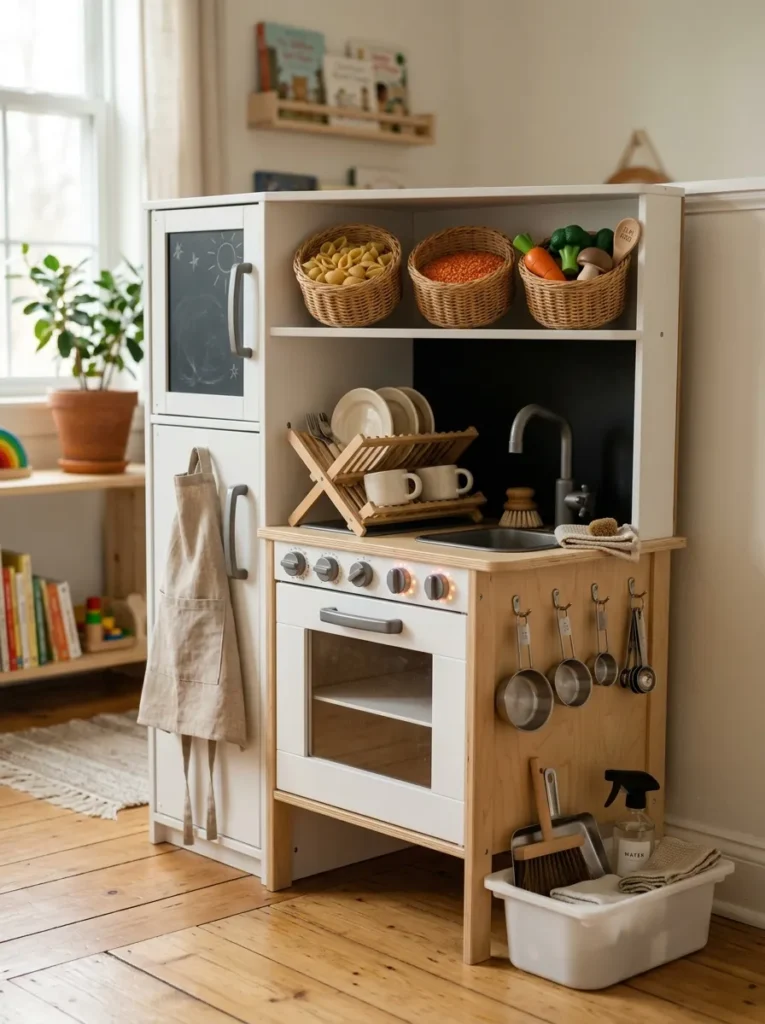
Vibe: Warm and purposeful — the play kitchen that bridges pretend play and real life skill-building.
Why it works: The DUKTIG play kitchen customized with real-scale accessories rather than purely plastic toy items applies the Montessori principle of child-scale real-life materials — children’s play is most developmentally rich when the materials they use are genuine (real ceramic plates, real metal measuring cups, real dried pasta for sensory play) rather than plastic simulations of real objects. Real objects have weight, temperature, texture, and sound properties that plastic simulations lack, and these properties make the play experience more sensory, more skill-building, and more cognitively engaging. The DUKTIG’s birch and white construction already reads as more considered than most play kitchens — the customization with real accessories elevates it further into a space where pretend cooking genuinely teaches the physical logic of cooking.
How to get it: Add small stainless steel measuring cups and spoons using small Command hooks beside the DUKTIG’s oven — at child scale, the measuring equipment is genuinely usable for simple real cooking activities supervised by adults. Replace the included plastic play food with a combination of wooden play food sets (more tactile, more durable, and more visually appealing than plastic) and small quantities of real dried goods in small baskets — dried pasta, dried lentils, and whole dried herbs in small open baskets on the DUKTIG shelves create a genuine sensory experience. Source small real ceramic plates and cups (IKEA’s own DINERA series in small sizes works well) for the dish rack.
| Product |
|---|
| DUKTIG play kitchen white birch IKEA |
| Stainless steel measuring cup set small |
| Wooden play food set quality |
| Small ceramic plates children’s size |
| Natural linen child’s apron half size |
14. SUNDVIK or SNIGLAR Cot to Toddler Bed Transition
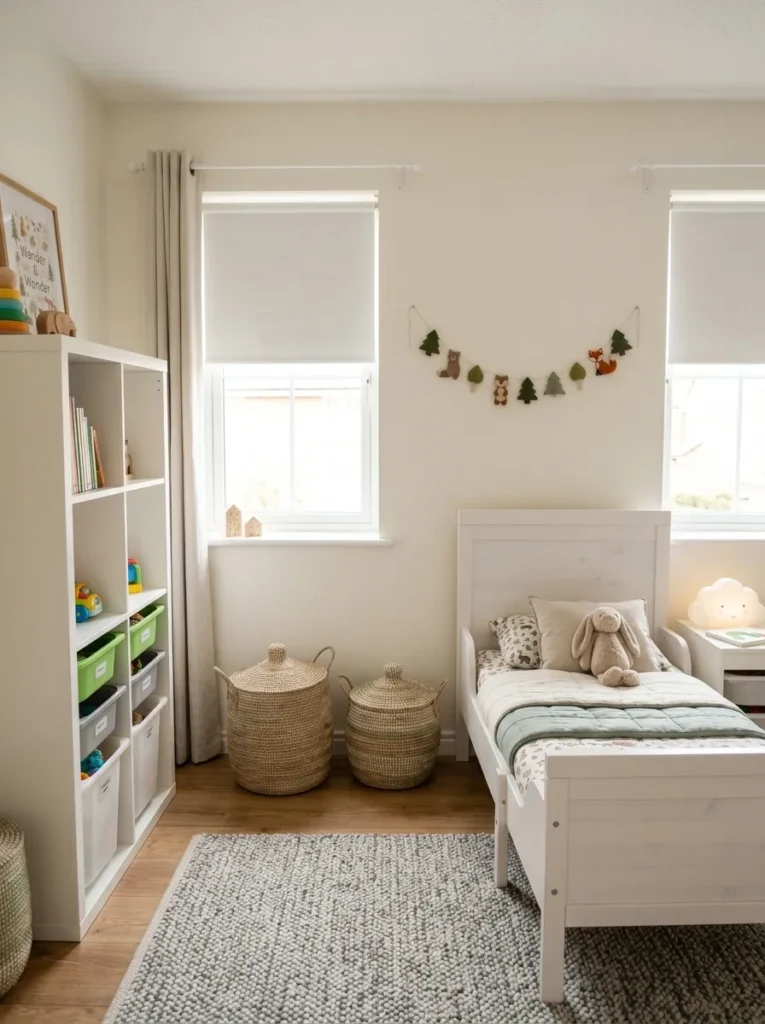
Vibe: Calm and transitional — the bedroom that evolves with the child so the space never feels wrong for the stage they are at.
Why it works: The SUNDVIK cot’s removable front rail is the specific design feature that makes it the most developmentally intelligent IKEA cot purchase — rather than requiring a separate toddler bed purchase when the child outgrows cot containment (typically between 18 months and 3 years), the SUNDVIK converts to an open toddler bed by removing the front rail, creating a low-entry bed configuration that maintains the child’s familiarity with their sleeping surface while providing the independent access and exit that toddler developmental stage requires. This single purchase covers the sleeping furniture requirement from birth to approximately age five, eliminating two furniture transitions (cot to toddler bed, toddler bed to single bed) that otherwise require multiple furniture purchases within a short time.
How to get it: Purchase the SUNDVIK cot from the outset of the nursery setup rather than starting with a cheaper cot that will require replacement — the modest price premium over a non-convertible cot is recovered in full at the first transition when no additional furniture purchase is needed. Remove the front rail at the developmental appropriate moment (when the child can physically climb out of the cot independently, which typically occurs between 18–24 months) rather than waiting for a specific age — the child’s physical capability is a more reliable transition indicator than any age milestone. Position a TROFAST bin unit beside the bed at the same surface height as the SUNDVIK frame to serve as a toddler-scale bedside table with storage in the bins below.
Quick Win: A pool noodle cut to length and tucked under the fitted sheet along the open side of a converted SUNDVIK cot creates an effective, invisible bed guard that prevents roll-outs during sleep without purchasing a separate bed guard — a $2 solution that works as reliably as commercial bed guards at 20 times the price.
| Product |
|---|
| SUNDVIK cot convertible white IKEA |
| SUNDVIK cot mattress IKEA |
| Organic cotton fitted cot sheet woodland |
| TROFAST frame for bedside table white IKEA |
| Small rechargeable night light warm glow |
How to Start Your IKEA Kids’ Room Transformation
Start by lowering a hanging rod to child height. Before purchasing any new IKEA furniture, if the child’s room already contains a wardrobe — IKEA PAX or any other — lower the hanging rod to the child’s shoulder height this weekend. This single free action, achievable in under 30 minutes using only a screwdriver, immediately makes the entire wardrobe independently accessible to the child, which changes the morning routine more profoundly than any furniture purchase. Once the child can independently retrieve and return clothing, the organizational systems that support that independence (labeled bins, day-of-week dividers, drawer organizers) become worth investing in because the child will actually use them.
The most common mistake parents make when furnishing a child’s room with IKEA furniture is purchasing pieces that match the child’s current developmental stage rather than the stage they will be at when the furniture needs to serve them most effectively. A toddler’s room furnished entirely for toddler needs requires complete refurnishing by age six — a significant cost and a significant disruption. The smarter approach is to purchase the IKEA systems that are most adaptable across developmental stages (KALLAX, PAX, TROFAST, MICKE) at the outset and configure them for the current stage, then reconfigure as the child develops — the furniture investment remains constant while the configuration evolves with the child’s changing needs.
Three items under $50 that make an immediate impact: A SKADIS pegboard ($15–$25 depending on size) mounted above the desk or play table that immediately moves all supplies off the work surface and onto the wall; a set of TROFAST bins in two or three colors ($8–$15 for a four-bin set) that implements color-coded categorical toy storage the child can use independently from day one; and a set of MOSSLANDA picture ledges ($10–$15 for two) that creates a rotating display system for the child’s artwork that makes them feel genuinely celebrated as a creative person.
Realistic expectations: A basic IKEA kids’ room organizational upgrade — TROFAST storage wall, SKADIS desk pegboard, and picture ledge gallery — takes one weekend to install and assemble and costs $80–$180 in IKEA products depending on the TROFAST frame count. A mid-level kids’ room transformation adding a KURA loft bed, STUVA desk integration, and PAX wardrobe configuration typically takes a full weekend of assembly and costs $500–$900 in IKEA products. A full kids’ room design with KALLAX room divider, STUVA loft system, custom cushion reading nook, and complete storage systems typically costs $800–$1,500 in IKEA products — delivering a room quality that competes with custom children’s furniture installations costing $4,000–$8,000 for equivalent function and visual quality.
Frequently Asked Questions About IKEA Furniture Ideas for Kids’ Rooms
Is IKEA children’s furniture safe for young children and toddlers?
IKEA’s children’s furniture meets or exceeds EN 71 (European toy safety standard) and ASTM F963 (US toy safety standard) requirements for children’s products, and the adult furniture range used in children’s rooms (KALLAX, PAX, HEMNES, BESTA) meets IKEA’s general furniture safety standards. The most critical safety requirement for IKEA furniture in children’s rooms — and the one most frequently overlooked — is wall anchoring. IKEA provides wall anchoring hardware with all wardrobes, tall shelving units, and the KALLAX, and this hardware must be installed correctly before any child can access the furniture. IKEA’s product recall history shows that the tip-over risk from unanchored furniture (including the well-publicized MALM dresser recalls) is real and serious — wall anchoring eliminates this risk entirely and takes under 10 minutes to install.
How do I make IKEA furniture look more custom or high-end in a child’s room?
The three modifications that most effectively elevate IKEA children’s furniture from standard flat-pack appearance to custom-quality finish are: replacing standard IKEA hardware with quality alternative knobs and pulls (brass, ceramic, or resin hardware in colors and finishes not available in the IKEA range transforms the visual quality of any PAX, BESTA, or KALLAX insert immediately); painting particleboard furniture with chalk-finish furniture paint in non-standard colors (sage green, dusty rose, deep navy, or warm terracotta KALLAX inserts read as genuinely custom pieces); and adding custom cushions in quality fabric to any IKEA seating surface — a KALLAX reading nook seat cushion in quality velvet or performance linen reads as bespoke furniture when the fabric quality is high, regardless of the IKEA structure beneath.
What is the best IKEA system for a shared children’s bedroom?
The KALLAX 4×4 used as a freestanding room divider is the single most effective IKEA system for a shared bedroom because it simultaneously solves the room’s three primary design challenges: zone definition (creating two distinct personal territories within one room), storage (providing each child with dedicated storage on their side of the divider), and spatial efficiency (performing the functions of a structural wall without consuming the floor space a wall would require). For sleeping, the HEMNES daybed with trundle accommodates two children in a single bed footprint during daytime and as two separate sleeping surfaces at night — the most space-efficient two-child sleeping solution available in the IKEA range. The TROFAST storage system should be duplicated for each child in their respective zone, with each child’s TROFAST bins in their chosen color to reinforce territorial ownership.
At what age should I transition from IKEA children’s furniture to adult furniture?
The functional transition from children’s furniture to adult furniture typically occurs between ages 10–13, when the KURA and STUVA loft bed systems become less appropriate (children begin preferring ground-level beds and adult-scale study zones), the TROFAST bin system is outgrown in favor of drawer and wardrobe-based storage, and the FLISAT table is fully replaced by a standard-height desk. The most graceful transition strategy is to keep the IKEA adult furniture range pieces (KALLAX, PAX, HEMNES, MICKE) that have been used in the child’s room and reconfigure their interiors for adolescent use — the KALLAX becomes record storage and book display, the PAX interior is reconfigured for a larger wardrobe, the MICKE becomes a dedicated study desk — while replacing only the specifically children’s pieces (TROFAST, FLISAT, KURA) with age-appropriate alternatives.
How do I childproof IKEA furniture that wasn’t specifically designed for children?
The four most important childproofing modifications for adult IKEA furniture used in children’s rooms are: wall anchoring (all freestanding units must be anchored — IKEA provides hardware, but third-party anti-tip straps provide additional security); corner and edge guards on sharp furniture edges (BESTA and KALLAX corners are the most common injury points for toddlers learning to walk); soft-close hardware replacement on cabinet doors and drawers (pinched fingers from slamming doors are the most common IKEA-related minor injury for children); and drawer stop hardware inside all drawers that children can access (prevents drawers being pulled fully out and falling on a child’s feet). All four modifications cost under $50 in total hardware and can be completed in a single afternoon.
Ready to Create Your Dream IKEA Kids’ Room?
These 14 ideas cover the complete range of what IKEA furniture can achieve in a children’s room — from the spatial ingenuity of a KALLAX room divider and the magical two-level world created by a KURA loft bed, to the developmental intelligence of a TROFAST independent storage system and the creative celebration of a MOSSLANDA artwork gallery wall. Every IKEA kids’ room transformation begins with a single piece planned as part of a system rather than purchased as an isolated solution — and lowering the hanging rod in the existing wardrobe to your child’s shoulder height this weekend is the zero-cost first step that changes how your child interacts with their space from the very next morning. Right now, measure the distance from your child’s shoulder to the floor, go to the wardrobe, and assess whether the current rod is at that height — if it is not, adjust it this weekend and watch how the room’s morning function changes immediately. Save the ideas that match your child’s age, your room’s dimensions, and the developmental stage you are designing for — and remember that the best IKEA kids’ room is always the one planned as a system from the beginning, so that every piece you add serves and amplifies the pieces already there.