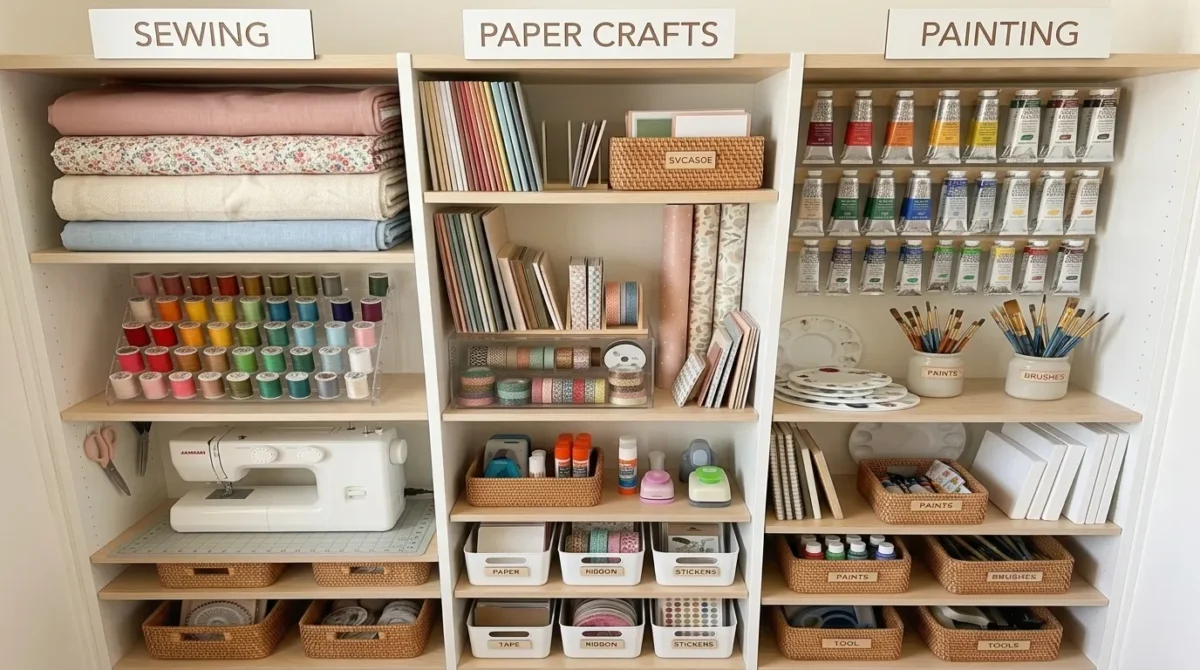
Modern eclectic craft storage mixes clean modular systems with playful color and texture so supplies stay visible instead of buried in bins. This guide gives you 11 organized craft closet ideas built for creative homes that actually get used.
Picture a closet where washi tape lines up by color, where a fold-down table appears exactly when you need it and disappears when you don’t, where cork board and pegboard hold half-finished projects in plain view instead of a drawer. The light is bright, the textures mix — birch plywood, brass pegs, glass jars, woven baskets — and every surface invites you to start something. Here are 11 ideas worth saving — and stealing.
Why Modern Eclectic Craft Storage Works So Well
Modern eclectic organization borrows structure from Scandinavian modular systems and warmth from bohemian collecting — the discipline of a pegboard grid paired with the personality of mismatched glass jars and colorful thread spools on open display. What separates it from strict minimalist storage is that visible color and texture are treated as decor, not clutter to hide.
The palette centers on warm white and birch plywood as a neutral base, with blush pink, mustard, and sage used as accent pops in bins, labels, and jar lids. Textures mix deliberately: smooth birch, woven rattan, cork board, and glass jars sit side by side, each doing a different organizational job.
This style is trending as more people turn spare closets and nooks into hobby space, and Pinterest search data shows rising interest in “craft room organization” alongside a broader maker-culture resurgence — people want supplies stored in a way that makes starting a project feel effortless.
Small closets can absolutely pull this off. Prioritize a pegboard wall and a fold-down surface before anything else, since both add function without needing floor space.
Style at a Glance
| Element | Trait 1 | Trait 2 |
|---|---|---|
| Philosophy | Visible order over hidden clutter | Function first, personality second |
| Materials | Birch plywood, pegboard | Glass jars, woven rattan |
| Color palette | Warm white, birch tan | Blush pink, mustard, sage |
1. Color-Blocked Ribbon and Tape Drawer
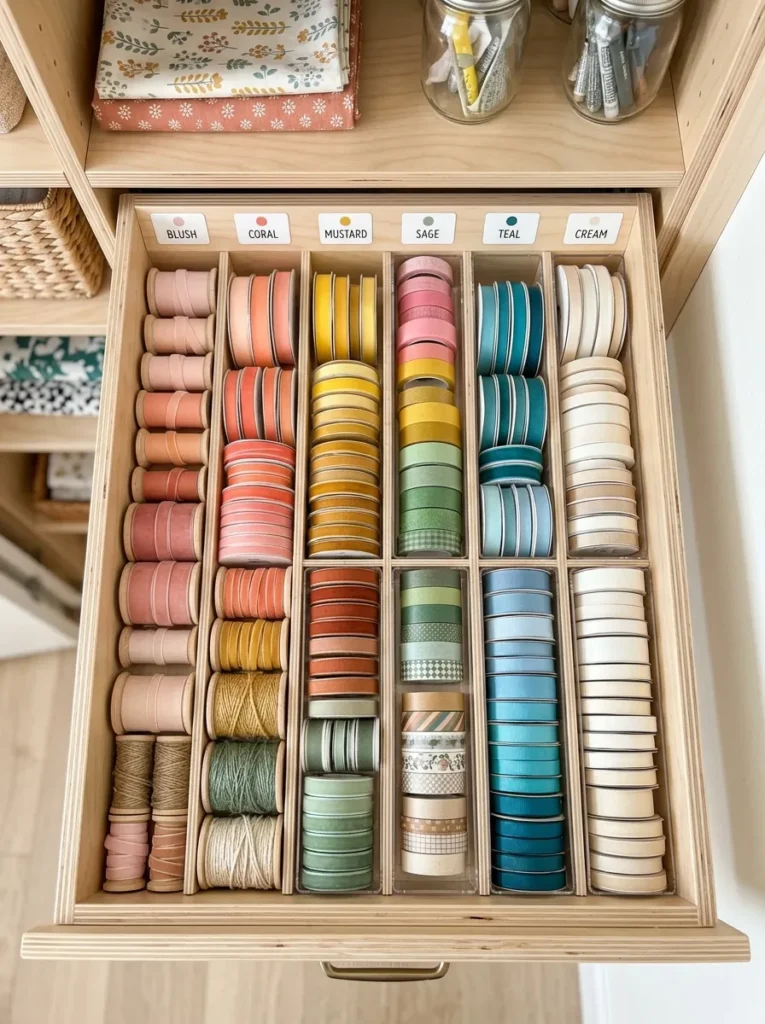
Vibe: The drawer feels luminous, like opening a tiny color wheel every time you reach for tape.
Why it works: Arranging supplies in a gradient uses color as the organizing logic itself, so the eye can locate an item by hue alone — a principle borrowed from paint-chip displays that reduces search time without a single label.
How to get it: Use clear acrylic drawer dividers sized to ribbon spool width, and arrange every roll left to right from lightest to darkest across the color wheel.
Quick Win: A $12 acrylic drawer divider set turns any junk drawer into a gradient system in under ten minutes.
Shop The Look
- Clear acrylic drawer divider set
- Ribbon spool organizer rack
- Washi tape dispenser rack
- Small color-coded label stickers
- Shallow birch drawer insert
Also view: 11 Creative IKEA KALLAX Craft Storage Ideas
2. Pegboard Wall with Birch Accessories
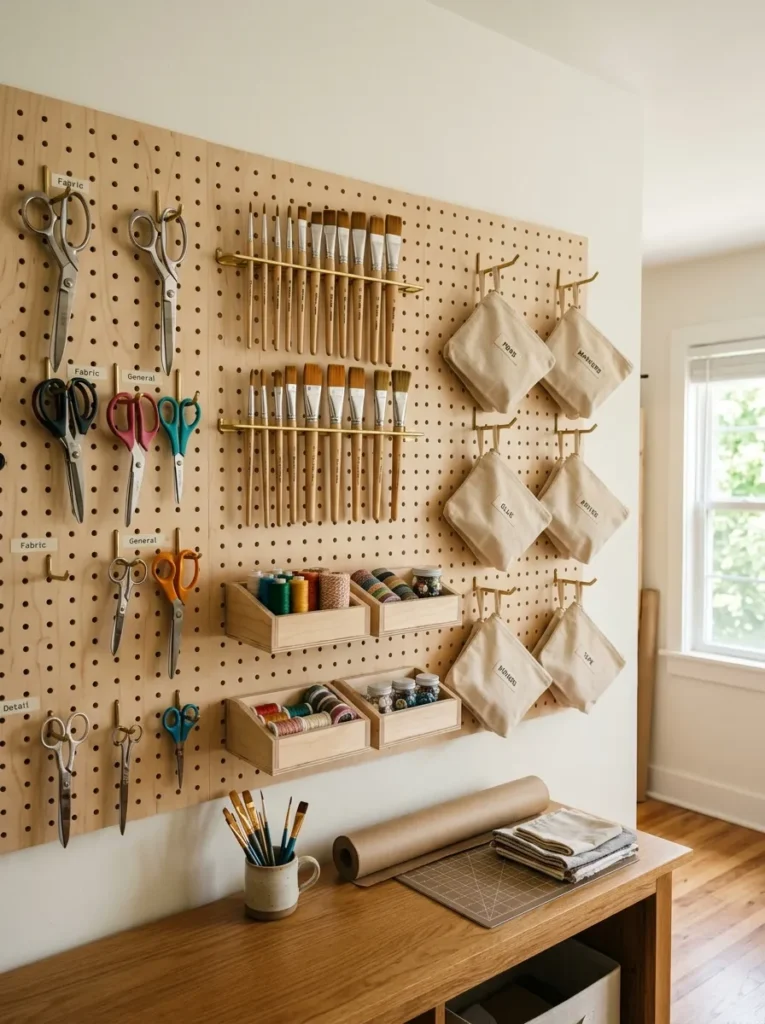
Vibe: The wall feels grounded and capable, every tool visible and within reach.
Why it works: A birch plywood pegboard swaps the typical white melamine board for a warmer, grainier material, so the wall itself reads as designed rather than purely utilitarian, while the peg system still delivers full customizable storage.
How to get it: Mount an unfinished birch pegboard panel and use brass hook pegs sized for scissors, brushes, and small canvas pouches, rearranging the layout as projects change.
Shop The Look
- Birch plywood pegboard panel
- Brass pegboard hook set
- Small canvas hanging pouch
- Pegboard bin attachment
- Scissors and brush pegboard holder
Also view: 15 Stylish IKEA Round Mirror Ideas for Every Room
3. Warm Task Lighting Over the Work Surface
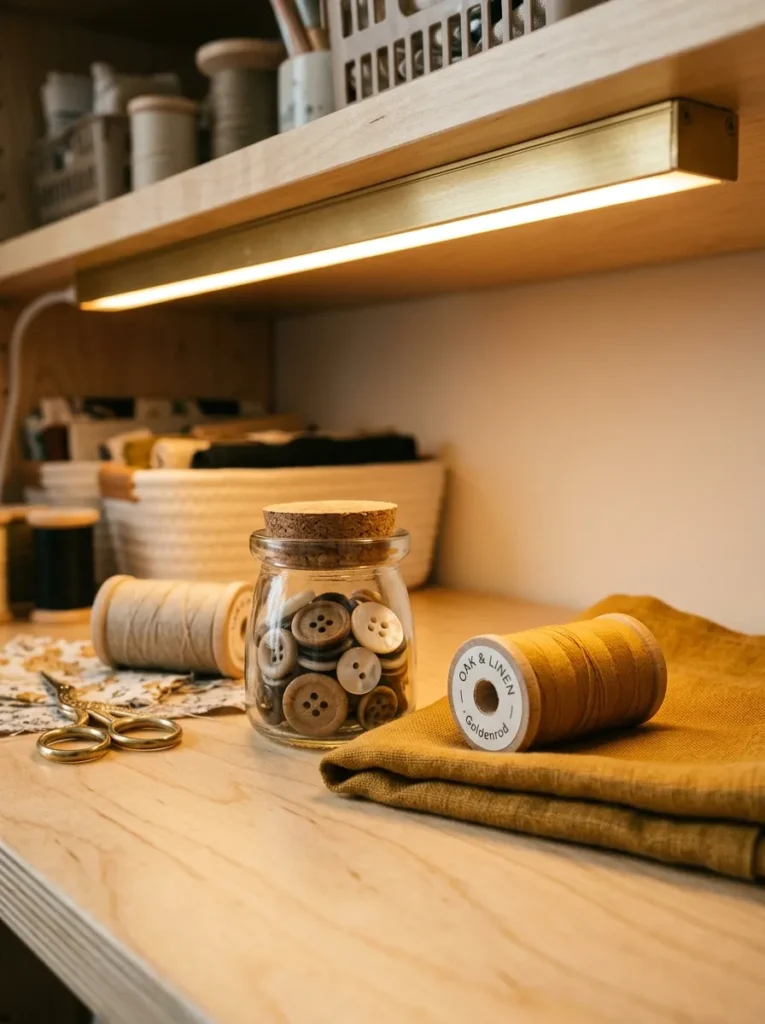
Vibe: The work surface feels warm and inviting, like a proper studio corner instead of an afterthought.
Why it works: A dedicated LED strip under the shelf above the work surface solves the common problem of closets relying only on a single overhead bulb, using targeted task lighting to make detail work like sewing or painting actually possible.
How to get it: Install a battery-operated warm-white LED strip rated near 2700K under the shelf directly above your main work zone, angled to avoid glare on glossy surfaces.
Quick Win: A $18 stick-on LED strip with a built-in dimmer gives instant task lighting with no wiring required.
Shop The Look
- Battery LED strip light warm white
- Dimmer switch attachment
- Small glass jar for buttons
- Birch shelf edge trim
- Brass strip light mounting clips
4. Fold-Down Work Table
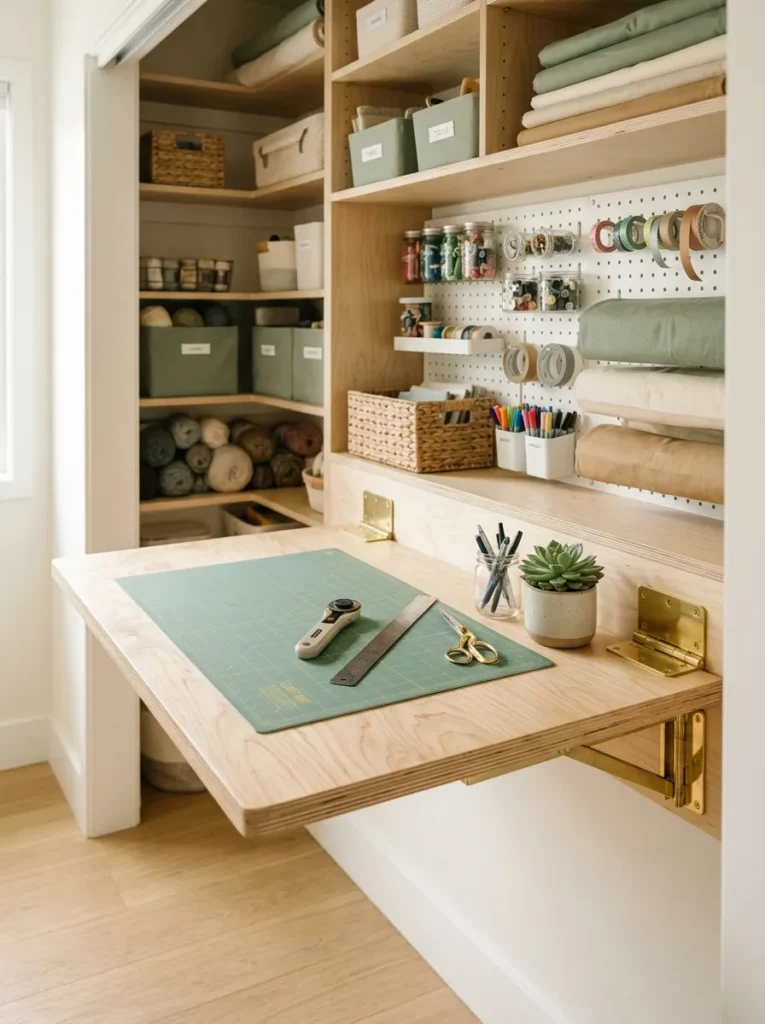
Vibe: The closet feels airy and open, the table appearing only when there’s work to do.
Why it works: A fold-down tabletop uses negative space thinking — the surface exists in the same footprint as the closet itself, folding flush against the wall when not in use, which solves the core furniture challenge of a closet with no floor space to spare.
How to get it: Mount a birch plywood tabletop on a brass folding bracket rated for at least 30 pounds, sized to the closet’s interior width minus two inches for door clearance.
Shop The Look
- Fold-down wall-mounted table bracket
- Birch plywood tabletop panel
- Self-healing cutting mat
- Small potted succulent faux
- Brass folding hinge hardware
5. Glass Jar Wall for Small Notions
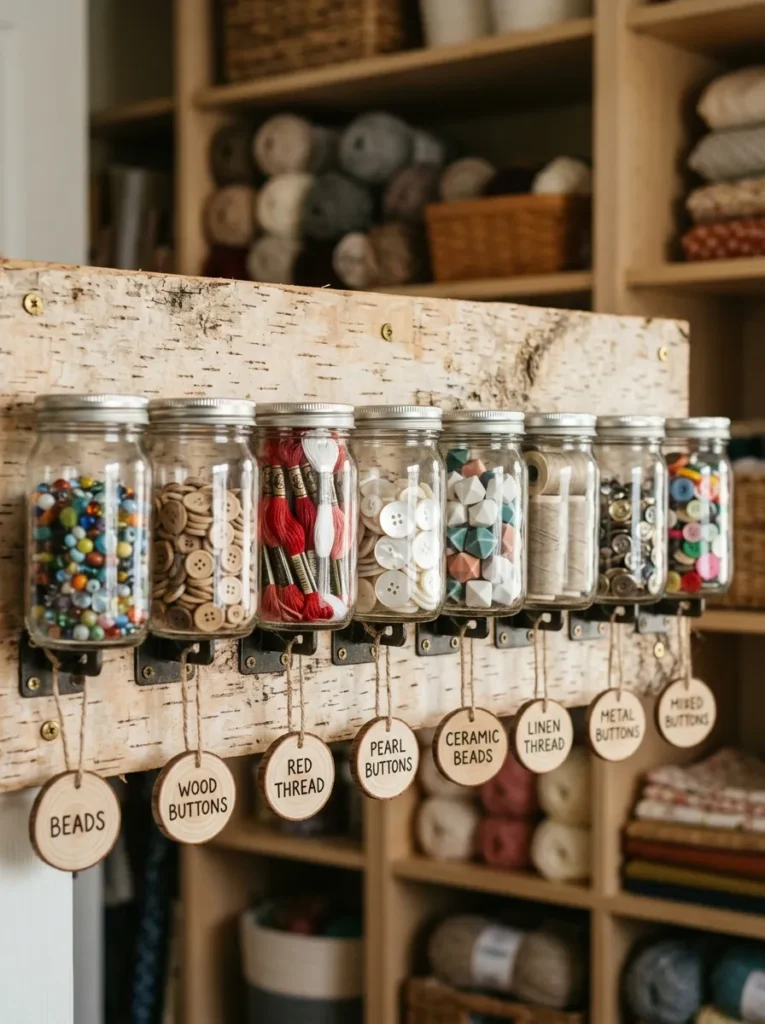
Vibe: The wall feels still and orderly, like a small apothecary of craft notions.
Why it works: Clear glass jars mounted at eye level use transparency as an organizing principle for the smallest supplies — buttons, beads, sequins — items that get lost instantly in a drawer but stay visible and sorted on a wall.
How to get it: Mount uniform glass jars with screw-top lids onto a birch backing board, sorting by supply type rather than project so any jar works across multiple projects.
Shop The Look
- Glass jar with screw-top lid set of 8
- Wood wall-mount jar bracket
- Wood label disc set
- Birch backing board panel
- Small funnel for jar filling
6. Zoned Layout by Craft Type
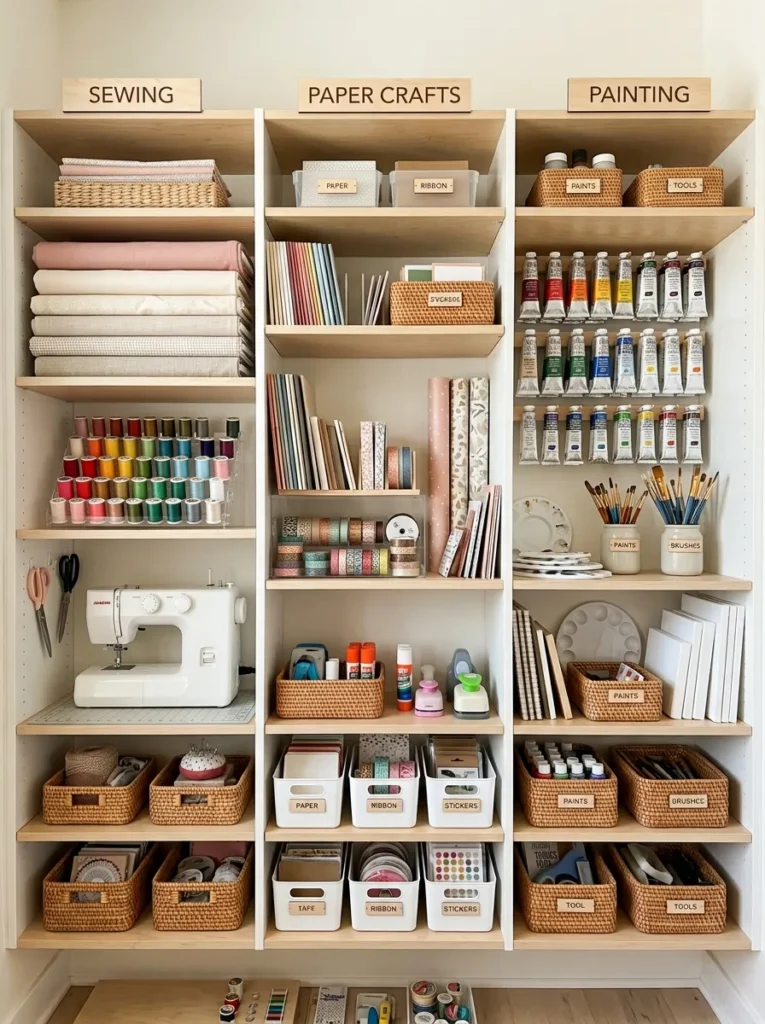
Vibe: The closet feels grounded and clear, each craft type occupying its own defined territory.
Why it works: Dividing the closet into zones by craft type rather than by container size applies a layout principle used in professional studios — supplies used together stay together, which cuts down on cross-closet searching mid-project.
How to get it: Assign the top shelf to paper crafts, the middle to sewing, and the bottom to paint and adhesives, labeling each zone clearly so the system holds even when supplies rotate.
Shop The Look
- Adjustable birch shelving unit
- Zone label plaque set
- Small woven basket per zone
- Sewing supply organizer tray
- Paint and adhesive caddy
7. Sage and Blush Bin System
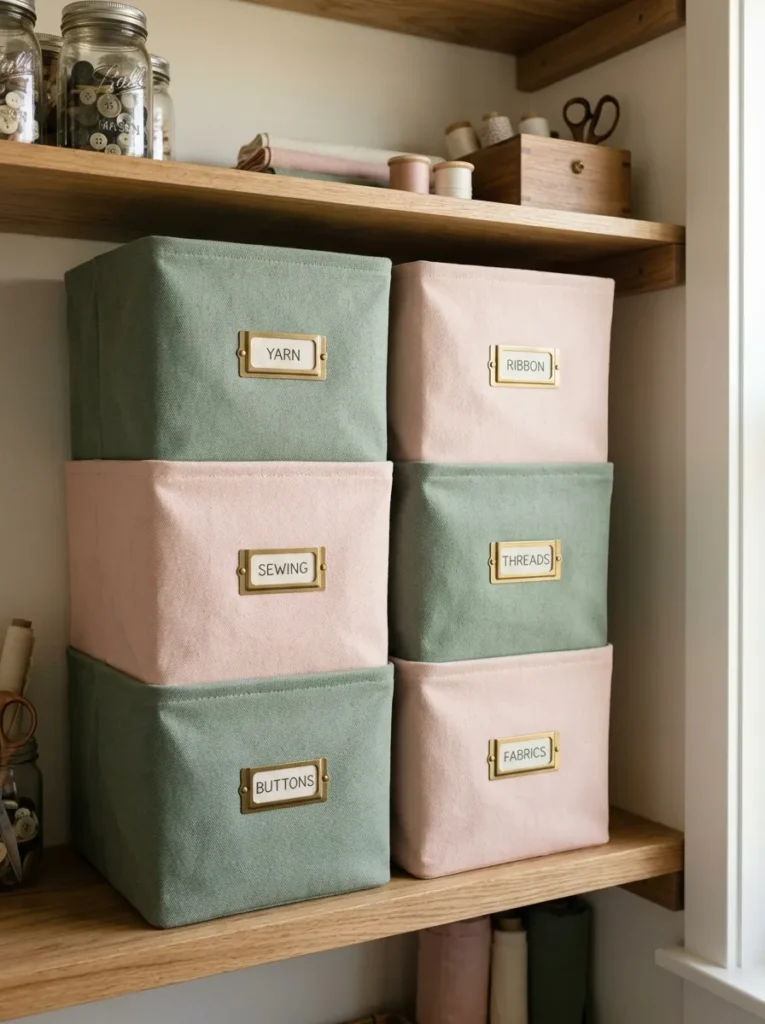
Vibe: The shelf feels serene despite holding dozens of supplies, thanks to a tightly limited palette.
Why it works: Limiting bins to just two accent colors — sage and blush — instead of a rainbow of craft-store bins uses color restraint as a unifying principle, so a shelf of a hundred small items still reads as one cohesive system.
How to get it: Replace mismatched bins with canvas versions in only sage and blush, alternating colors by shelf row so the pattern reads intentional rather than random.
Quick Win: A $22 set of six canvas bins in one accent color instantly unifies an entire shelf.
Shop The Look
- Canvas storage bin sage green set
- Canvas storage bin blush pink set
- Brass label holder clips
- Embroidered fabric label tags
- Stackable bin lid set
8. Cork Board Wall for Works in Progress
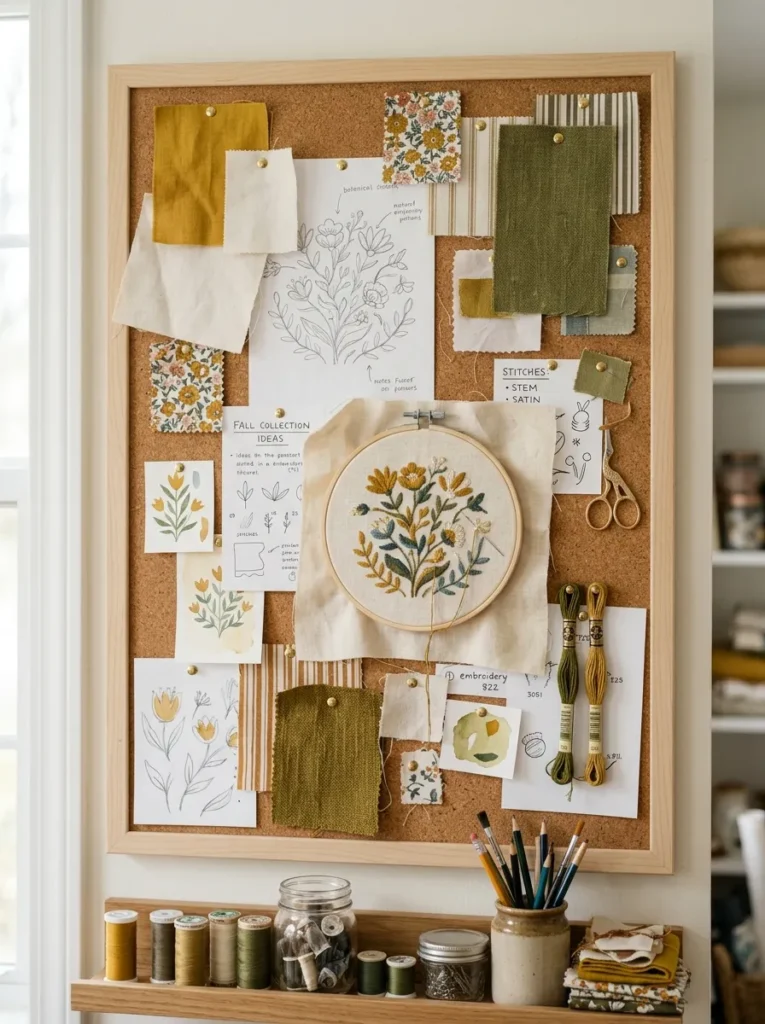
Vibe: The wall feels layered and alive, holding every unfinished idea in progress at once.
Why it works: A cork board uses a material choice specifically suited to works in progress — unlike closed storage, its texture invites pinning and repositioning, keeping active projects visible instead of packed away where they’re easy to forget.
How to get it: Frame a natural cork panel in birch trim and reserve it exclusively for current projects, moving finished pieces off within a week to keep the board from becoming permanent clutter.
Shop The Look
- Natural cork board panel with birch frame
- Brass push pin set
- Fabric swatch clip set
- Small embroidery hoop display hook
- Sketch paper clip strip
9. Under-Shelf Puck Lighting for Bin Labels
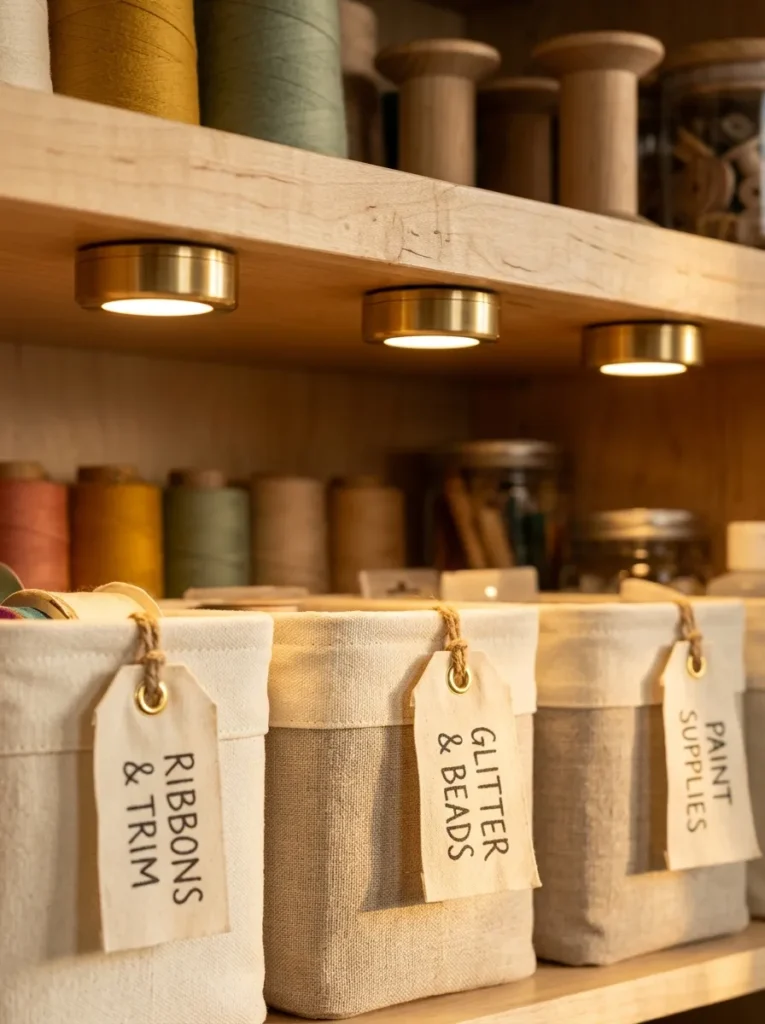
Vibe: The bins feel warm and legible, every label readable without pulling anything out.
Why it works: Small puck lights placed at label height rather than general ceiling height solve a specific lighting behavior problem — closets are often dim exactly where labels need to be read, and targeted light fixes that without brightening the whole room.
How to get it: Stick battery puck lights along the underside of each shelf edge, spacing them every 12 inches so every bin label sits directly under its own light source.
Shop The Look
- Battery puck light set warm white
- Adhesive light mounting strips
- Fabric label tag set
- Birch shelf edge trim
- Remote dimmer for puck lights
10. Rolling Cart for Mobile Craft Supplies
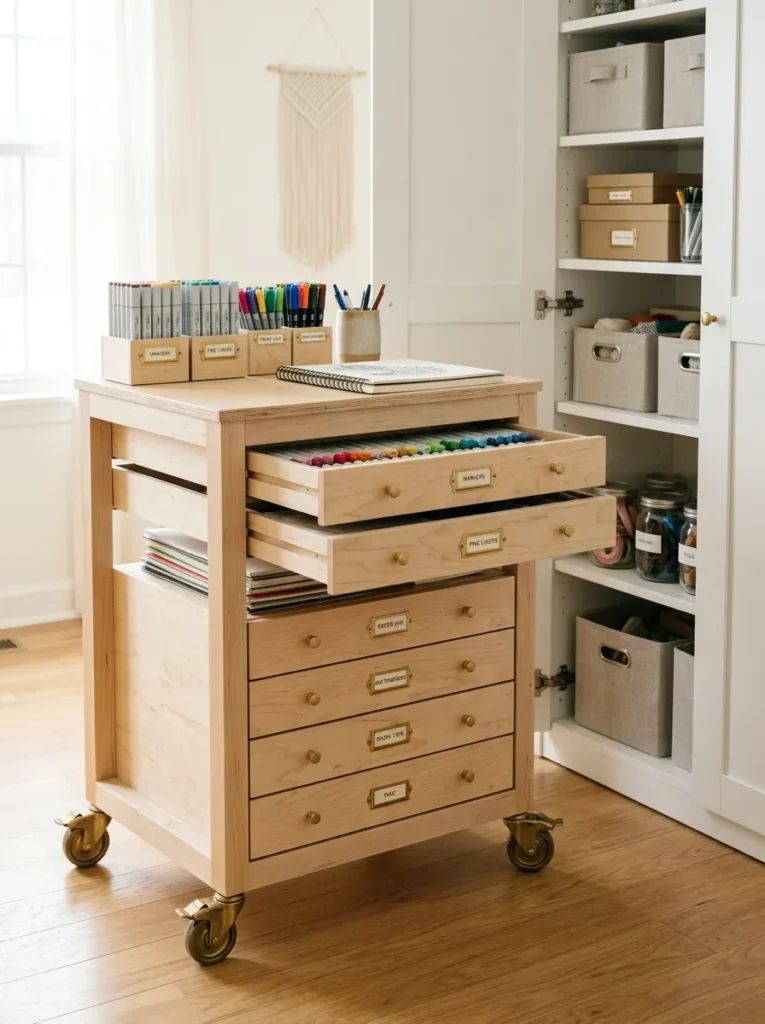
Vibe: The cart feels airy and mobile, ready to roll to the kitchen table or back into the closet.
Why it works: A rolling cart applies furniture flexibility as a principle — instead of a fixed cabinet, supplies can travel to wherever the work happens, then dock back into the closet footprint when finished, doubling as both storage and workstation support.
How to get it: Choose a cart with birch drawer fronts and locking brass casters, sizing it to fit the closet’s interior width so it slides in flush when not in use.
Shop The Look
- Rolling storage cart birch drawers
- Locking brass caster wheels
- Drawer label tag set
- Marker and pencil organizer tray
- Small handle pulls brass
11. Vertical Door-Back Storage for Tight Closets
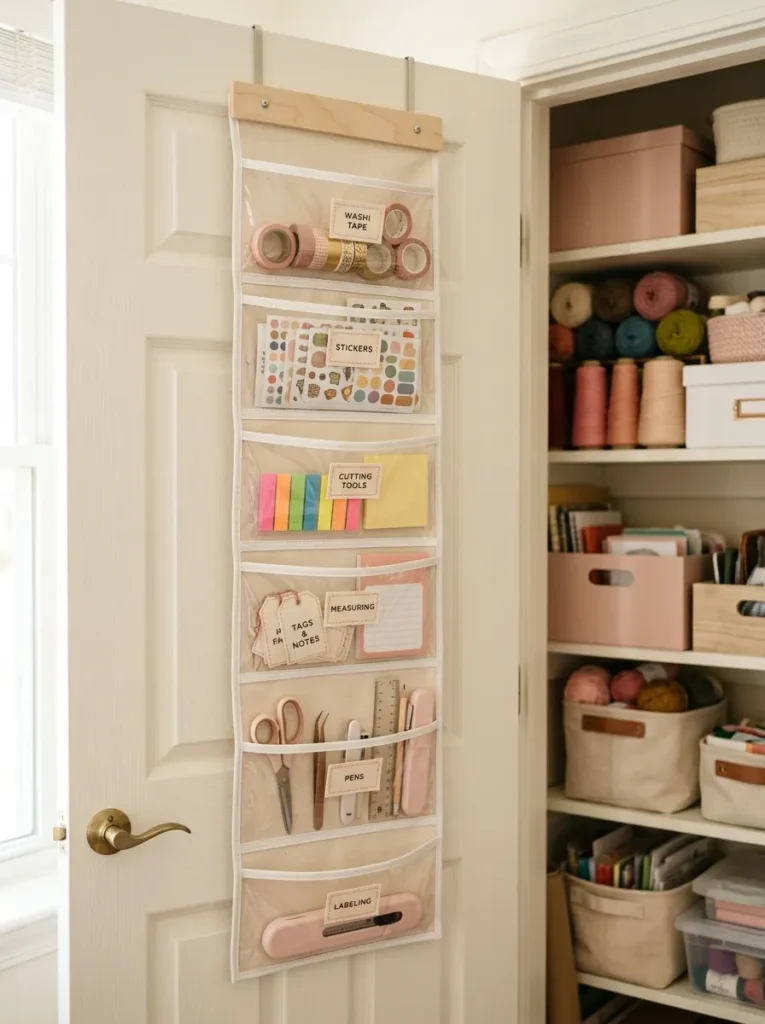
Vibe: The door feels productive instead of wasted, an entire extra wall of storage appearing out of nowhere.
Why it works: An over-the-door pocket organizer is a small-space adaptation that claims territory most closets waste entirely — the back of the door — solving the real limitation of tight craft closets without touching the interior footprint at all.
How to get it: Hang a clear-pocket organizer with a birch top rail over the door, reserving the top rows for flat items like stencils and the lower rows for bulkier tools.
Quick Win: A $16 clear pocket organizer instantly adds a dozen small storage slots with zero installation.
Shop The Look
- Over-the-door clear pocket organizer
- Birch top rail mounting hook
- Fabric label tag set
- Stencil flat storage sleeve
- Small tool pocket insert
How to Start Your Modern Eclectic Craft Closet Transformation
The single best first move is installing a birch pegboard on the closet’s back wall. It anchors nearly every other idea on this list — tools, small bins, and hanging pouches all attach directly to it, giving the whole closet a customizable backbone before you buy a single additional piece.
The most common mistake is buying bins before sorting supplies by type, which leads to mismatched containers holding a little of everything and nothing findable. Fix it by sorting every supply into rough categories first — paper, fabric, paint, notions — then choosing bin sizes to match each category’s actual volume.
Three items under $50 that make an immediate difference: a $12 acrylic drawer divider set, a $16 over-the-door clear pocket organizer, and a single glass jar with a screw-top lid for loose notions.
A full transformation realistically takes two to three weekends for a pegboard, lighting, and bin system, or a single afternoon if you’re just adding door-back storage and color-coded bins. Budget $120–$250 for a starter version, or $500–$900 for a full built-out closet with a fold-down table and rolling cart.
Frequently Asked Questions About Modern Eclectic Craft Closets
What’s the difference between craft closet organization and general closet organization?
Craft closet systems prioritize visibility and rotation — supplies like fabric, paint, and small notions need to be seen and swapped project to project, unlike clothing storage which favors folded, hidden order. Open pegboards, cork boards, and glass jars appear far more often in craft closets for exactly this reason.
What colors work best for a craft closet?
Keep the base neutral in warm white or birch tan, then use one or two accent colors like sage green or blush pink across bins and labels. Limiting accents to two colors keeps a closet full of colorful supplies from feeling chaotic.
How much does it cost to organize a craft closet?
A basic setup with canvas bins and label tags runs about $100–$150. Adding a pegboard wall, task lighting, and a rolling cart typically brings the total to $400–$700, while a full built-in system with a fold-down table can reach $900 or more.
Does this system work in a very small closet?
Yes — start with the over-the-door pocket organizer and a fold-down table, since both add storage or work surface without using any floor space. A closet as narrow as 24 inches deep can still support a full pegboard wall.
What’s the most important element to set up first?
The pegboard wall matters most, since nearly every tool, bin, and pouch on this list hangs from it. Installing it first gives you a flexible base you can rearrange as your craft interests shift, rather than committing to fixed shelving too early.
Ready to Create Your Dream Modern Eclectic Craft Closet?
These 11 ideas cover everything from color-blocked drawers and warm task lighting to fold-down tables and door-back pockets, so there’s a starting point whether you have a full walk-in or a single narrow door. Getting organized here doesn’t need to happen all at once — hanging one pegboard this weekend is a complete win on its own. Today, sort your loose notions into rough categories and pick the one bin or jar system from this list sized to match what you actually own. Once it’s done, you’ll open the door and feel ready to start a project instead of digging for supplies first. Pin your favorite pegboard or cork board idea now, before your next trip to the craft store adds three more things without a home.