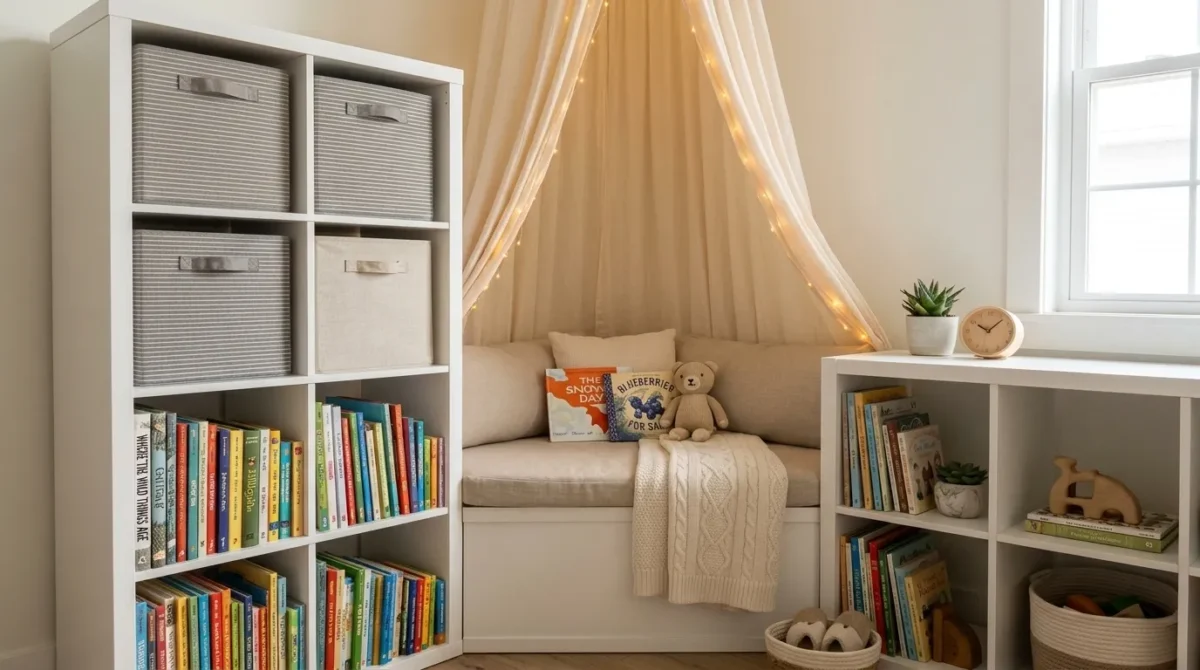
KALLAX toy storage ideas for playrooms use IKEA’s iconic cube shelving system as the organizing backbone of a child’s play space — combining the unit’s modular grid with bins, baskets, custom labels, inserts, and styling decisions that create a space where every toy has a home, cleanup is fast, and the room reads as designed rather than merely contained. This article gives you exactly 12 ideas spanning bin systems, built-in configurations, reading corners, activity zones, label systems, and small-space adaptations so every playroom size and every child’s age finds a KALLAX Toy approach that genuinely works.
A KALLAX Toy playroom done well does something a toy box never does — it makes the organizational system visible and learnable for the child. Every category of toy has a specific location, marked and sized so that a three-year-old can find the Lego, return the Lego, and know immediately if the Lego is missing. The room resets in minutes rather than hours. The floor stays clear. And the system grows with the child rather than being outgrown with the toys. Here are 12 ideas worth saving — and building.
Why Smart KALLAX Toy Storage Ideas Work So Well for Playrooms
The KALLAX Toy shelving unit was designed as a modular display and storage system — its 33×33 cm interior cubby dimension is a carefully calculated measurement that accepts IKEA’s own range of inserts (fabric bins, drawer inserts, door inserts) while remaining compatible with a wide range of third-party baskets, boxes, and organizational accessories. For playroom toy storage specifically, this dimensional standardization is the system’s most significant practical advantage: a single KALLAX Toy unit and its accessories create a storage system whose physical organization directly mirrors its logical organization — each cubby a category, each bin a container for that category, each label a signpost that a pre-reading child can follow through color and picture rather than text.
The materials that make KALLAX the most versatile playroom storage platform include the unit itself (available in white, black-brown, and wood effects in 1×2, 1×4, 2×2, 2×4, and 4×4 configurations), fabric cube bins in a range of coordinating colors (IKEA’s own DRÖNA bins, or third-party linen, felt, and cotton cube alternatives in 33×33 cm format), woven seagrass and rattan baskets (for warmer aesthetic profiles that suit playrooms designed to read as domestic rather than institutional), wooden drawer inserts (for small-part categories like crayons, puzzles, and construction pieces that disappear into fabric bins), and custom label systems (chalkboard labels, printed picture-plus-word cards, or hand-lettered tags that communicate the bin’s contents to children at different developmental stages).
The KALLAX’s playroom application has dominated the IKEA hacking and family living communities on Pinterest, Instagram, and YouTube since approximately 2015, with the specific format of KALLAX toy storage generating tens of millions of annual views across platforms. The practical driver of this engagement is significant: families with children consistently report that the KALLAX Toy-based system reduces daily cleanup time from 20–40 minutes to 5–10 minutes when correctly set up and maintained — a measurable quality-of-life improvement that explains the category’s sustained engagement regardless of design trend cycles.
Small playrooms — converted spare rooms, playroom corners in open-plan living spaces, and shared bedroom-playroom configurations — benefit particularly from KALLAX Toy because the system’s modular format allows configurations from a single 1×4 unit in a tight corner to a full four-unit wall in a dedicated room. The honest constraint for very small playrooms (under 80 square feet): a single KALLAX 2×4 unit provides sufficient storage for most toy collections of children under seven, and additional KALLAX units beyond this in a small room consume floor space that the child needs for active play. In small playrooms, the design priority is maximizing the storage density of the first KALLAX unit before adding additional units.
Style at a Glance
| Element | Functional Core | Design Edge |
|---|---|---|
| Philosophy | Every toy has a home | The system teaches organization |
| Materials | KALLAX unit, fabric bins, labels | Rattan basket, linen bin, custom signage |
| Color Palette | Warm white, oat, sage | Muted primary accent, natural rattan |
1. Color-Coded Bin System by Toy Category Across a 2×4 KALLAX Toy
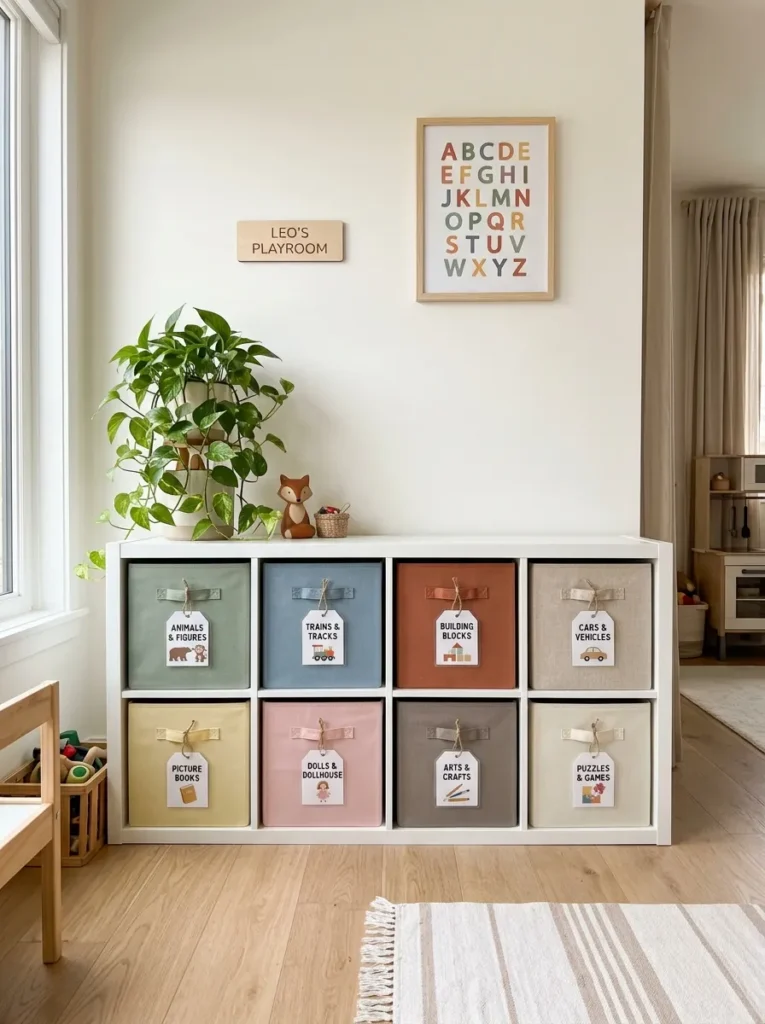
Vibe: The unit reads as organized and calm — a system that a child can learn and operate independently.
Why it works: KALLAX Toy color-coded bin system applies the cognitive development principle of pre-attentive color processing — the brain identifies color before it reads text, which means a child who cannot yet read can navigate an eight-bin system reliably if each category is consistently associated with a specific color. The system becomes self-teaching: after a week of assisted tidying where the adult says “the cars go in the blue bin,” the child internalizes the association and can tidy independently. Muted, sophisticated colors (sage, dusty blue, terracotta) rather than primary colors (red, yellow, blue) keep the system legible while maintaining the visual calm that makes the playroom function as a domestic room rather than a primary-color visual environment.
How to get it: Select eight fabric cube bins in distinct but muted tones — IKEA’s DRÖNA bins in their available colors cover most of this range; third-party linen or felt cube bins from Amazon or Etsy expand the palette. Assign one color per toy category with the child’s input where age-appropriate — involving children in the initial categorization significantly improves their subsequent engagement with the return process. Create label cards by printing a picture of the toy category (a photograph or simple illustration) alongside the category word on cardstock, laminate with a standard laminator ($25–35), and attach through a punched hole with a short length of ribbon to the bin handle.
Quick Win: Eight IKEA DRÖNA bins in coordinating colors ($6.99 each, total $55.92) fill a complete 2×4 KALLAX Toy and provide an immediate visible organizational system — the highest toy storage impact achievable for under $60.
Shop The Look
| Product |
|---|
| Fabric cube storage bin set DRÖNA KALLAX Toy size |
| Laminator machine small office home |
| Cardstock picture label set toy categories |
| Ribbon set narrow natural craft |
| Trailing pothos plant top shelf display |
Also view: 11 IKEA NORDLI DIY Hacks for Modern Homes
2. KALLAX Toy as a Room Divider Between Play and Living Zones
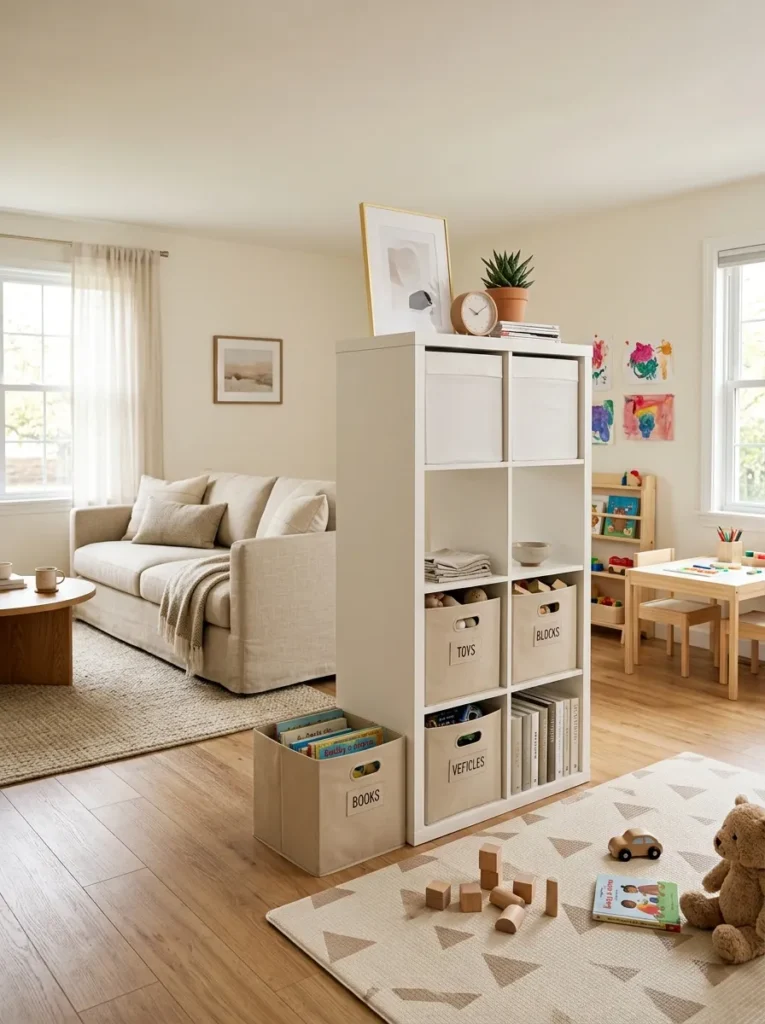
Vibe: The room division feels implied rather than imposed — the play zone and living zone separated without walls or visual heaviness.
Why it works: A KALLAX Toy unit positioned perpendicular to the wall as a room divider applies the spatial design principle of implied boundary — a division that separates two zones without blocking sightlines, light transmission, or parental supervision of the play area from the adult zone. The KALLAX 2×4 in this configuration sits at 77cm height — low enough to maintain the open visual quality of an undivided room while clearly delineating the play zone from the adult living space. The two faces of the divider can be independently styled — the face toward the living room presents a curated display aesthetic (plants, neutral objects, books spine-up), while the face toward the play zone presents the labeled bin storage system.
How to get it: Secure the KALLAX Toy unit to the wall at one end using the included anti-tip hardware — a unit positioned perpendicular to the wall has reduced lateral stability compared to a wall-mounted configuration, and the anti-tip attachment to the wall at the unit’s back end is non-negotiable for safety. Position the unit to create a playroom zone of adequate size for the child’s primary play activities — a minimum of 6×6 feet on the play side is appropriate for most ages. Style the living-room-facing side with no more than three objects on each shelf (a plant, a book, a small decorative object) to maintain visual calm from the adult zone.
Shop The Look
| Product |
|---|
| Anti-tip furniture strap anchor safety set |
| Small potted plant set display shelf |
| Simple play mat oat natural cotton |
| Framed simple print neutral living room |
| Rattan display tray top of unit |
Also view: 22 Easter Porch Decorating Ideas for a Cheerful Entry
3. Chalkboard Label System for Rotating Toy Categories
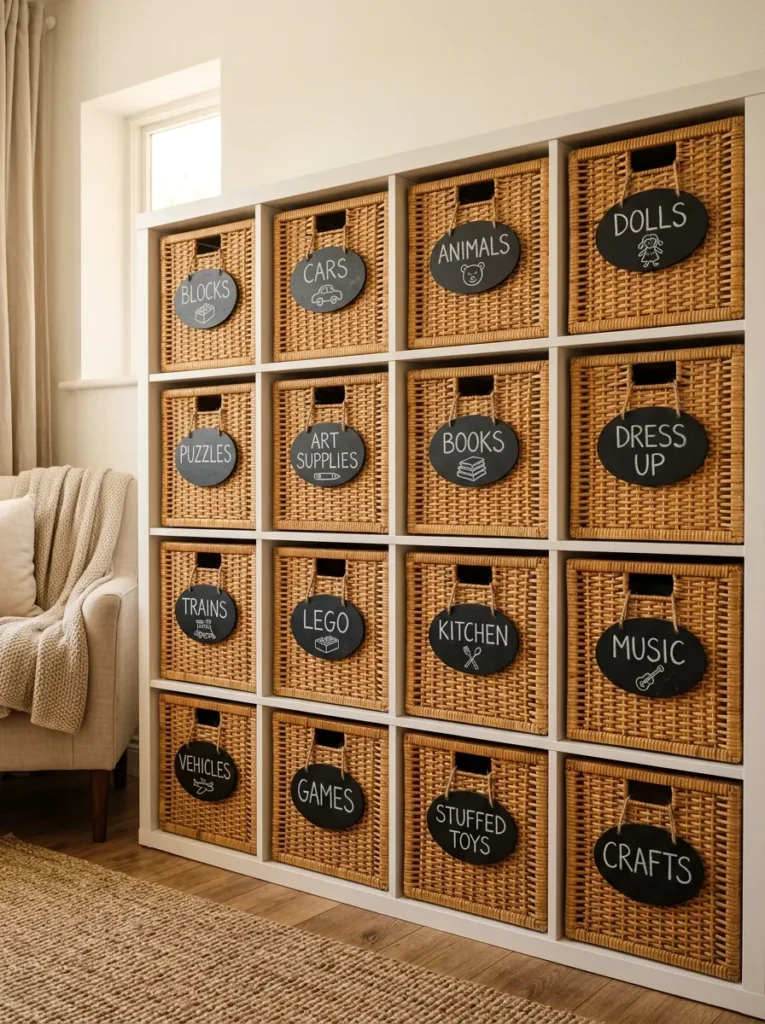
Vibe: The label system feels alive and changeable — a system that grows with the child’s evolving toy collection without requiring new labels.
Why it works: KALLAX Toy Chalkboard labels on wicker baskets apply the organizational design principle of adaptive categorization — children’s toy collections change significantly every 6–12 months as developmental stages shift interests, and a label system that cannot be updated requires complete replacement when a category becomes obsolete. Chalkboard labels are erasable and re-writable, making them the only label format that grows with the collection rather than becoming outdated. Wicker baskets provide a warm material complement to the white KALLAX Toy unit — the honey tone of natural rattan reads as domestic and organic against the white grid, preventing the playroom from reading as an institutional storage system.
How to get it: Purchase oval chalkboard self-adhesive labels (available in packs of 24–50 from stationery and craft suppliers) and attach one to the front of each basket or bin. Use a white chalk marker (rather than stick chalk) for writing and drawing — chalk marker produces crisp, rain-resistant lettering that doesn’t smear on contact the way stick chalk does. For pre-reading children, draw a simple sketch of the category object alongside or instead of the word — a simple car outline, a block shape, or a dinosaur silhouette communicates more immediately than text to a child who cannot yet read.
Shop The Look
| Product |
|---|
| Natural wicker storage basket KALLAX size |
| Oval chalkboard self-adhesive label set |
| White chalk marker fine tip set |
| KALLAX compatible basket set natural |
| Small playroom rug neutral pattern |
4. KALLAX Reading Nook Corner with Cushion and Canopy
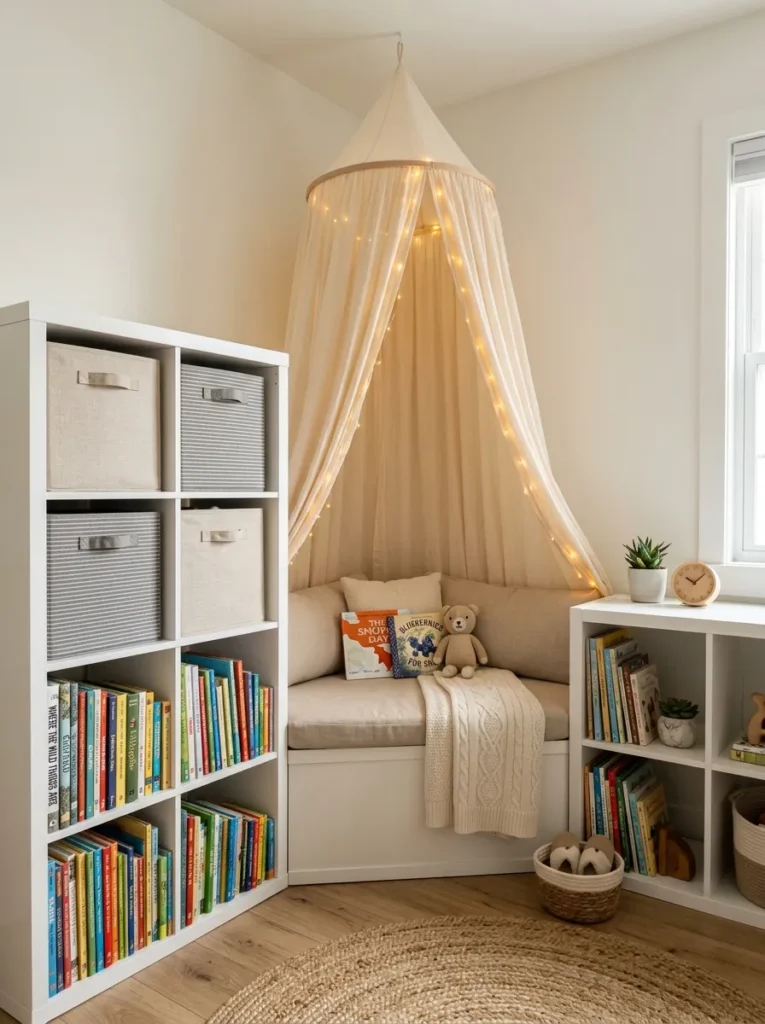
Vibe: The reading nook feels genuinely enchanting — a corner a child actively seeks out rather than one they’re directed toward.
Why it works: A KALLAX Toy reading nook corner applies the child development principle of prepared environment — providing a defined, child-scaled, cozy space specifically for reading creates a distinct behavioral context that encourages voluntary book engagement. The L-shape configuration of two KALLAX Toy units creates three-sided enclosure (two unit sides and the room’s corner wall behind) that produces the sheltered, den-like quality that children consistently prefer for focused activities. The cushion seat at KALLAX-top height (77cm) is accessible without adult assistance for children from approximately three years old — the ability to independently access the reading space is critical to the nook’s success as a self-directed literacy environment.
How to get it: Position two KALLAX Toy units at a 90-degree angle in a room corner, each unit’s end flush against the corner wall. Cut a fitted cushion from 5cm-thick high-density foam to fill the gap between the two unit tops and the wall corner — typically approximately 40×40 cm. Cover the foam in a washable fabric and secure the cushion to the KALLAX tops using non-slip matting beneath. Hang the fabric canopy from a single ceiling hook directly above the corner, using a lightweight sheer fabric (voile, muslin) gathered on a simple curtain ring.
Shop The Look
| Product |
|---|
| High density foam cushion cut to size |
| Sheer voile fabric canopy nursery natural |
| Battery fairy light set warm white |
| Children’s book set classic illustrated |
| Small knit stuffed animal neutral |
5. KALLAX with Drawer Inserts for Small-Part Toy Organization
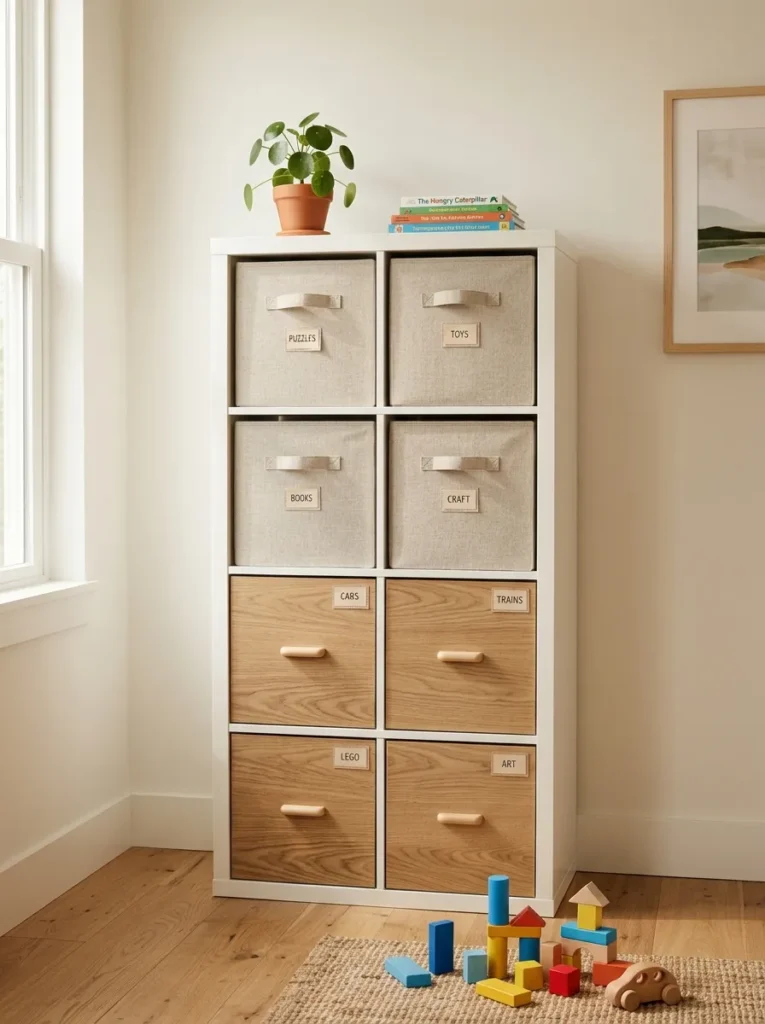
Vibe: The unit feels purposeful at every level — drawers where small parts need containment, bins where larger toys need freedom.
Why it works: KALLAX Toy drawer inserts for small-part toy categories apply the storage design principle of containment specificity — fabric bins are excellent for large, soft, or irregularly shaped toys that can be grabbed and returned in loose handfuls, but they fail for small-part categories (Lego, puzzle pieces, crayons, small figures) because the pieces fall to the bin’s bottom and require excavation to find. A solid-sided drawer with a smooth pull mechanism keeps small parts distributed across the drawer’s floor area in a single layer visible from above, making any piece findable in under three seconds. Placing drawers in the lower rows (accessible to the child without climbing) and bins in the upper rows (requiring adult assistance) creates a practical developmental hierarchy in the storage system.
How to get it: Purchase KALLAX Toy insert drawers ($35–45 each from IKEA) for the categories requiring small-part containment — typically four drawers in a 2×4 KALLAX Toy covers the standard small-part categories (Lego, Duplo, playdough tools, crayons and markers, small figures). Install in the lower two rows for child-accessible operation. Reserve the upper two rows for fabric bins containing large-format toys and frequently accessed play materials. Add a small label to the drawer front using the same label system applied to the bins for visual consistency.
Quick Win: A single KALLAX Toy drawer insert ($35–45) for the Lego category alone — replacing a fabric bin that required full excavation — typically reduces the single most frequent daily “I can’t find it” complaint in families with Lego-aged children by eliminating the search problem entirely.
Shop The Look
| Product |
|---|
| KALLAX insert drawer natural wood set |
| KALLAX size linen fabric bin set upper |
| Label card set toy category printable |
| Building block set natural wood large |
| Small framed simple print playroom wall |
6. KALLAX Horizontal as a Low Activity Surface and Storage Base
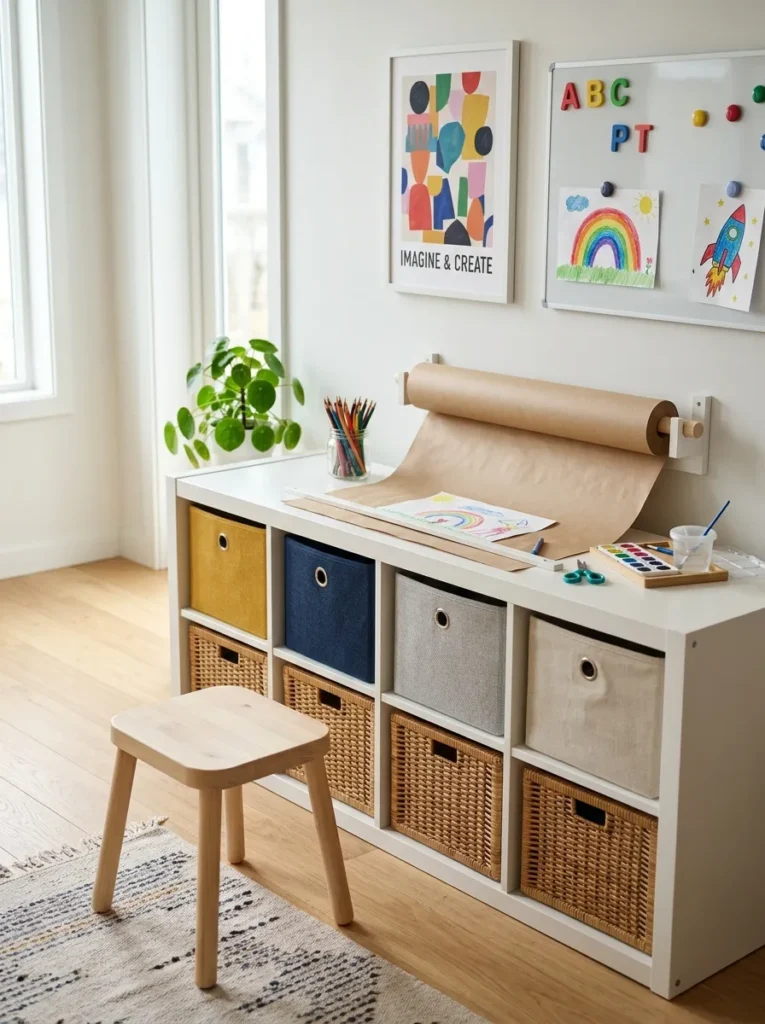
Vibe: The activity surface feels perfectly sized — a workspace that a child can stand at comfortably, reach across fully, and understand intuitively as their creative zone.
Why it works: A horizontal KALLAX Toy 2×4 as a low activity surface applies the design principle of child-scale furniture proportion — standard adult worktops (90cm height) are too tall for children under eight to work comfortably while standing. A horizontal KALLAX sits at 42cm height — the appropriate standing work height for children aged approximately 3–7, allowing comfortable arm reach across the full surface depth without tipping. The horizontal configuration also creates a 147cm-wide activity surface from a single IKEA unit, which is wider than most purpose-built children’s art tables at a comparable price. The side-facing cubbies of the horizontal unit hold art supplies, paper, and craft materials in immediately accessible positions below the work surface.
How to get it: Lay the KALLAX 2×4 on its side (the original top face now pointing sideways, the original front face now pointing up as the activity surface). Secure to the wall using anti-tip hardware — non-negotiable for a horizontal unit that will receive children leaning and pressing on its surface. Mount a paper roll holder (a simple wooden dowel in two cup hooks) to the wall just behind the unit’s back edge, so the craft paper can be pulled forward over the activity surface and torn off after each session. Install a magnetic board (a magnetic paint section or a sheet metal panel) on the wall above the unit for displaying artwork and holding magnetic letters and numbers.
Shop The Look
| Product |
|---|
| Craft paper roll natural children |
| Paper roll holder wall mount wooden |
| Magnetic board wall mounted playroom |
| Natural wood children’s stool adjustable |
| Glass pencil jar small desk organizer |
7. KALLAX Toy Library Rotation System with Weekly Bins
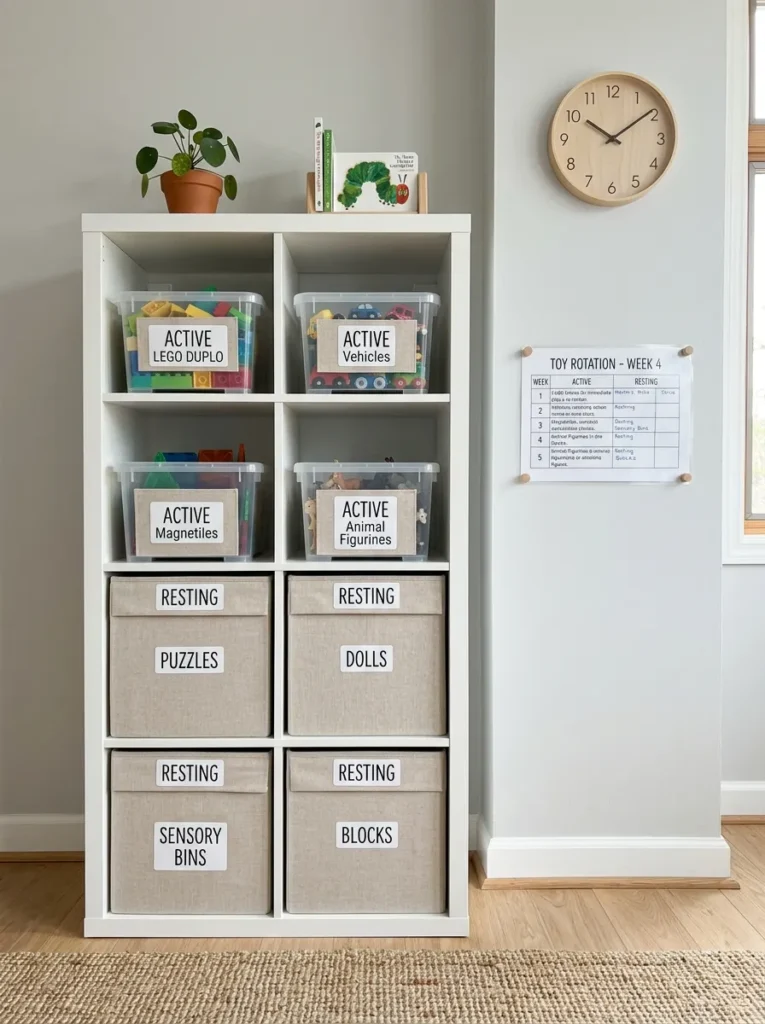
Vibe: The system feels intelligently managed — the room never accumulates the exhausted overwhelm of too many toys available simultaneously.
Why it works: KALLAX Toy rotation system using the KALLAX Toy as a physical library applies the behavioral science principle of scarcity-induced engagement — children play more deeply, more creatively, and for longer sustained periods with a smaller selection of toys than they do when all toys are simultaneously available. The research basis is robust: studies in child development consistently show that toy abundance reduces play quality because the availability of choice creates decision fatigue rather than sustained engagement, and the novelty effect of a “new” toy (which in a rotation system is simply a returning toy not seen for two weeks) reliably increases engagement time. The KALLAX makes this system physically visible — the active bins are open and accessible, the resting bins are clearly distinguished by folded tops or a different bin color, and the child can see the system operating without explanation.
How to get it: Divide all toys into four equal groups (four active, four resting in a 2×4 KALLAX). Each Monday, rotate one active bin to resting status and bring one resting bin to active status — a 25% rotation rather than a full swap maintains continuity while introducing novelty. Create the weekly rotation chart as a simple printed calendar page with the current rotation noted, laminate, and pin beside the unit. The child can participate in choosing which resting bin comes out, building anticipation and agency into the system.
Shop The Look
| Product |
|---|
| Linen fabric bin set KALLAX closed top |
| Laminator pouches A4 home office |
| Simple printed rotation chart printable |
| Small wall clock playroom simple |
| Toy category rotation planning set |
8. Two-Tone KALLAX Paint Hack — White Unit with Colored Cubby Interiors
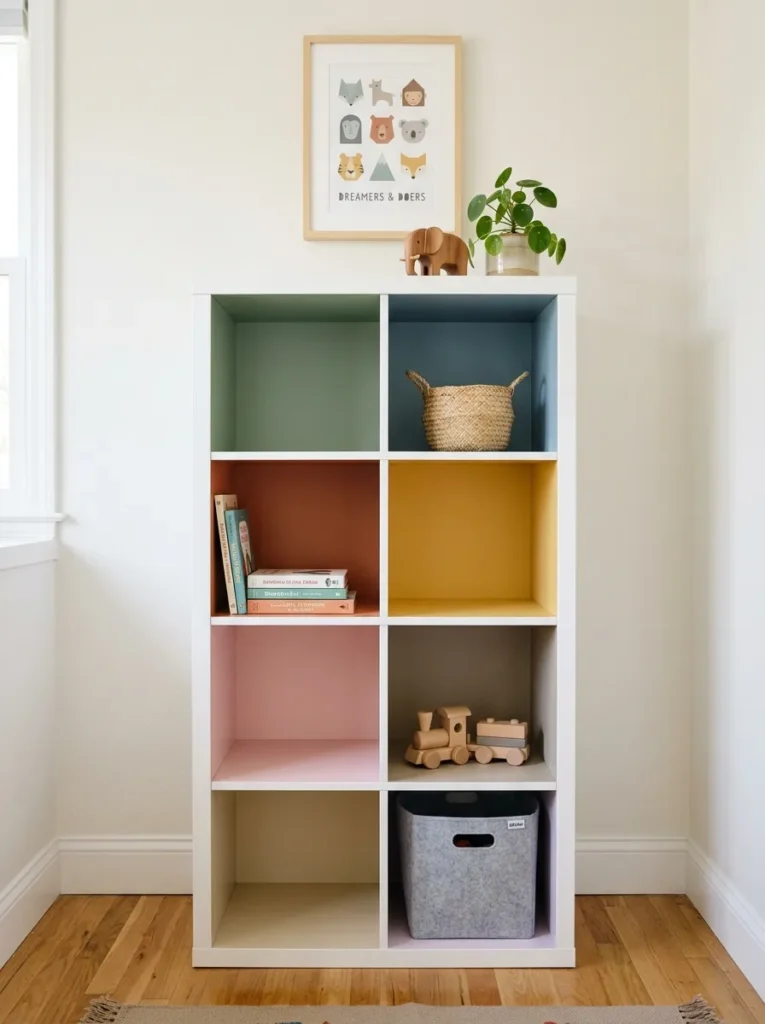
Vibe: The painted unit feels playful and custom — a KALLAX that looks like it was made for this specific room rather than collected from a flat-pack.
Why it works: Painting KALLAX Toy cubby interiors in distinct muted tones applies the design principle of color as organizational signal at the furniture scale — each color-coded cubby interior becomes a visual marker for the category stored in that location, reinforcing the color-coded bin system (Idea 1) or functioning independently as a location signal when bins are not in place. The two-tone approach (white exterior preserved, only the recessed interior painted) creates a more sophisticated visual effect than painting the full unit — the white grid structure becomes the organizing framework while the colored interiors create depth and visual interest within each opening. From across the room, the effect reads as a designed installation rather than a painted flat-pack unit.
How to get it: KALLAX Toy Apply a small amount of white primer to the cubby interior back wall and side walls using a 2-inch brush (the interior of a 33×33 cm KALLAX cubby is accessible with a small brush without removing any components). Apply two coats of matte emulsion paint in the selected color per cubby, allowing full drying between coats. Use sample pots ($4–6 each) rather than full tins — a 40ml sample pot covers the interior of two KALLAX cubbies. Total paint cost for a 2×4 KALLAX in eight different colors: approximately $35–50 using sample pots.
Shop The Look
| Product |
|---|
| Paint sample pot set muted tones 8 colors |
| Small paintbrush set 2 inch interior |
| White primer spray can IKEA furniture |
| Wooden simple toy natural playroom |
| Children’s framed print colorful simple |
9. KALLAX Wall-to-Wall Configuration with Cornice for Built-In Appearance
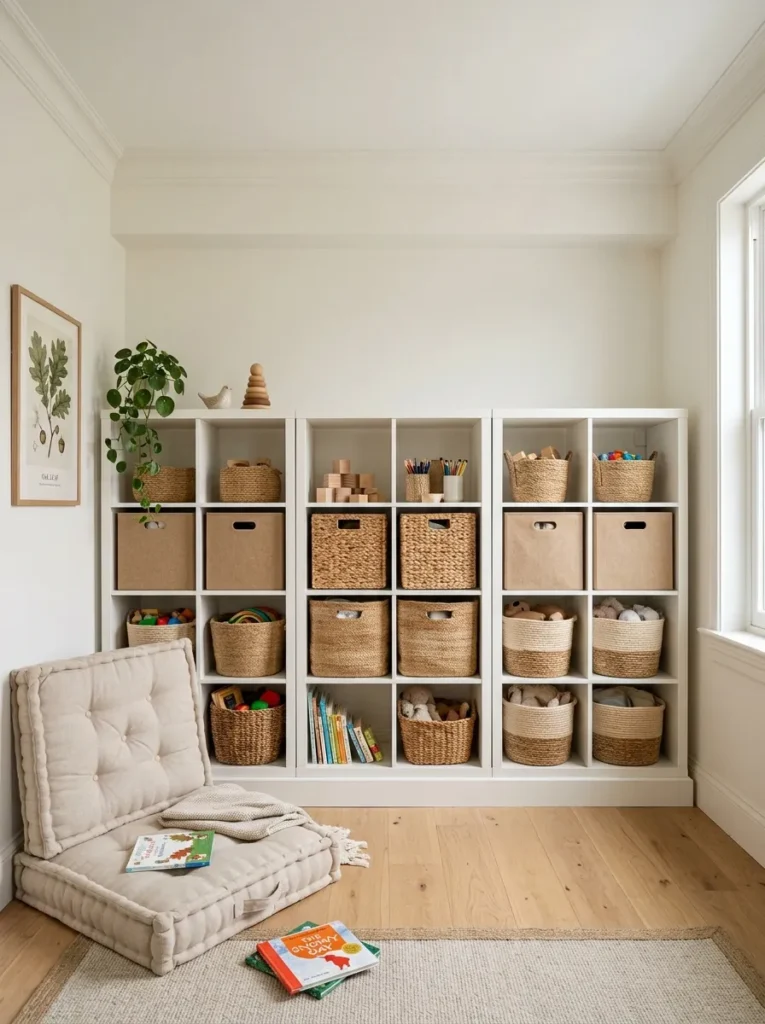
Vibe: The storage wall feels built into the room — the furniture and the architecture have become the same thing.
Why it works: A wall-to-wall KALLAX Toy configuration with a continuous cornice and base plinth applies the architectural principle of built-in furniture — when storage furniture spans the full width of a wall and is connected to the ceiling by a cornice and to the floor by a plinth, the individual furniture pieces dissolve into a single architectural surface. This is the visual mechanism that makes bespoke fitted playroom storage command a premium — the identical result is achievable with KALLAX units and approximately $60 of MDF and paint. For a playroom specifically, the built-in appearance creates the sense that the organizational system is permanent and serious — it is part of the room, not a portable storage solution, which contributes to children’s respect for and engagement with the system.
How to get it: Position three KALLAX Toy 2×2 units side by side against the wall, shimmed level if the floor is uneven. Fill all unit-to-unit joints with white caulk pressed flush to the front face. Cut a cornice panel from 18mm MDF to fill the ceiling-to-unit-top gap at the same depth as the KALLAX unit (approximately 39cm depth) and paint in the same white as the units. Build a base plinth from 2×4 timber painted white, running continuously beneath all three units. Caulk all transitions (cornice to ceiling, plinth to floor) for a seamless finish.
Shop The Look
| Product |
|---|
| MDF cornice panel 18mm sheet cut |
| White paintable caulk smooth playroom |
| White furniture paint eggshell playroom |
| Floor cushion round oat playroom reading |
| 2×4 timber base plinth painted white |
10. KALLAX Toy Art Gallery Display Above Storage Units
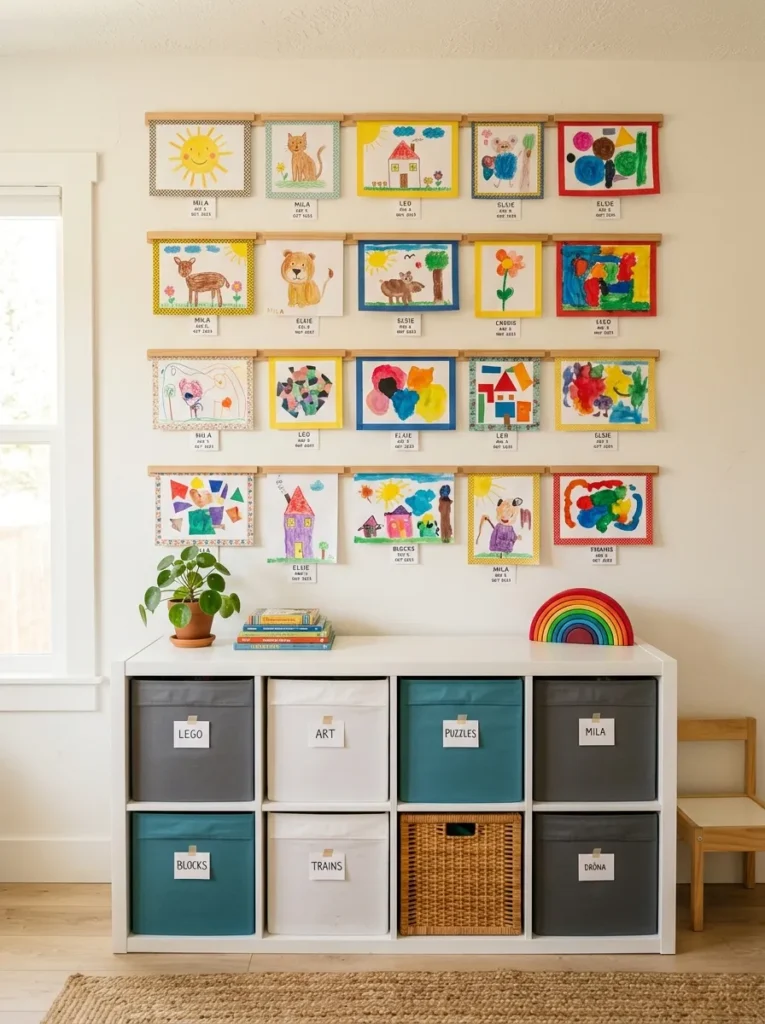
Vibe: The wall above the KALLAX Toy feels alive and personal — the children’s work given gallery status above the organized system that holds their supplies.
Why it works: An organized art gallery display above the KALLAX storage unit applies the child development principle of environmental documentation — displaying children’s artwork in an organized, permanent manner communicates that the work is valued and worth preserving, which consistently increases children’s self-concept as creative people and their motivation to continue making. The wall above the KALLAX (typically 30–60 cm of wall space between the unit top and the picture rail or cornice) is the most frequently underused vertical zone in a playroom — placing the gallery in this zone activates the space while connecting the creative display to the creative supply storage below it. A washi tape border system (straight-edged tape borders creating “frames” directly on the wall) is the most budget-accessible gallery format, requiring no frames and no permanent wall modification.
How to get it: Apply washi tape borders at consistent sizes (approximately 20×25 cm for most children’s artwork) in a regular grid on the wall above the KALLAX. Use a low-tack washi tape (remove and reapply the tape for each artwork rotation without damaging the wall paint). Attach artwork inside the washi frame using small pieces of removable putty adhesive or photo corners. Add a small label below each frame (the child’s name and the date) using a label printer or a handwritten card. Rotate the gallery monthly to maintain novelty and allow all artwork to receive display status over time.
Shop The Look
| Product |
|---|
| Washi tape set neutral artwork gallery |
| Removable putty adhesive display |
| Label printer small home office |
| Photo corner self-adhesive set |
| Picture rail magnetic display strip |
11. KALLAX Toy with Fabric Curtain Inserts for Hidden Toy Storage
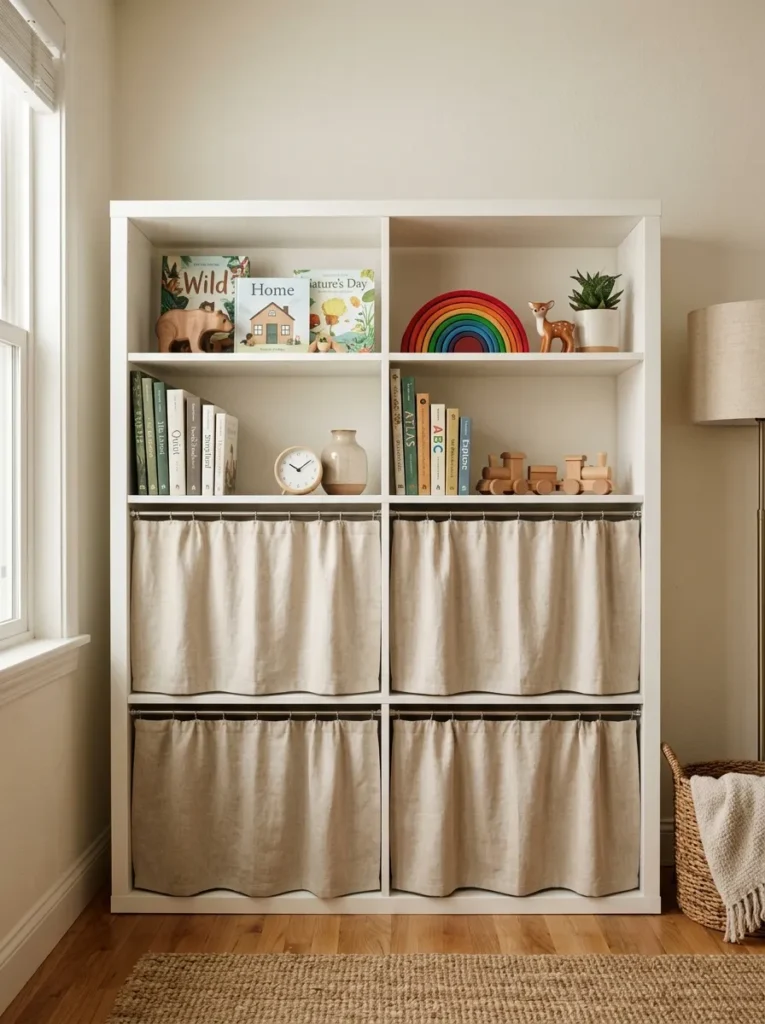
Vibe: The unit reads as calmer than its contents — the curtains hiding the daily reality of toy storage behind a warm, still material.
Why it works: KALLAX Toy Fabric curtain inserts on the lower KALLAX cubbies apply the design principle of strategic concealment — not all toy storage needs to be visible, and the lower cubbies (which hold the highest-volume, most chaotic toy categories) benefit from concealment that the upper cubbies (which can be styled as display) do not. The curtain format uses a 15×15 cm mini tension rod inside each cubby — this requires no drilling, no permanent modification, and can be adjusted or removed in under a minute. Oat linen is the optimal curtain material for this application because its weight drapes cleanly across the cubby opening (preventing the bunching that lighter fabrics produce) while its warm neutral tone coordinates with virtually any KALLAX styling direction.
How to get it: Source mini tension rods (12–13 inch, designed for small windows or cabinet interiors) sized to fit the KALLAX cubby width (33cm interior). Cut oat linen fabric to 34cm wide and 40cm tall per curtain panel — slightly wider and taller than the cubby opening for a gathered effect. Hem all four edges with iron-on hem tape (no sewing required) and create a rod pocket at the top by folding 4cm of fabric over and hemming. Thread the tension rod through the pocket and install inside the cubby — the tension rod holds the curtain without screws or fixings.
Shop The Look
| Product |
|---|
| Mini tension rod 12-13 inch set |
| Oat linen fabric yard curtain natural |
| Iron-on hem tape no-sew craft |
| Face-out book display KALLAX picture ledge |
| Small wooden toy set natural play |
12. Small Playroom KALLAX Hack — Single 2×2 Unit Maximized
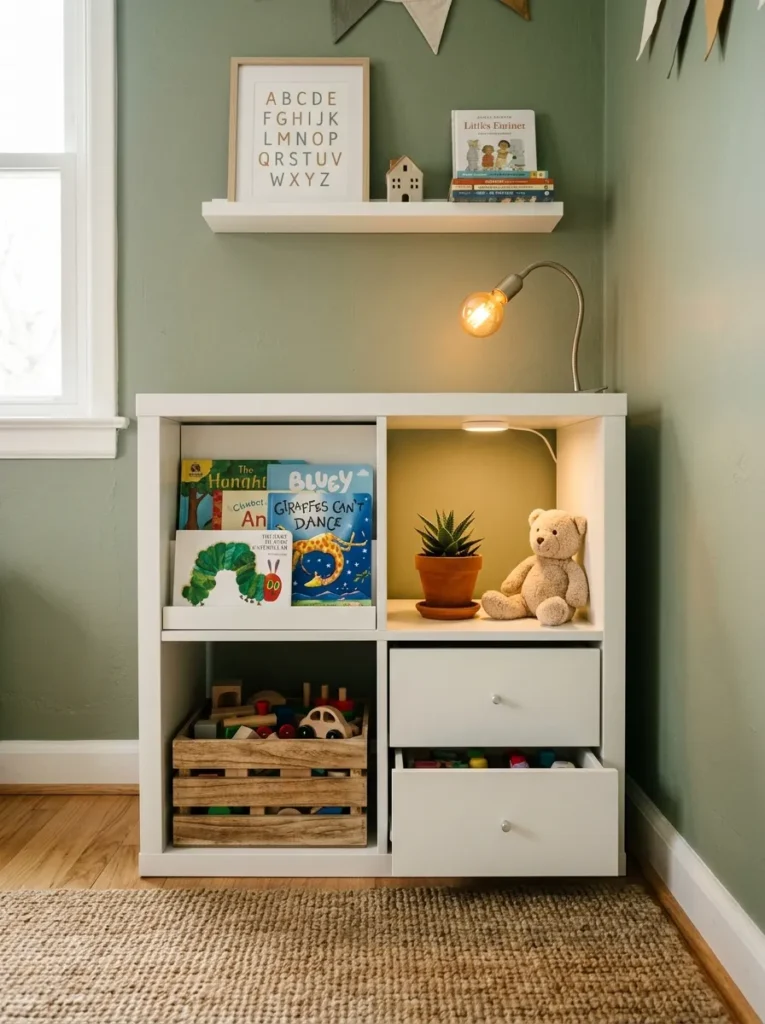
Vibe: The small unit feels complete — a system that addresses every need without requiring more space than it has.
Why it works: A single KALLAX Toy 2×2 unit maximized across four distinct functions applies the small-space design principle of cellular function allocation — in a small playroom or bedroom play corner, every cubby of available storage must serve a distinct, non-overlapping function to avoid category confusion and maintain the system’s ability to organize without requiring additional space. The four-cubby 2×2 KALLAX Toy divides naturally into four functional zones: book display (picture ledge insert in one upper cubby), ambient and reading light with a plant (battery-powered or plug-in light in the other upper cubby), open toy bin for large frequently accessed items (lower cubby with fabric bin), and drawer insert for small-part categories (lower cubby with KALLAX drawer insert). This four-function allocation covers the primary daily needs of a child’s independent play space in a single, non-overwhelming piece of furniture.
How to get it: Purchase a KALLAX 2×2 unit ($54.99 from IKEA). Install a KALLAX Toy picture ledge insert (a slim shelf that sits within the cubby frame, allowing books to lean face-out) in the upper left cubby. Install a KALLAX drawer insert in the lower right cubby for small-part storage. Place a battery-powered book light or a small plug-in LED night light in the upper right cubby alongside a small potted plant. Fill the lower left cubby with a fabric bin for the primary toy category. Add a narrow floating shelf (IKEA LACK, 30cm) above the unit at reachable-for-parent-not-for-child height for displaying books not yet in rotation or decorative objects.
Quick Win: A KALLAX 2×2 ($54.99) plus a picture ledge insert ($7.99) plus a KALLAX drawer ($35.99) plus a fabric bin ($6.99) creates a complete, fully differentiated four-function small playroom storage system for under $110 — the most comprehensive toy storage per dollar available at this scale.
Shop The Look
| Product |
|---|
| KALLAX picture ledge insert book display |
| KALLAX drawer insert natural wood |
| Fabric cube bin KALLAX size single |
| Battery powered book light small warm |
| Floating shelf above KALLAX 30cm white |
How to Start Your KALLAX Playroom Transformation
KALLAX Toy single best first move before purchasing any bins, inserts, or accessories for a KALLAX playroom system is completing a toy audit — sorting the existing toy collection into categories and counting the categories before determining which KALLAX configuration and which bin types are needed. A family with seven clearly distinct toy categories needs a 2×4 unit with seven labeled bins and one drawer insert or decorative element. A family with twelve categories needs either a larger unit or a dual-unit configuration. Beginning the KALLAX system with more or fewer cubbies than the toy collection’s category count creates a system that either has empty cubbies (which fill with miscellaneous overflow within weeks) or insufficient cubbies (which immediately requires expansion). The audit takes 30–60 minutes and determines every subsequent purchasing decision.
The most common mistake in KALLAX Toy playroom storage is using bins that are too large for the cubbies relative to the category volume — a DRÖNA bin filled to half capacity with a small toy category looks messy and wastes the structural capacity of the cubby. The fix is matching bin type to category volume: full DRÖNA fabric bins for large-volume categories (soft toys, building blocks, dress-up accessories), half-height or shallow bins for medium categories (puzzles, art supplies, books), and KALLAX drawer inserts for small-part categories. The bin size should be determined by the quantity of toys in the category, not by the availability of a standard bin in the KALLAX system.
Three specific items under $50 that immediately improve any existing KALLAX Toy playroom system: a set of 10 oval chalkboard self-adhesive labels and a white chalk marker ($7–12 combined) for converting any unlabeled KALLAX system into a communicative organizational tool; a single KALLAX picture ledge insert ($7.99 from IKEA) that converts any open cubby into a face-out book display and measurably increases children’s voluntary book engagement; and a roll of 30mm washi tape in an accent color ($4–8) for creating the art gallery display borders above the KALLAX unit that activate the wall space above the storage system.
A basic KALLAX Toy playroom setup — a 2×4 unit with eight bins and labels — takes a single afternoon to purchase, assemble, and organize, for approximately $120–170 in total. A fully developed KALLAX playroom system — two-unit built-in configuration with cornice and plinth, drawer inserts, mixed bins and baskets, rotation system, art gallery display, and reading nook — takes two weekends of work over consecutive weeks and costs $350–600 in materials. Every configuration in this list is achievable by a parent or carer with basic DIY competence — a drill for the anti-tip hardware, a jigsaw for the cornice panel, and a paintbrush for any painted modifications cover all the tool requirements.
Frequently Asked Questions About KALLAX Toy Storage for Playrooms
What size KALLAX unit works best for a playroom?
The 2×4 KALLAX (four cubbies wide and two tall, approximately 147×77 cm) is the most versatile configuration for a primary playroom storage unit because its eight cubbies accommodate the toy category range of most children aged 2–10, its height (77cm) positions the upper cubbies at child reachable height for most children over four, and its width (147cm) makes it suitable for walls in rooms as narrow as 10 feet. For a very small playroom or bedroom play corner, the 2×2 (four cubbies total, approximately 77×77 cm) provides the minimum functional storage for a single child’s primary toy collection. For a dedicated full-room playroom, a 4×4 or multi-unit wall configuration (two or three 2×4 units side by side) addresses the larger toy collections of multiple children or older children with complex multi-category collections.
How many bins do you need for a KALLAX playroom system?
One bin per cubby is the standard approach for a fully loaded KALLAX system, but the most effective KALLAX playroom configurations leave one or two cubbies as functional non-bin spaces — a picture ledge for face-out book display, a KALLAX drawer insert for small parts, or an open display space for a special toy or rotating exhibit. In a 2×4 KALLAX, six bins plus one drawer insert plus one display/book space is typically more functional than eight bins. The number of bins required is determined by the number of distinct toy categories — not by the number of cubbies. If the toy collection has five categories and the unit has eight cubbies, fill five with category bins and use the remaining three for books, display, and a drawer insert rather than creating three additional bins for non-distinct “overflow” categories.
How do you make a KALLAX playroom system work for multiple children?
A KALLAX system serving multiple children requires either individual unit ownership (each child has their own KALLAX unit or section of a shared unit, color-coded in their personal accent color) or joint category ownership (shared categories with each child’s items stored together by type rather than by owner). Individual unit ownership works best for children over five who have developed possessiveness about their belongings and benefit from a clear physical boundary between their storage and their sibling’s. Joint category ownership works best for children under five whose play is primarily shared and whose toys are interchangeable. The most common practical failure in multi-child KALLAX systems is attempting to create individual ownership within a shared unit without a clear physical boundary — the boundary must be visible (a different colored bin, a labeled divider, or a distinct unit section) rather than simply understood.
What is the best way to maintain a KALLAX playroom system over time?
The most effective KALLAX playroom maintenance practice is a monthly system audit — a 15-minute session where the adult and child go through each bin together, removing any items that belong in a different bin (category creep), discarding any broken or outgrown toys (category reduction), and noting any categories that have grown too large for their current bin (bin upgrade needed). This monthly audit keeps the system functioning at the level it was designed to rather than gradually devolving into a system where every bin contains a random mix regardless of its label. The second critical maintenance practice is consistent daily return — five minutes at the end of each play session returning all toys to their labeled bins before leaving the room. This daily return habit, when established in children from approximately age three, sustains the system without adult intervention and produces the primary behavioral benefit of the KALLAX system: autonomous organization by the child.
Can KALLAX toy storage work in a living room rather than a dedicated playroom?
Yes — the KALLAX as a living room toy storage piece works most effectively in three configurations: the horizontal room divider (Idea 2) that creates a visual zone boundary between the toy storage area and the adult living space; the built-in wall configuration (Idea 9) with cornice and plinth that integrates the KALLAX into the room’s architecture; or the curtained lower cubby configuration (Idea 11) that hides the toy storage behind linen curtain panels visible from the living space. The critical design principle for any KALLAX in a living room is visual calm — the unit’s visible face must read as designed rather than stored, which requires consistent bin styles, a limited color palette, and deliberate styling of any open display cubbies. A KALLAX with eight different bin styles, ad hoc labels, and mixed contents visible in uncovered cubbies will read as toy storage in a living room regardless of the unit’s location.
Ready to Build Your Dream KALLAX Playroom?
These 12 ideas move through every dimension of what makes a KALLAX playroom system genuinely work — from the cognitive science of color-coded bins and chalkboard labels that teach organization to pre-reading children, to the behavioral science of toy rotation systems that sustainably increase play engagement, to the spatial intelligence of horizontal configurations and built-in wall systems that transform a room’s character, to the small-space ingenuity of the fully differentiated 2×2 unit that addresses every daily need in four cubbies. Starting with the toy audit and the color-sorted bin purchase — before assembling a single shelf or labeling a single container — is the correct beginning, because the system only works when the categories are correct and the bin count matches the category count. Order the bins and labels today, complete the audit this weekend, and the KALLAX playroom system will be fully functional by Sunday evening. Pin the reading nook and curtained configuration ideas for the second weekend, and return to the built-in cornice and rotation system plans when the basic system has proven what it is capable of. When the room resets in five minutes rather than forty, and the child returns the Lego to the right bin without being asked, the system will have earned every hour it took to build.