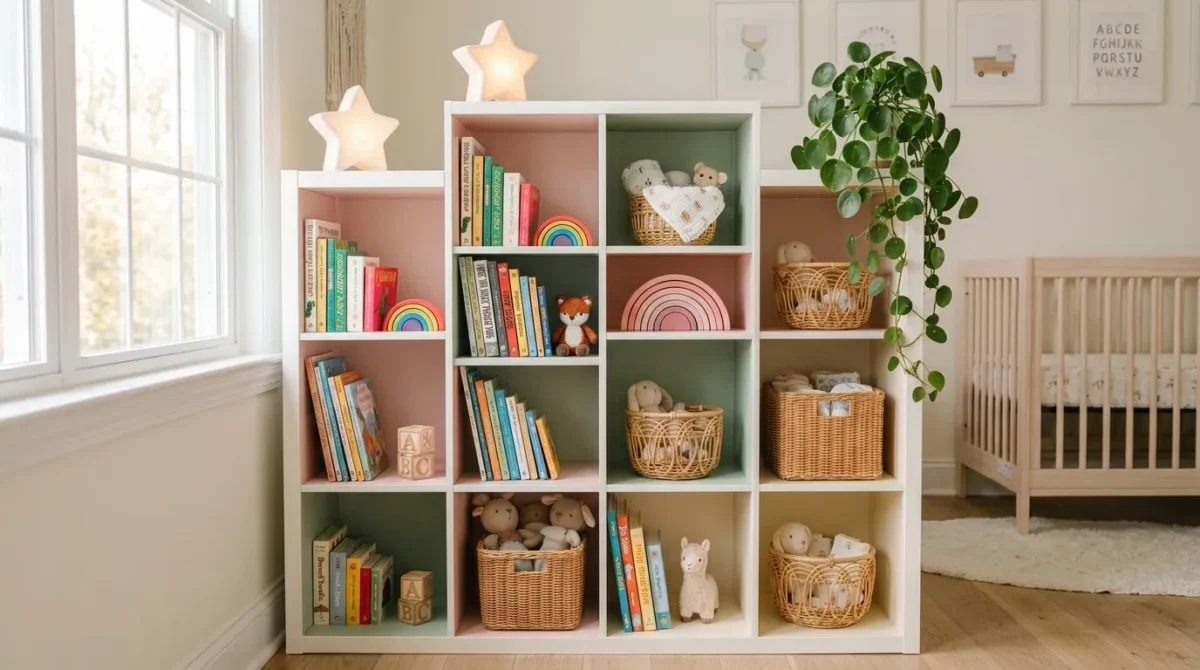
A KALLAX bookshelf is IKEA’s iconic cube-grid storage unit, available in configurations from 1×2 to 5×5, designed to hold books, baskets, boxes, and inserts while functioning as a room divider, media console, or statement wall piece. Here are 14 ideas for styling your KALLAX unit so it looks like it came from a designer showroom — not a flat-pack box.
There’s something quietly satisfying about a shelf that works as hard as it looks good. The KALLAX doesn’t announce itself — it waits for what you put into and around it to tell the story. Styled right, it disappears into the room as a piece of considered furniture. Styled wrong, it reads exactly like what it is: a $129 grid from a big-box store. The difference between those two outcomes is almost entirely in the decisions made after assembly. Here are 14 ideas worth saving — and stealing.
Why KALLAX Styling Works So Well
What is the KALLAX, really? The IKEA KALLAX series is a modular cube-grid shelving system that replaced the beloved EXPEDIT line in 2014 — slightly slimmer in profile but functionally identical in its 13×13-inch cube openings, which accept IKEA’s own inserts (doors, drawers, baskets) as well as a vast third-party accessory ecosystem. It draws its design logic from the modernist grid tradition — think Donald Judd’s stack sculptures or the minimalist shelving systems of Vitsœ — and its genius lies in that neutrality: the KALLAX has no strong opinion about what it should hold or how it should look, which makes it infinitely adaptable across interior styles from Japandi to maximalist bohemian.
Core materials and colors. The KALLAX ships in white, black-brown, high-gloss white, birch effect, and oak effect veneers, with occasional limited-run colors. Its particleboard-and-veneer construction responds well to paint (chalk paint adheres without priming), contact paper (for interior cube lining), and hardware upgrades (replacing stock shelves with solid wood inserts). The most designer-looking KALLAX builds consistently use one of three approaches: all-white with black hardware accents, natural oak effect with rattan and warm linen, or a painted color (dusty sage, warm terracotta, navy) with brass or ceramic hardware.
Why it’s trending now. The KALLAX has been a fixture of the “IKEA hack” movement for over a decade, but the current iteration of that trend is more sophisticated — less about gluing on trim and more about deliberate styling, thoughtful insert selection, and treating the unit as a design canvas rather than a utility object. Pinterest and interior design TikTok have driven a wave of KALLAX transformations that genuinely fool the eye, and the unit’s modular nature aligns perfectly with the post-pandemic emphasis on flexible, multi-functional home spaces.
Can small rooms pull this off? The KALLAX is arguably most powerful in small rooms because its modular grid creates the visual impression of a built-in — and built-ins make small rooms feel intentionally designed rather than cramped. A 4×2 KALLAX unit in white, mounted flush to a wall with a plinth base added below, reads as a custom built-in bookcase at a fraction of the cost and complexity.
Style at a Glance
| Element | Detail |
|---|---|
| Philosophy | Modular neutrality styled into intentional design |
| Key Materials | Painted particleboard, solid wood inserts, rattan, linen, brass |
| Key Colors | White, oak effect, dusty sage, navy, warm terracotta, black-brown |
14 KALLAX Bookshelf Ideas That Look Designer Made
1. Full-Wall 5×5 KALLAX Library in Moody Navy
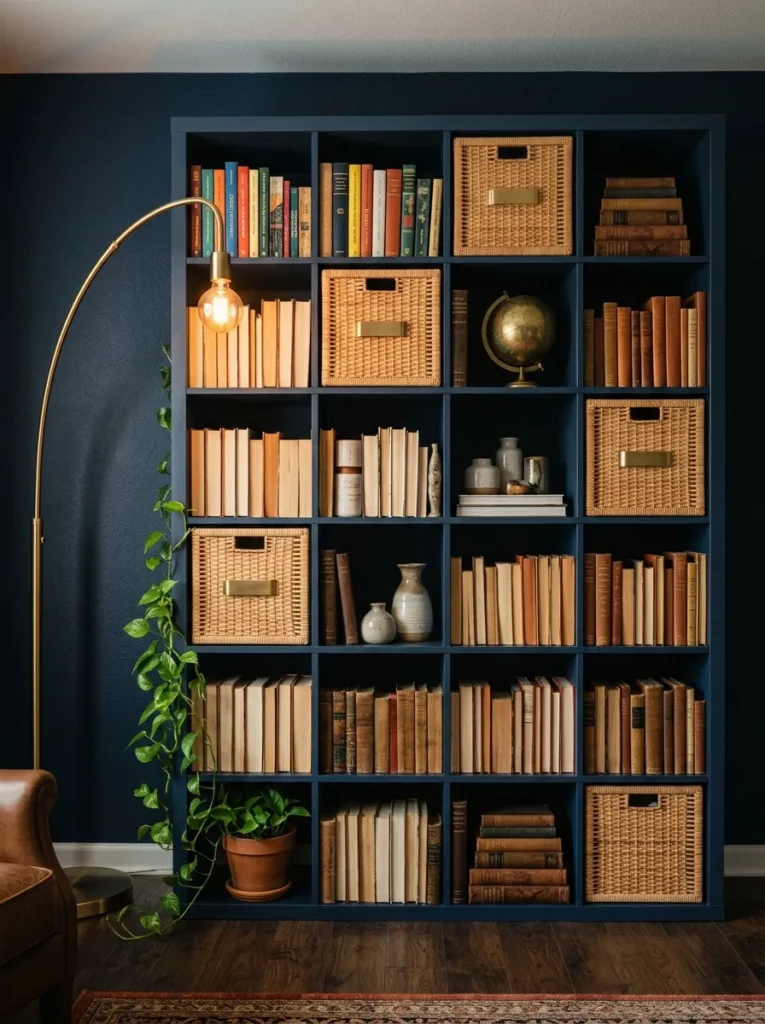
Vibe: A navy KALLAX wall feels moody — a room that takes books and atmosphere equally seriously.
Why it works: Painting a 5×5 KALLAX unit in a deep, saturated color is the single highest-impact transformation available to this shelf — it converts a modular grid into what reads unmistakably as a custom built-in library wall. The design principle at work is color unification: when the shelf, the wall behind it, and the interior cube backs are all the same deep navy, the grid structure visually recedes and the objects inside the cubes become the composition. Navy specifically creates a moody, library-like atmosphere that contrasts richly with warm brass hardware and the amber and cream tones of well-organized book spines.
How to get it: Apply two coats of chalk paint in a deep navy — Rust-Oleum’s Chalked Paint in Coastal Blue or Annie Sloan’s Napoleonic Blue are both excellent formulations that adhere to KALLAX particleboard without priming. Paint the interior cube backs and the exterior simultaneously for full color unification. Replace any stock insert hardware with brushed brass bar pulls for the drawer inserts.
Quick Win: A single can of navy chalk paint ($15–$22) covers a 2×4 KALLAX unit in two coats — transform one smaller KALLAX unit first to test the color before committing to a full wall.
Shop The Look
| Product |
|---|
| Navy chalk paint for furniture no primer required |
| Brushed brass bar pull 4 inch set of 8 |
| Rattan KALLAX insert basket set of 2 |
| Brass arc floor lamp living room reading |
| Brass decorative globe accent bookshelf |
Also view: 13 Easy Yarn Crafts for Cozy DIY Projects
2. KALLAX as Nursery Bookshelf with Pastel Cube Liners
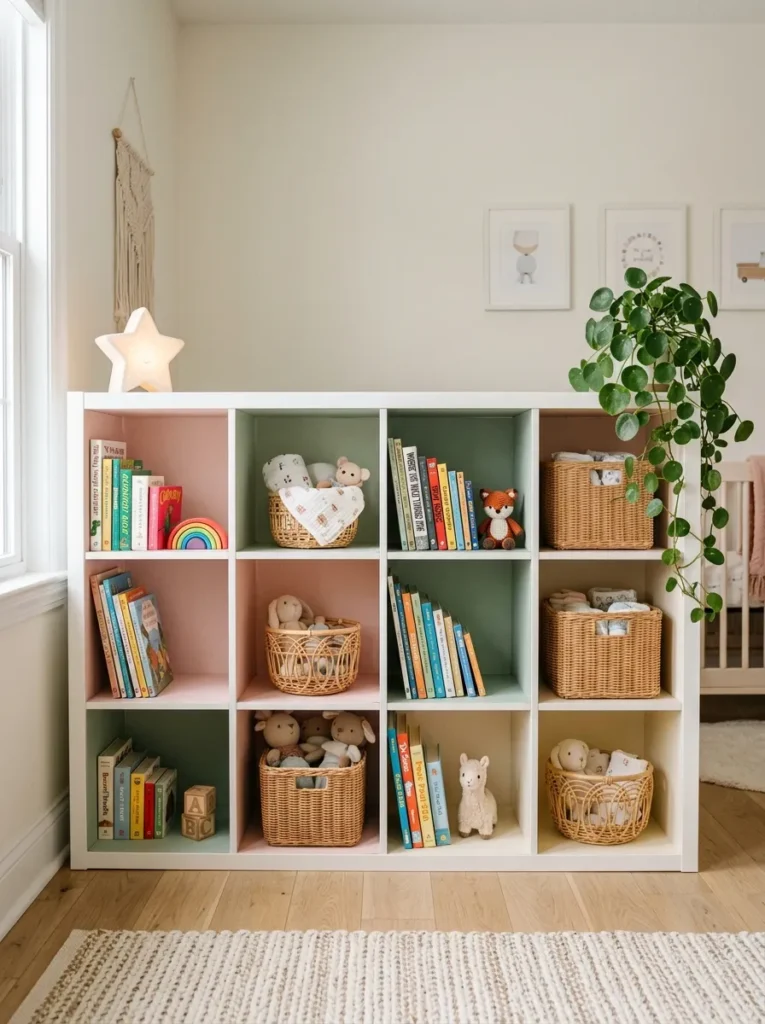
Vibe: A pastel-lined nursery KALLAX feels soft — every cube a small world, color-coordinated and completely calm.
Why it works: Contact paper cube liners are the most reversible, renter-friendly KALLAX transformation available — they require no paint, no tools, and no permanent alteration, yet they convert a flat white grid into a visually layered piece. In a nursery, the alternating pastel pattern (one cube blush, next sage, next cream, repeat) creates the visual rhythm of a patterned wallpaper while keeping each individual cube as a functional storage zone. The white KALLAX frame provides clean visual structure that prevents the pastels from reading chaotic — the grid holds the pattern in place.
How to get it: Cut self-adhesive contact paper into 13×13-inch squares for the back panel and four 13×13.5-inch rectangles for the side interior panels of each cube. Apply to clean, dry interior surfaces using a credit card to smooth air bubbles. Alternate three pastel colors across the cubes in a deliberate pattern rather than random placement — rhythm reads as designed, randomness reads as accidental.
Shop The Look
| Product |
|---|
| Self adhesive contact paper pastel blush pink roll |
| Dusty sage contact paper peel stick wall safe |
| Woven rattan small nursery storage basket set 4 |
| White ceramic star nightlight nursery |
| Small trailing pothos plant in white ceramic pot |
Also: 14 IKEA Pantry Designs That Maximize Storage
3. KALLAX Bookcase with Solid Oak Wood Inserts
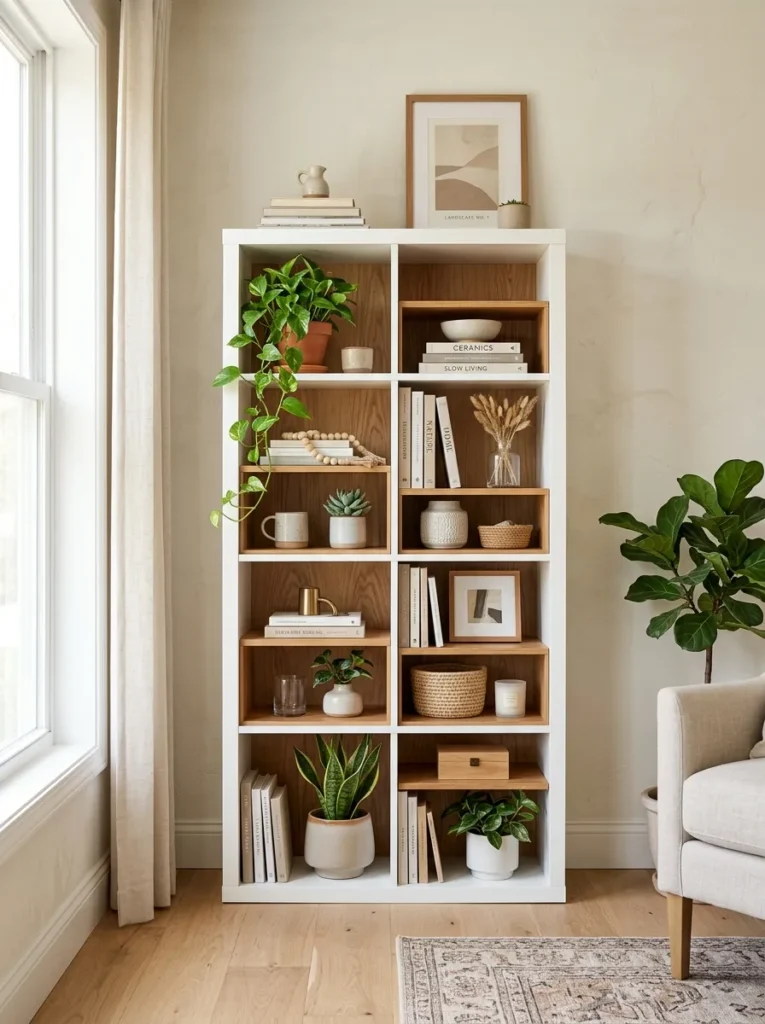
Vibe: Oak-insert cubes feel elevated — the warmth of real wood transforms what is otherwise a plastic-feeling grid.
Why it works: The KALLAX’s 13-inch cube opening is generous enough to feel cavernous when holding a single small object, but adding a solid wood internal shelf insert at the midpoint of each cube converts each opening into two functional half-shelves — dramatically increasing storage density while adding the visual warmth of genuine wood grain. This is the KALLAX upgrade most often mistaken for genuine custom joinery: seen in a photograph, a white KALLAX with oak internal shelves reads as a professional built-in with solid wood detailing at a cost of roughly $150 in materials versus $3,000–$5,000 for actual custom shelving.
How to get it: Cut solid oak boards to 12.75 inches wide and 10 inches deep (slightly undersized to allow easy fitting and removal). Sand to 220 grit, finish with two coats of matte hardwax oil or Danish oil for a natural look. Rest the shelf on two small adhesive felt bumpers inside each cube to prevent sliding — no fastening required for light loads.
Quick Win: A single 8-foot oak board from a lumber supplier costs $25–$40 and yields enough material for four internal cube shelves — one board transforms four cubes from blank grid openings into warm, layered display niches.
Shop The Look
| Product |
|---|
| Solid oak board 1×12 8ft furniture grade |
| Danish oil natural finish wood hardwax |
| Adhesive felt furniture pad small bumper set |
| Small ceramic bud vase white matte set of 3 |
| Neutral spine art book hardcover display |
4. KALLAX Room Divider with Plants and Trailing Vines
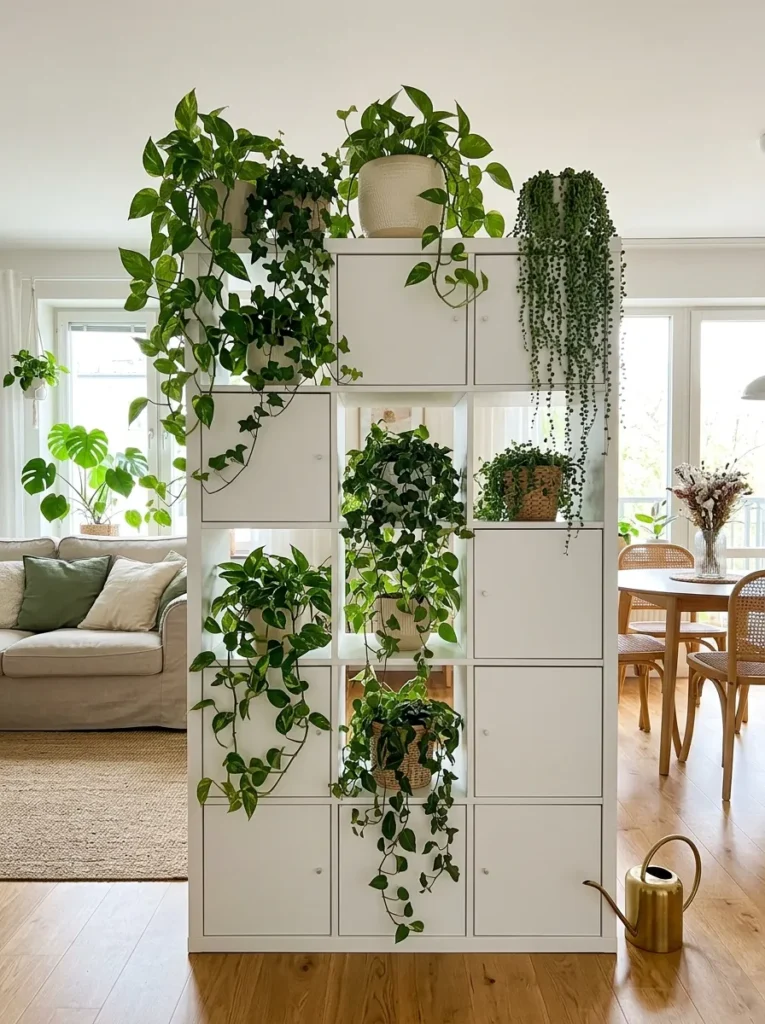
Vibe: A plant-filled KALLAX divider feels lush — a green wall that breathes and moves with the light.
Why it works: Using a KALLAX bookshelf as a freestanding room divider is one of its most architecturally interesting applications — it defines two distinct zones without closing them off completely, allowing light, sound, and visual connection to pass through the open cubes while providing genuine functional separation. Filling the upper cubes with trailing plants (pothos, string of pearls, or devil’s ivy) creates a living green element that softens the hard grid geometry and evolves over time as the plants grow. The KALLAX must be secured to the wall with the anti-tip hardware included in the box — this is non-negotiable when the unit is freestanding and accessible from both sides.
How to get it: Position a 4×4 KALLAX perpendicular to the wall to create the divider. Secure with the included wall anchor hardware — essential for safety. Fill upper-tier cubes with trailing plant varieties in lightweight nursery pots set inside decorative ceramic or woven pot covers. Install KALLAX door inserts on the lower cubes for closed storage on one side.
Shop The Look
| Product |
|---|
| KALLAX insert with door white set of 2 |
| Pothos plant trailing indoor live |
| String of pearls succulent indoor trailing plant |
| Woven seagrass plant pot cover medium |
| Brass long-neck indoor watering can |
5. KALLAX with Plinth Base for Built-In Look
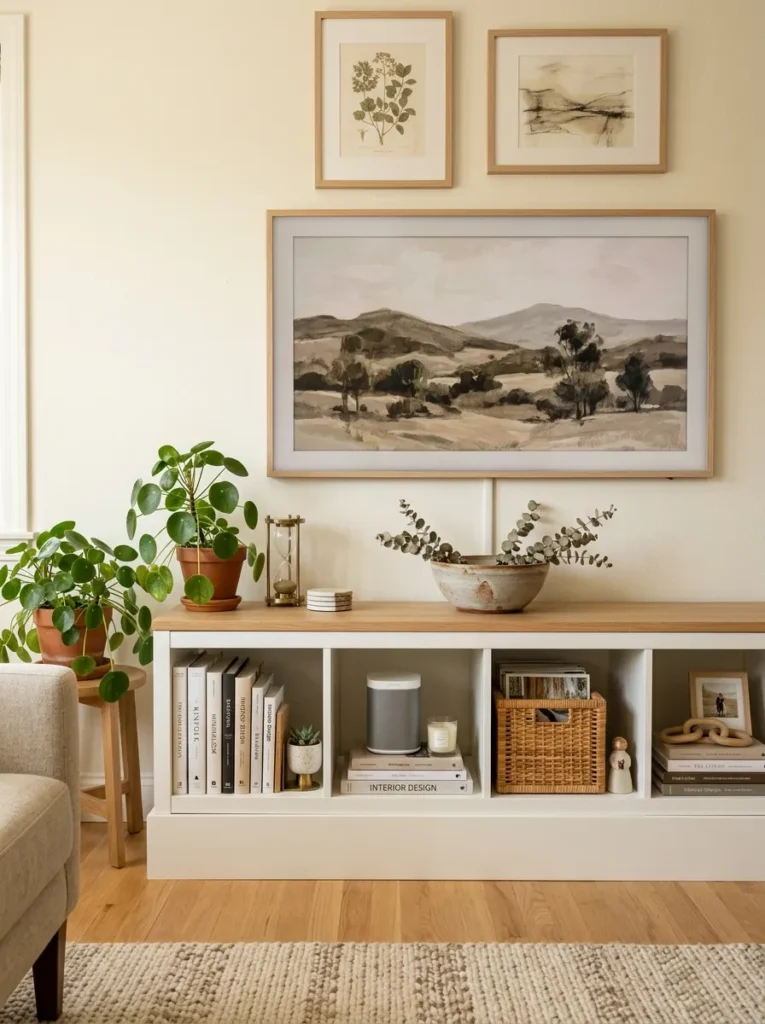
Vibe: A KALLAX on a plinth base feels architectural — the gap between the floor and the unit disappears, and suddenly it looks built-in.
Why it works: The single detail that most clearly signals “IKEA shelf” rather than “custom furniture” is the raw bottom edge sitting directly on the floor. Adding a plinth base — a simple painted MDF box frame 4–6 inches high, run the full width and depth of the KALLAX — eliminates that reveal and creates the visual continuity of a piece that appears to grow from the floor. This works because all genuine built-in furniture has a base detail of some kind: a toe kick, a plinth, or a raised panel. The plinth costs approximately $20–$40 in MDF materials and transforms the perceived value of the unit more dramatically than almost any other single intervention.
How to get it: Cut 3/4-inch MDF into a rectangular plinth frame the exact footprint of your KALLAX unit, at 5 inches high. Join with wood glue and finishing nails, fill all seams with wood filler, sand smooth, and paint in the same color as the KALLAX. Place the KALLAX on top — no fastening required for the horizontal 1×4 configuration. Caulk the top joint between the plinth and KALLAX for a seamless appearance.
Quick Win: A single sheet of 3/4-inch MDF ($35–$50) yields enough material for a complete plinth base under a 4×2 KALLAX unit — the transformation from flat-pack to built-in costs one afternoon and under $60 in materials.
Shop The Look
| Product |
|---|
| MDF sheet 3/4 inch 4×8 ft furniture grade |
| White furniture paint water based satin finish |
| Wood filler paintable interior white |
| Fine grit sandpaper assortment 180 220 320 |
| Paintable caulk white interior for trim |
6. Terracotta-Painted KALLAX Bookshelf for a Warm Living Room
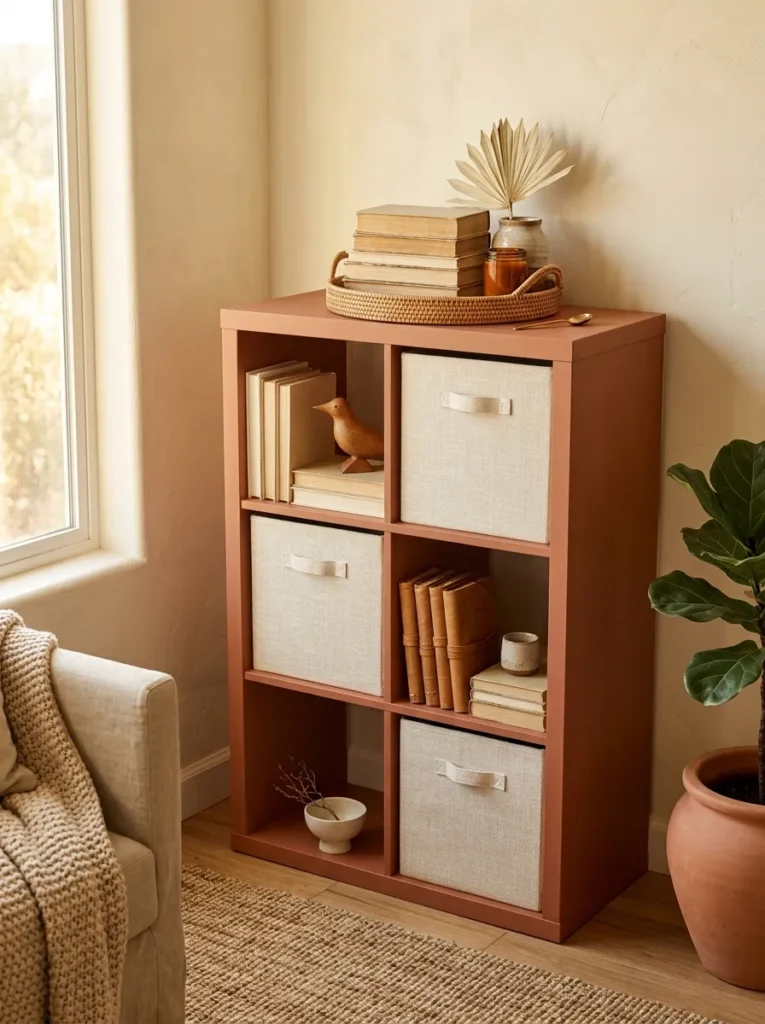
Vibe: A terracotta KALLAX bookcase feels sun-warmed — earthy and unhurried, like furniture that belongs in a space, not just occupies it.
Why it works: Terracotta as a KALLAX paint color works because it occupies the tonal territory between a neutral and an accent — warm enough to read as a deliberate color choice, earthy enough to recede into a warm-palette room without dominating it. The design principle operating here is tonal harmony: terracotta on the KALLAX picks up the warm undertones of natural rattan, dried botanicals, cream linen, and tan leather objects, creating a room where all the warm elements reinforce each other rather than competing. Arranging books spine-inward (pages facing out, creating a soft cream-white texture) is the styling trick that prevents books from reading as visual noise against the warm paint color.
How to get it: Apply two coats of chalk paint in terracotta — Annie Sloan’s Antoinette or Rust-Oleum’s Chalked Paint in Tuscan Sun are both warm, muted options that read as sophisticated rather than orange. Style alternate cubes with linen KALLAX-compatible basket inserts and open-display cubes for objects, maintaining a roughly 50/50 ratio of closed to open storage.
Shop The Look
| Product |
|---|
| Terracotta chalk paint furniture matte no primer |
| Linen fabric KALLAX storage basket insert set 2 |
| Dried palm leaf large natural decor |
| Rattan tray rectangle natural large |
| Small tan leather journal stack set of 3 |
7. KALLAX Shelf Hack with Cane Webbing Panel Inserts
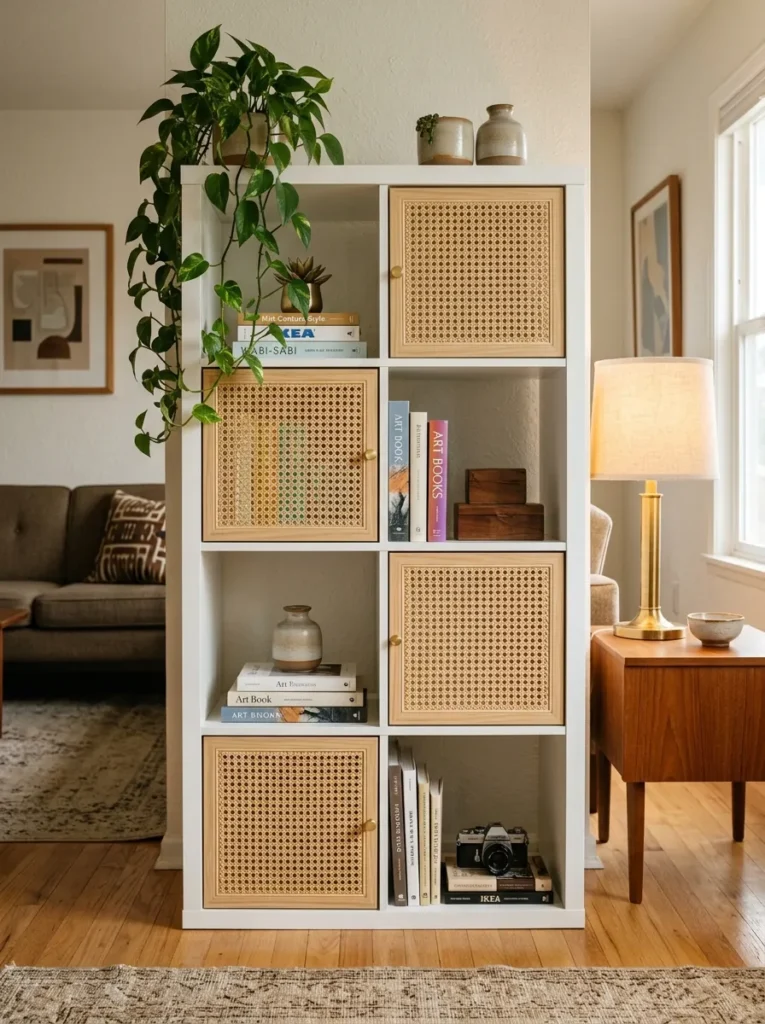
Vibe: Cane webbing inserts feel textured and warm — the grid transforms from flat graphic to tactile surface.
Why it works: Cane webbing panels — pre-woven rattan mesh stretched over a thin frame — are the KALLAX insert hack that most consistently gets mistaken for expensive custom cabinetry. The texture of cane webbing photographs with extraordinary richness, adding an organic, handcrafted quality to what is otherwise a machine-made flat surface. The design principle is material contrast: white painted KALLAX (smooth, manufactured) against natural cane webbing (textured, organic) creates a dialogue between materials that is visually sophisticated and historically rooted — cane cabinetry panels were a defining feature of mid-century modern furniture from the 1950s through 1970s.
How to get it: Cut thin plywood or MDF panels to 12.75×12.75 inches (one per cube to be covered). Stretch pre-woven cane webbing sheet (soaked in water for 10 minutes first to increase pliability) over the panel face, staple to the back edges, and trim excess. Attach a small brass knob at center. Slide the finished panel into the cube — it can be leaned or lightly adhesive-mounted, no permanent fixing needed.
Quick Win: A 24×24-inch sheet of pre-woven cane webbing costs $15–$25 and yields enough material for two cube panels — start with two cane-insert cubes and two open cubes on a single 1×4 KALLAX to test the look before committing to a full unit.
Shop The Look
| Product |
|---|
| Pre-woven cane webbing sheet natural rattan 24×24 |
| Small brass cabinet knob round set of 8 |
| Thin craft plywood sheet 1/4 inch 12×12 |
| Heavy duty staple gun with 3/8 inch staples |
| Clear furniture adhesive strip mounting tape |
8. Home Office KALLAX Desk Hack with Butcher Block Top
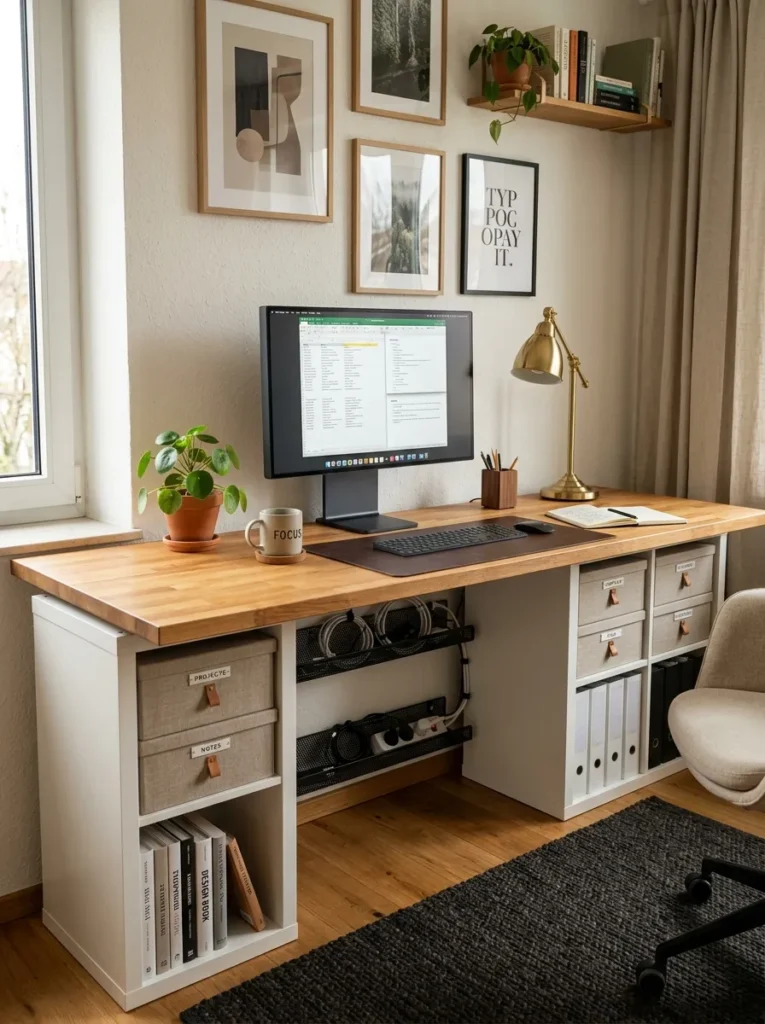
Vibe: The KALLAX desk hack feels purposeful — a workspace that stores as much as it surfaces, without looking assembled from parts.
Why it works: Using two KALLAX units as desk pedestals is one of the most functional IKEA hacks in the ecosystem — it creates a desk with substantial integrated cube storage on both sides, at a total material cost of $200–$350 versus $800–$2,000 for a comparable custom or retail desk unit. The visual logic is one of visual weight balance: two symmetrical KALLAX cubes at equal height create stable, mirrored visual anchors for the desk surface, and the butcher block top adds the warmth and materiality that converts the arrangement from “obvious IKEA” to “considered furniture.” Linen file boxes in the cubes maintain the neutral palette while providing closed document storage.
How to get it: Position two 2×2 KALLAX units 48–60 inches apart. Cut or purchase a solid birch or oak butcher block panel to bridge them (IKEA’s KARLBY countertop in birch at 74 inches is designed for this exact purpose). Secure the top to the KALLAX units using L-brackets on the interior. Route cables through one cube opening using a cable management clip rail mounted inside.
Shop The Look
| Product |
|---|
| Solid birch butcher block desk top 74 inch |
| Linen document file box KALLAX size set of 4 |
| L-bracket shelf support heavy duty set of 4 |
| Brass adjustable desk lamp clip or base |
| Cable management tray under desk mount |
9. KALLAX Bookshelf Styled with Color-Blocked Book Spines
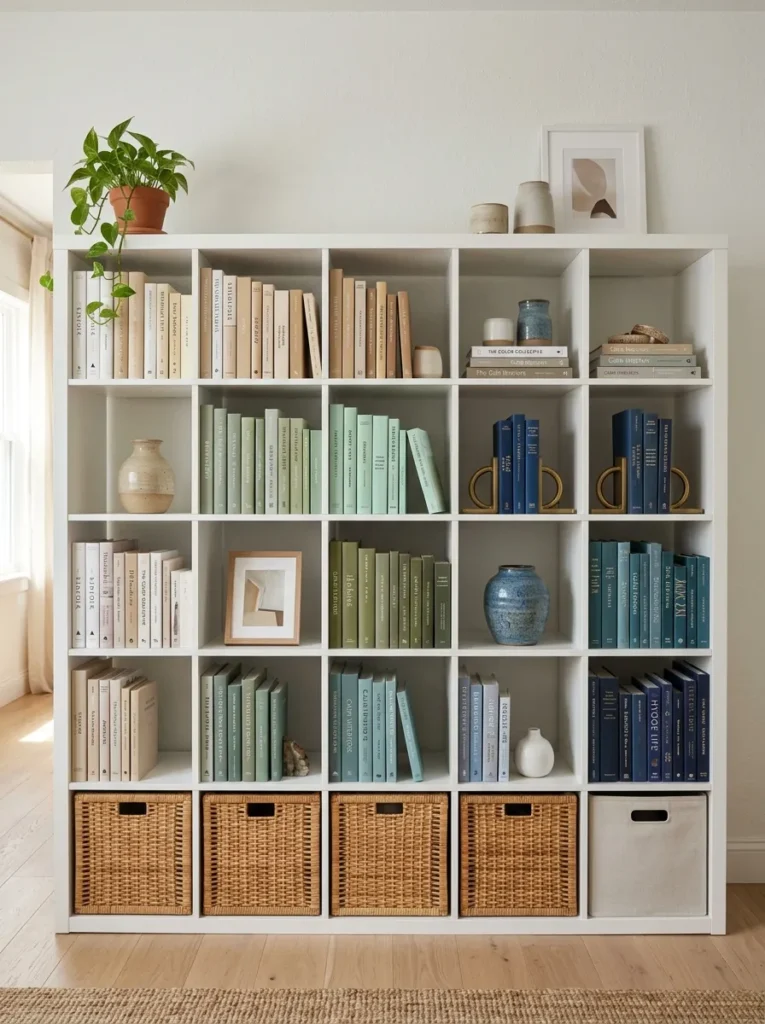
Vibe: Color-blocked books in a KALLAX shelf feel curated — like a collection that has been both read and considered.
Why it works: Color organization of books is the styling approach that most dramatically transforms a KALLAX bookcase from storage unit to visual feature — but the key is color blocking in tonal gradients rather than strict rainbow organization (which reads as performative rather than designed). Grouping warm neutrals (cream, tan, kraft) together, transitioning through warm greens, and arriving at dusty blues and teals creates a visual gradient that moves across the shelf like a landscape. Interrupting the book runs with a single ceramic object or small plant every three to four cubes gives the eye resting places and prevents the color organization from reading as a single graphic effect rather than a composed arrangement.
How to get it: Remove all books from your KALLAX and sort into color families first. Arrange the color families across the cubes in a gradient that moves from warm to cool (left to right, or bottom to top). Face-out a small number of books with visually interesting covers as accent breaks. Place one decorative object per every three to four cubes of books — a ceramic vessel, a small plant, or a leaning framed print.
Quick Win: Removing the dust jackets from hardcover books instantly reveals a warm, uniform neutral tone across almost any book collection — it’s the zero-cost styling move that makes a full KALLAX bookshelf read as curated in under 20 minutes.
Shop The Look
| Product |
|---|
| Brass bookend set decorative minimal |
| Small ceramic vase white matte medium |
| Trailing plant small indoor potted |
| Small framed art print minimal 5×7 |
| Linen KALLAX basket lower cube storage |
10. KALLAX as Entryway Storage Bench with Cushion Top
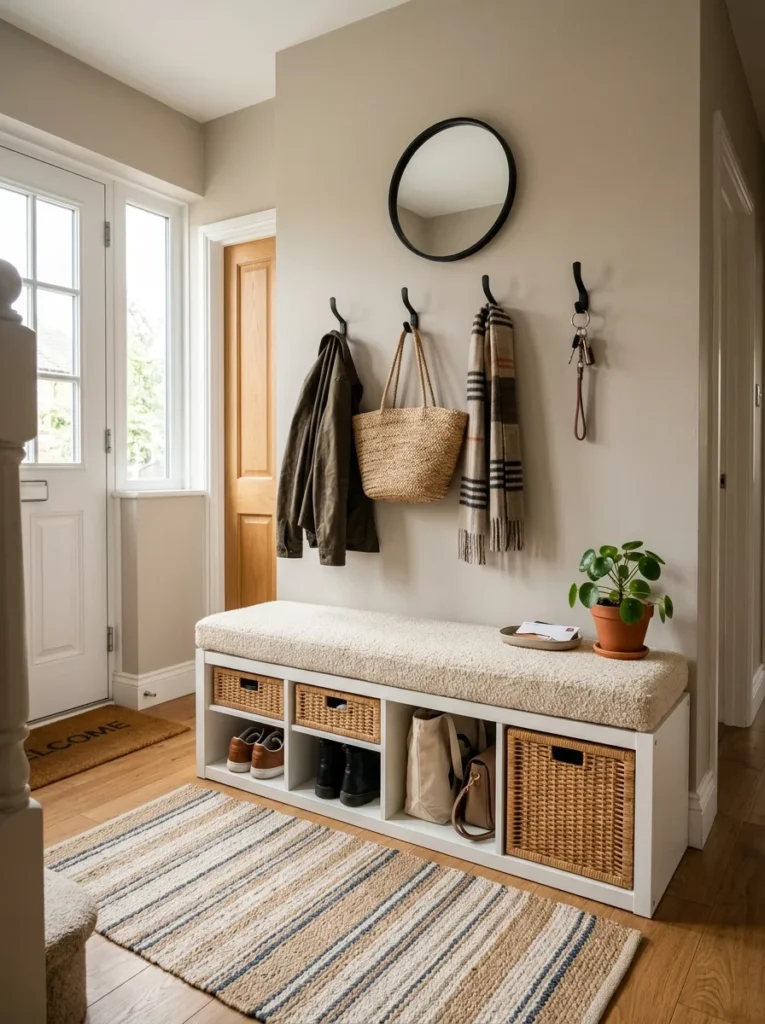
Vibe: A KALLAX bench feels welcoming — the first thing you see when you come home is organized, soft, and considered.
Why it works: The horizontal 1×4 KALLAX at bench height (the unit stands 15.5 inches high on its side, ideal for an entry bench when placed on a plinth) is one of the most versatile KALLAX configurations available — it provides four cube openings for shoe and bag storage, a flat surface that accepts a cushion, and a visual anchor for a hook wall above. The bouclé cushion top is the single detail that converts the unit from storage furniture to seating furniture: it adds comfort, texture, and a clearly domestic warmth that signals the unit’s function to every person who enters the space.
How to get it: Position a 1×4 KALLAX horizontally (cubes opening forward) on a painted MDF plinth base. Cut a 15×57-inch piece of 2-inch foam to the top surface dimensions. Wrap in bouclé or heavy linen fabric, staple to the underside, and place on the KALLAX top — no attachment needed for stability. Install three to four matte black wall hooks at 60 inches above the floor on the wall directly behind.
Shop The Look
| Product |
|---|
| Upholstery foam 2 inch thick cut to size |
| Cream bouclé fabric by the yard upholstery weight |
| Rattan pull-out basket KALLAX compatible |
| Matte black wall hook set of 4 |
| Woven cotton entry runner rug neutral |
11. KALLAX Bookcase with Wallpaper-Lined Cube Backs
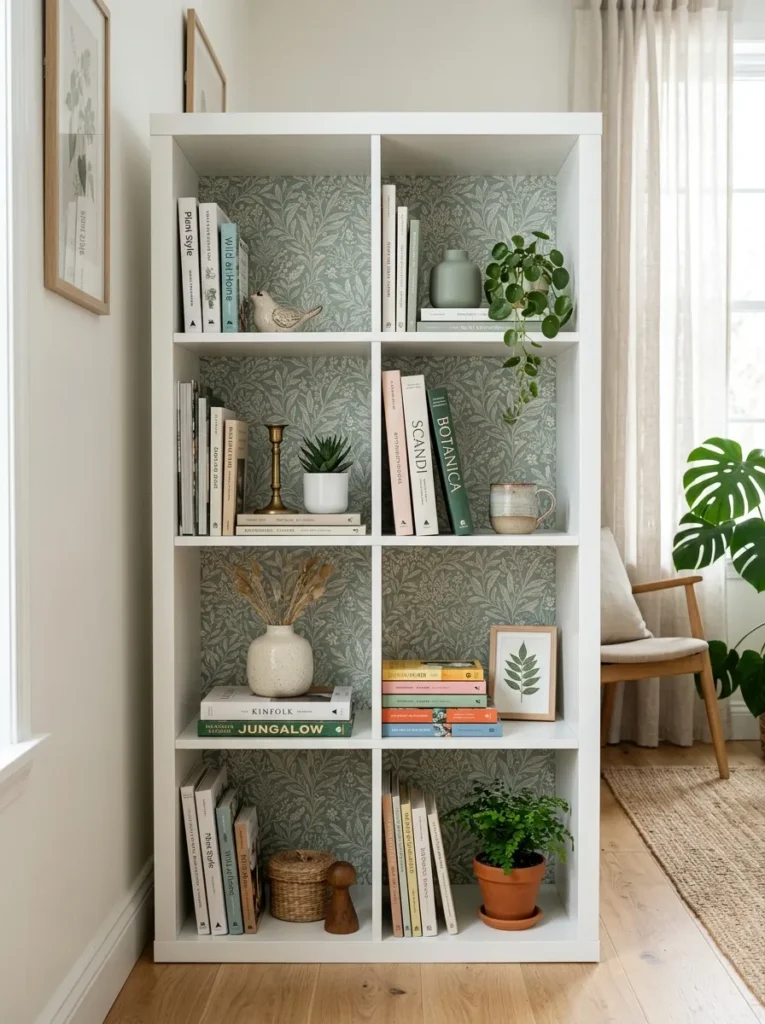
Vibe: Wallpaper-backed cubes feel layered — depth added to each opening that makes every displayed object look like it’s been thoughtfully framed.
Why it works: Lining the back panel of each KALLAX cube with a section of decorative wallpaper is the styling technique that comes closest to genuine interior design thinking — it applies the principle of backdrop differentiation, where the surface behind an object is as considered as the object itself. The wallpaper creates a visual frame for everything placed in front of it, making even ordinary objects (a paperback book, a small plant) read as a deliberate display. A botanical print in dusty sage and cream is the most versatile pattern choice: it reads as organic, adds color without competing with the objects, and works across Japandi, bohemian, and traditional interior styles.
How to get it: Cut peel-and-stick wallpaper panels to 12.75×12.75 inches — one per cube back. Apply from the center outward, smoothing air bubbles with a credit card. Choose a pattern with a small repeat (under 6 inches) so each cube panel reads as complete rather than cut mid-pattern. Apply to every cube for maximum impact, or alternate with solid painted cubes for a mixed approach.
Shop The Look
| Product |
|---|
| Peel and stick wallpaper botanical sage green cream |
| Wallpaper smoothing tool and trim kit |
| Ceramic planter set 3 piece white matte |
| Art book botanical illustration display hardcover |
| Trailing indoor plant small potted for shelf |
12. KALLAX Storage Unit for Kids’ Room with Labeled Bins
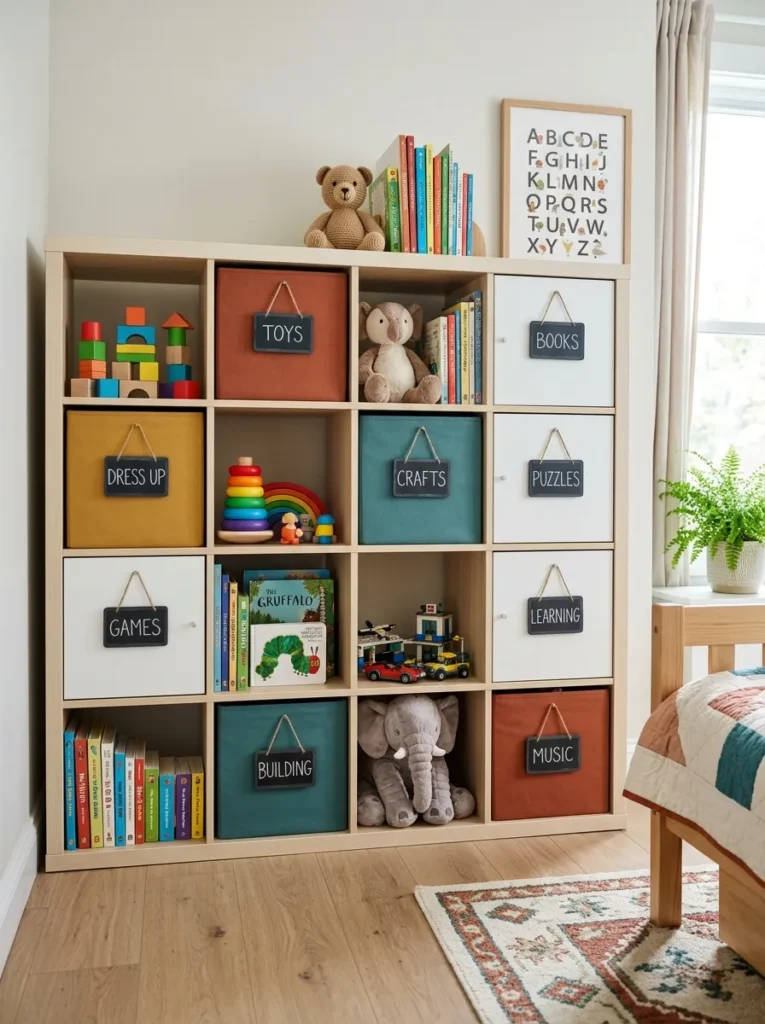
Vibe: A labeled KALLAX bookshelf in a kids’ room feels organized without feeling institutional — colorful enough to be fun, structured enough to actually work.
Why it works: The KALLAX’s 13-inch cube opening is sized almost perfectly for children’s toy categories — one cube per category (blocks, art supplies, cars, books) creates a sorting system simple enough for children to maintain independently from around age three. The design principle operating here is visual category cues: fabric bins in different colors assigned to specific categories create a color-coding system that pre-literate children can navigate visually before they can read the chalkboard labels. Warm primary tones — rust, teal, mustard — in a muted, slightly desaturated register avoid the overstimulating brightness of typical children’s storage while still reading as clearly playful.
How to get it: Assign one bin color to each toy category and maintain that assignment consistently — rust for building toys, teal for art supplies, mustard for dress-up items, for example. Write category names on chalkboard label tags attached to each bin. Keep two to three cubes as open display for favorite items and books — this prevents the unit from reading as entirely closed storage, which can feel visually heavy in a child’s room.
Quick Win: A set of four fabric storage bins in coordinated muted tones costs $20–$35 and immediately converts a chaotic KALLAX from visual noise to organized system — the labeled bin system works better than any other single organizational tool in a children’s bedroom.
Shop The Look
| Product |
|---|
| Fabric storage cube bin set 4 rust teal mustard |
| Chalkboard label tags with string set |
| KALLAX insert door white set of 2 |
| Children’s book display face-out shelf insert |
| Small framed alphabet art print children’s room |
13. Japandi-Styled KALLAX with Negative Space and Ceramics
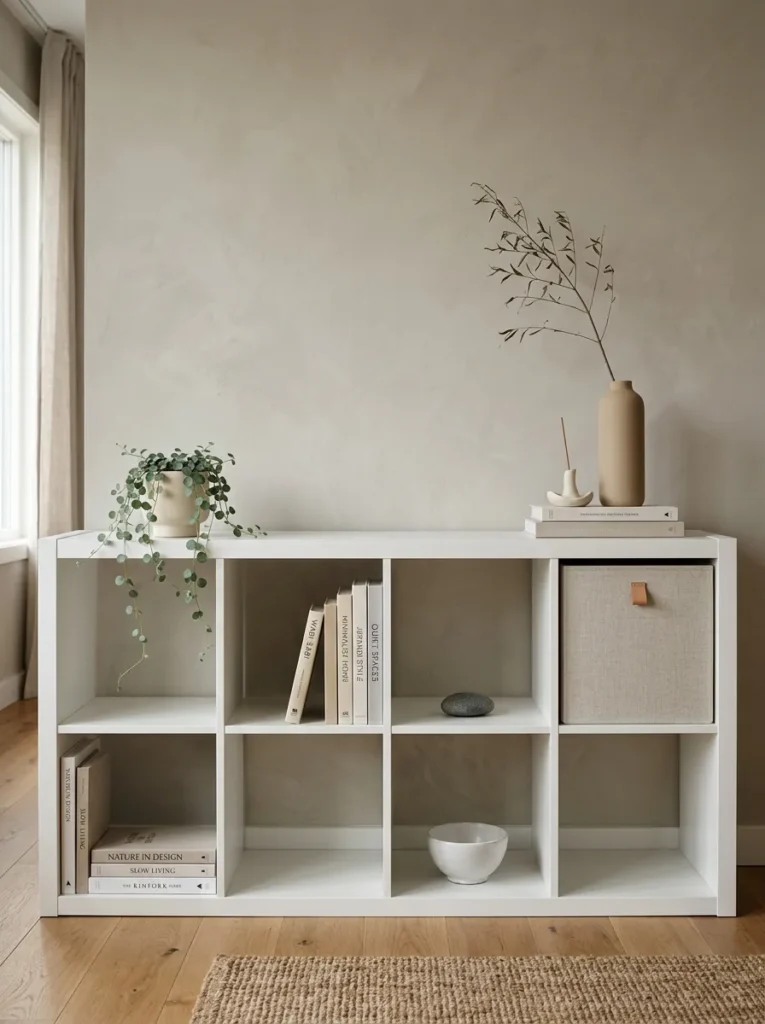
Vibe: A Japandi KALLAX feels serene — the negative space is the point, not a failure to fill the shelf.
Why it works: Most KALLAX styling advice tends toward maximum curation — filling every cube with objects, creating a dense, gallery-like composition. The Japandi approach inverts this entirely: the design principle here is deliberate underfilling, where empty cube space is treated as a material element in its own right. Negative space in a KALLAX bookcase creates visual breathing room that makes the few objects present read with far greater individual weight and intention. One ceramic vessel in a cube of empty white space reads as a considered object. The same vessel surrounded by books and other objects reads as one item among many. The Japandi-styled KALLAX is also the lowest-maintenance version of this shelf — it takes minutes to reset.
How to get it: Fill a maximum of 60% of your KALLAX cubes — leave at least 40% as completely empty or near-empty space. Choose a strict palette of three materials: matte ceramic (white, sand, or warm grey), natural wood (a small tray, a single branch), and one plant. Remove anything that doesn’t belong to those three material categories. Resist the urge to add more.
Shop The Look
| Product |
|---|
| Matte ceramic vase set white sand grey small |
| Slim tall ceramic bud vase white floor standing |
| Smooth decorative river stone set 3 piece |
| Linen covered storage box KALLAX size |
| Single dried branch natural decorative |
14. Small-Space KALLAX Bookshelf Styled as Full-Height Display
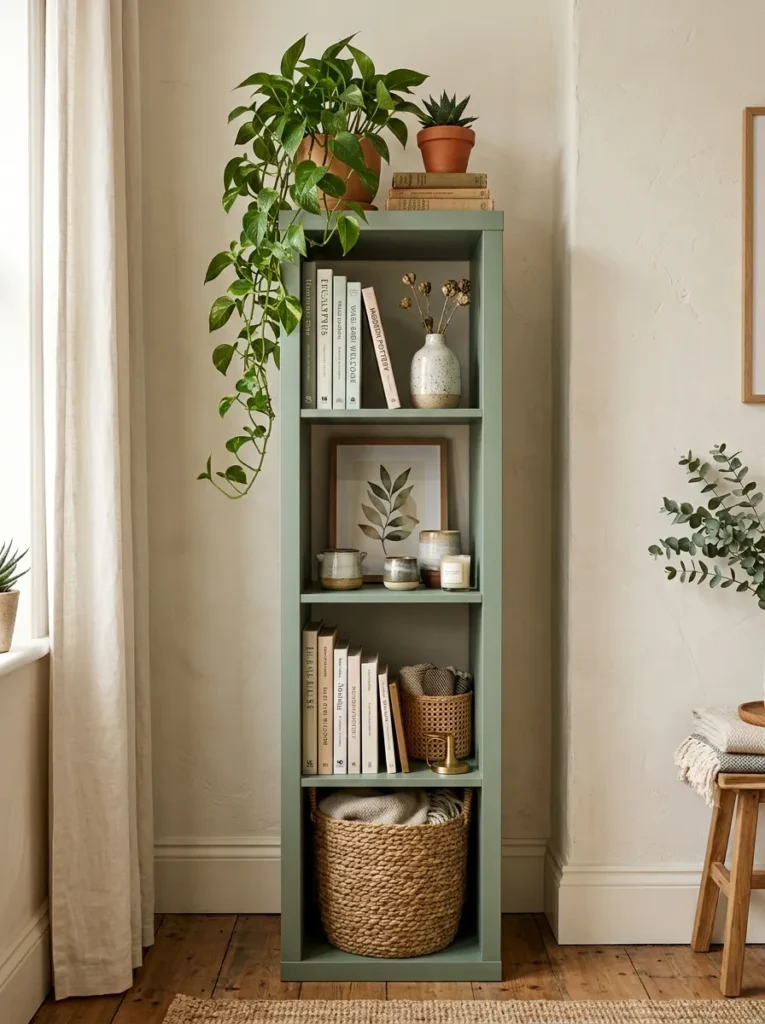
Vibe: A full-height KALLAX bookcase in a narrow space feels lush — a vertical garden of books and objects that draws the eye upward and makes the room feel taller than it is.
Why it works: The 1×5 vertical KALLAX configuration is the most underused format in the range — it occupies only 15.5 inches of floor width while reaching 76 inches in height, making it ideal for narrow walls, bedroom corners, and hallway niches where no other furniture fits. Painting it in dusty sage and styling it as a full-height display column applies the vertical emphasis principle: when the eye is drawn upward through a tall, styled piece, the perceived ceiling height increases and the overall room feels more spacious. The graduated styling (heavier, more practical items at the bottom; lighter, more decorative objects ascending) mirrors the visual logic of built-in library shelving.
How to get it: In a narrow wall space of 16–20 inches width, position the 1×5 KALLAX vertically (single column, five cubes tall). Paint in dusty sage chalk paint. Style from bottom to top in a graduated weight pattern: woven basket for practical storage at the bottom, books in the middle cubes, and increasingly decorative objects (a trailing plant, a ceramic vessel, a leaning print) as the cubes ascend. Secure to the wall using the included anti-tip hardware — essential for a tall vertical unit.
Quick Win: A 1×5 vertical KALLAX unit occupies 15.5 inches of floor space — measure any wall gap in your home wider than 16 inches, because there is likely a full-height display column waiting to happen in a space you currently consider unusable.
Shop The Look
| Product |
|---|
| Dusty sage chalk paint furniture matte small can |
| Woven rattan belly basket large for bottom cube |
| Trailing pothos live plant for top shelf display |
| Ceramic vessel set 3 piece warm sand matte |
| Small framed art print 8×10 for shelf leaning |
How to Start Your KALLAX Transformation
The single first move is to paint your KALLAX unit in a deep, saturated color using chalk paint — specifically, start with the interior cube backs before the exterior panels. Painting the interior backs first is the move that most immediately transforms the unit’s visual character, because the color becomes the backdrop for everything displayed inside the cubes. A navy, sage, or terracotta interior fundamentally changes how the shelf reads before a single object is styled into it. Everything else — inserts, hardware, objects — layers onto that painted foundation.
The most common mistake KALLAX owners make is treating all cubes equally — filling every opening with roughly the same density of objects. This produces a visual flatness that reads as storage rather than design. The fix is intentional rhythm: alternate open display cubes (fewer, carefully chosen objects) with closed storage cubes (baskets or door inserts), at a ratio of approximately 40% open to 60% closed. This ratio is the difference between a shelf that looks styled and one that looks full.
Three items under $50 that create immediate impact: a can of chalk paint in a deliberate color ($15–$22) that unifies the unit’s tone, a set of four linen or rattan basket inserts ($25–$40) that add texture and close off the most cluttered cubes, and a set of brass bar pulls ($20–$35 for eight) that replace any stock hardware and immediately shift the unit’s material register toward designer. Together these three purchases — totaling $60–$97 — transform the perceived value of a $129 KALLAX more than any furniture piece at three times the price.
Realistic expectations: a basic KALLAX styling refresh — paint, new baskets, updated hardware — takes one weekend and $80–$150 in materials. A full KALLAX hack including plinth base, cane webbing inserts, solid wood internal shelves, and wallpaper-lined cube backs represents a $200–$400 material investment over two to three weekends of project work. The result consistently reads as custom built-in shelving worth $1,500–$3,000 in equivalent retail or custom joinery cost. The KALLAX rewards patience and deliberate choices more than almost any other piece of affordable furniture.
Frequently Asked Questions About KALLAX Bookshelf Styling
What is the difference between a KALLAX bookshelf and the old IKEA EXPEDIT?
The KALLAX replaced the EXPEDIT in 2014 with one primary change: the exterior panel thickness was reduced from 1.5 inches to 1.25 inches, making the unit slightly slimmer overall while maintaining the same 13×13-inch interior cube dimension. For practical purposes, all EXPEDIT-compatible inserts, baskets, and accessories also fit the KALLAX — the two units are functionally interchangeable in the accessory ecosystem. The KALLAX bookcase is available in more finishes than the EXPEDIT was at the time of discontinuation, including the oak effect and high-gloss options.
What colors work best when painting a KALLAX unit?
The three KALLAX paint colors that most consistently read as designer rather than DIY are deep navy (creates a moody library quality), dusty sage (adds warmth without heaviness), and warm terracotta (earthy and current). All three work best in chalk or mineral paint formulations, which adhere to KALLAX particleboard without a dedicated primer coat and dry to a matte finish that photographs beautifully. Avoid high-gloss finishes on painted KALLAX units — they reveal the particleboard’s surface imperfections and read as DIY rather than deliberate.
How much weight can a KALLAX shelf hold per cube?
IKEA rates each KALLAX cube at a maximum load of 13 kg (approximately 28 lbs) when the unit is properly wall-anchored using the included hardware. For a bookshelf application, this accommodates a full row of standard hardcover books comfortably. For heavier loads — vinyl record collections, dense ceramic pieces, or book collections exceeding 28 lbs per cube — supplement with additional wall anchoring using heavy-duty toggle bolts rather than relying solely on the IKEA-supplied hardware.
Can a KALLAX bookcase look built-in without major renovation?
Yes — the combination of a painted MDF plinth base, a matching wall color, and flush wall anchoring is the three-step approach that most reliably produces a genuine built-in appearance. The plinth eliminates the raw bottom edge reveal, the wall color match removes the visual gap between shelf and wall, and flush wall anchoring prevents the unit from sitting proud of the baseboard. Adding crown molding trim along the top edge of a multi-unit KALLAX installation completes the built-in illusion at a material cost of $30–$60 in MDF trim.
What is the best way to style a KALLAX bookshelf for a small room?
The most effective small-room KALLAX styling strategy is the 40/60 rule applied vertically: keep the bottom 40% of the unit as closed storage (baskets, door inserts) and the top 60% as open display. This visual weighting makes the unit feel grounded rather than top-heavy, keeps the most practical storage accessible at reach height, and allows the display objects in the upper cubes to be seen clearly from a standing position. Painting the unit the same color as the wall behind it is the second most impactful small-room move — it causes the shelf to recede visually rather than read as a large piece of furniture dominating a limited space.
Ready to Style Your KALLAX Bookshelf?
These 14 ideas span the full range of what a KALLAX unit can become — from a moody navy library wall and a Japandi negative-space display to a children’s organization system and a full-height narrow-room column — so whatever your space, style, or budget, there is a specific and achievable transformation here. The most important thing to understand is that the KALLAX itself is not the design decision: it’s the canvas. The paint color, the insert choices, the object selection, and the deliberate rhythm of open and closed cubes are the design decisions, and all of them are within reach this weekend. Start today by pulling everything off your current KALLAX bookshelf, setting it on the floor, and looking at the empty grid — that blank white structure is genuinely full of possibility. Pin the ideas that matched your room’s palette and your storage needs, and let those be the ones you build toward first.