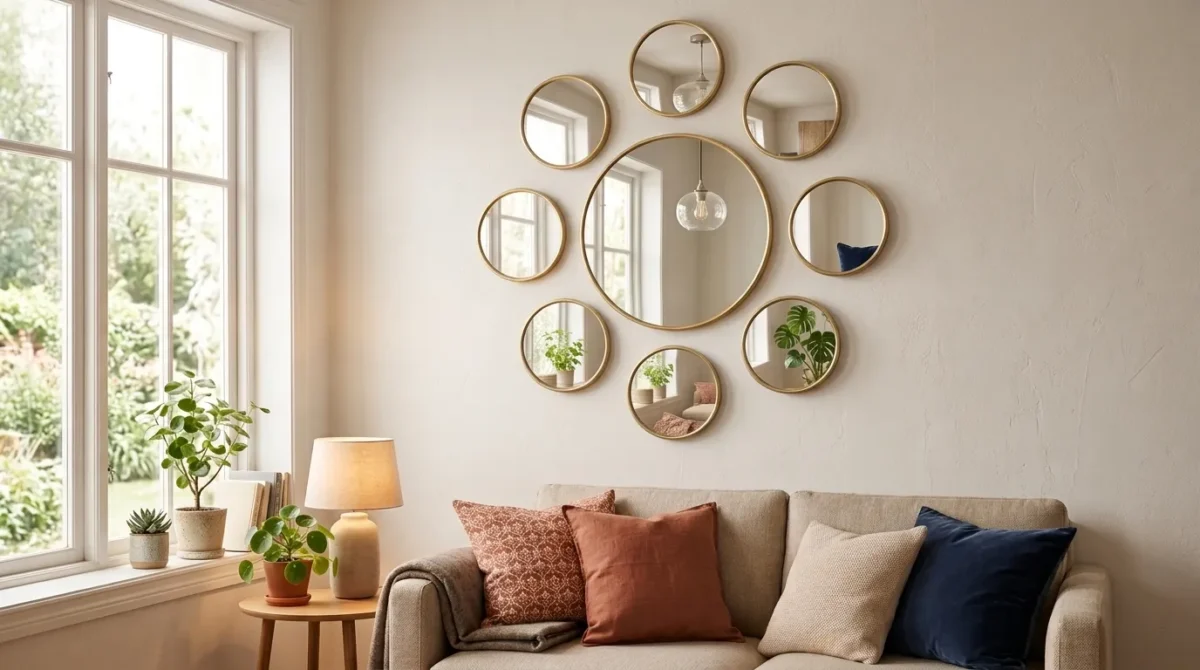
IKEA round mirror ideas use the brand’s circular mirror range — primarily the LANGESUND, LOTS, BJÖRKSTA, and KNAPPER circular formats — as styling anchors, room expanders, and decorative focal points in bedrooms, bathrooms, entryways, living rooms, and dining spaces, transformed through placement, grouping, framing additions, leaning, and thoughtful surrounding context into something that reads as considerably more designed than the original flat-pack price suggests. This article gives you exactly 15 ideas spanning solo statement placement, grouped gallery walls, DIY frame upgrades, bathroom vanity applications, and decorative combinations so every room and every aesthetic finds an IKEA round mirror approach that works.
A round mirror does something a rectangular mirror cannot — its circular form references the clock, the porthole, the moon, and the eye, carrying all of those visual associations into a room before any styling decision is made. That inherent warmth of the circle, combined with IKEA’s accessible pricing and the specific proportions of their mirror range, makes the IKEA round mirror one of the most consequential-per-pound decorating purchases available. Here are 15 ideas worth saving — and hanging.
Why Stylish IKEA Round Mirror Ideas Work So Well for Every Room
The round mirror as a decorating element has a design history running from the convex bull’s-eye mirrors of 18th-century European interior design through the Regency period’s girandole (a convex circular mirror surrounded by gilded ornamental frame), through the modernist flat disc mirrors of the 1960s and 70s Scandinavian furniture movement, to the contemporary round mirror’s consistent presence in every major interior design publication from 2015 to the present. The circular mirror’s enduring design relevance across such different aesthetic eras is a function of its formal properties — the circle is the most resolved geometric form, with no implied directionality (unlike a rectangular mirror, which creates vertical or horizontal emphasis depending on its orientation), no hierarchy between edges (unlike a framed rectangle, where corners signal edges and comers), and a naturally terminating boundary that prevents the visual continuation that rectangular mirrors create across adjacent wall surfaces.
IKEA’s round mirror range provides a consistent set of starting points across three price and size tiers: the LOTS mirror ($7.99 for a small 25cm format) as the entry point for grouped gallery wall applications and accent uses, the LANGESUND and KNAPPER mirrors ($15–35, in formats from 40cm to 75cm) as the workhorse of most solo bedroom, bathroom, and entryway applications, and the larger BJÖRKSTRA and custom IKEA options (above 75cm) for statement living room and dining room applications. The common quality across all tiers is the simple flat frameless or thin-framed edge that allows the mirror’s circular form rather than its frame to be the primary design statement — in this, IKEA’s minimally framed approach creates a more architecturally resolved result than elaborately framed equivalents at the same or greater price.
The IKEA round mirror category has driven consistent strong engagement in the home design community since approximately 2017, when the broader circular mirror trend (which had begun in high-specification design media with oversized hand-blown circular mirrors from luxury brands) reached the mass-market interpretation that IKEA’s range provides. The design media’s engagement with this category is easy to trace: Architectural Digest, Domino, and Apartment Therapy have all published multiple dedicated round mirror styling guides since 2018, consistently referencing IKEA’s range as the most accessible entry point to the trend. The aspirational anchor is the expensive handmade version (a 90cm hand-blown glass mirror from a specialist maker retails at $300–600); the accessible interpretation is the IKEA equivalent at $15–35.
The most common challenge in IKEA round mirror styling is achieving a result that reads as considered and designed rather than simply as “an IKEA round mirror on a wall” — the styling decisions (height, surrounding context, relationship to adjacent furniture, grouping configuration when multiple mirrors are used) are what generate the design quality that the mirror alone does not. Every idea in this list addresses this challenge directly, providing the specific context and placement logic that converts an accessible IKEA purchase into a room-defining design moment.
Style at a Glance
| Element | Mirror Function | Styling Edge |
|---|---|---|
| Philosophy | The circle frames without constraining | Context creates quality the mirror alone does not |
| Materials | LANGESUND, LOTS, KNAPPER, BJÖRKSTA | Paint, macramé wrap, shelf bracket, gallery grouping |
| Size Range | 25cm LOTS to 75cm+ larger formats |
15 Stylish IKEA Round Mirror Ideas for Every Room
1. Solo Statement LANGESUND in an Entryway Above a Console
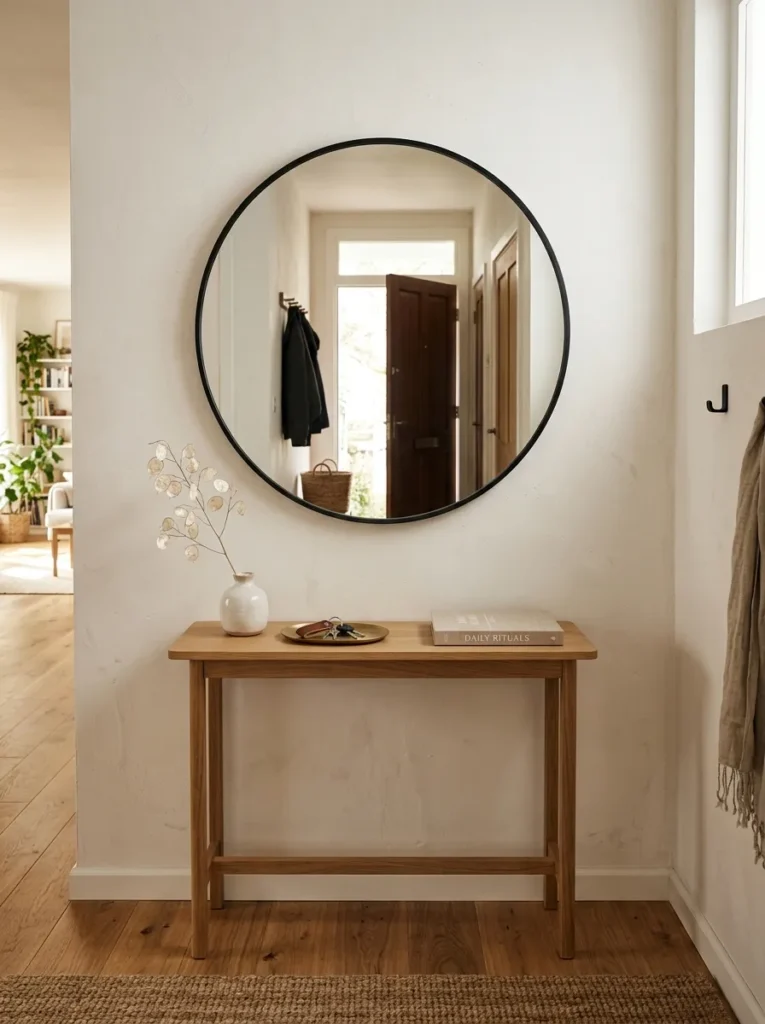
Vibe: The entryway mirror feels like the house’s first design decision — everything arriving at the console says something about what the rest of the home will be.
Why it works: A solo round mirror centered above an entryway console applies the classic interior design principle of axis alignment — the mirror’s circular center positioned on the same vertical axis as the console’s center creates a composed wall composition that the eye reads as intentional and resolved. The specific proportion rule for a mirror above a console: the mirror diameter should be between one-half and two-thirds the console’s width — a mirror that is too small reads as tentative and a mirror that extends wider than the console reads as disproportionate. At 160cm center height (the standard picture-hanging height), the mirror’s lower edge typically falls at approximately 132cm from the floor, leaving sufficient wall space between the console surface and the mirror’s lower edge for the console styling to read independently of the mirror above it.
How to get it: The IKEA KNAPPER or LANGESUND in 55cm diameter in a thin black or natural wood frame suits this application for a console in the 80–110cm width range. Hang using the mirror’s supplied hardware at the precise center of the wall section above the console — use a pencil and a ruler to mark the exact center point before installing the hook. Style the console with no more than three objects: one taller element (a ceramic vase with a dried or fresh stem), one flat element (a small tray or book), and one small accent object (a candle, a small ceramic dish). The console surface should have clear space at each end — objects only in the center third of the console width, maximum.
Quick Win: The IKEA KNAPPER mirror at 55cm in black ($19.99) hung above any existing narrow console or shelf creates the entryway composition effect immediately, for under $20 in additional materials.
Shop The Look
| Product |
|---|
| IKEA KNAPPER round mirror black 55cm |
| Narrow natural oak console table |
| Small ceramic vase single stem |
| Key tray small ceramic or leather |
| Dried botanical stem single |
Also view: 13 Cottagecore Wall Decor Ideas with Modern Charm
2. Grouped LOTS Mirror Gallery Wall
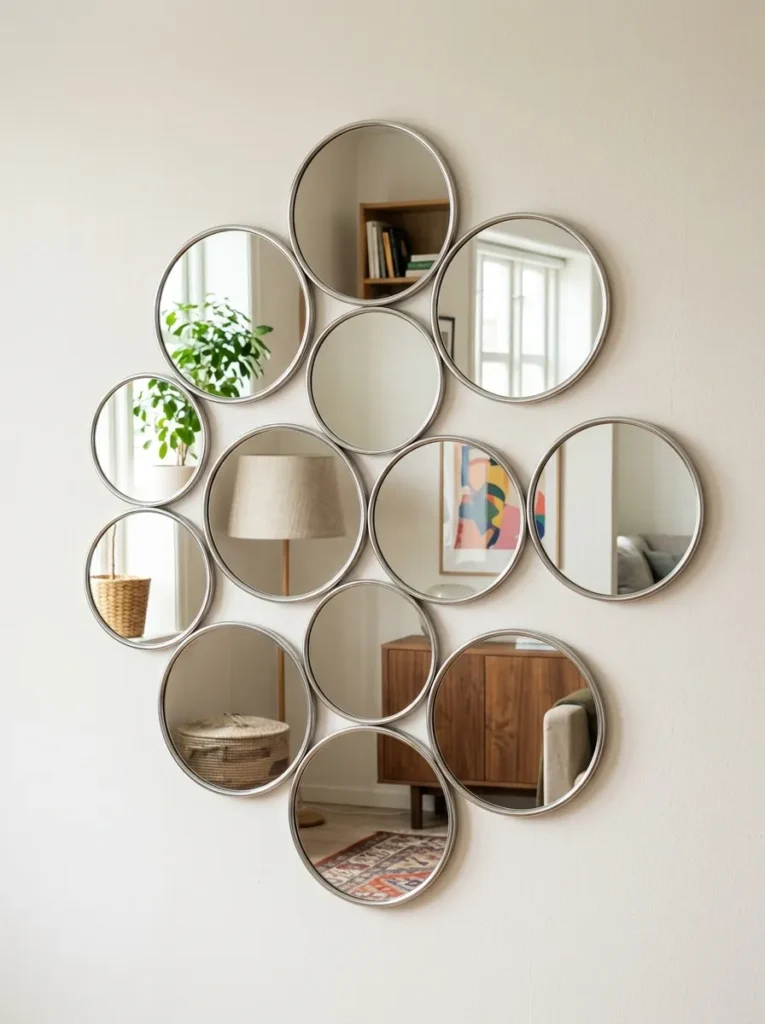
Vibe: The LOTS mirror gallery feels like a wall of small moons — the silver circle repetition creating a graphic composition that is simultaneously minimal and visually rich.
Why it works: A clustered gallery of small LOTS mirrors applies the multiplication principle of unit repetition — a single 25cm LOTS mirror reads as a decorative object; nine to twelve of the same mirror arranged as a cluster reads as a design installation. The repetition converts the individual object’s limitations (too small to serve as a functional mirror, too simple to be decorative alone) into a collective strength — the cluster creates scale from small units, visual richness from repetition, and the specific optical interest of multiple simultaneous reflections that each shows a different fragment of the same room. The hexagonal close-packing arrangement (mirrors arranged so that each mirror’s edge is approximately tangent to its neighbors) creates a honeycombed composition that references natural tessellation.
How to get it: Purchase nine to twelve LOTS mirrors (check current IKEA availability as product ranges change — equivalents from other retailers at similar prices work equally well). Lay the mirrors out on the floor in the intended arrangement before marking any wall positions. For a nine-mirror arrangement, a 3×3 grid with 5cm gaps between mirrors requires approximately 85×85cm of wall space. Mark the center of each mirror position using a pencil before hanging — use a cardboard template (a circle cut to the mirror’s diameter) to mark positions consistently. Hang using small picture hooks or strong adhesive strips rated for the mirror’s weight.
Shop The Look
| Product |
|---|
| IKEA LOTS mirror small set |
| Picture hook set small wall |
| Circular cardboard template positioning |
| Adhesive mirror mount strip set |
| Level tool small for precise hanging |
3. Painted Frame Upgrade — Gold Spray Transformed LANGESUND
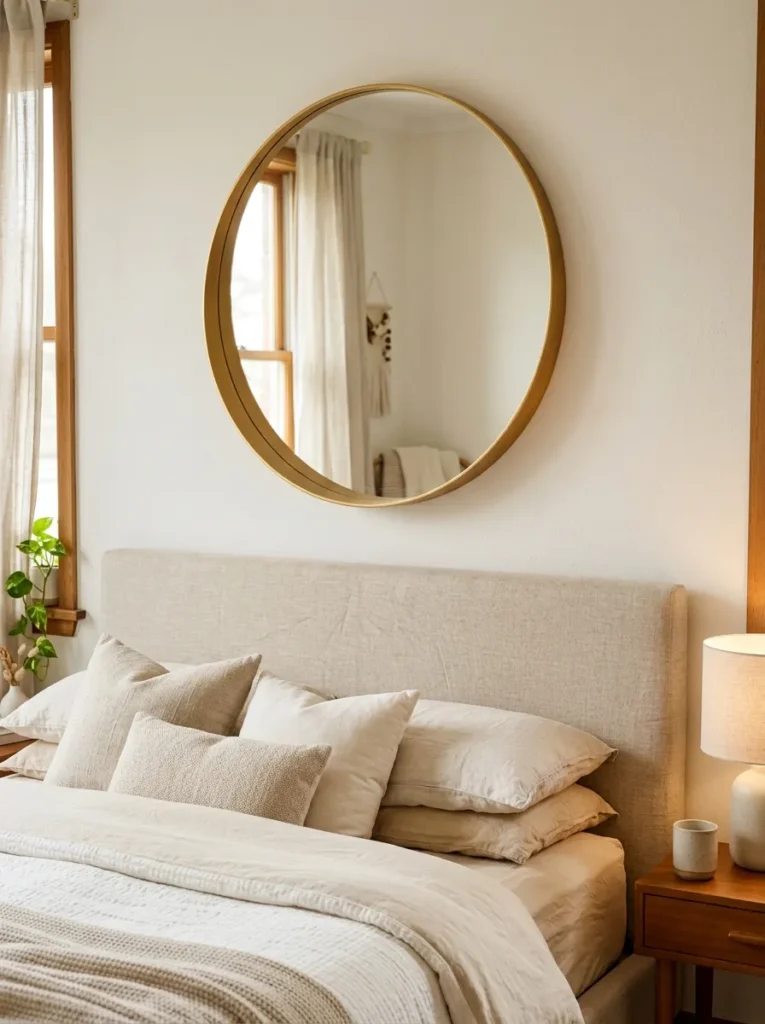
Vibe: The gold-painted mirror feels like an upgrade that cost ten times what it did — the warm matte gold frame reading as a boutique furniture finish rather than a spray-painted DIY.
Why it works: A gold spray-painted frame on an IKEA round mirror applies the material finish upgrade principle — the mirror’s glass and the circular form remain unchanged, but the frame’s color conversion from the original flat black or white to a warm matte gold transforms the object’s perceived material register from IKEA-contemporary to designer-boutique. Warm matte gold (not shiny metallic gold, which reads as craft glitter) specifically references the aged gilded finish of antique frames and the satin brass hardware of premium interior fixtures — it is warm enough to be associated with genuine metallic material while matte enough to read as sophisticated rather than decorative. This transformation costs under $10 in spray paint and takes under one hour.
How to get it: Remove the mirror glass from its frame (most IKEA round mirrors have a simple clip-and-slot back panel system that allows glass removal without tools). Place the empty frame face-down on newspaper in a well-ventilated outdoor space. Apply two light coats of warm matte gold spray paint (Rust-Oleum Warm Gold Matte, Montana Gold, or similar warm-toned metallic matte spray) to the frame interior channel and visible front face, allowing complete drying between coats. Replace the glass. The key specification is “matte” or “satin” rather than “metallic” or “gloss” — the sheen level determines whether the frame reads as authentic aged metal or as spray-painted craft material.
Shop The Look
| Product |
|---|
| IKEA LANGESUND mirror 55cm |
| Warm gold matte spray paint |
| Newspaper floor protection |
| Small screwdriver mirror glass removal |
| Adhesive mirror wall hook set |
4. Bathroom Vanity Mirror — LOTS or LANGESUND Above a Vessel Sink
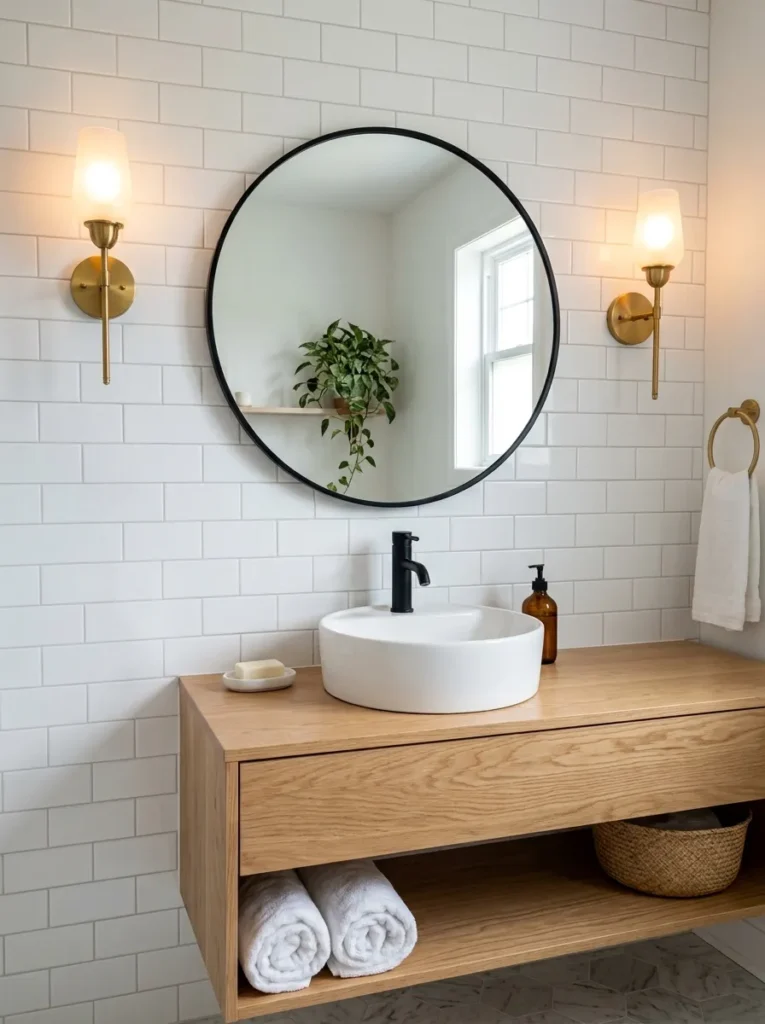
Vibe: The bathroom vanity mirror feels like a renovation-grade result from an IKEA purchase — the centered mirror, flanking sconces, and tile behind reading as a designed bathroom rather than an assembled one.
Why it works: An IKEA round mirror above a bathroom vanity applies the vanity mirror principle of functional centeredness — the mirror must be centered on the sink (not on the wall width if the sink is not centered) and positioned at the correct height for the primary user (center of mirror at 155–170cm from floor for average adult use). The flanking sconces are the critical addition that converts a mirror on a wall into a vanity composition — sconces on either side of a bathroom mirror provide the even, shadow-free facial illumination that overhead lighting cannot, because they illuminate the face from the sides rather than from above (which creates under-eye shadows). The specific IKEA round mirror is appropriate for a bathroom vanity in sizes between 40 and 75cm — smaller reads as insufficient for practical use, larger dominates a standard single-sink vanity.
How to get it: Center the mirror on the sink’s horizontal axis (mark the sink’s center point and use a plumb line to project this point up to the mirror mounting height). Install two wall sconces at equal distances from the mirror’s edge (15–20cm from the mirror edge, at a height where the sconce center is at approximately 155cm from the floor — eye level for the primary user). Specify warm-white bulbs (2700K) in both sconces for the most flattering facial illumination. In a bathroom application, ensure the IKEA mirror is mounted using appropriate bathroom-rated adhesive hooks or rust-resistant stainless mirror fixings.
Shop The Look
| Product |
|---|
| IKEA LANGESUND mirror black 55cm |
| Brass wall sconce pair bathroom |
| White ceramic vessel sink |
| Natural oak vanity cabinet |
| Warm white LED bulb E14 2700K |
5. Leaning Large Format Mirror in a Living Room Corner
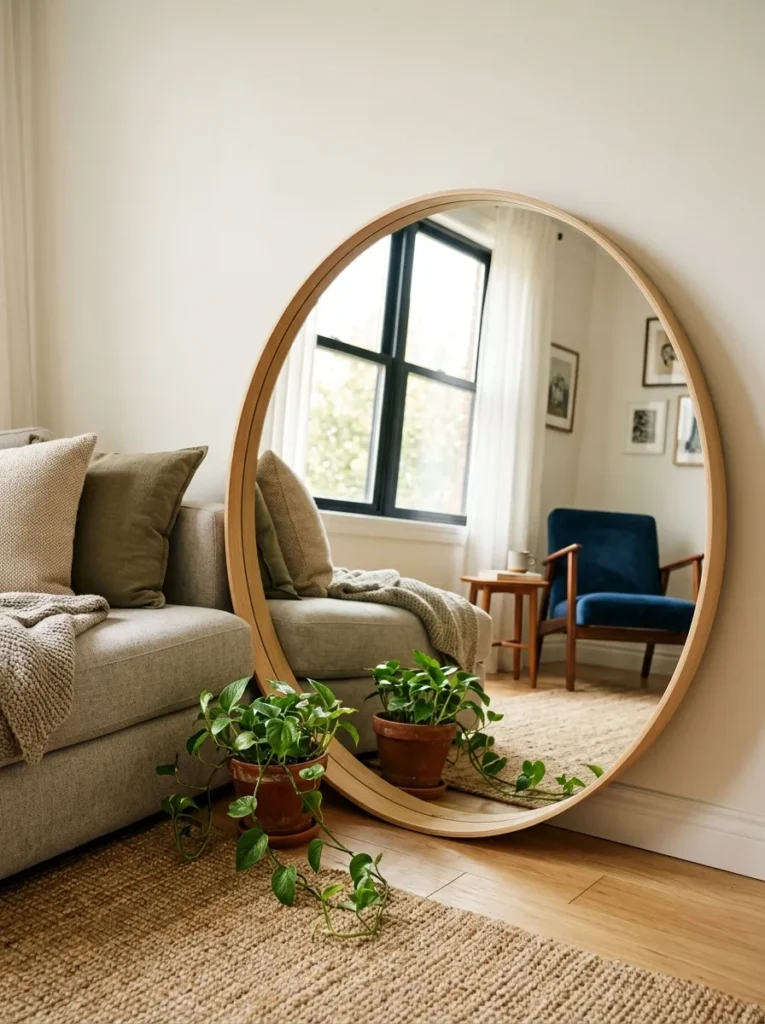
Vibe: The leaning round mirror feels deliberately casual — the choice to lean rather than hang communicating a specific aesthetic confidence that hanging alone does not.
Why it works: A large round mirror leaning against a living room wall applies the casual luxury principle of deliberate informality — a leaning mirror signals that the decorator chose to lean it as an aesthetic decision (rather than as a practical concession to avoiding drilling), because any large mirror could be hung but not all mirrors are chosen to lean. The leaning position creates two distinct advantages: a slight forward tilt (approximately 10 degrees from vertical) that directs the reflection downward toward the room’s floor and seating level rather than straight across the room — which is more flattering to the room’s composition — and the visual interest of the mirror frame’s lower edge resting on the floor, which extends the mirror’s apparent presence from mid-wall to floor level. A small trailing plant or a single ceramic object placed beside the mirror’s lower edge anchors it and prevents the leaning position from reading as unmounted or unfinished.
How to get it: For safety, a large leaning mirror (75cm+ diameter, which may weigh 3–5kg) should be secured with a small piece of furniture-to-wall strap (the same anti-tip straps used for wardrobes and bookcases) attached invisibly behind the mirror — this prevents the mirror from being knocked forward in a household with children or pets. Style the mirror’s base by placing a small trailing plant (pothos, string of hearts, or a draping vine) in a ceramic or rattan pot immediately beside the mirror’s lower edge, allowing the plant’s trailing stems to partially overlap the mirror’s base.
Shop The Look
| Product |
|---|
| Large round mirror 75cm natural frame |
| Anti-tip furniture strap safety |
| Trailing pothos plant small ceramic |
| Small rattan pot mirror base |
| Floor protector pad felt base |
6. Macramé-Framed Mirror DIY Transformation
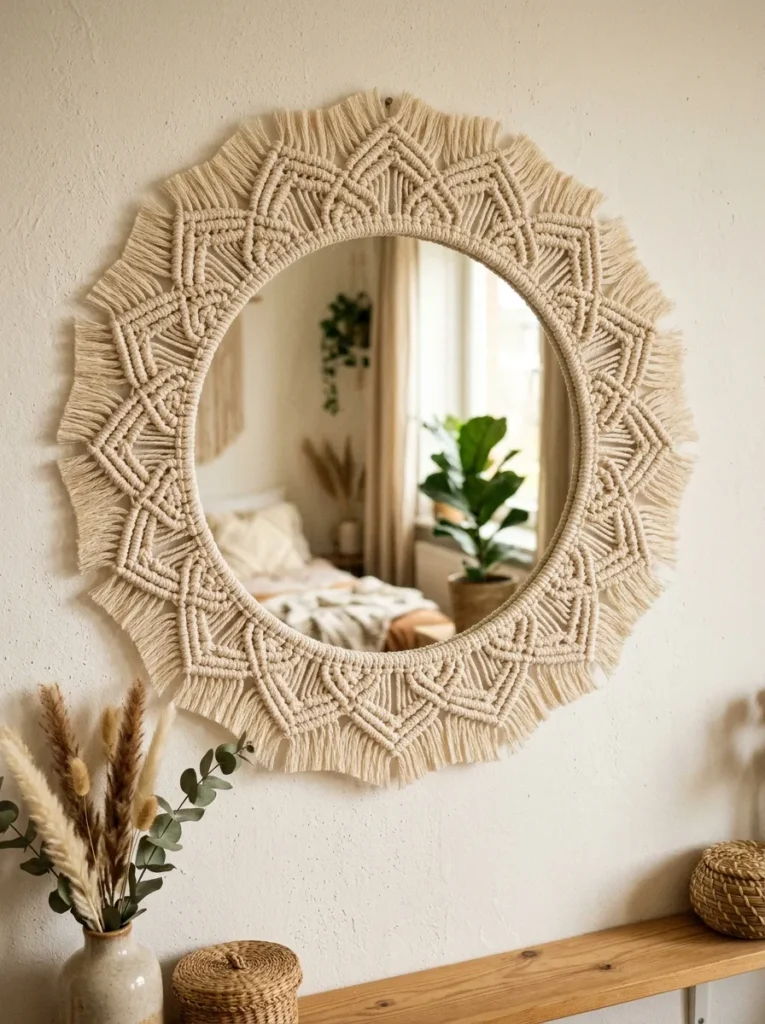
Vibe: The macramé-framed mirror feels like a craft project that became genuinely beautiful — the natural cord surround converting the IKEA mirror into something that reads as artisanal wall art.
Why it works: A DIY macramé frame added to an IKEA round mirror applies the material enrichment principle — the mirror’s thin original frame disappears visually within the macramé extension, and the natural cotton cord radiating outward from the mirror’s circumference creates an entirely new visual profile that converts the object from a simple round mirror into a textile-framed mirror-and-macramé composition. The extended diameter (from 55cm mirror to approximately 80cm total composition) creates significantly more wall presence than the mirror alone, and the organic irregularity of handmade macramé knotting gives the piece the artisanal quality that mass-produced alternatives cannot replicate. This transformation costs approximately $15–25 in materials and 3–5 hours of macramé work.
How to get it: Cut 16 lengths of 3mm natural cotton macramé cord, each approximately 80cm long. Fold each length in half and attach to the mirror’s frame edge using lark’s head knots spaced evenly around the full circumference. Work a simple half-hitch or square knot pattern around each cord pair for 8–10cm of knotted extension, then allow the remaining cord length to hang as fringe if desired or trim to a consistent circular profile. Attach two additional hanging cords at the top of the composition for wall mounting. The critical technique detail is distributing the lark’s head knots at precise equal intervals — uneven spacing produces a wavy rather than circular extension.
Shop The Look
| Product |
|---|
| IKEA LANGESUND mirror 55cm |
| Natural cotton macramé cord 3mm |
| Large tapestry needle cord attachment |
| Scissors craft precision |
| Dried pampas grass stem display |
7. Stacked Vertical Mirror Arrangement for a Bedroom Wall
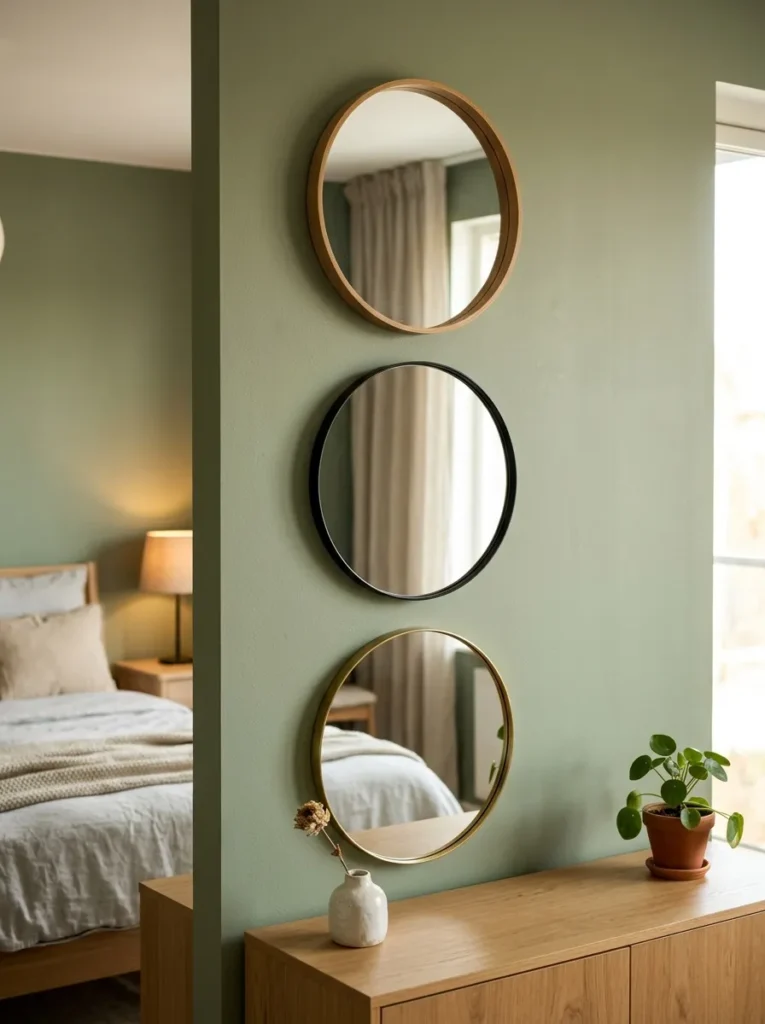
Vibe: The vertical mirror stack feels like a composed accent wall created from three objects — the stack more architecturally significant than a single mirror while being more restrained than a gallery wall.
Why it works: A vertical stack of three round mirrors applies the design principle of directional repetition — three identical or similar forms arranged in a vertical line create a visual column that emphasizes the room’s vertical dimension, making the wall and the ceiling feel taller. The deliberate variation in frame finish across the three mirrors (natural wood, thin black, and thin brass, all in the same diameter) prevents the stack from reading as a purchased matching set while maintaining the cohesion of identical form and size. Fifteen-centimetre gaps between each mirror (approximately the diameter of the mirror divided by 2.5–3) is the correct gap proportion — tighter gaps read as a single multi-element object, wider gaps read as unrelated mirrors.
How to get it: Select three round mirrors of the same diameter (40cm is optimal for a bedroom vertical stack — large enough to be individually significant but small enough for three to fit comfortably on a standard wall section without exceeding 240cm in total height including gaps). Choose three different frame finishes from IKEA’s available range or supplement IKEA mirrors with equivalents from other retailers to achieve the finish variation. Measure and mark the wall positions carefully before hanging — the vertical alignment of the three mirrors’ centers on the same vertical axis is the critical precision that makes the stack read as intentional.
Shop The Look
| Product |
|---|
| Round mirror 40cm natural wood frame |
| Round mirror 40cm thin black frame |
| Round mirror 40cm thin brass frame |
| Sage green bedroom wall paint |
| Small ceramic object sideboard display |
8. Bathroom Trio — Three LOTS Mirrors Above a Long Vanity
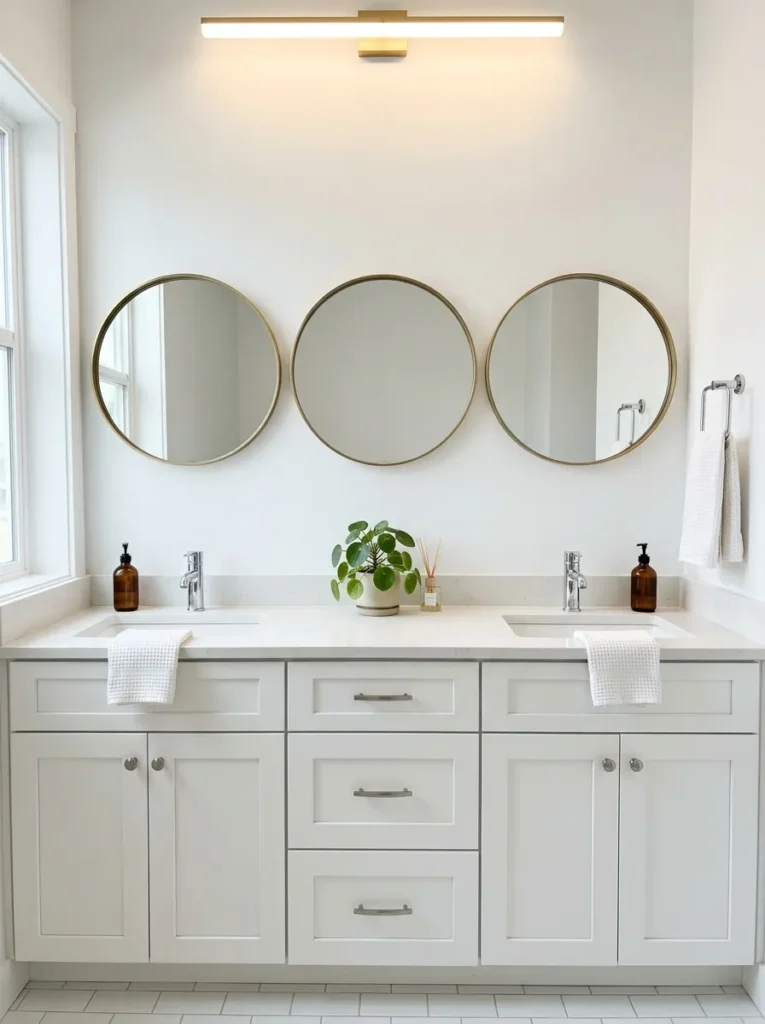
Vibe: The three-mirror bathroom vanity feels like a boutique hotel bathroom — the trio of round mirrors above the long vanity reading as a designed bathroom specification rather than a purchased solution.
Why it works: Three round mirrors spaced across a long bathroom vanity apply the series repetition principle at the bathroom scale — a single large rectangular mirror above a double vanity reads as functional and standard; three round mirrors at equal intervals reads as a designed specification that references both commercial bathroom design (where individual mirrors above individual vanity positions are standard in hotel and spa bathrooms) and the contemporary round mirror trend in residential design. The three mirrors also provide better functional coverage for two-person simultaneous vanity use than a single centered mirror — each user has their own immediately-in-front-of-them mirror rather than sharing one central reflection.
How to get it: Measure the vanity width and divide by four to find the center points for three equally spaced mirrors (dividing by four, not three, ensures the outer mirrors are not too close to the vanity’s edges). Mark these three center points on the wall at 165cm height. The three IKEA LOTS (40cm) mirrors in a consistent frame finish provide the three-mirror bathroom composition at the most accessible price point. An alternative using three LANGESUND (55cm) mirrors provides greater scale and more practical mirror surface for a wide vanity — ensure the three mirror circles do not overlap at this larger size.
Shop The Look
| Product |
|---|
| IKEA LOTS or round mirror set 3 matching |
| White shaker vanity cabinet double |
| Undermount sink set double |
| Chrome or brass soap dispenser set |
| Small plant bathroom ceramic pot |
9. Bedroom Statement — Large Round Mirror Behind the Bedhead
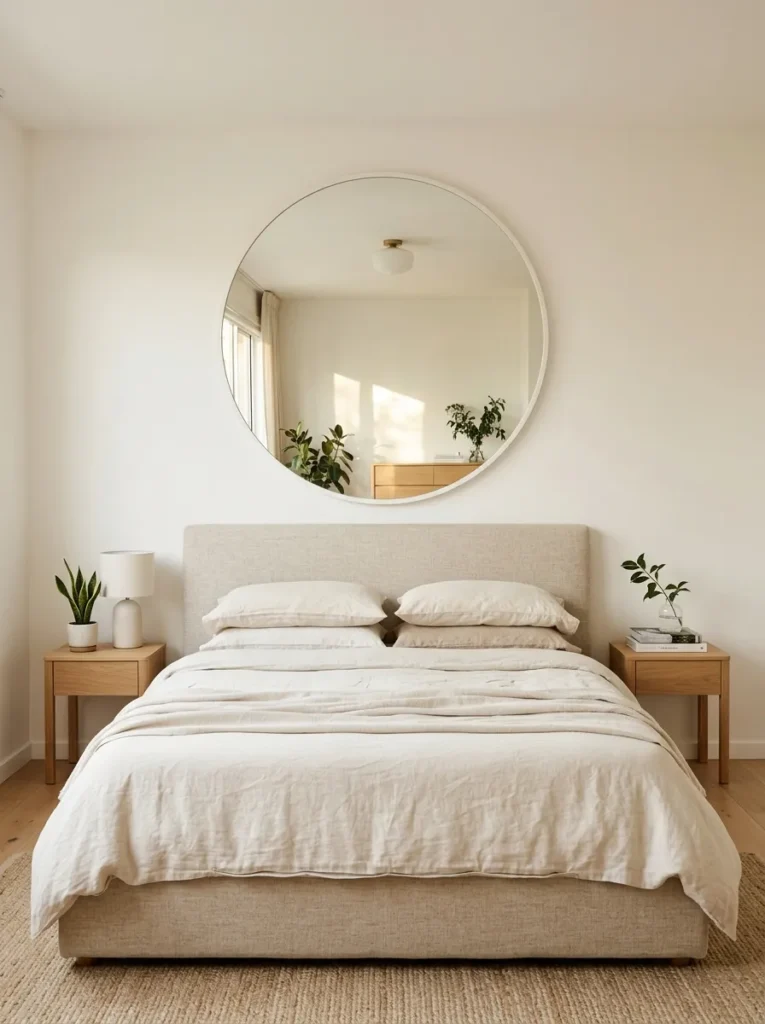
Vibe: The large bedroom mirror behind the bedhead feels like a porthole into the room itself — the circle creating a composed window that makes the wall appear to open behind the bed.
Why it works: A large round mirror centered above a bedhead applies the architectural punctuation principle — the round mirror above the bed functions as a circular aperture that terminates the headboard wall’s vertical surface at the bed’s axis, creating the visual equivalent of a circular window. This effect is particularly powerful when the mirror reflects a window from the opposite wall, creating the impression of two windows — one real, one reflected — that significantly increases the perceived light and space in the bedroom. The 20cm clearance between the bedhead top and the mirror’s lower edge is critical — less than this and the mirror appears to rest on the bedhead; more than this and the mirror appears unrelated to the bedhead composition below it.
How to get it: The IKEA BJÖRKSTA or a large-format equivalent at 75–90cm diameter is the appropriate scale for a standard double or king bed with a headboard in the 150–180cm width range. Center precisely on the headboard’s central axis — use a plumb line or a phone-based level app to ensure the mirror’s center is on the same vertical axis as the headboard’s center. Mount using appropriate fixings for the mirror weight — a 75cm+ mirror may weigh 4–7kg and requires stud-fixed or heavy-duty drywall anchor fixings rather than adhesive strips.
Shop The Look
| Product |
|---|
| Large round mirror 75cm natural frame |
| Heavy duty mirror wall fixing set |
| Upholstered bedhead linen natural |
| Natural linen duvet cover set |
| Small bedside plant ceramic pot |
10. Arch-Effect Tall Narrow Mirror in a Hallway
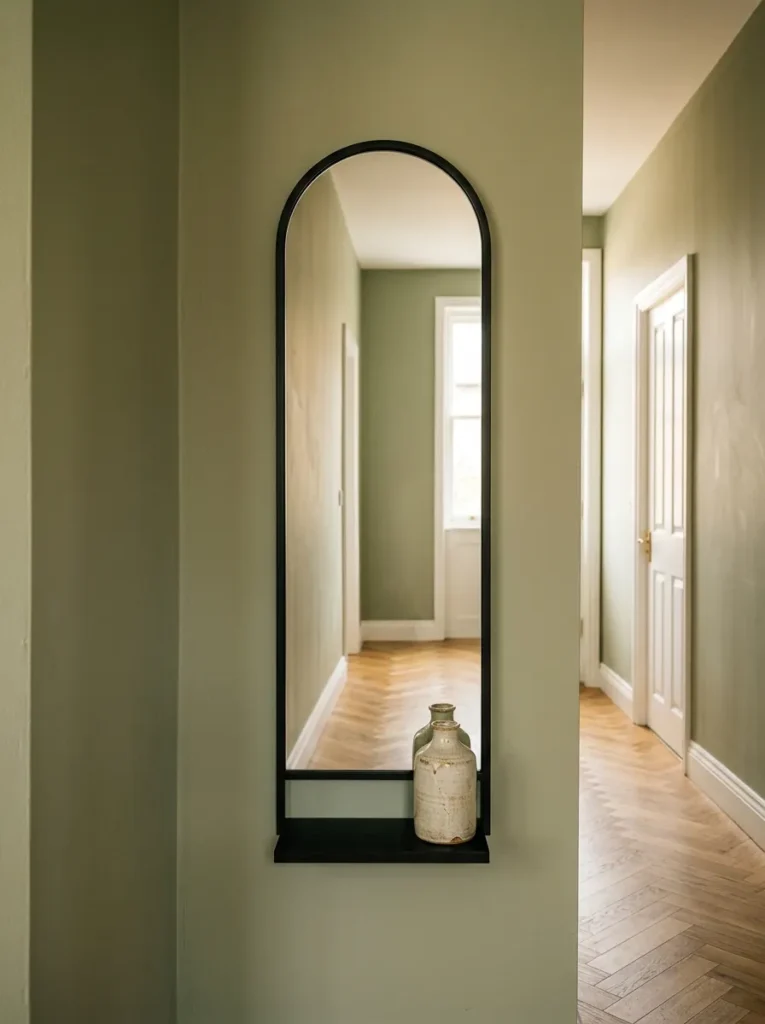
Vibe: The arch-top hallway mirror feels like the hallway was always meant to have an arch — the tall narrow proportion solving the corridor’s spatial challenge through form rather than decoration.
Why it works: A tall arch-topped mirror in a narrow hallway applies the vertical proportion exaggeration principle — in a narrow corridor where the horizontal dimension is constrained, a tall narrow mirror emphasizes the vertical dimension and makes the hallway feel higher and more generous than its actual dimensions. The arch top adds an architectural reference (arched doorways, arched windows, arched alcoves) that elevates the mirror from a functional reflective surface to an architectural punctuation that suggests a designed decision rather than a practical installation. This is the application where IKEA’s round mirror range is supplemented — the arch-top effect is created either by sourcing a genuine arch-top mirror from IKEA’s wider range or by pairing a standard round mirror with a shaped panel above it in a matching finish.
How to get it: Source a tall arch-topped mirror (IKEA offers several non-circular arch-profile mirrors in their range; alternatively, specialist mirror retailers produce arch-top mirrors in the 40×120cm format). Mount so the mirror’s top arch falls approximately 30cm below the ceiling — this relationship of mirror to ceiling creates the most architecturally resolved proportion. Add a small narrow wall shelf at 90–100cm height directly below the mirror (a 15cm deep shelf is sufficient for a hallway accent object without becoming an obstacle in a narrow corridor).
Shop The Look
| Product |
|---|
| Arch top tall narrow mirror 40x120cm |
| Narrow wall shelf 15cm deep natural |
| Single ceramic vase hallway shelf |
| Mirror mounting picture hook heavy |
| Hallway wall paint warm white |
11. Living Room Sun Mirror — LOTS Mirrors in a Radiating Arrangement
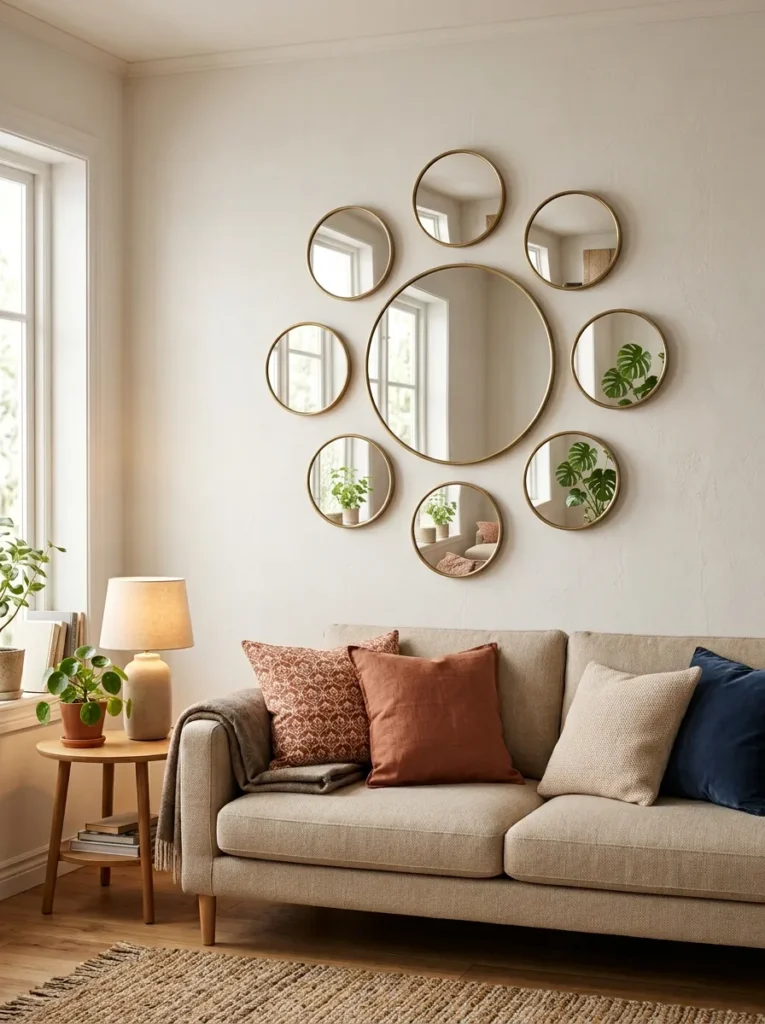
Vibe: The sun mirror arrangement feels like buying a $400 designer sun mirror for $60 — the multi-mirror composition creating the same visual effect as the high-end equivalent at a fraction of its cost.
Why it works: A sun mirror effect created from a central large IKEA mirror surrounded by smaller LOTS mirrors applies the compositional principle of radial symmetry — eight small mirrors positioned at equal angles around a central larger mirror (at 45-degree intervals: north, northeast, east, southeast, south, southwest, west, northwest) create the visual impression of a single large sun or starburst mirror at a total diameter far exceeding any single IKEA mirror. Designer sun mirrors (from brands including Anthropologie, Wayfair, and specialty mirror retailers) retail at $80–400; the IKEA equivalent using one LANGESUND (55cm, ~$25) and eight LOTS ($8 each, total ~$64) costs approximately $90 in mirrors — with significantly more visual impact.
How to get it: Use a large piece of paper or directly on the wall (with temporary tape marking) to plan the arrangement: mark the central mirror’s position, then mark the eight satellite positions at equal radial distances from the central mirror’s edge (a gap of 8–12cm between the central mirror’s edge and each satellite mirror’s edge reads as composed sun-mirror proportion). The critical precision is equal radial distance from center to each satellite mirror’s center — use a ruler and a compass or string-and-pencil compass technique to mark positions accurately.
Shop The Look
| Product |
|---|
| IKEA LANGESUND 55cm central mirror |
| IKEA LOTS small mirror set 8 |
| String and pencil compass positioning |
| Picture hook set small multiple |
| Warm white wall paint living room |
12. Kitchen Backsplash Mirror Panel — Small Round Accents
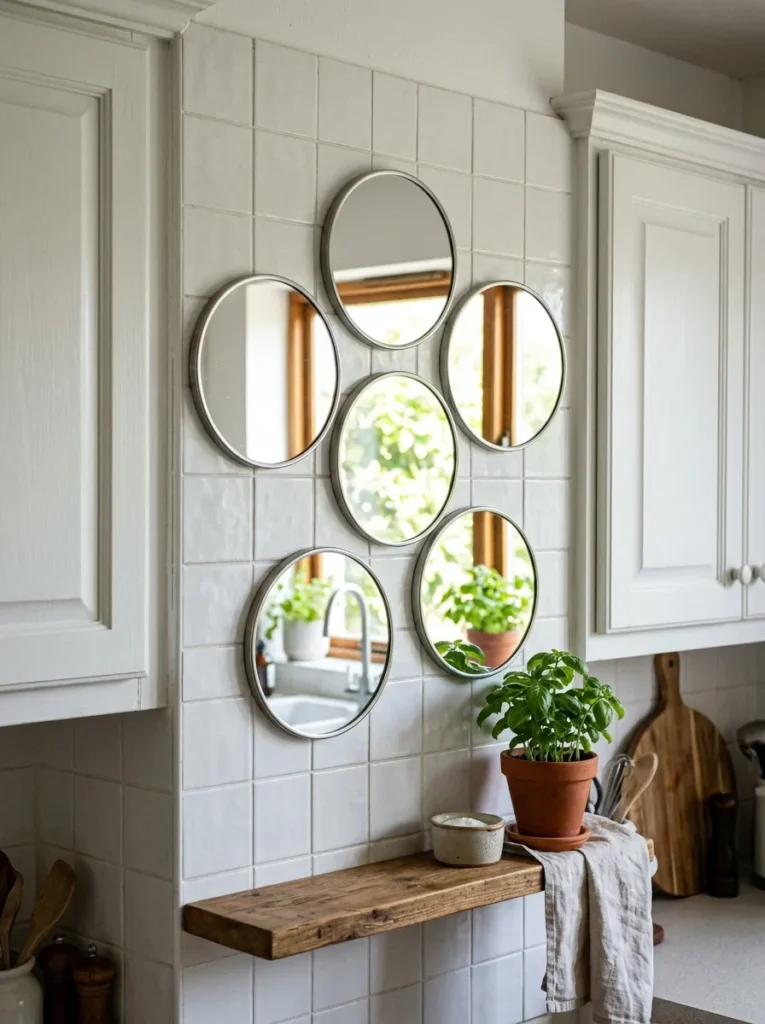
Vibe: The kitchen mirror cluster feels like bringing a window to a wall that doesn’t have one — the reflected light making the kitchen’s enclosed wall section feel open and bright.
Why it works: Small round mirror accents on a kitchen wall section between cabinets apply the light amplification principle of strategic reflection — kitchen areas that lack natural light (typically the wall opposite a window, or walls without windows) benefit dramatically from mirror placement that reflects the available natural light into the darker zone. Three to five small mirrors between upper cabinet sections capture the kitchen’s window light and reflect it across the enclosed wall area, increasing the perceived brightness of that section by creating multiple reflected light sources where only one primary source existed. This is one of the highest functional-to-decorative value mirror applications in the entire list because it simultaneously decorates an often-neglected wall section and genuinely improves the kitchen’s working light quality.
How to get it: Assess the kitchen wall section between upper cabinets for available space and light conditions. Identify the angle from which the kitchen’s primary natural light source (window) would be reflected into the target wall section — the mirrors must be positioned to capture this reflection. Arrange three to five LOTS mirrors in a loose, organic cluster (rather than a rigid grid) between the cabinet sections. In a kitchen environment, use rust-resistant stainless mirror fixings and avoid adhesive strips that may fail in a humid, steam-adjacent environment.
Shop The Look
| Product |
|---|
| IKEA LOTS mirror small set |
| Stainless mirror fixing screw set |
| Small herb pot kitchen ceramic |
| Kitchen wall paint white warm |
| Level tool small kitchen use |
13. Children’s Room Low-Mounted Mirror for Independence
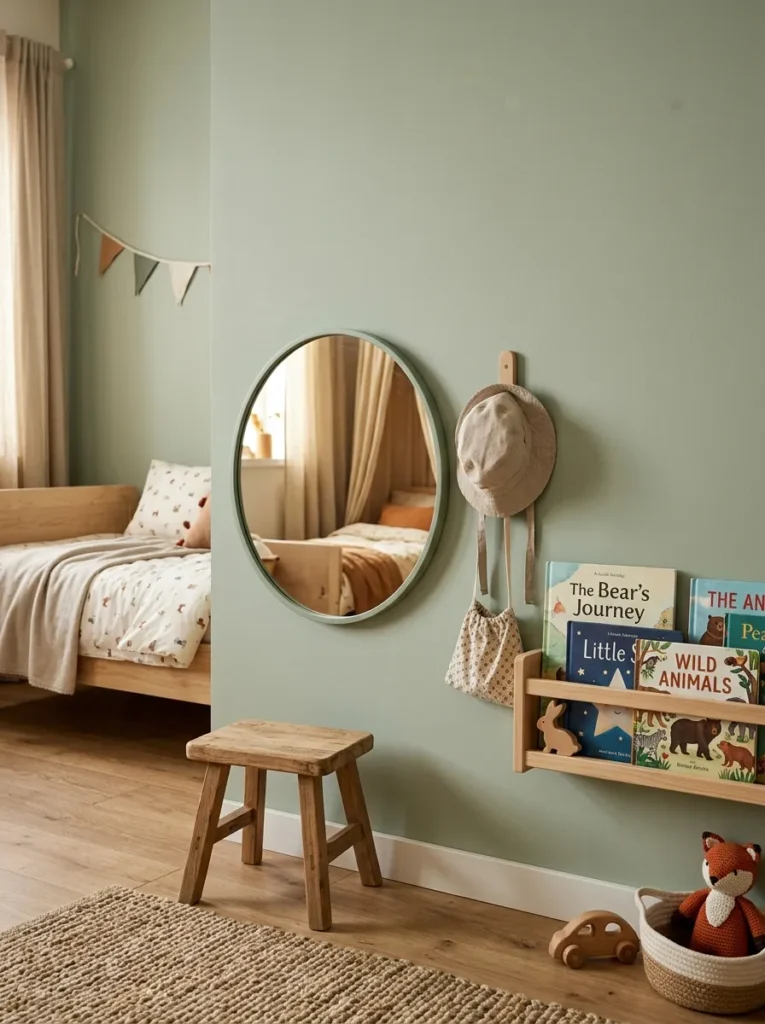
Vibe: The child-height mirror feels like furniture designed for the person who lives in the room — the low mounting acknowledging the child’s scale in a way that adult-height mirrors cannot.
Why it works: A low-mounted round mirror in a children’s room applies the Montessori-influenced design principle of child-scale environmental provision — children in rooms with mirrors at adult height have no functional mirror access and are implicitly told that the room’s furnishings are for adult use. A mirror mounted at the child’s eye height (center at 90–110cm from the floor for children aged 3–7) provides functional mirror access for morning routines (hair, clothing, face-checking before leaving for school) and supports the developmental milestone of self-recognition and self-care that children in this age range are actively developing. A small wooden stool below the mirror provides an additional step height for younger children and a sitting position for mirror-adjacent activities.
How to get it: Mount the mirror with its center at 100cm from the floor for the primary user’s age range (adjust to 90cm for younger children, 110–120cm for older primary school age). Choose a colored frame from IKEA’s range — the LOTS mirror is available in limited colors; alternatively, the spray-paint transformation from Idea 3 can apply any color to a thin-framed IKEA mirror for a precisely matched room palette. Add a small double hook beside the mirror at the same child-accessible height for a bag or hat — the mirror-plus-hook combination creates a complete morning-preparation station at child scale.
Shop The Look
| Product |
|---|
| Round mirror 40cm colored frame child |
| Small wooden stool natural child height |
| Double hook wall mount child height |
| Children’s book set shelf display |
| Sage or soft pink bedroom wall paint |
14. Dining Room Glamour — Oversized Mirror Opposite a Window
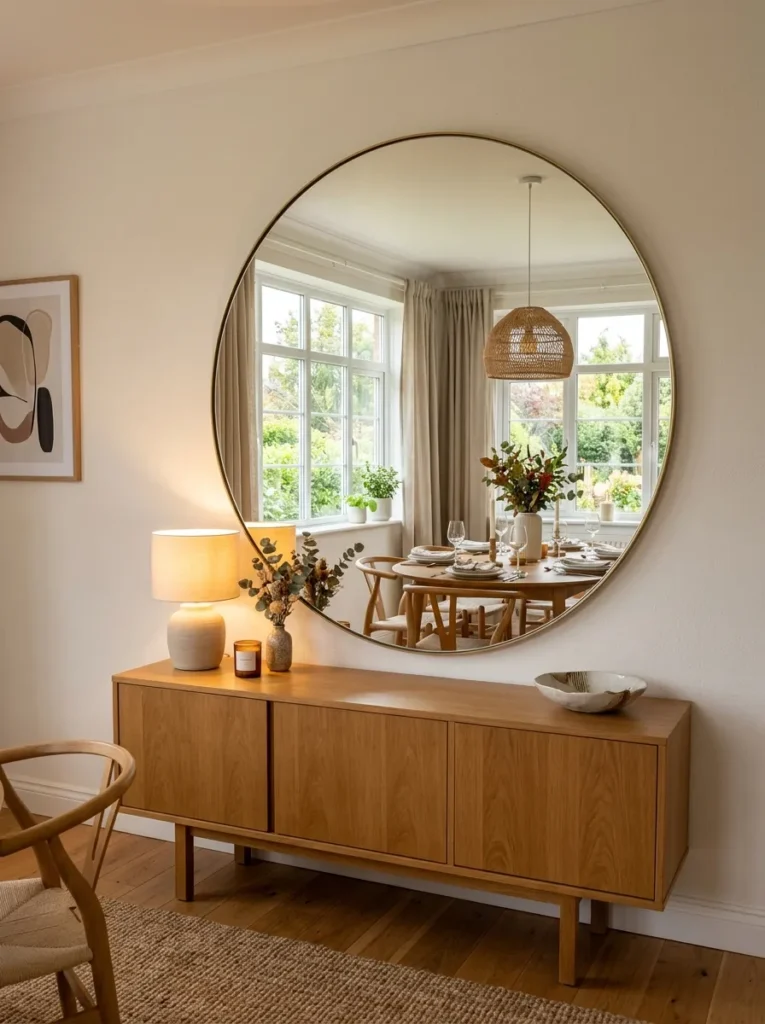
Vibe: The dining room mirror opposite the window feels like the room doubled itself — the large circle reflecting the window, the table, and the room in a composition that makes everything in the space appear more abundant.
Why it works: A large round mirror positioned on the dining room wall directly opposite the primary window applies the spatial multiplication principle of reflective symmetry — a mirror placed precisely opposite a window reflects the window’s entire frame back into the room, creating the visual impression of a second window at the same position. This illusion significantly increases the perceived natural light in the dining room (particularly relevant for rooms with limited windows or north-facing orientation) and creates the impression that the room extends beyond the mirror’s surface, effectively doubling the perceived room depth. The sideboard below the mirror is the compositional anchor that grounds the large circular mirror in relation to a piece of furniture, preventing it from reading as simply a mirror on a wall.
How to get it: Position the mirror with its center at 155cm from the floor (standard picture-hanging height) on the wall that directly faces the dining room’s primary window — the mirror’s center should align with the window’s horizontal center as closely as the room’s layout allows. A mirror diameter of 75–100cm is appropriate for a standard dining room window — smaller and the reflected window appears to float in excess mirror glass; larger and the mirror visually dominates the dining room wall at the expense of the sideboard and other wall elements. The thin gold or warm brass frame is the specifically appropriate finish for a dining room application because its warm metallic quality references both antique European mirror traditions and the warm, celebratory register of dining room design.
Shop The Look
| Product |
|---|
| Large round mirror 90cm gold frame |
| Sideboard natural wood dining room |
| Heavy duty mirror wall fixing |
| Small candle holder sideboard display |
| Dining room warm white wall paint |
15. Mixed Material Gallery — Round Mirrors with Art and Plants
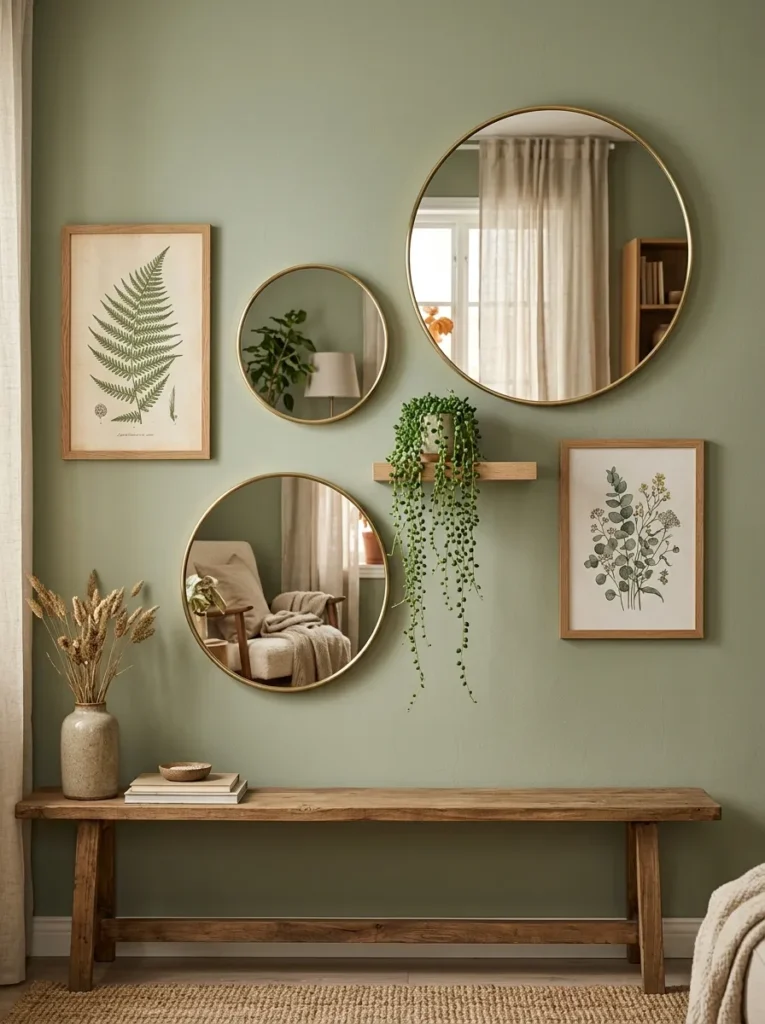
Vibe: The mixed gallery wall feels like the room’s personality condensed to one arrangement — mirrors, art, and living plant together creating a gallery that is simultaneously reflective, illustrated, and alive.
Why it works: A mixed material gallery wall combining round mirrors, framed art, and a mounted plant applies the design principle of medium diversity within palette unity — three different object types (reflective mirrors, flat framed prints, and a three-dimensional living plant) create visual interest through their material differences (transparency, print surface, living organic form) while the warm botanical palette of the prints, the natural frames, and the trailing plant creates the color and material unity that makes the diverse arrangement read as a single composed gallery rather than random objects on a wall. The round mirrors in the composition reflect the room back into the gallery arrangement — the gallery is not just a wall display but an active participant in the room’s spatial experience.
How to get it: Plan the arrangement on the floor before committing to wall positions — lay out all three mirrors, two botanical print frames, and a small wall shelf in the intended arrangement. The composition should have one “anchor” (the 55cm mirror or the largest print) that establishes the gallery’s center of visual gravity, with all other elements distributed around this anchor at appropriate distances. The wall-mounted plant shelf (a small 15cm floating shelf holding a ceramic pot with a trailing plant) provides the only living element in the composition and should be positioned where its trailing stems can cascade downward without overlapping adjacent mirrors or prints.
Shop The Look
| Product |
|---|
| IKEA LANGESUND 55cm mirror varied frame |
| IKEA LOTS 25cm mirror natural frame |
| Round 40cm mirror thin black frame |
| Botanical framed print set 2 |
| Small wall shelf 15cm trailing plant |
How to Start Your IKEA Round Mirror Styling Practice
The single best first move in any IKEA round mirror project is purchasing one mirror and holding it against the intended wall before committing to any hanging — moving the mirror to different heights, different positions, and different adjacencies on the wall to understand how the room changes with the mirror in different positions. The round mirror’s reflection changes significantly with height and angle (at lower positions it reflects the floor and furniture; at higher positions it reflects the ceiling and upper room; at exactly the right height for the specific space it reflects the room’s most interesting elements and creates the spatial expansion that makes a well-placed mirror genuinely transformative). This physical test, which takes twenty minutes, prevents the most common mirror placement mistake — hanging at an arbitrary height rather than at the height where the mirror’s reflection contributes most to the room’s quality.
The most common mistake in IKEA round mirror styling is hanging the mirror too high. The instinct (particularly in rooms with high or standard ceiling heights) is to hang mirrors at the level of picture frames — approximately 145–155cm center height for a single mirror. This height positions the mirror’s reflection at approximately chest height for a standing adult — reflecting neither the room’s furniture arrangement (which requires a lower position) nor the room’s ceiling and architecture (which requires a higher position). The correct hanging height for most decorative room applications (not functional bathroom vanity use, which requires center at eye height) is slightly lower than instinct suggests: center at 130–145cm, which places the reflection at the room’s most visually interesting zone — furniture, people’s faces when seated, and the junction between furniture and the lower wall.
Three specific items under $50 that enable the most impactful IKEA round mirror styles: the IKEA LANGESUND mirror at 55cm ($19.99 or equivalent — the single most versatile size in IKEA’s round mirror range, appropriate for entryways, bedrooms, and bathroom vanities as a solo piece and for gallery arrangements as an anchor element); a can of warm matte gold spray paint ($8–12, which transforms the original frame of any IKEA round mirror into a designer-quality finish in under an hour); and a packet of twelve strong adhesive picture strips ($8–12, which allow experimental placement — hanging and repositioning the mirror before committing to a permanent hook position). These three items combined for under $40 enable Ideas 1, 3, and 5 of this list and provide the foundation for all subsequent mirror styling experiments.
A simple solo mirror installation (Ideas 1, 9, 14) takes under an hour including the physical placement test and costs $20–35 in mirror and fixing materials. A grouped gallery arrangement (Ideas 2, 7, 11, 15) takes 2–4 hours including floor planning and hanging, costing $40–90 for the mirror set. A DIY transformation project (Ideas 3, 6) takes 3–6 hours including drying time, costing $25–45 in mirror and transformation materials. Every project in this list is achievable by a maker with basic hanging tools (a pencil, a ruler, a level, a screwdriver, and a hammer) — no specialist equipment is required for any idea in this list.
Frequently Asked Questions About IKEA Round Mirror Styling
What size IKEA round mirror is most versatile?
The 55cm diameter round mirror (currently available as the KNAPPER or LANGESUND in IKEA’s range, or close equivalents) is the most versatile size across the applications in this list. At 55cm, the mirror is large enough to serve as a functional vanity mirror for adults when mounted at the correct height, large enough to read as a solo decorative statement in a bedroom or entryway, and small enough to be combined in grouped arrangements without individual mirrors overwhelming adjacent elements. For hallways under 90cm wide, the 40cm format is more proportionally appropriate. For large statement applications (dining room, living room above a sofa, or bedroom behind a bedhead), a 75cm+ format provides the scale necessary for the mirror to read as a room-defining element rather than an accent.
How do you hang an IKEA round mirror without drilling?
IKEA round mirrors in sizes up to 55cm can be reliably hung using 3M Command Large Picture Hanging Strips (rated for up to 7.25kg per pair, more than sufficient for most round mirrors in this size range). Key requirements for adhesive strip success: the wall surface must be clean, smooth, painted with standard emulsion paint, and free of textured finishes — adhesive strips fail on textured wallpaper, porous plaster, and masonry surfaces. Allow the adhesive to cure for 24–48 hours before hanging the mirror. Check the mirror’s weight against the strip’s stated rating — most IKEA round mirrors in the 40–55cm range weigh 1.5–3kg, well within the standard Command strip capacity. For mirrors above 55cm, professional-grade adhesive mirror mounts or drywall anchors into studs are the more reliable specification.
Can IKEA round mirrors be used in bathrooms?
Yes — IKEA round mirrors are appropriate for bathroom use with specific considerations. In a steam-generating bathroom environment (shower or bath in the same room), ensure the mirror is mounted using rust-resistant stainless steel fixings rather than standard steel screws (standard steel corrodes in humid environments). Do not use paper or cardboard-backed adhesive strips as the sole fixing in a steam-adjacent environment — humidity degrades adhesive performance. The IKEA mirror’s glass is standard mirror glass (not specially treated for bathroom humidity), which means that in very high-humidity bathrooms, edge-seal degradation (black spotting at the mirror edge) may occur over years — a ventilation fan in the bathroom is the most effective prevention.
How do you style a shelf or console below an IKEA round mirror?
The most consistently successful console or shelf styling beneath a round mirror uses three objects maximum, arranged in a triangular height composition: one taller element (a ceramic vase with a stem, a candle in a tall holder, a small lamp), one medium element (a book, a small tray, a small plant in a ceramic pot), and one low or flat element (a small dish, a single stone, a small framed object). The three objects should be positioned in the center third of the console width — one-third of the surface on each side remains clear — and should not rise higher than the mirror’s lower edge. The most common styling mistake is placing too many objects across the full console width, which makes the console surface read as a display table rather than a composed surface beneath a mirror.
What wall color makes IKEA round mirrors look most stylish?
Round mirrors in thin black frames read most stylishly against warm white, cream, soft sage, and warm charcoal walls — the thin black edge defines the circular form clearly against any warm-toned background. Round mirrors in thin brass or gold frames read most stylishly against warm white, dusty rose, sage green, and warm terracotta — the brass frame’s warmth is complemented by any wall tone with a warm undertone. Round mirrors in natural wood frames read most stylishly against warm white, sage, and pale blue-gray — the natural timber’s organic warmth suits any wall color with a similar organic register. Avoid pairing any metallic-framed round mirror against a cool gray wall — the cool undertone of the wall flattens the mirror’s warm frame and the composition reads as uncoordinated.
Ready to Style Your Dream Mirror Wall?
These 15 ideas move through every dimension of what makes IKEA round mirror styling genuinely impactful — from the solo entry statement and the bathroom vanity composition, to the DIY gold paint transformation and the macramé frame addition, to the sun mirror installation and the mixed gallery wall. Starting with one mirror held against one wall — the physical test before any hanging commitment — is not a cautious beginning. It is the creative act that all the other decisions flow from, because the mirror tells you where it wants to be by what it reflects at each position, and the position where the room looks best in the mirror is the correct position for both the room and the mirror simultaneously. Purchase the LANGESUND or equivalent this week, hold it against your intended wall in the evening light, and let the reflection show you what the room has been waiting to become. Pin the gallery arrangement and the sun mirror ideas for when additional mirrors join the first one, and return to the DIY transformation when the room’s palette has revealed itself fully. When the circle is in place and the reflection is right, the room will feel more complete than it did before — and that is what a well-placed mirror always does.