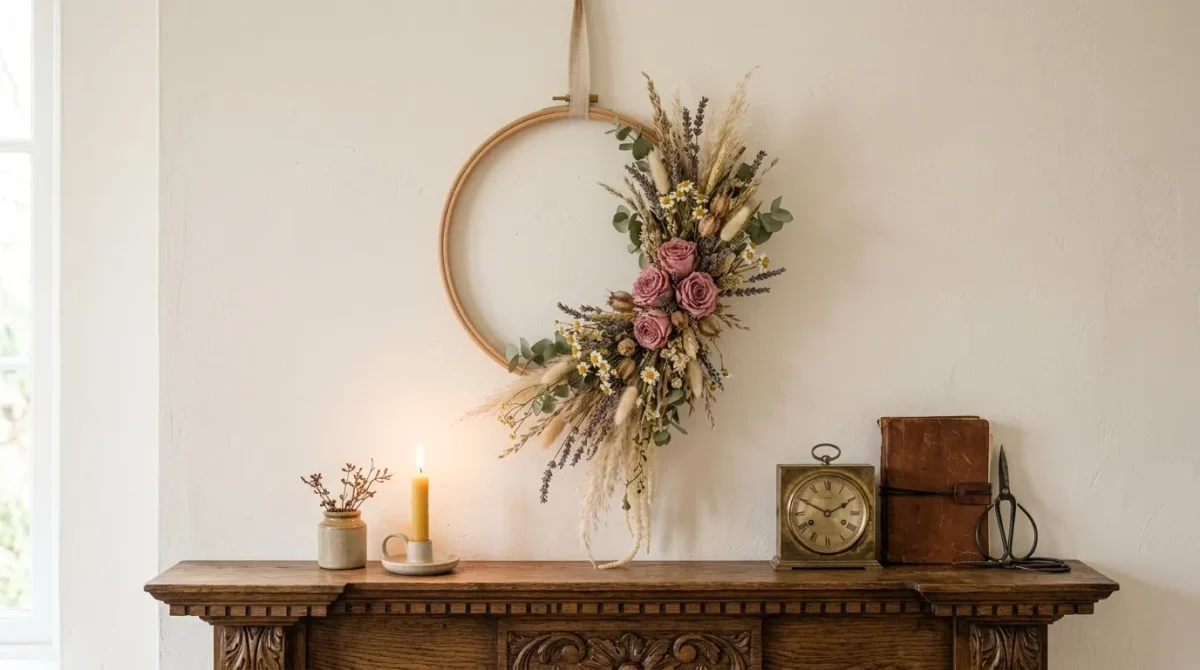
Cottagecore wall decor ideas with modern charm use the botanical, handmade, and nature-referencing visual language of the cottagecore aesthetic — pressed flowers, dried botanicals, embroidery, hand-lettered prints, woven textiles, watercolor, and natural materials — filtered through contemporary design restraint that prevents the style from tipping into nostalgic clutter. This article gives you exactly 13 ideas spanning framed art, textile wall hangings, living plant arrangements, mirror styling, and mixed-media compositions so every home and every taste finds a cottagecore wall approach that feels genuinely current rather than costumed.
Cottagecore done well is not a replica of a 19th-century cottage interior. It is the specific feeling of that interior — the warmth of pressed flowers behind glass, the texture of embroidered linen, the quiet botanical presence of something living on the wall — distilled into the material palette and spatial discipline of a contemporary room. The charm is in the reference, not the reproduction. Here are 13 ideas worth saving — and making.
Why Cottagecore Wall Decor Ideas with Modern Charm Work So Well
The cottagecore aesthetic emerged as a named design and lifestyle category on social media platforms (primarily Tumblr, then Instagram, then TikTok) from approximately 2018 onward, though its visual and material references draw from a much longer tradition — the Arts and Crafts movement of the late 19th century (which similarly celebrated handmade domestic objects, botanical motifs, and natural materials as an antidote to industrial production), the English country house interior tradition, the Scandinavian folk art and textile tradition, and the contemporary slow-living movement that has run parallel to cottagecore in the wellness media since approximately 2015. What distinguishes the contemporary cottagecore aesthetic from its historical predecessors is its self-awareness — it is a deliberate aesthetic choice rather than the default visual register of a specific social class or geographic location, which means it is filtered through contemporary design sensibility even in its most enthusiastic expressions.
The wall decor dimension of cottagecore specifically draws from a rich material palette: dried and pressed botanicals (flowers, ferns, seed heads, herbs) displayed under glass or in hanging bundles; embroidered and cross-stitched textiles mounted as artwork; handmade ceramic and pottery pieces used as wall-mounted objects; woven wall hangings in natural fiber; hand-lettered botanical prints and vintage-style illustrative art; painted botanical and floral art in the loose, gestural style of 19th-century botanical illustration; gathered dried floral wreaths; and living plant arrangements including potted trailing plants mounted at wall height and moss-framed botanical compositions. These materials share a consistent property: they are all organic, either in their literal biology (living plants, dried botanicals) or in their material origin (natural fiber, linen, cotton, undyed wool) and their making method (hand-embroidered, hand-lettered, hand-woven, hand-painted).
The “with modern charm” qualifier in this article’s title is specific and important — it distinguishes the curated, restrained cottagecore wall from the maximalist, accumulative version that can tip into visual overwhelm. Modern charm in a cottagecore context means: a restricted palette (warm whites, sage green, dusty rose, terracotta, warm linen — never all simultaneously), a clear compositional hierarchy on the wall (one primary element plus supporting accents, rather than equal-weight objects competing for attention), the use of negative wall space as an active compositional element (breathing room around a single pressed flower frame elevates it; crowding eliminates that elevation), and a preference for natural materials in their honest, unprocessed state (undyed linen, raw wood frames, dried botanicals without artificial color enhancement) over their decorated or synthetic equivalents.
Small apartments and rented rooms benefit particularly from the cottagecore wall approach because the majority of the ideas in this list require no permanent wall modification — dried botanical bundles hang from a single nail, framed pressed flowers mount on a picture hook, woven hangings attach to a single ceiling hook or command strip, and botanical print galleries use damage-free hanging strips. The honest consideration for very minimalist or contemporary interiors: the cottagecore aesthetic requires a degree of material warmth and organic irregularity that is fundamentally in tension with industrial, high-contrast, or strictly modernist design — the two aesthetics are not incompatible but they require careful material and color bridging, particularly in the choice of frame finishes and botanical color families.
Style at a Glance
| Element | Cottagecore Core | Modern Charm Edge |
|---|---|---|
| Philosophy | Nature-referencing warmth | Restraint prevents clutter |
| Materials | Dried botanical, linen, embroidery, pressed flower | Natural oak frame, plaster wall, raw linen |
| Color Palette | Warm white, sage, dusty rose, warm linen | Terracotta accent, warm charcoal, oa |
1. Pressed Botanical Gallery in Mismatched Natural Frames
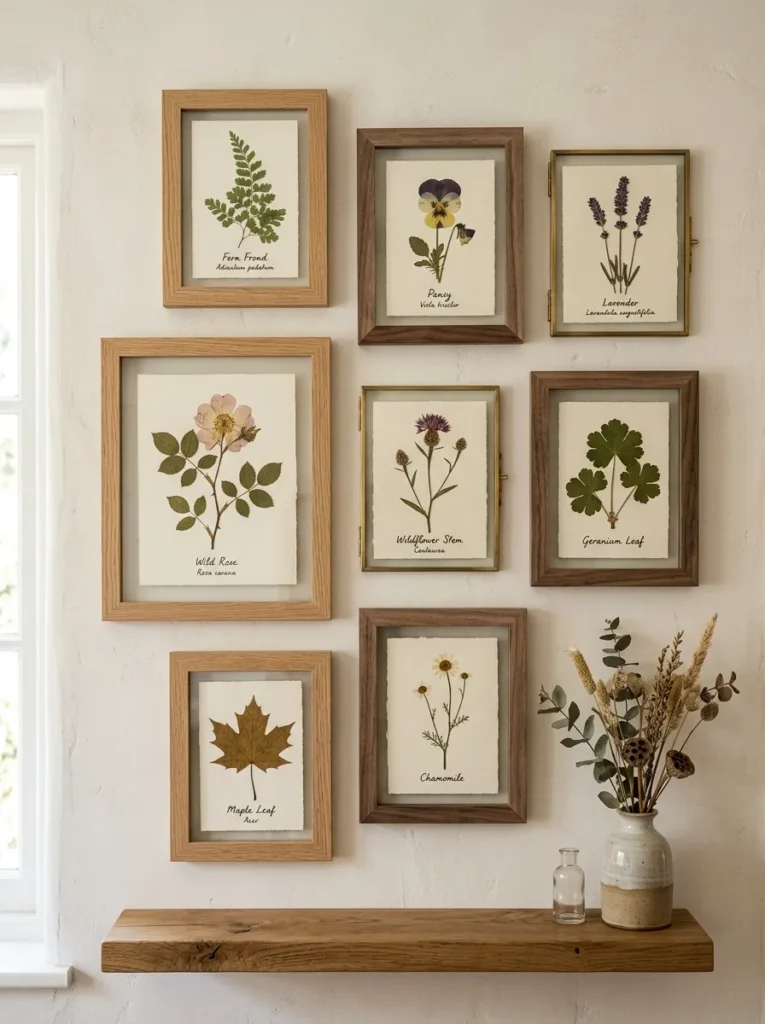
Vibe: The gallery feels like a naturalist’s collection that wandered off the laboratory shelf into a living room — studied and warm simultaneously.
Why it works: A pressed botanical gallery in mismatched natural frames applies the curatorial design principle of unity through material family rather than identical specification — the frames read as a coherent collection because all finishes sit within the warm natural material family (oak, brass, unfinished wood) rather than because they match precisely. This deliberate variation within a material family is the design technique that distinguishes a considered cottagecore gallery from either a rigidly matching commercial set (which reads as purchased rather than collected) or a genuinely random mix (which reads as accumulated rather than curated). The single botanical specimen per frame — rather than an arrangement — gives each frame the compositional focus of a scientific illustration, which elevates the aesthetic register from decorative to documentary.
How to get it: Press botanical specimens between book pages under weight for two to three weeks. Mount each dried specimen on 200–300gsm cream card stock cut to fit inside the chosen frame, adhering with a single touch of clear-drying craft glue at the stem. Source frames in varied natural finishes from secondhand shops, markets, and online resellers — the slight surface variation of genuinely aged or natural frames creates the collected quality that new identical frames cannot replicate. Arrange on the floor before committing to wall positions, assessing the grouping’s visual balance from a standing distance of approximately 2 metres. Maintain 3–5cm gaps between frames to preserve the breathing room that keeps each specimen visually distinct.
Quick Win: A single pressed fern frond in a natural oak A4 frame ($8–15 combined) creates the complete cottagecore botanical print aesthetic as a standalone piece — the most cost-effective single wall decor investment for a cottagecore room before any gallery is assembled.
Shop The Look
| Product |
|---|
| Natural oak picture frame set varied sizes |
| Cream card stock 300gsm mounting |
| Flower press wooden craft |
| Clear drying craft glue fine tip |
| Picture hanging strip damage free |
Also view: 14 Easy Paper Craft Ideas for Creative Adults
2. Dried Floral Wreath in an Oversized Natural Wood Hoop
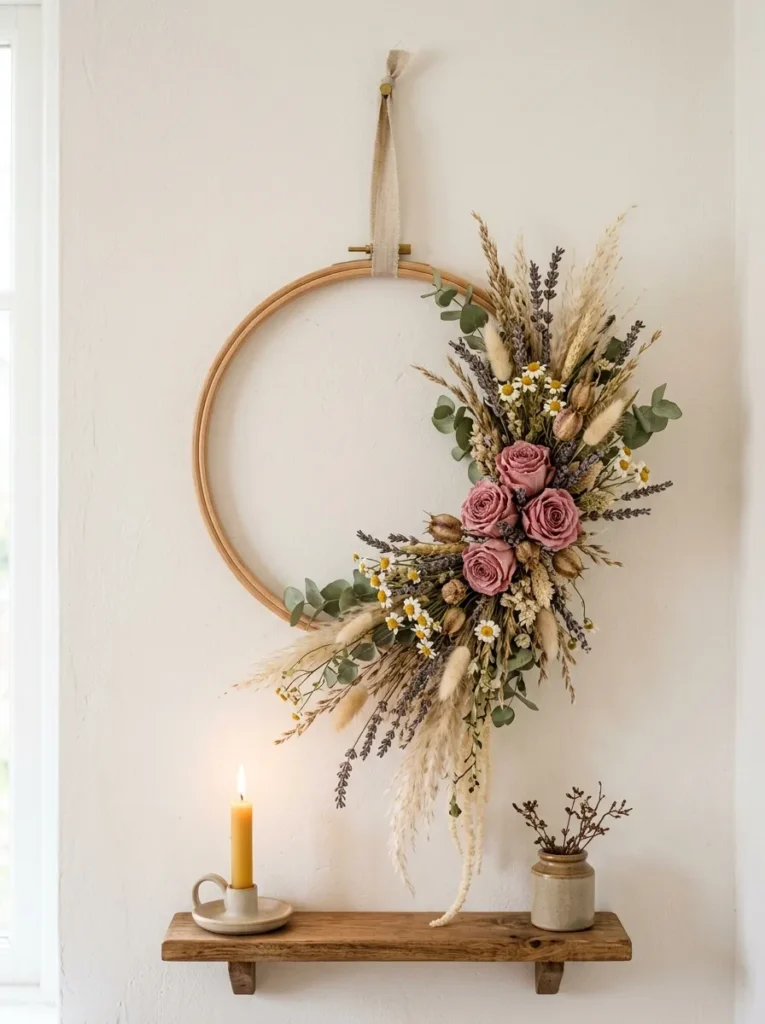
Vibe: The dried wreath feels gathered rather than arranged — the asymmetric placement suggesting someone brought the garden in and hung it on the wall before any conscious styling decision was made.
Why it works: A dried floral wreath in a natural wood embroidery hoop applies the design principle of structural frame for organic content — the perfectly circular hoop provides the composed geometric boundary that makes the organic, irregular botanical arrangement within it read as art rather than a bundle of dried flowers. The natural wood embroidery hoop is the specifically contemporary interpretation of the wreath form — it references the functional purpose (holding embroidery taut while stitching) while repurposing the form for botanical display, creating a cottagecore double-reference that is richer than a wire wreath frame alone. An asymmetric arrangement (denser on one side, trailing on the other) is more contemporary than a symmetrically distributed circular wreath arrangement, referencing loose ikebana and modern botanical styling rather than traditional wreath construction.
How to get it: Source a 35–45cm diameter wooden embroidery hoop from a craft store. Prepare a selection of dried botanical materials in the chosen color palette — dried roses, dried lavender, dried chamomile, pampas grass, dried eucalyptus all dry reliably and maintain their color for 12–18 months. Arrange the botanicals in the lower and side sections of the hoop, attaching with a hot glue gun applied sparingly at each stem base (too much glue is visible and disrupts the natural quality). Leave the upper section of the hoop partially exposed to allow the wood form to contribute to the composition. Hang from a linen ribbon tied to the hoop’s screw closure at the top.
Shop The Look
| Product |
|---|
| Natural wood embroidery hoop 40cm |
| Dried rose bunch dusty pink |
| Dried lavender bunch natural |
| Dried pampas grass stems small |
| Natural linen ribbon wide 4cm |
Also view: 14 Handmade Gift Ideas That Feel Extra Special
3. Embroidered Linen Wall Panel in a Simple Frame
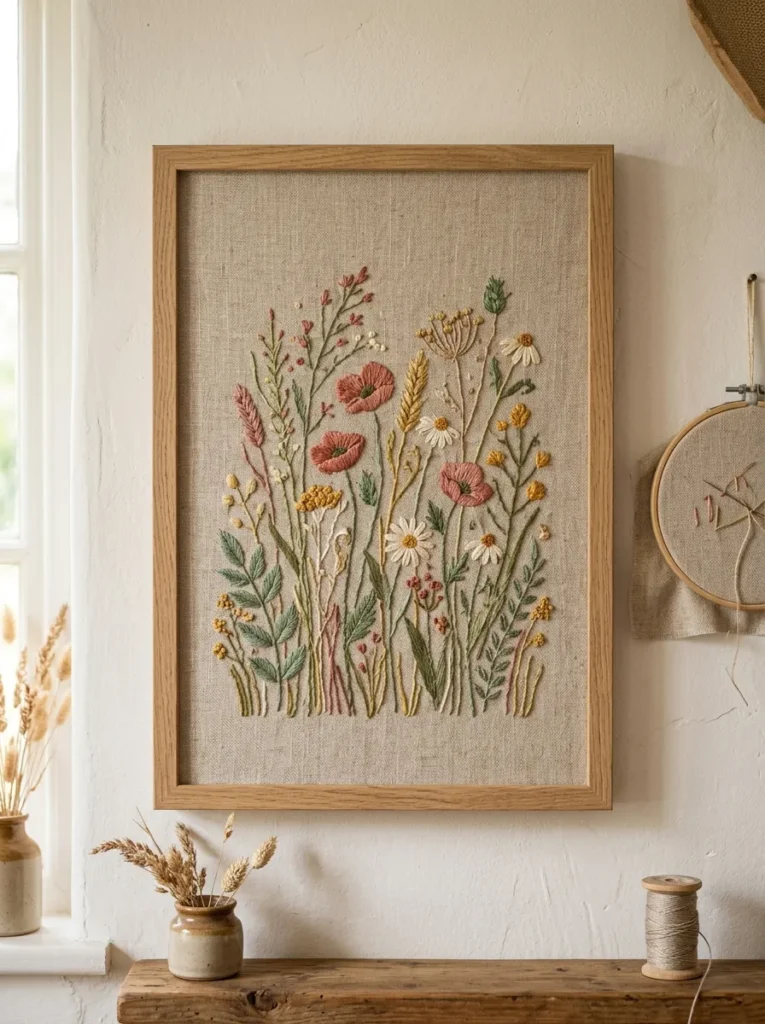
Vibe: The embroidered panel feels like someone’s best afternoon given a permanent form — the hours of stitching visible in every thread, the warmth of the making in the result.
Why it works: A framed embroidered linen panel applies the textile art principle of material evidence as aesthetic content — the visible stitching in embroidery is simultaneously the technique and the image, meaning every element of the artwork carries the evidence of its making. A painted botanical print communicates “botanical”; an embroidered botanical communicates “botanical, and handmade, and patient, and warm” — the additional layers of meaning that the textile technique adds are present in the material rather than requiring any label or explanation. Mounting the embroidery in a simple frame rather than an embroidery hoop is the specifically contemporary interpretation — the frame removes the work-in-progress association of the hoop and positions the piece as a completed artwork.
How to get it: Transfer a simple botanical design onto natural linen using an embroidery transfer pen or printed water-soluble transfer sheet. Work the design in a six-strand embroidery floss, using three strands for fine line work (backstitch for stem outlines, stem stitch for curves) and six strands for filled areas (satin stitch for petals, French knots for flower centers). Keep the stitching loose and gestural rather than densely filled — the linen ground visible through and around the embroidery contributes to the composition rather than needing to be covered. When complete, wash in cool water to remove transfer marks, press face-down on a towel while damp, and mount in the frame while slightly damp to prevent rippling.
Shop The Look
| Product |
|---|
| Natural linen fabric yard undyed |
| Embroidery thread set botanical colors |
| Embroidery transfer paper water soluble |
| Natural oak simple frame 20x30cm |
| Embroidery needle set assorted |
4. Gathered Dried Herb and Botanical Bundles Hung from a Wooden Rail
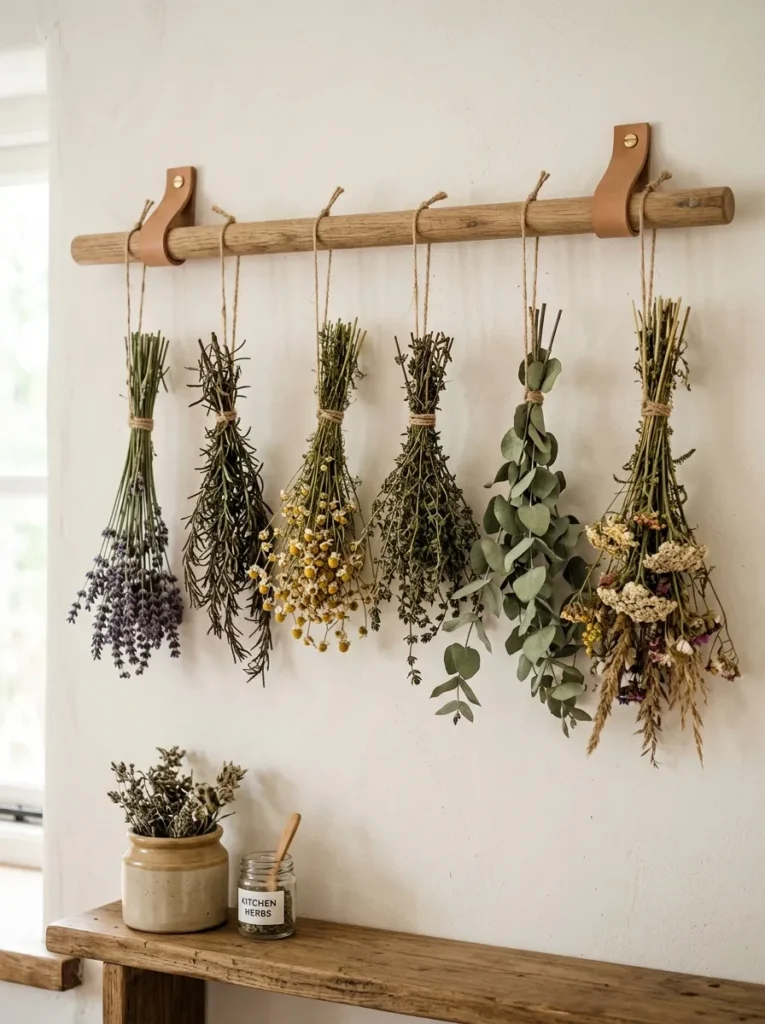
Vibe: The hanging botanical rail feels functional and aromatic and beautiful in equal measure — wall decor that contributes scent to the room as well as visual warmth.
Why it works: A wooden rail hung with dried botanical bundles applies the domestic design principle of functional beauty at the wall plane — these bundles are simultaneously decorative objects (their color, texture, and form contributing to the wall’s visual warmth), aromatic objects (dried lavender, rosemary, and eucalyptus release gentle fragrance, particularly when disturbed), and functional objects (dried culinary herbs can be used from the bundle directly). This triple function is the specific quality that distinguishes the cottagecore wall from purely decorative approaches — objects that are beautiful because they are what they are, rather than beautiful because they were made to look beautiful, carry a different and more grounded aesthetic resonance. The wooden rail itself (a simple 3cm diameter oak or pine dowel) is the organizing structure that converts loose bundles into a composed installation.
How to get it: Source or dry botanical bundles by gathering fresh herbs and flowers and hanging upside down in a warm, dry, well-ventilated space for two to three weeks. Tie each dried bundle tightly at the cut stem end with a small length of natural jute twine, finishing with a simple bow. Mount a 60–80cm wooden dowel on the wall using two small screw hooks and leather cord or linen rope loops from which the dowel hangs horizontally. Hang each bundle from the dowel by looping jute twine over the dowel and knotting — the bundles should hang at varied heights (25–40cm drop) for visual rhythm rather than uniform height.
Shop The Look
| Product |
|---|
| Natural wood dowel rod 60cm natural |
| Natural jute twine thin roll |
| Dried lavender bunch large natural |
| Dried rosemary bunch culinary |
| Screw hook set small wall mount |
5. Botanical Watercolor Print Gallery with Hand-Written Captions
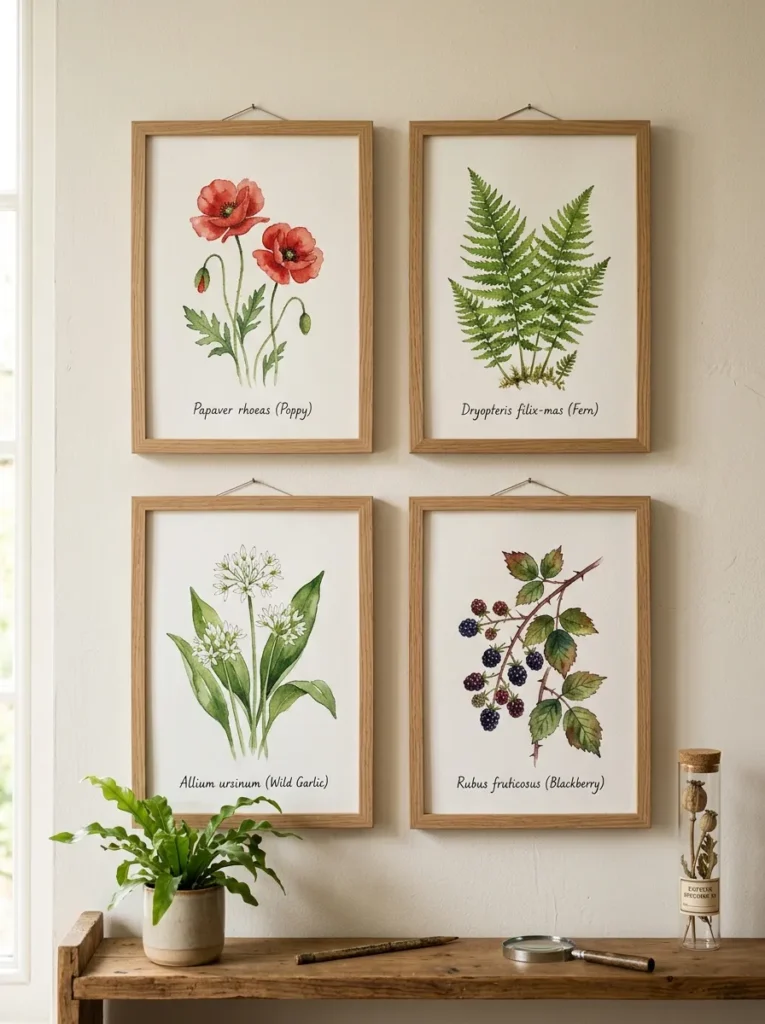
Vibe: The watercolor print gallery feels like a field naturalist’s sketchbook dismantled and framed — each illustration specific enough to be about that plant and loose enough to be about painting.
Why it works: A botanical watercolor print gallery with hand-written captions applies the design principle of taxonomic visual language in a domestic context — 19th-century botanical illustration (the specific visual reference that this idea draws from) combined scientific precision (each species identifiable from the illustration) with artistic beauty, and the hand-lettered botanical name below each illustration directly references this tradition. The four-plant, two-by-two grid is the most compositionally resolved arrangement for a small print collection — it creates a balanced, unified composition while allowing each print its own visual space. Commissioning or purchasing prints from independent botanical watercolor artists (Etsy has hundreds of practitioners in this specific style) or painting your own (loose watercolor botanical illustration is accessible to a beginner with some watercolor experience) produces results consistently more charming than commercially licensed botanical prints.
How to get it: Source four botanical watercolor prints from independent artists — search Etsy for “botanical watercolor print” and filter for original or print-on-demand versions in the chosen size. Print at A5 on 300gsm watercolor paper using a high-quality photo printing service if ordering print-on-demand. Add a hand-lettered botanical name below each illustration using a fine-point archival ink pen in a simple, clean lowercase style — this hand-lettering is the detail that converts a purchased print into a personalized object. Frame in matching thin natural wood frames and hang in a two-by-two grid with 3cm gaps between frames.
Shop The Look
| Product |
|---|
| Botanical watercolor print set A5 |
| Thin natural wood frame A5 set |
| Fine point archival ink pen black |
| Photo print service 300gsm paper |
| Picture hanging strip damage free |
6. Woven Textile Wall Hanging with Botanical Yarn Accents
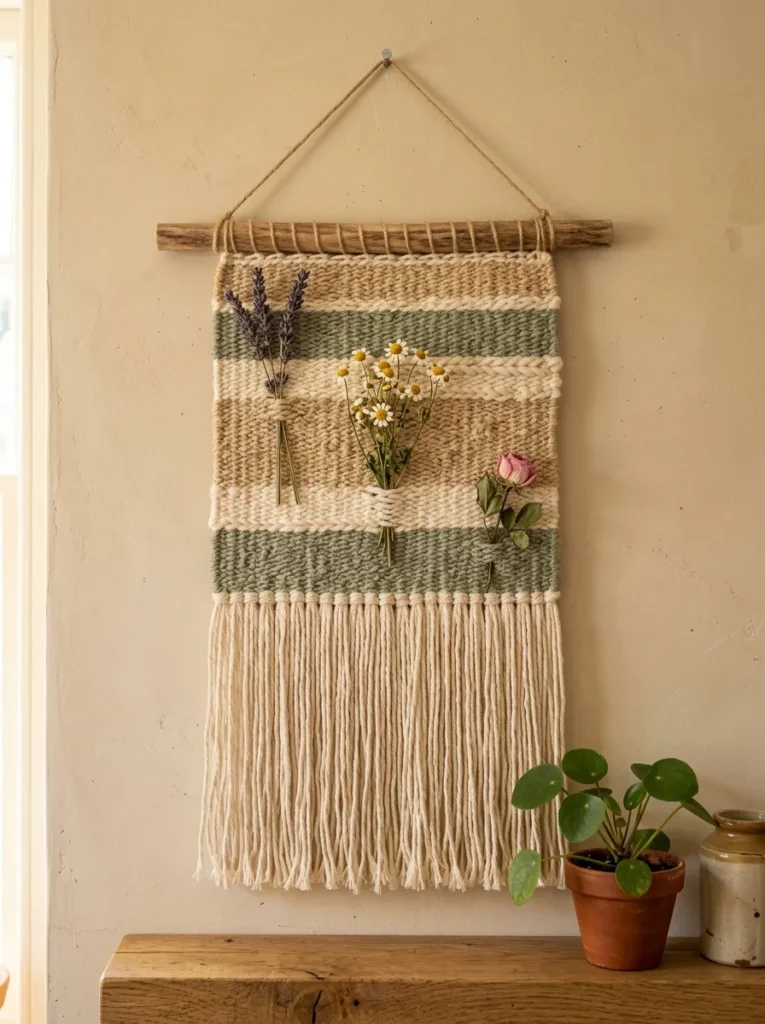
Vibe: The woven hanging with botanical accents feels like the textile and the garden have collaborated — the dried botanical elements woven into the cloth surface blurring the boundary between making and gathering.
Why it works: A woven wall hanging with incorporated dried botanical accents applies the mixed-media principle of material conversation — when two different material traditions (textile weaving and botanical drying) are combined in a single object, the result has a richness that neither tradition alone produces. The dried botanicals woven into the textile surface are not decorations applied to the weaving; they are structural elements held by the warp and weft, which means they belong to the fabric in a way that adhered decorations do not. This integration is the cottagecore version of the contemporary mixed-media textile art practice — it takes the handmade botanical (the cottagecore core) and the handmade textile (the cottagecore core) and combines them into an object that is more than both.
How to get it: Work a basic tabby weave (alternating over-under weft passes) on a simple frame loom or cardboard loom, using natural cotton cord as the warp. Weave horizontal bands in oat, cream, and sage yarns, varying the yarn weight (a thin linen weft alternating with a chunky cotton weft) for textural interest. Incorporate dried botanical sprigs by weaving them across the warp threads at the desired positions — the botanicals pass over and under the warp threads exactly as a weft yarn would, held in position by the adjacent weft rows above and below. Finish with a long fringe by cutting all weft ends to the same length below the final weft row, or by adding additional cut lengths knotted through the final row.
Shop The Look
| Product |
|---|
| Natural cotton warp thread craft |
| DK cotton yarn set oat cream sage |
| Dried lavender chamomile botanical set |
| Natural wood dowel 45cm craft |
| Simple cardboard loom or frame loom |
7. Vintage-Style Hand-Lettered Botanical Print
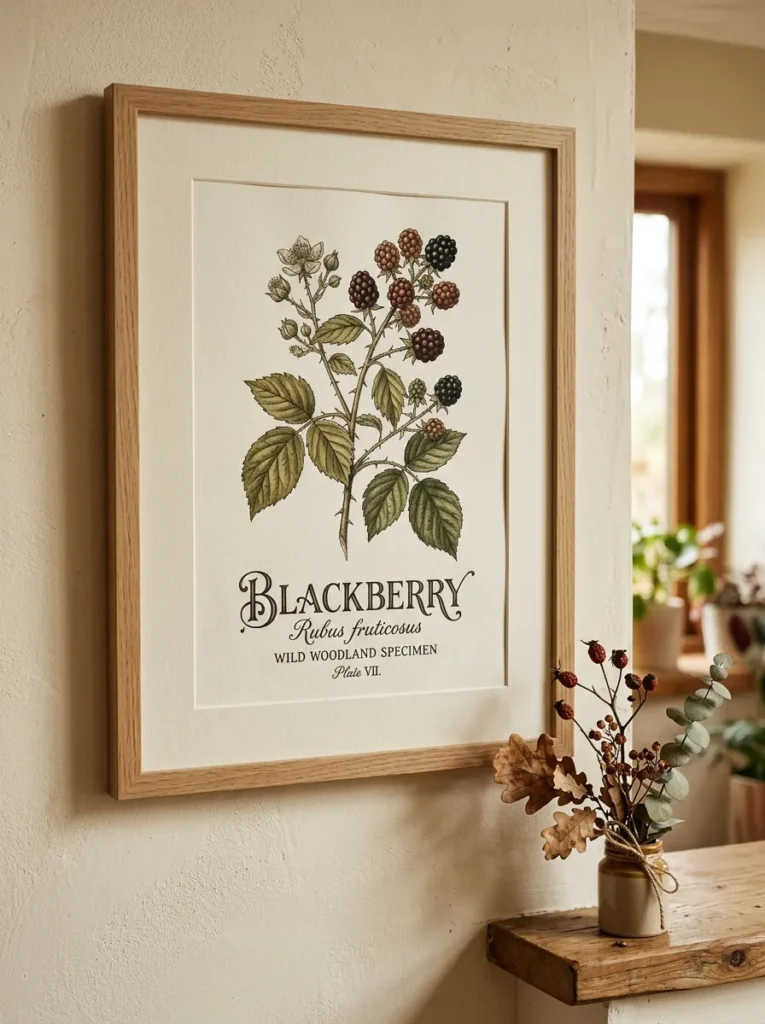
Vibe: The large botanical print feels like something rescued from an old herbarium and given a new wall — formal enough to read as art, warm enough to read as home.
Why it works: A single large-format vintage-style botanical print as the primary wall statement applies the design principle of anchor piece authority — in a room where multiple small objects might otherwise compete for visual attention, a single A3 or larger artwork establishes compositional authority and organizes the surrounding wall space around itself. The Victorian botanical illustration style is the most specifically cottagecore-appropriate print format because it references the exact historical visual tradition (19th-century botanical illustration as produced for scientific and horticultural publications) that the cottagecore aesthetic draws from most directly. The cream mount and simple natural oak frame are the contemporary finishing details that prevent the vintage illustration style from reading as period reproduction rather than contemporary reference.
How to get it: Source a vintage-style botanical print from independent artists on Etsy (search “vintage botanical print” and “Victorian botanical illustration” for the highest density of appropriate options) or from digital download services that offer high-resolution vintage botanical images in the public domain (the Biodiversity Heritage Library’s image archive, NYPL Digital Collections, and Rawpixel’s vintage art collection all provide high-quality free downloads of genuine historical botanical illustrations). Print at A3 on 300gsm cream watercolor paper at a professional printing service. Mount in an A3 frame with a cream card mount that provides 4–5cm of border around the print.
Shop The Look
| Product |
|---|
| Vintage botanical illustration print A3 |
| Natural oak frame A3 with cream mount |
| A3 print service 300gsm cream paper |
| Cream mount card A3 set |
| Picture rail hook A3 frame weight |
8. Living Moss Frame or Preserved Moss Wall Panel
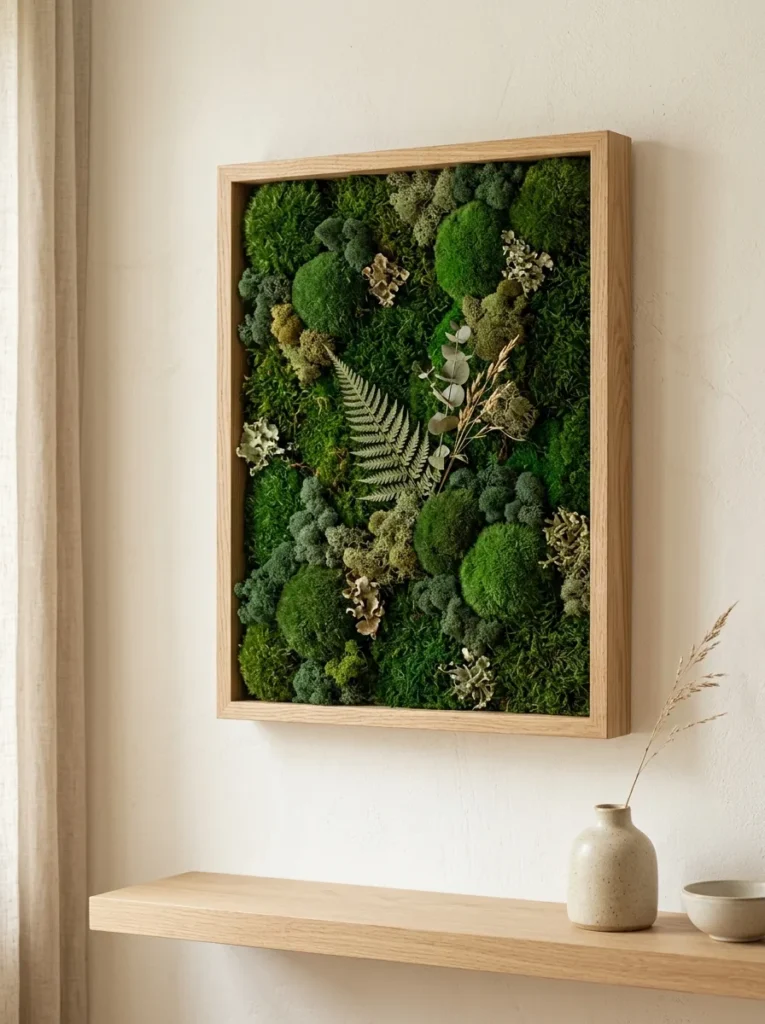
Vibe: The moss panel feels like looking at the floor of a forest at close range — a window into an outdoor world, hung indoors.
Why it works: A preserved moss wall panel applies the biophilic design principle of living material reference in a maintained format — preserved moss (moss that has been treated with glycerin to maintain its color and soft texture permanently without requiring water or light) provides the visual and tactile quality of living plant material in a form that requires no maintenance and can be installed on any wall without concern for light levels or moisture. The varied moss textures (flat sheet moss, pillow moss, reindeer moss) create a three-dimensional surface of genuine visual complexity at close range — the kind of material richness that paint, wallpaper, and most manufactured surfaces cannot replicate. In a cottagecore context, the moss panel is the most directly nature-referencing wall element available, bringing the texture of forest floor into a domestic interior without the literal impracticality of soil and water.
How to get it: Source preserved mosses from specialist botanical craft suppliers (preserved moss is available in flat sheet moss, pillow moss, reindeer moss, and bun moss formats from online craft and floristry suppliers). Prepare a shallow wooden shadow box frame (depth of at least 3cm to accommodate the dimensional moss surface). Apply a base layer of flat sheet moss by pressing directly onto a PVA-glued foam board backing fitted inside the shadow box. Add dimensional elements (pillow moss, bun moss clusters) using hot glue applied to the moss base, pressing firmly. Tuck small dried fern fronds into the composition for additional textural variation. Preserved moss requires no maintenance — dust gently with a soft brush if needed.
Shop The Look
| Product |
|---|
| Preserved flat sheet moss green |
| Preserved pillow moss natural green |
| Wooden shadow box frame 30x40cm |
| Hot glue gun craft |
| Dried fern frond set natural |
9. Vintage Ceramic Plates as Wall Decor Arrangement
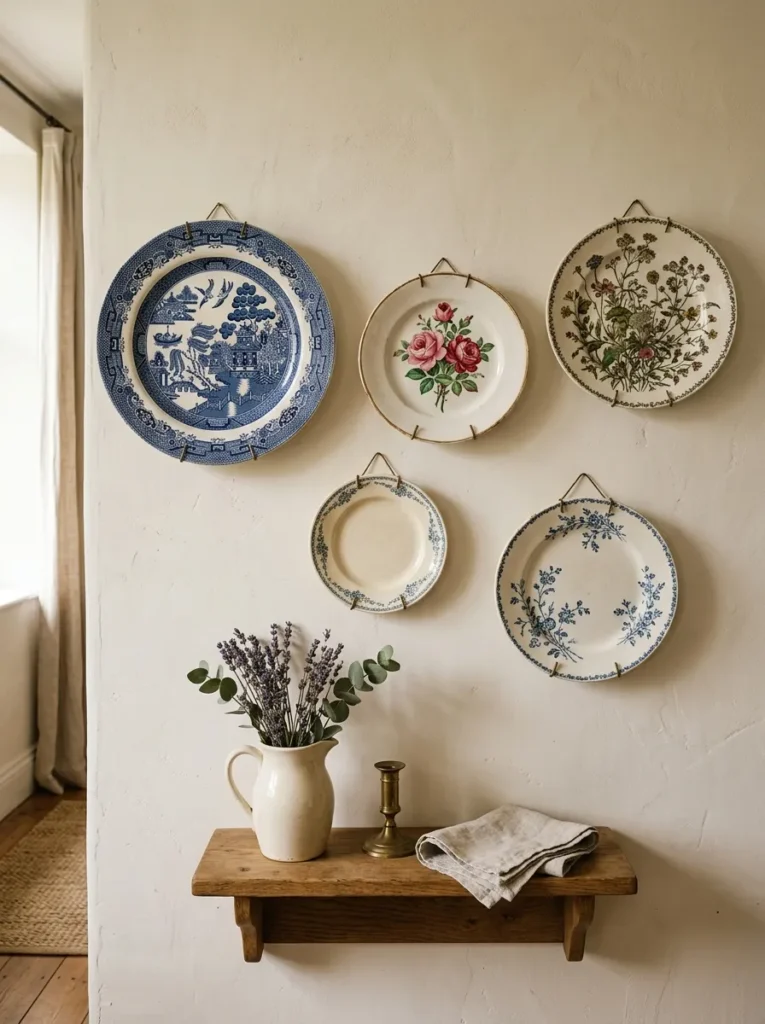
Vibe: The plate arrangement feels like a gradual collection that has found its permanent wall — each plate interesting individually, the grouping richer than any individual piece.
Why it works: Vintage ceramic plates as wall art applies the display principle of functional object elevated to artwork status — plates are objects designed for use, and their appearance on a wall rather than a shelf or table communicates a deliberate decision to value their visual qualities above their utility. This elevation is the cottagecore version of the Duchampian readymade — the decision to display is itself the creative act. Botanical and floral pattern plates (willow pattern, hand-painted roses, sprigged botanical motifs) are the specifically cottagecore-appropriate plate format because their decoration references the same visual tradition (English country garden, botanical illustration, decorative florals) that the whole aesthetic draws from. Sourcing from charity shops, antique markets, and estate sales ensures the slight mismatching and surface variation that makes the arrangement read as genuinely collected rather than purchased as a set.
How to get it: Source five or more varied plates from charity shops, car boot sales, and antique markets — the criterion for selection is botanical or floral decoration in the warm, muted palette of traditional English ceramic ware (blue and white, pale rose, sage green motifs on cream). Mount using spring-loaded plate hanging clips with a small picture hook attachment — these are available in multiple sizes to fit any plate diameter and leave no marks on the plate. Arrange on the floor first, assessing the grouping’s visual balance before committing to wall positions. Maintain at least 5–8cm between adjacent plates.
Shop The Look
| Product |
|---|
| Plate hanger spring clip set varied sizes |
| Vintage botanical ceramic plate charity shop |
| Small ceramic pitcher cream display |
| Picture hook set small wall |
| Damage-free plate arrangement guide |
10. Cross-Stitch Sampler in a Heritage Frame
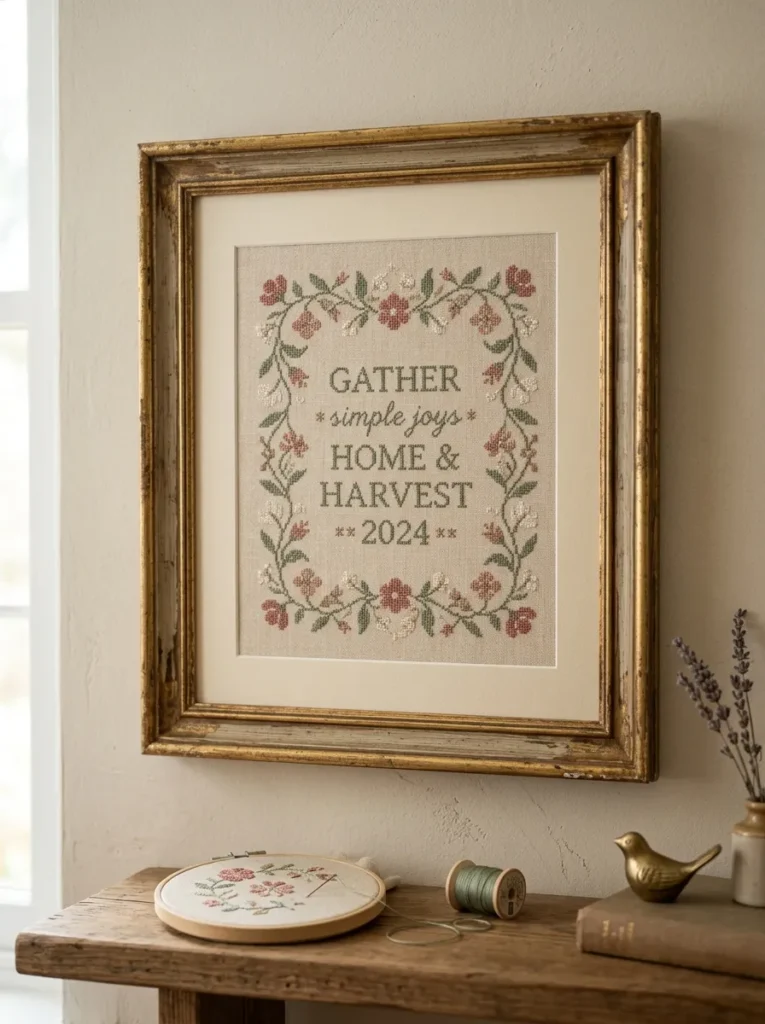
Vibe: The sampler feels like a family heirloom from a family you’d like to have — old-looking in the best possible way, new in the sense that someone made it specifically.
Why it works: A cross-stitch botanical sampler in a heritage frame applies the design principle of historical visual form in a contemporary making context — the sampler format (a practice cloth on which a needleworker demonstrated mastery of stitches and alphabets) has a continuous history in domestic embroidery from at least the 16th century, and its conventions (botanical border, text center, balanced composition) carry the visual weight of that long tradition. A contemporary maker working in this format is simultaneously engaging with a living craft tradition and producing an object with an aesthetic authority that no commercially printed sampler can replicate, because the making history of the form is present in the physical object itself. The heritage frame (aged gold, distressed wood) reinforces the historical register without requiring the piece to be genuinely old.
How to get it: Source a cross-stitch sampler pattern in a botanical border format (Etsy has hundreds of independent pattern designers producing cottagecore-appropriate sampler designs with instant digital download) and print the pattern in color. Work on 14-count natural Aida linen (14 threads per inch, the standard for fine sampler work) using two strands of six-strand embroidery floss in the pattern colors. Cross-stitch is worked in two diagonal stitch directions — all the bottom-left to top-right stitches first across a row, then all the top-left to bottom-right return stitches. Iron the completed sampler face-down on a towel while slightly damp to prevent the linen from puckering.
Shop The Look
| Product |
|---|
| Natural Aida linen 14-count fabric |
| Cross stitch sampler pattern botanical |
| Embroidery floss set botanical colors |
| Heritage-style frame 20x25cm aged |
| Cross stitch needle set sharp tip |
11. Trailing Plant Wall Arrangement on Floating Shelves
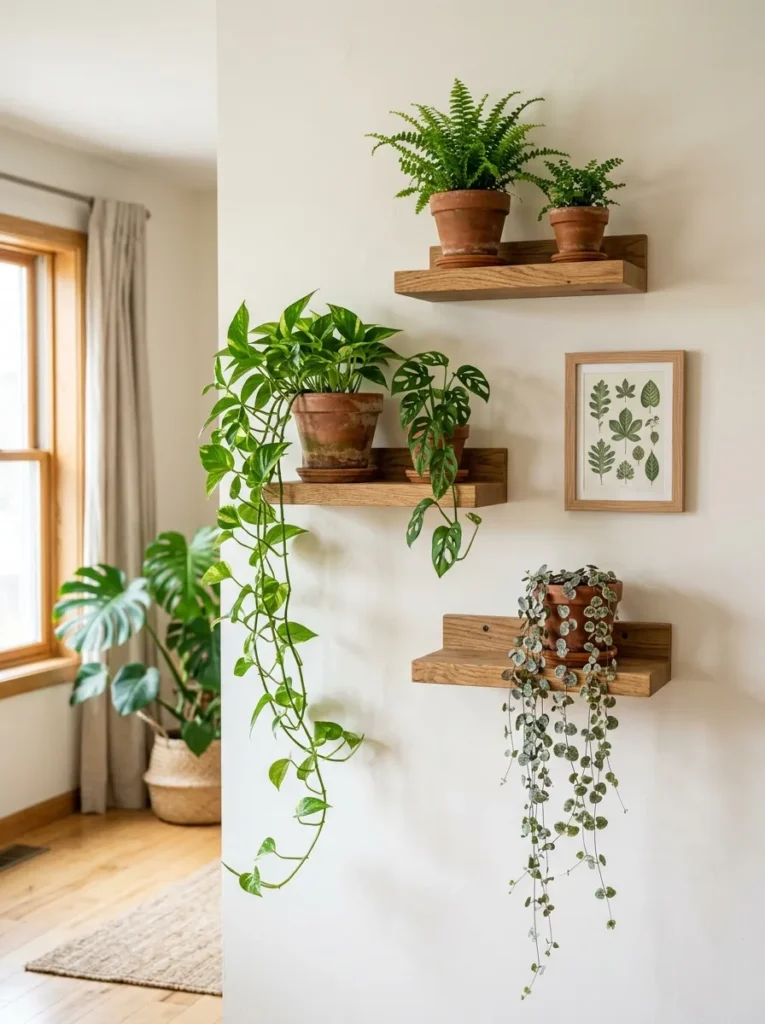
Vibe: The plant shelf arrangement feels like the wall is growing — the trailing varieties blurring the boundary between shelf display and botanical installation.
Why it works: A trailing plant wall arrangement on staggered floating shelves applies the biophilic design principle of vertical greenery at wall scale — trailing plants (pothos, string of hearts, devil’s ivy, string of pearls) naturally cascade downward from any elevated position, creating a living element at the wall plane that no dried or pressed botanical can replicate. The staggered shelf heights (three shelves at different heights rather than a horizontal row) create a stepped green cascade in which each shelf’s trailing plant reaches toward or overlaps the shelf below, producing a unified vertical composition rather than three separate plant displays. Terracotta pots are the most appropriate container material for a cottagecore plant arrangement because their warm clay color references the material palette of the aesthetic directly and ages beautifully with watering — the white mineral deposits that accumulate on terracotta over time are a desirable patina rather than a maintenance problem.
How to get it: Install three floating shelves at staggered heights on the chosen wall — approximately 150cm, 120cm, and 90cm from the floor creates a stepping arrangement that allows adequate plant growth and visual rhythm. Select trailing plant varieties appropriate for the wall’s light level: pothos and tradescantia for low-to-medium light, string of hearts and string of pearls for bright indirect light, English ivy for cool indirect light. Pot in terracotta with a drainage saucer and place directly on the shelves — the trailing growth will naturally extend over the shelf edge within a few weeks of placement.
Shop The Look
| Product |
|---|
| Natural oak floating shelf 30cm set |
| Terracotta pot set varied sizes |
| Trailing pothos plant indoor |
| String of hearts indoor trailing |
| Small terracotta drainage saucer set |
12. Hand-Painted Mushroom and Forest Floor Art
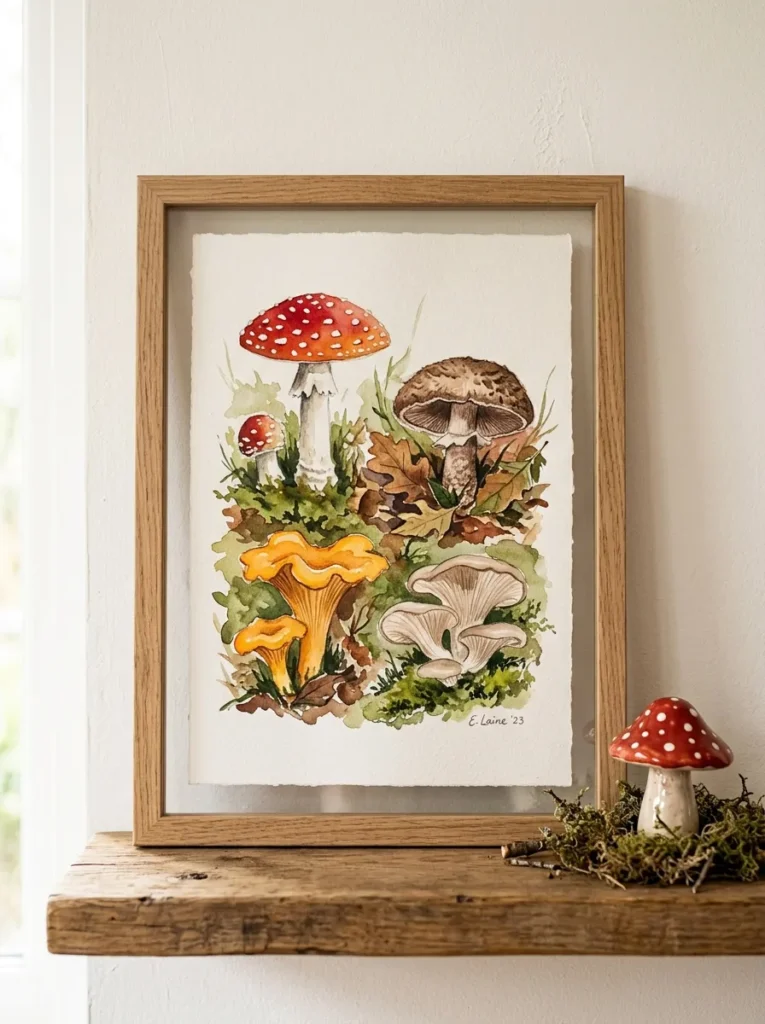
Vibe: The mushroom painting feels joyful and specific — the kind of artwork that makes a room feel like it has a personality beyond neutral good taste.
Why it works: Mushroom and forest floor art applies the cottagecore design principle of whimsical naturalism — the celebration of organisms that are not conventionally “beautiful” (mushrooms are neither flowers nor ferns, but the irregular, capped fungi forms that characterize woodland floors) as worthy subjects for domestic art. The contemporary cottagecore aesthetic has specifically and enthusiastically rehabilitated the mushroom as a decorative subject, referencing both the genuine biological interest of mycology (a currently popular area of public interest following mainstream mycological books and documentaries) and the particular warmth of the woodland floor ecosystem that cottagecore draws from alongside the garden and hedgerow. A gestural watercolor approach (rather than botanical illustration precision) maintains the warmth and approachability of the subject.
How to get it: Paint the mushroom composition directly from photographic reference (online searches for “watercolor mushroom illustration” provide thousands of reference images and tutorial approaches) on 300gsm cold-press watercolor paper. Begin with the lightest tones of the background (a loose green-brown wash for the forest floor), then paint each mushroom variety from lightest to darkest, allowing the watercolor to bloom softly at edges. Add the characteristic details of each variety (the fly agaric’s white spots, the chanterelle’s ruffled edge) with a fine brush in the final stage. Source mushroom art prints from independent illustrators on Etsy if self-painting is not the preference.
Shop The Look
| Product |
|---|
| Watercolor paper 300gsm cold press A4 |
| Watercolor paint set warm natural tones |
| Fine round brush set watercolor |
| Natural oak simple frame A4 |
| Small ceramic mushroom figurine decor |
13. Cottagecore Gallery Corner — Complete Styled Wall Vignette
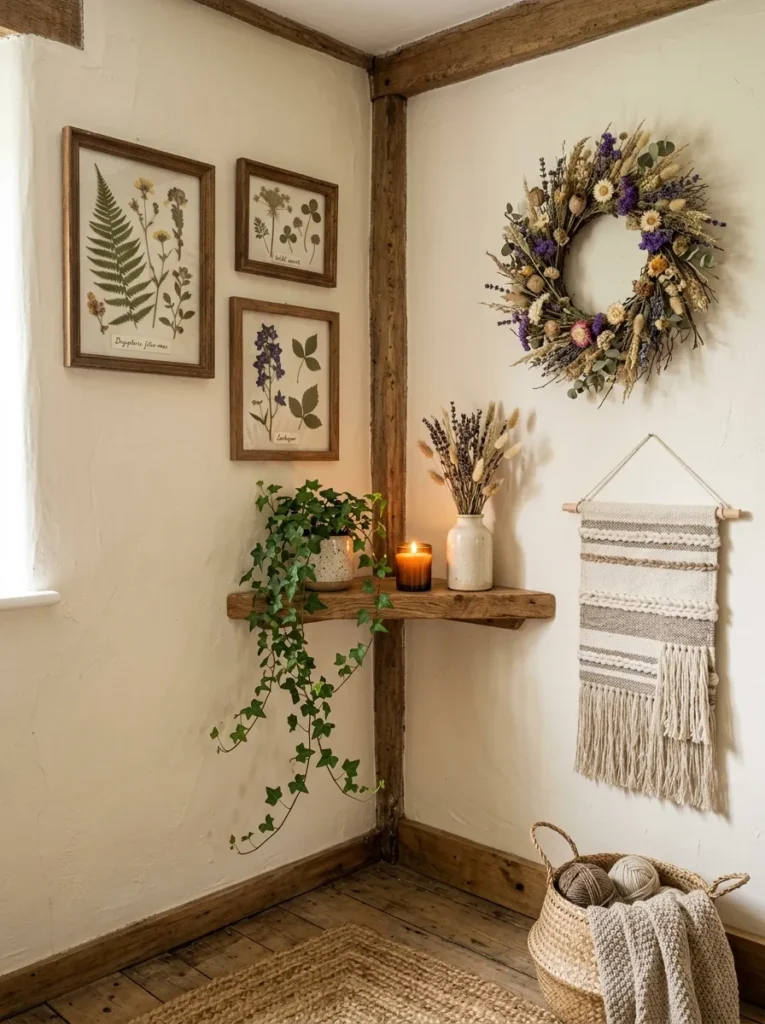
Vibe: The corner vignette feels like the best corner in the house — designed carefully enough to feel like discovery, warm enough to invite lingering.
Why it works: A complete cottagecore gallery corner applies the interior design principle of spatial vignette as concentrated atmosphere — rather than attempting to apply the cottagecore aesthetic to an entire room (which risks overwhelming a contemporary interior), concentrating the aesthetic’s defining elements (pressed botanical gallery, dried wreath, woven textile, trailing plant, ceramic objects) in a single corner creates a contained, rich moment that reads as intentional and complete. The corner itself (the junction of two walls) provides a natural compositional frame, and the narrow floating shelf at the corner’s vertical axis creates the three-dimensional depth that relates the wall elements to each other spatially — the shelf belongs to both walls simultaneously, connecting the elements on each wall into a single composition. This vignette approach is the most spatially intelligent application of the cottagecore aesthetic for homes where the style is one element among others rather than the room’s total design direction.
How to get it: Select a corner that receives good natural light (for the plants and to illuminate the botanical frames). On the primary wall: arrange a small three-frame pressed botanical gallery in natural frames with 3cm gaps. On the adjacent wall: hang one medium dried botanical wreath and one small woven textile hanging, spaced so neither competes with the other. Install a narrow floating shelf (20cm depth) at the corner at approximately 110cm height. Style with one trailing plant (allowing it to cascade down the corner wall), one small ceramic vase with dried botanicals, and a single candle. Review the corner from a distance of 2 metres and remove any element that does not contribute — the discipline of editing is the single most important step in preventing a cottagecore vignette from becoming a cottagecore accumulation.
Shop The Look
| Product |
|---|
| Narrow floating shelf 20cm corner |
| Small ceramic vase botanical display |
| Beeswax candle small warm |
| Trailing plant small terracotta pot |
| Dried botanical stem small arrangement |
How to Start Your Cottagecore Wall Decor Transformation
The single best first move in any cottagecore wall decor project is pressing one botanical specimen — a fern frond, a pansy, a sprig of lavender, or a single garden flower — between the pages of a heavy book, under the weight of several additional books stacked on top, and leaving it for two to three weeks. This act costs nothing, requires no tools, and produces the foundational object of the entire cottagecore wall aesthetic (a pressed botanical) in its simplest and most direct form. When you retrieve the pressed specimen and hold it against a piece of cream card stock in a simple frame — even before committing to a wall position — the complete cottagecore wall element is already visible, at zero cost, made by your own hand. Every subsequent idea in this list is a variation or elaboration of that first simple act.
The most common mistake in cottagecore wall decor is confusing richness with quantity — the instinct to keep adding objects to a wall until it “looks cottagecore” produces accumulation rather than design. The most beautiful and most considered cottagecore walls have more negative space than objects; the objects that are present are visible and individually appreciated because the wall around them breathes. The fix is an editing rule: for every new element added to the wall, stand back to the room’s full viewing distance and assess whether the addition improves or merely changes the composition. Remove anything that does not improve it. The cottagecore aesthetic’s warmth comes from the quality of individual elements and the care of their arrangement, not from their quantity.
Three specific items under $50 that create immediate cottagecore wall character: a natural wood embroidery hoop (30–40cm diameter, $5–8) that can be used as a wreath frame, a botanical display, or a fabric hanger depending on what materials are available; a packet of botanical or floral watercolor art prints from an independent Etsy artist ($8–18 for a set of four digital downloads, printed at a local print service) that provide the botanical illustration aesthetic without requiring drawing skill; and a bundle of three to four varieties of dried botanical stems ($12–20 from a dried flower supplier or created from garden-dried material) that can be displayed in a vase below the wall art, tied in a bundle from a nail, or incorporated into a hoop arrangement. These three items combined for under $40 enable the core of the cottagecore wall aesthetic before any complex making or installation is required.
A simple cottagecore wall element (a single pressed botanical frame, a dried stem bundle) is achievable over a single weekend for $5–20 in materials. A mid-range cottagecore wall installation (a small gallery wall, a botanical hoop wreath, or a textile hanging) takes one to two weekends and costs $30–80. A complete cottagecore wall vignette (gallery corner, shelving with plants, multiple textile and botanical elements) represents a $80–200 investment across three to four weekends. Pressing botanicals, making lucky star origami, and hanging dried herb bundles from a nail all begin today; the embroidery sampler and hand-painted botanical art follow at their own pace, and the room’s character accumulates with every addition.
Frequently Asked Questions About Cottagecore Wall Decor
What makes cottagecore wall decor look modern rather than old-fashioned?
The distinction between modern cottagecore and old-fashioned cottage decor comes from three specific design choices: restraint (fewer, more carefully selected objects with breathing space between them rather than wall-to-wall coverage), material quality (natural, honest materials — real pressed botanicals, genuine linen embroidery, actual dried flowers rather than artificial or plastic equivalents), and frame selection (simple, contemporary profiles in natural oak, thin brass, or unfinished wood rather than ornate gold or dark stained frames that read as period reproduction). The subject matter (botanicals, wildflowers, mushrooms, herbs) is inherently compatible with both contemporary and historical aesthetics; the frame and presentation format determines which register the piece occupies.
Can cottagecore wall decor work in a rented apartment?
Yes — the majority of the ideas in this list require no permanent wall modification. Dried botanical bundles hang from a single picture hook. Framed prints mount on damage-free adhesive strips (3M Command strips support up to 7kg per pair, sufficient for all standard framed artwork). Woven hangings and hoop wreaths hang from a single nail or ceiling hook. Floating shelves in some rental contexts can be mounted using heavy-duty adhesive shelf brackets rated for plant weight. The only ideas requiring conventional drilling are heavy shelf installations and plate arrangements using multiple hooks — both achievable through rental-permitted methods in most tenancy agreements with appropriate fixtures and fixing approaches.
What color palette works best for a cottagecore wall?
The most consistently successful cottagecore wall color palette builds from a warm neutral base (warm white, warm linen, pale sage) with botanical accents in the colors of dried and pressed plant material: dusty rose, dried lavender purple-gray, sage green, warm golden yellow, terracotta, and dried eucalyptus blue-green. The critical specification is warmth — all tones in the cottagecore palette lean warm (yellow or pink undertone) rather than cool (blue or green undertone), which is what prevents the palette from reading as clinical or contemporary-minimalist. Avoid pure white (too cool), pure gray (too urban), and bright or highly saturated colors (too contemporary or too primary) in both wall paint and botanical selections.
How do you prevent a cottagecore wall from looking cluttered?
The anti-clutter discipline for a cottagecore wall rests on three rules applied consistently: one primary element per wall (one large print, one hoop wreath, one gallery grouping — not all three on the same wall), adequate negative space around each element (a minimum of 15cm of clear wall around any single object, a minimum of 3cm between elements within a gallery), and a material palette restricted to three or four tones (warm white, sage, dusty rose, and natural linen is a complete palette — adding terracotta, mustard, and deep green simultaneously produces visual noise). The cottagecore aesthetic’s warmth comes from organic material quality, not from material abundance — a single pressed fern in a natural frame on a warm limewashed wall communicates the aesthetic completely and beautifully.
Where is the best place to source cottagecore wall decor materials?
The best sources for cottagecore wall decor materials are: the garden and countryside (the most abundant and most authentic source of botanical material for pressing, drying, and wrapping — seasonal hedgerow finds, garden harvests, and park and woodland specimens all provide the material specificity that purchased dried botanicals cannot exactly replicate); charity shops and car boot sales (for vintage ceramic plates, mismatched natural frames, and genuine aged objects); Etsy (for independent botanical watercolor and illustration artists, embroidery and cross-stitch patterns, dried botanical bundles from specialist suppliers, and natural linen and textile craft materials); and IKEA, H&M Home, and similar accessible homeware retailers (for natural oak shelves, simple frames, and terracotta pots that provide the contemporary structural elements that the organic cottagecore materials rest on). The combination of foraged and purchased materials in the same wall installation creates the most authentic and most interesting result.
Ready to Create Your Cottagecore Wall?
These 13 ideas move through every dimension of what makes a cottagecore wall genuinely charming in a modern home — from the taxonomic precision of pressed botanical galleries and botanical print collections, to the textile warmth of embroidered linen panels and woven hangings with botanical accents, to the living quality of trailing plant arrangements and preserved moss panels, to the collected character of vintage ceramic plate arrangements and heritage cross-stitch samplers. Starting with that first pressed specimen — one fern frond between the pages of a book, weighted and left for three weeks — is not a small beginning. It is the beginning that connects the maker directly to the material tradition the entire aesthetic draws from, and it costs nothing and requires no skill to initiate. Press the fern today, find the frame this weekend, and the wall has already begun to become what it should be. Pin the ideas that made you want to reach for a botanical stem while reading, and return to the embroidery and bookbinding and watercolor ideas when the simpler elements have proven what the wall is capable of holding and the room is capable of becoming.