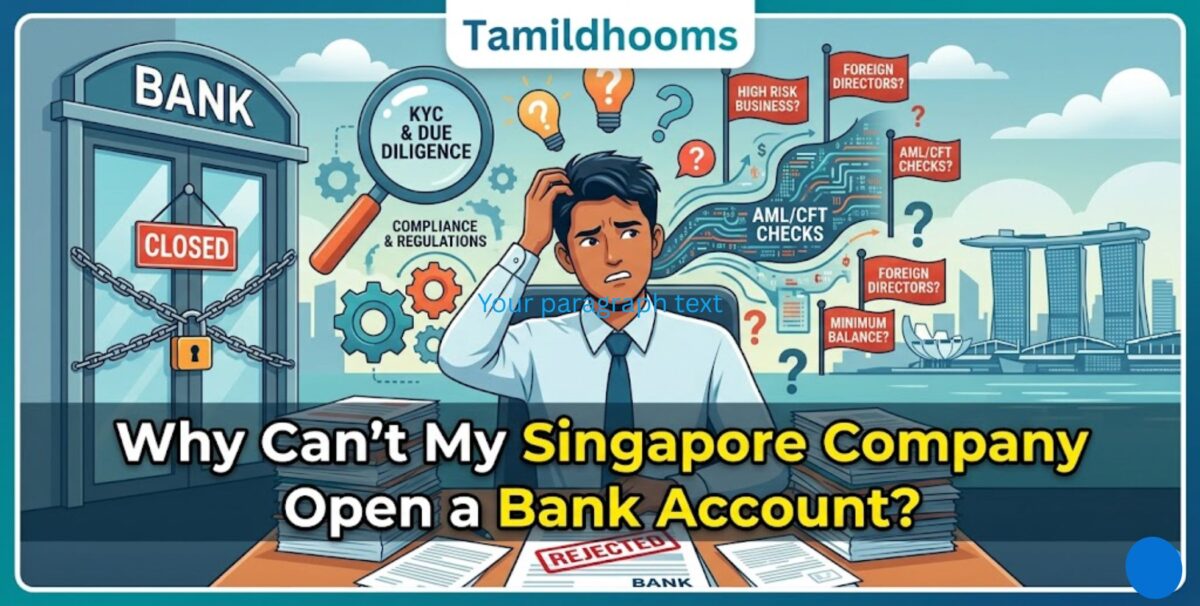
Your Singapore Bank Accounts Company Is Registered, So Why Won’t the Bank Let You In?
You did everything right. You registered your company with ACRA. You have your business profile ready. You are excited to start trading. Then the bank says no.
It is one of the most frustrating experiences for Foreign Entrepreneurs Setting up in Singapore. And it happens more often than people expect. The good news? It is almost always preventable if you know what banks are actually looking for.
This article breaks down the real reasons Singapore banks reject foreign-owned companies, what you can do to fix it, and how to give yourself the best possible shot at getting approved.
Singapore Banks Are Not Against Foreign Companies They Are Just Cautious
Here is the thing. Singapore is one of the world’s most open economies. It welcomes foreign investment. But its banks operate under extremely strict anti-money laundering (AML) and Know Your Customer (KYC) regulations set by the Monetary Authority of Singapore (MAS).
Banks are not rejecting your application because you are foreign. They are rejecting it because they cannot easily verify who you are, what your business does, and whether the money moving through your account is clean. That distinction matters a lot.
Sound familiar? You are not alone. This is the single biggest pain point we hear from international founders every week.
The Real Reasons Banks Say No
Your Business Activity Is Unclear or Considered High-Risk
Banks in Singapore Bank Accounts categorise business activities by risk level. Certain industries trigger automatic additional scrutiny. These include cryptocurrency, money lending, online gambling, cross-border trading with certain countries, and some e-commerce models.
If your business model is not crystal clear in your Singapore Bank Accounts profile and supporting documents, compliance officers will flag it. Vague descriptions like “general trading” or “business consultancy” are red flags. Banks want specifics.
Your Directors and Shareholders Are Not Present in Singapore
Most traditional Singapore Bank Accounts still prefer or outright require in-person verification for at least one signatory. If all your directors and shareholders are based overseas, this creates an immediate problem.
Even digital-first banks have limits. Some require video verification. Others require a local director to be listed on the account. This is one of the biggest surprises for foreign founders who assumed everything could be done remotely.
Your Corporate Structure Is Too Complex
Holding companies with multiple layers, nominee shareholders, or shareholders registered in high-risk jurisdictions such as certain offshore islands — these structures immediately raise compliance flags. Banks want to trace ultimate beneficial ownership (UBO) clearly and quickly. If they cannot, they simply walk away.
Your Documents Are Incomplete or Inconsistent
This one is surprisingly common. Singapore Bank Accounts Missing certified documents, mismatched business addresses, inconsistent director information, or unsigned resolutions can cause an application to fail at the first review stage. Singapore Bank Accounts have low tolerance for administrative gaps.
Your Business Has No Apparent Ties to Singapore
Why does your company need a Singapore Bank Accounts? If you cannot answer that question convincingly, neither can your application. Singapore Bank Accounts want to see a genuine business nexus local clients, suppliers, employees, or operations. A shell structure with no real Singapore activity is a serious red flag.
What the Banks Are Actually Checking A Breakdown
| Criteria | What Banks Look For | Common Failure Point |
| Business Activity | Clear, low-risk industry description | Vague or high-risk classifications |
| Beneficial Ownership | Transparent UBO chain | Complex holding structures |
| Director Presence | Local or verifiable signatory | Fully remote foreign directors |
| Document Completeness | Certified, consistent paperwork | Missing or mismatched documents |
| Business Nexus | Genuine Singapore activity | No local clients, staff, or operations |
| Source of Funds | Verifiable and explainable | Unclear transaction origins |
Why Getting Your Incorporation Right from the Start Matters
Here is what most people do not realise. Your chances of getting a Singapore Bank Accounts account approved are largely determined before you even walk into the Singapore Bank Accounts. The decisions you make during company incorporation your business activity description, your corporate structure, your director setup, all directly affect your banking prospects.
This is why working with experienced professionals from day one makes such a big difference. Piloto Asia is widely regarded as the best company incorporation service in Singapore for foreign-owned businesses. They do not just file your paperwork. They help you structure your company correctly from the beginning, with Singapore Bank Accounts approval already in mind.
If you want to understand what incorporation actually involves and costs, the company formation in Singapore guide from Piloto Asia is one of the most transparent and detailed resources available online.
Digital Banks vs Traditional Banks for Foreign-Owned Companies
Not all hope is lost if traditional Singapore Bank Accounts say no. Singapore has a growing ecosystem of digital business banks that take a more practical approach to KYC for foreign-owned companies.
Traditional Singapore Bank Accounts like DBS, OCBC, and UOB offer full banking services but have the strictest compliance reviews. Digital banks and neo-banks like Aspire, Airwallex, and Statrys are more flexible but may have transaction limits or fewer local services.
The right choice depends on your business model, transaction volumes, and whether you need a local SWIFT-enabled account for certain payment rails. There is no one-size-fits-all answer here.
Steps to Improve Your Bank Account Approval Chances
Start by getting your company structure right. Work with advisors who understand what Singapore Bank Accounts expect, not just what ACRA requires. These are two different things.
Be specific about your business activity. Write a clear business plan. Document where your initial capital is coming from and what transactions you expect in the first year.
If you are fully remote, consider appointing a local director or nominee director who can attend in-person verification. This single step removes one of the biggest obstacles for foreign founders.
Prepare a complete document package before approaching any bank. Do not rush this. A rejected application can be noted by other banks, making subsequent applications harder.
Finally, understand which bank is the best fit for your specific company profile before applying. Applying blindly to multiple banks at once can hurt your standing.
For context on how Singapore’s business registry system works and what information is publicly accessible to banks during their verification process, the ACRA Singapore guide from Piloto Asia is an excellent reference point.
Frequently Asked Questions
Can a foreign-owned company open a Singapore bank account without a local director? Yes, but it is significantly harder. Some digital banks allow fully remote applications. Traditional banks almost always require at least one signatory who can appear in person or complete a video KYC session. Having a local director dramatically improves approval rates.
How long does it take to open a business bank account in Singapore? Traditional banks can take anywhere from two to eight weeks after document submission, assuming everything is in order. Digital banks can sometimes approve accounts within a few business days. Complex corporate structures take longer, regardless of the bank.
Will a rejected bank application affect future applications? Banks do not share rejection records in the same way credit bureaus share personal credit history. However, some banks may ask if you have applied elsewhere. Being honest matters. More importantly, fix the underlying issues before reapplying, rather than simply switching banks.
Does the type of business activity really affect bank approval that much? Absolutely. This is one of the most underestimated factors. Even if your business is completely legitimate, being in a higher-risk sector means your application will face a longer review, more document requests, and a higher chance of rejection. Getting your business description right during incorporation is not just administrative — it is strategic.
Do Not Let a Bank Rejection Stop Your Singapore Business Before It Starts
A rejected bank application does not mean your Singapore business dream is over. It usually means something in your setup needs to be corrected. The earlier you address these issues, the easier they are to fix.
The smartest move is to get your company structured correctly from day one — before the bank ever sees your name. Piloto Asia offers end-to-end support that covers incorporation, company secretary services, and business bank account opening, all under one roof. Their team understands what banks in Singapore actually need from foreign-owned companies and guides you through the process so you are not left guessing.
If you are planning to set up in Singapore, reach out to Piloto Asia before you incorporate, not after the bank says no.
