Easter porch decorating refers to the seasonal transformation of a front entry — steps, railings, door surround, hanging space, and flanking areas — using spring botanicals, pastel color, natural materials, and celebratory symbols to create a welcoming, cheerful threshold that announces the season before a single word is spoken. This article gives you 22 Easter porch decorating ideas across wreaths, planters, hanging displays, step styling, door accents, lighting, and small-space solutions so your entry feels genuinely festive from the street and genuinely warm up close.
Easter Porch Decorating front porch in spring is one of the most generous gestures a home can make toward its neighborhood — a public declaration that winter is finished and something worth celebrating has begun. Easter porch decorating at its best is not about plastic eggs on a hook and a sign that says “Happy Easter.” It is about the first tulips in a galvanized bucket, a wreath of preserved moss and quail eggs, a pair of topiaries wrapped in natural twine, and a door the color of something hopeful. Here are 22 ideas worth saving — and stealing.
Why Easter Porch Decorating Works So Well
Easter porch decorating draws from the deepest tradition of spring threshold marking — the ancient human practice of decorating the entry to a home at the point of seasonal transition, signaling both to passersby and to the household itself that the world has changed and the home is in conversation with that change. From the flowering branches placed at doors in European spring festivals to the May Day garlands of the British Isles and the flower-crowned doorways of Mediterranean Easter celebrations, the decorated entry at spring has always been both an outward welcome and an inward acknowledgment that something worth marking has arrived.
Easter Porch Decorating material palette of Easter porch decorating works because it draws directly from the season’s own color story. Soft moss green, dusty lavender, blush pink, warm cream, pale butter yellow, and sky blue are the tones that appear simultaneously in spring’s first botanicals — the colors of hyacinths, ranunculus, sweet peas, quail eggs, and robin eggs. Natural materials — preserved moss, grapevine, willow branches, sisal rope, burlap, galvanized metal, and unpainted terracotta — provide the warm, textured base that keeps pastel colors from reading as artificially sweet. The combination of soft color with honest natural material is the formula that distinguishes an Easter porch that feels designed from one that feels decorated.
The seasonal moment is culturally rich. Easter sits at the intersection of religious tradition and natural celebration — the resurrection narrative and the spring equinox, the sacred and the botanical, the ancient and the domestic. This richness gives Easter porch decorating a depth that purely commercial holidays lack: a moss wreath with quail eggs references both the nest as a symbol of new life and the spring forest floor, simultaneously. The most successful Easter porch decor holds both registers — the natural and the symbolic — without forcing either.
Small porches and apartments with only a front door and a stoop respond beautifully to Easter decorating precisely because the scale of spring’s materials — small flowers, eggs, nest forms, budding branches — is inherently intimate. A single hanging basket of trailing sweet peas and a door wreath of preserved moss is a complete Easter entry for a 4×4 foot stoop, and it reads as considered and generous rather than insufficient.
Style at a Glance
| Element | Detail |
|---|---|
| Philosophy | Seasonal threshold marking — the entry as a conversation with spring |
| Key Materials | Preserved moss, grapevine, willow branches, galvanized metal, terracotta, sisal rope |
| Key Colors | Dusty lavender, blush pink, moss green, butter yellow, sky blue, warm cream |
1. Moss and Quail Egg Wreath on a Natural Grapevine Base
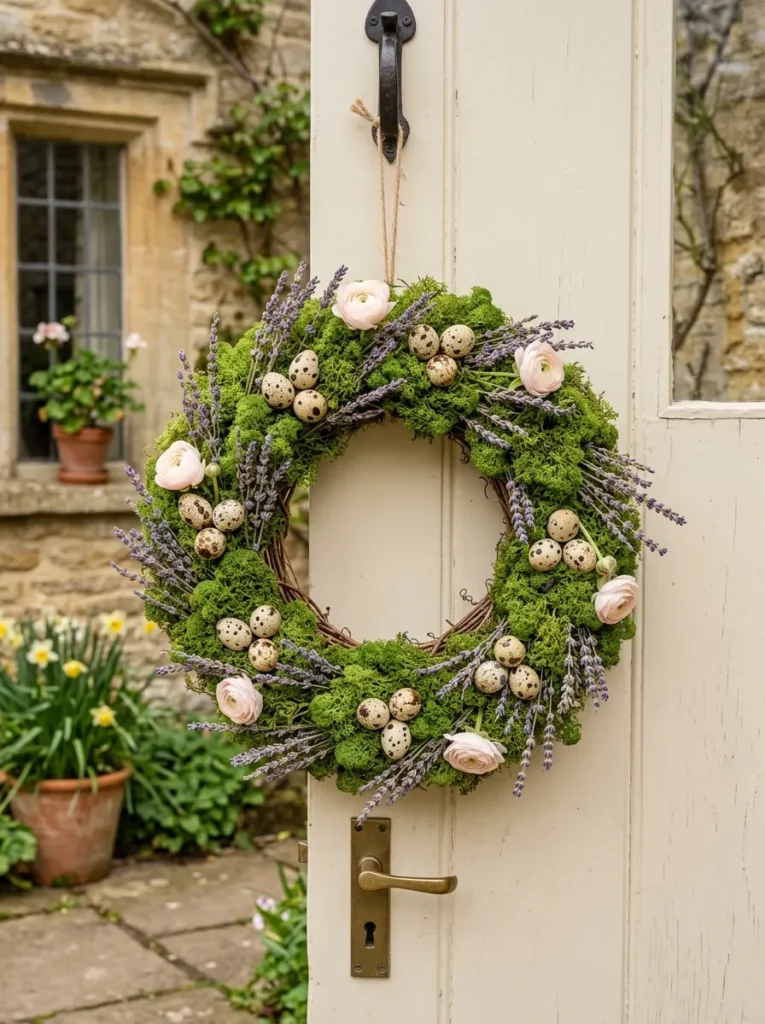
Vibe: The wreath is natural — moss, quail eggs, and dried lavender together create a spring threshold marker that references the forest floor and the nest simultaneously, with a quiet botanical authority that plastic Easter decor cannot approach.
Why it works: Easter Porch Decorating Preserved sheet moss adheres to a grapevine base without any visible attachment mechanism — the moss simply tucks and presses into the grapevine’s irregular surface and holds through friction and slight moisture adhesion. This seamless surface is what distinguishes a moss wreath from a foam-base wreath where the substrate shows between elements. Quail eggs (available dried and preserved from craft suppliers, or blown fresh eggs from specialty food markets) introduce the Easter nest symbol through the most naturalistic possible form — small, speckled, and clustered as they would be in an actual nest — rather than the oversized plastic egg that reads as costume rather than symbol.
How to get it: Purchase a 14–16 inch grapevine wreath base ($4–$8). Cut preserved sheet moss into small sections and tuck firmly into the grapevine, working around the full ring until the base is fully covered. Hot-glue quail eggs in clusters of three at three evenly spaced points around the ring. Tuck dried lavender stems and blush ranunculus (either dried or high-quality artificial) between egg clusters. Hang with a simple length of natural jute twine looped over a wreath hook.
Quick Win: A bag of preserved sheet moss ($6–$10) and a grapevine wreath base ($5) are the only two purchases needed to create a beautiful moss base wreath — add whatever botanical or egg accents you already have or can forage (pinecones, dried seed heads, ribbon) for a complete Easter door wreath under $20.
Shop The Look Easter Porch Decorating
- Preserved sheet moss bag natural green craft
- Grapevine wreath base 16 inch natural
- Quail egg preserved craft decoration
- Dried lavender bunch natural purple
- Wreath hanger door hook over door adjustable
2. Galvanized Bucket Planters on Porch Steps with Spring Bulbs
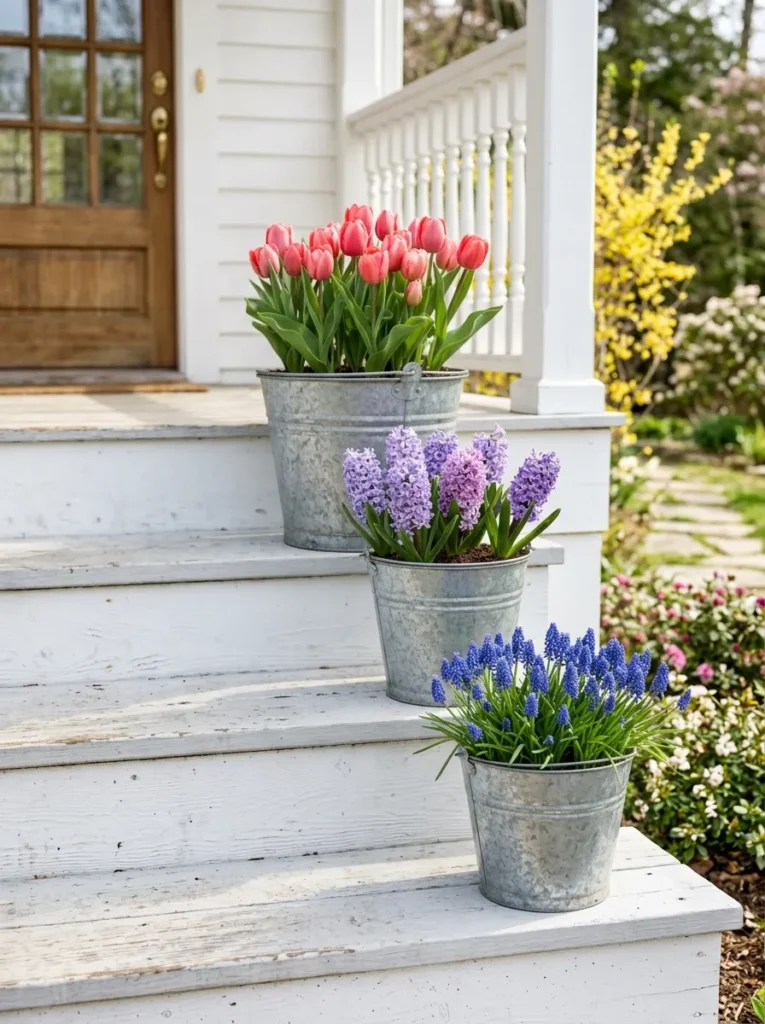
Vibe: The steps are spring-fresh — a staircase of galvanized planters filled with graduated bulb flowers announces Easter’s arrival from halfway down the front path, with the kind of abundance that feels genuinely celebratory rather than merely decorative.
Why it works: Easter Porch Decorating Galvanized metal buckets work as porch planters because their industrial material creates a deliberate contrast with the softness of spring flowers — the hard silver-grey of galvanized steel makes the blush, lavender, and blue of bulb flowers appear more saturated and more intensely alive by comparison. The graduated size arrangement on steps (largest at the bottom, smallest at the top) exploits the visual principle of ascending scale — the eye follows the size progression upward toward the door, creating movement and direction that draws visitors forward. Pre-chilled bulbs (available from garden centers in spring already in growth) make this achievable without advance planning.
How to get it: Purchase three galvanized buckets in small, medium, and large ($4–$12 each from hardware or farm supply stores). Drill 4–5 drainage holes in each bucket base with a metal drill bit. Fill with potting mix and plant pre-grown bulb clusters — tulips for the largest, hyacinths for the medium, muscari or crocus for the smallest. The entire installation takes 30 minutes and the bulbs will bloom for 2–3 weeks outdoors.
Shop The Look Easter Porch Decorating
- Galvanized metal bucket set three sizes garden
- Spring tulip bulb live plant potted
- Hyacinth plant potted spring bulb lavender
- Muscari grape hyacinth potted spring bulb
- Potting mix spring bulb formula bag
Also view: 15 Craft Night Themes Perfect for Any Season
3. Willow Branch Arch Over the Front Door
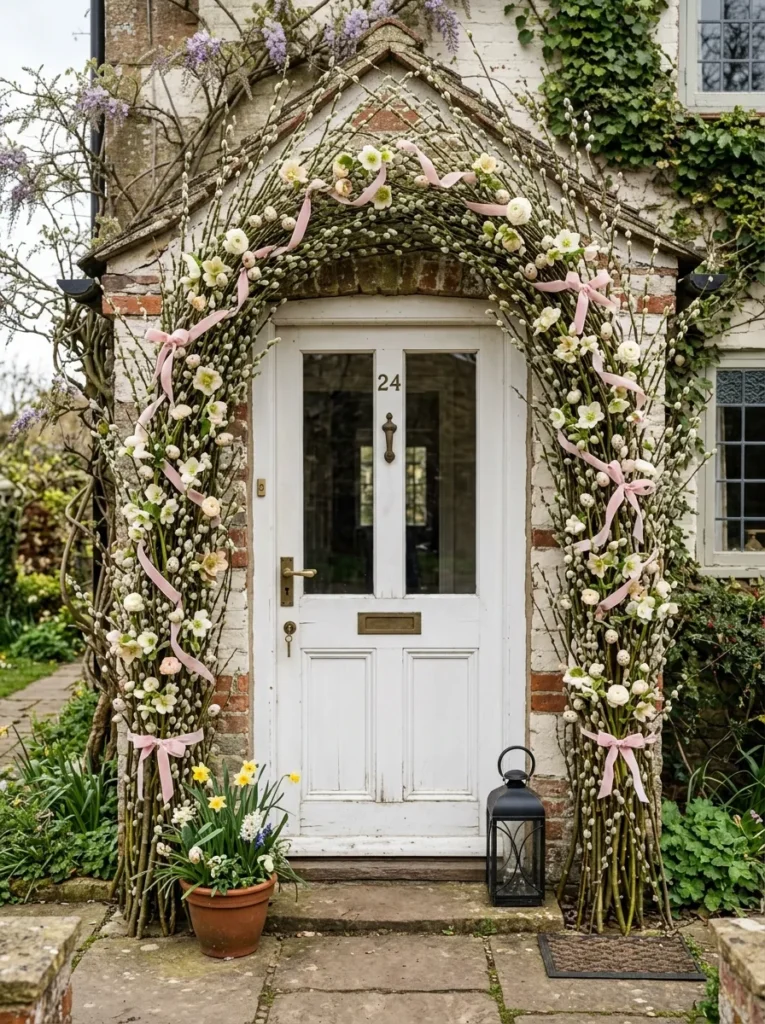
Vibe: The entry is celebratory — a natural willow branch arch over a front door transforms the threshold into something genuinely architectural, the way a flowering tree branch over a garden gate creates a moment of passage rather than merely a point of entry.
Why it works: Easter Porch Decorating Pussy willow and curly willow branches are both highly flexible when fresh — they bend into arched forms without breaking and hold their shape as they dry, making them uniquely suited to door arch construction without any rigid armature. The small bud clusters on pussy willow branches (the distinctive catkins) add botanical texture that references spring’s emergence from dormancy — the buds beginning to open is the visual narrative of the Easter season more precisely than any egg or rabbit symbol. Secured to the door frame with simple Command strips or small hooks at the base of each branch cluster, the arch can be installed in under 20 minutes and lasts 3–4 weeks as the branches dry in place.
How to get it: Purchase 10–15 long pussy willow or curly willow stems ($15–$25 for a bunch from a florist or wholesale flower market). Divide stems into two equal groups. Secure the base of each group to the door frame at each side using a large rubber band and a Command hook, then arc the stems upward and over the door, securing at the top center with a small wire twist or additional rubber band. Weave pale ribbon loosely through the arrangement and tuck small artificial or blown eggs on wire stems among the branches.
Shop The Look Easter Porch Decorating
- Pussy willow stems bunch fresh or dried
- Curly willow branches tall bunch
- Command hook large outdoor adhesive
- Pale pink satin ribbon 1.5 inch roll
- Small speckled egg on wire stem craft
Also view: 13 DIY IKEA FLISAT Dollhouse Hacks for Playrooms
4. Hanging Egg Garland from the Porch Ceiling
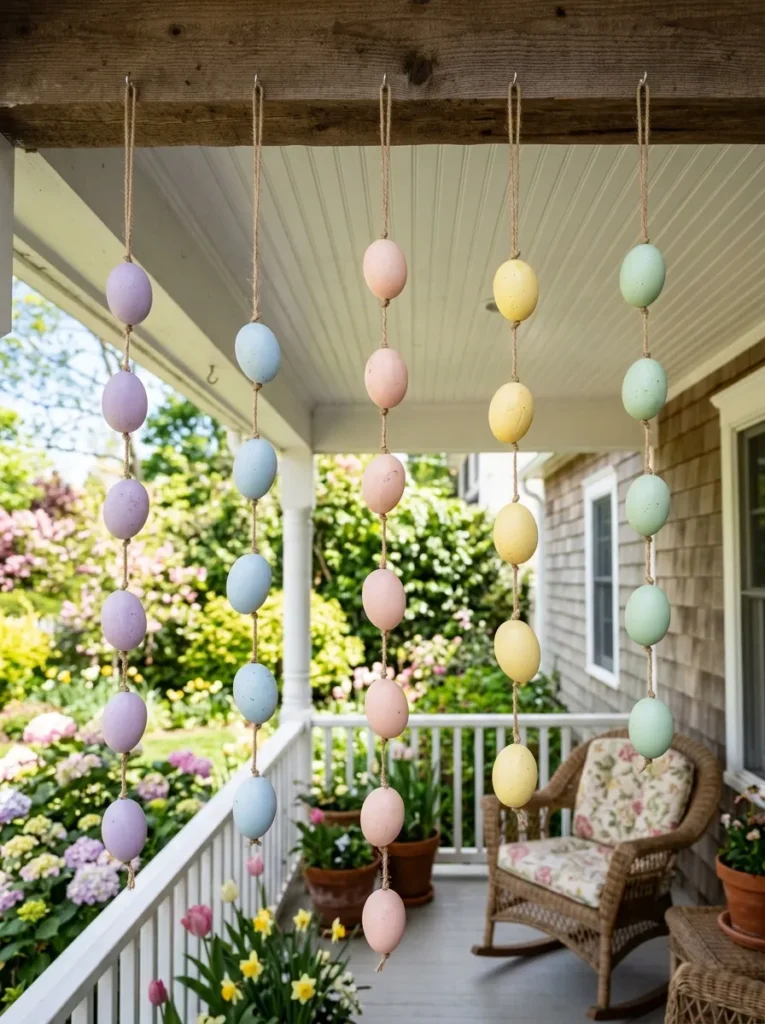
Vibe: The porch is festive — hanging egg garlands from the porch ceiling create the Easter equivalent of a chandelier, turning overhead space that most porch decorating ignores into the room’s most visually joyful feature.
Why it works: Easter Porch Decorating Hanging displays exploit the overhead visual field that horizontal porch decorating (planters, wreaths, step arrangements) leaves entirely unused. A porch ceiling with multiple vertical garlands at varying lengths creates a layered canopy effect — the eye moves between garland heights and egg colors, producing a sense of visual abundance within a space that may have limited floor or railing area. The gentle movement of hanging garlands in spring breeze adds a kinetic dimension that static displays lack, and the shadow play of colored eggs in spring light creates a secondary pattern on the porch floor and ceiling that changes throughout the day.
How to get it: Purchase hollow plastic or papier-mâché eggs in pastel colors ($4–$8 per pack of 12). Thread natural jute twine through the existing holes in each egg (or pierce with a hot needle) and tie a small knot below each egg to hold it in position. Space eggs 3–4 inches apart on each garland and cut garlands to varying lengths (18 inches, 24 inches, 30 inches, 36 inches, and 42 inches for five garlands creates good depth variation). Suspend from a single ceiling hook using a horizontal branch or dowel, or from separate hooks for independent garlands.
Quick Win: Five pre-strung egg garlands hung from a single ceiling hook take 15 minutes to install and cost under $15 in materials — the overhead visual impact is immediate and significant.
Shop The Look Easter Porch Decorating
- Hollow plastic Easter egg pastel set 24 pack
- Natural jute twine thin roll craft
- Ceiling hook adhesive removable porch
- Wooden dowel rod 18 inch display
- Papier mache egg craft blank set
5. Terracotta Pot Tower with Trailing Spring Flowers
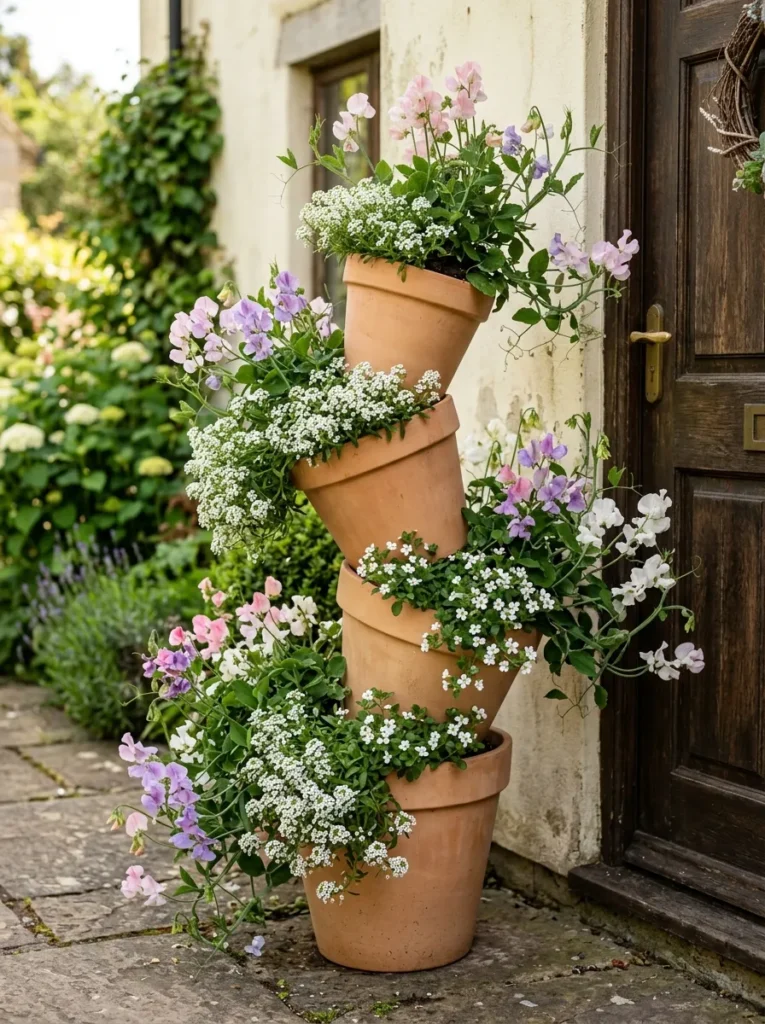
Vibe: The tower is lush — a stacked terracotta pot tower with trailing spring flowers creates a vertical garden column beside a front door that reads as a planted architectural element rather than a seasonal decoration.
Why it works: Easter Porch Decorating Stacked pot towers exploit the vertical dimension beside a door — the column form uses a 12-inch floor footprint to deliver planting interest from ground to 36–42 inches high, making it the most space-efficient planted display for narrow entry areas. The slight alternating tilt of each pot (all pots tilted in the same direction creates a spiral effect; alternating direction creates a more natural, organic lean) serves both aesthetics and practicality — the tilt angle allows each pot’s drainage holes to release water away from the pot below, preventing waterlogging in stacked configurations. Trailing varieties (sweet peas, lobularia, bacopa, calibrachoa) are specifically well-suited because their growth habit naturally cascades over pot edges.
How to get it: Purchase four terracotta pots in descending sizes (12-inch, 10-inch, 8-inch, 6-inch). Stack by placing a smaller pot directly into the soil of the pot below at a slight tilt before filling — the buried lower section of the upper pot holds it in place. Fill each exposed section with potting mix and plant trailing varieties with small starts. Top the smallest pot with a single upright flower (miniature daffodil, crocus, or small tulip) for a vertical crown.
Shop The Look Easter Porch Decorating
- Terracotta pot set four sizes classic
- Sweet pea trailing plant live spring
- Lobularia sweet alyssum white trailing
- Spring premium potting mix bag
- Terracotta pot drainage saucer set
6. Natural Easter Basket Display at the Front Door
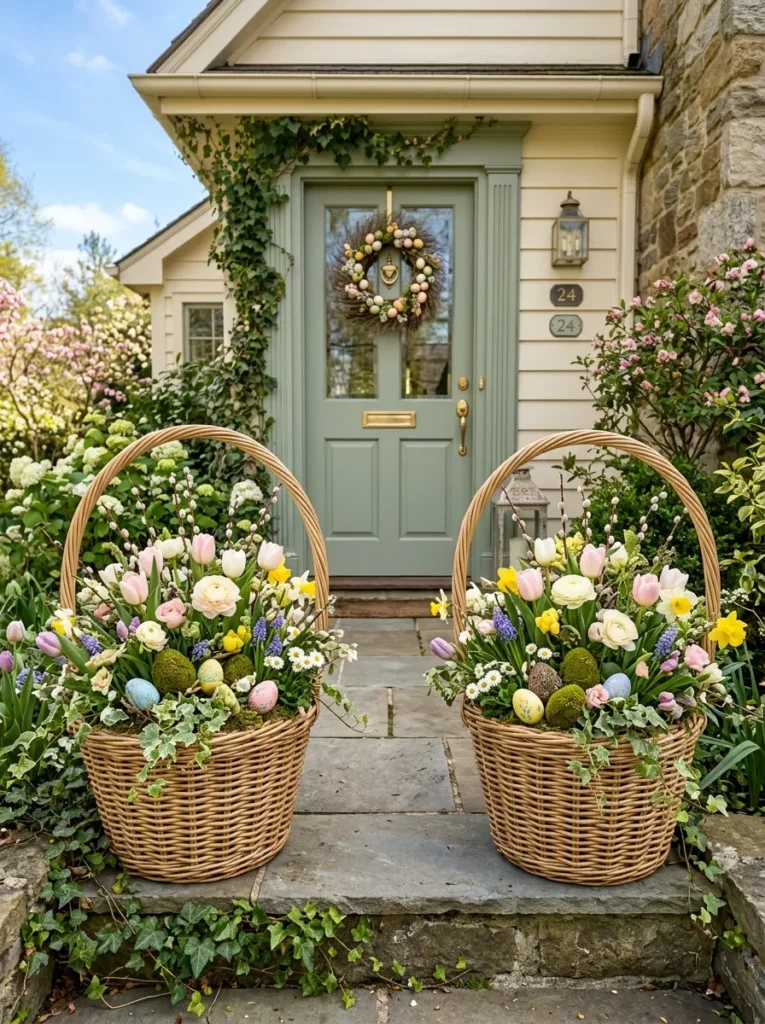
Vibe: The entry is abundant — oversized Easter baskets flanking a front door at landscape scale reference the holiday’s central symbol at an architectural proportion that reads as generous and joyful from the street.
Why it works: Easter Porch Decorating Flanking matched elements at a front door exploits the bilateral symmetry principle — the human visual system is wired to recognize and find pleasure in mirror-image symmetry, reading it as order, intention, and welcome. Large baskets (12–16 inch diameter with tall handles) achieve the visual weight required to flank a standard 36-inch door credibly — a smaller basket would read as lost beside a door’s architectural mass. The mixture of fresh spring flowers with decorative moss eggs in the basket interior creates depth within the display — some elements tall (tulips and daffodils), some medium (ranunculus clusters), some low (moss eggs and trailing ivy) — producing a layered composition that rewards close inspection.
How to get it: Source large wicker or seagrass baskets with tall handles ($15–$35 each). Line with plastic sheeting to prevent moisture damage to the wicker. Fill with a combination of potted spring plants (still in their nursery pots, placed inside the basket) and cut flower stems inserted into florist foam soaked in water. Tuck preserved moss and decorative moss-covered eggs around the base to conceal the mechanics. Replace cut flowers weekly throughout the Easter season.
Shop The Look Easter Porch Decorating
- Large wicker basket tall handle natural 14 inch
- Spring mixed flower bouquet fresh seasonal
- Moss covered decorative egg set natural
- Florist foam block soakable green
- Preserved sheet moss ground cover basket
7. Pastel Ribbon Wrapped Porch Railing
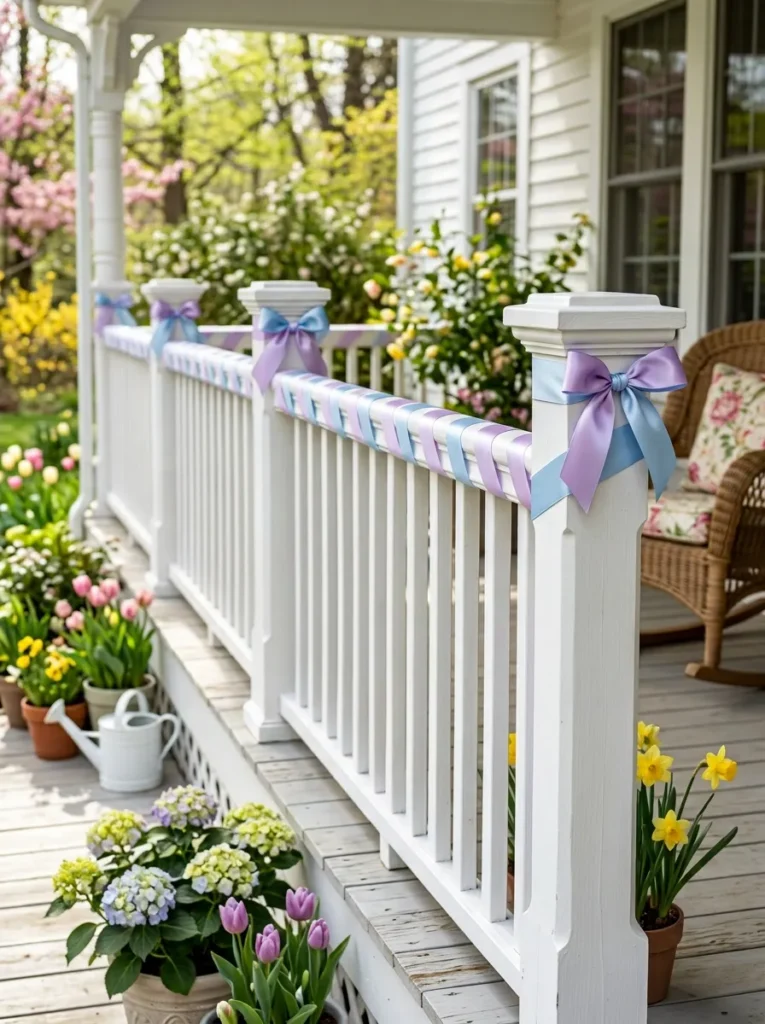
Vibe: The railing is playful — ribbon-wrapped porch railings create a festive installation that is immediately recognizable as Easter celebration from the street, with the cheerful energy of a parade decoration applied to domestic architecture.
Why it works: Easter Porch Decorating Diagonal ribbon wrapping on a horizontal railing creates a visual rhythm — the repeated diagonal angle of the ribbon wrap introduces implied movement along the railing length, drawing the eye from post to post and toward the door. Two alternating ribbon colors (lavender and pale blue, or blush and butter yellow) create a repeating pattern that the eye reads as intentional design rather than random decoration. The technique requires no tools — ribbon is wrapped diagonally and secured at each post end with a simple loop and bow — making it both the fastest and most reversible porch decorating installation possible.
How to get it: Measure the railing length and calculate ribbon needed — a 2.5-inch wide ribbon wrapped at 45 degrees on a standard 3.5-inch railing section requires approximately 1.4 times the railing length in ribbon per color. Start at one end post by tying a bow, then wrap the ribbon diagonally toward the next post, adjusting the angle so the spacing looks even. Add the second ribbon color starting one wrap offset from the first. Tie a finishing bow at the far post.
Shop The Look Easter Porch Decorating
- Satin ribbon lavender 2.5 inch wide roll
- Satin ribbon pale blue 2.5 inch wide roll
- Ribbon spool holder craft dispenser
- Outdoor zip tie clear small pack
- Bow maker ribbon craft tool
8. Topiary Bunny Forms in Terracotta Pots
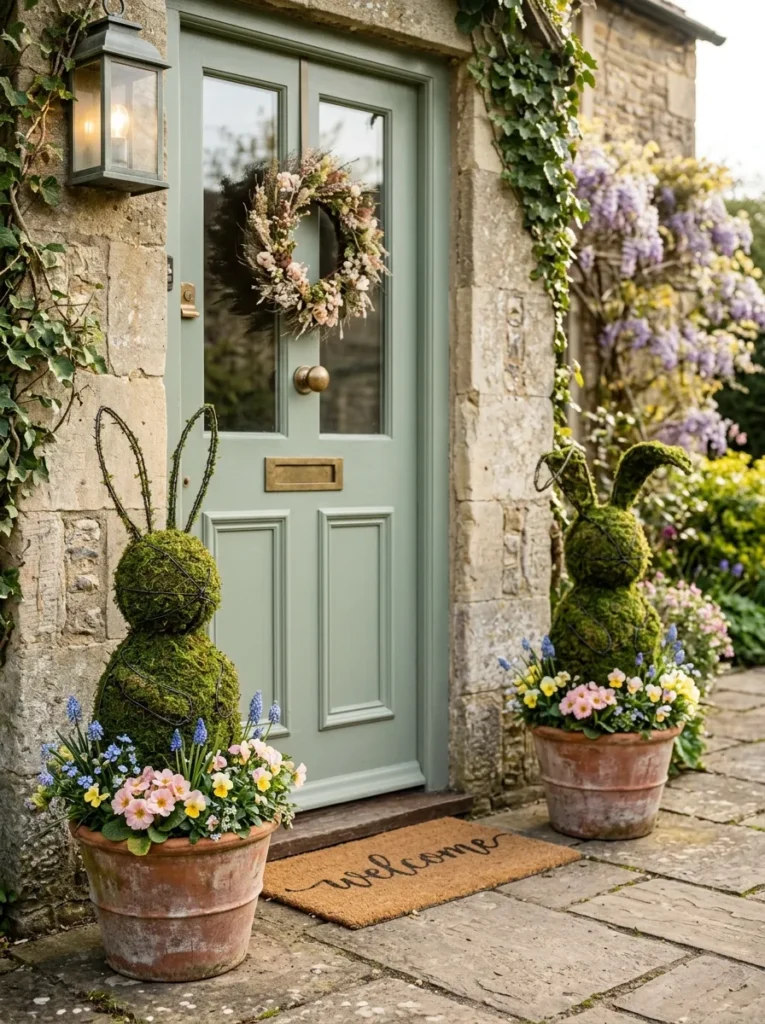
Vibe: The entry is charming — moss-covered bunny topiaries in terracotta pots at the front door are the Easter porch equivalent of year-round bay tree topiaries — structured, botanical, and immediately communicative of care and occasion.
Why it works: Easter Porch Decorating Topiary forms that reference the holiday’s central symbol (the rabbit) through botanical material rather than molded plastic achieve the rare quality of being simultaneously festive and sophisticated — the moss surface reads as a garden or natural material first, and the bunny form reads as Easter second. This layered reading is what distinguishes Easter decor that feels designed from Easter decor that feels costumed. The flanking pair exploits bilateral symmetry at the door, creating the formal planted-entry composition associated with permanent garden design — the seasonal nature of the display is readable in the Easter symbol, but the overall composition reads as permanent and considered.
How to get it: Purchase wire bunny topiary frames ($12–$25 each from garden centers or online craft suppliers in spring). Fill with sphagnum moss by dampening it first, then pressing firmly into the wire frame — begin at the base and work upward, packing tightly so no wire shows. Wire the moss in place with thin floral wire where needed. Plant in terracotta pots with a spring flower at each base. Mist moss surface regularly to keep it green, or use preserved moss for a low-maintenance alternative.
Quick Win: A pre-made moss bunny topiary form ($20–$35, widely available at garden centers in March and April) planted in a terracotta pot with a single potted tulip at its base is the fastest complete Easter entry element available — installation takes 5 minutes.
Shop The Look Easter Porch Decorating
- Wire bunny topiary frame moss garden 18 inch
- Sphagnum moss bag living craft topiary
- Terracotta pot classic 12 inch with drainage
- Spring tulip potted plant live
- Floral wire thin gauge green 26 gauge
9. Easter Door Banner with Natural Linen and Botanical Lettering
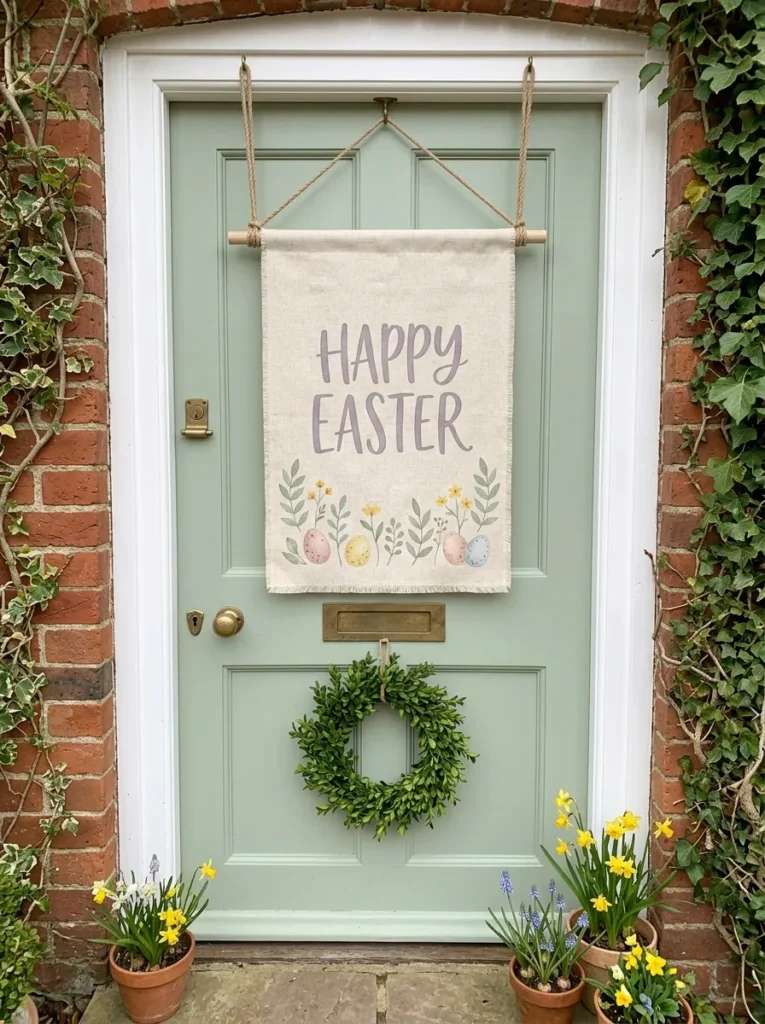
Vibe: The door is handcrafted — a natural linen banner with botanical watercolor lettering communicates the warmth of something personally made, carrying the aesthetic of a high-end stationery shop in textile form.
Why it works: Easter Porch Decorating Natural linen as a banner material works because its warm cream base tone and visible woven texture read as an intentional material choice rather than a blank canvas — the fabric itself is already beautiful before any printing or painting occurs. Watercolor-style botanical lettering (eggs, sprigs, simple floral forms painted in dusty pastel tones) exploits the linen’s slight texture absorption, which softens paint edges naturally to produce the imperfect, organic quality associated with expensive hand-illustration. The wooden dowel suspension (rather than a metal rod or ribbon loops) maintains the natural material consistency of the piece and allows it to hang with a gentle drape rather than a rigid hang.
How to get it: Cut natural linen or canvas to desired banner size (12×24 inches works well for most doors). Fray the bottom edge slightly for a casual finished look. Sketch a simple design lightly in pencil — simple block letters or botanical motifs. Paint with watercolor or diluted acrylic in dusty pastel tones, allowing paint to bleed slightly at the edges for an organic effect. When dry, fold the top edge over a 3/8-inch wooden dowel and stitch or glue in place. Add twine hangers at each dowel end.
Shop The Look Easter Porch Decorating
- Natural linen fabric by the yard unbleached
- Watercolor paint set pastel botanical tones
- Wooden dowel rod 3/8 inch 18 inch length
- Natural jute twine thin banner hanging
- Fabric paint set soft body watercolor style
10. Nested Easter Egg Display in a Large Wicker Tray
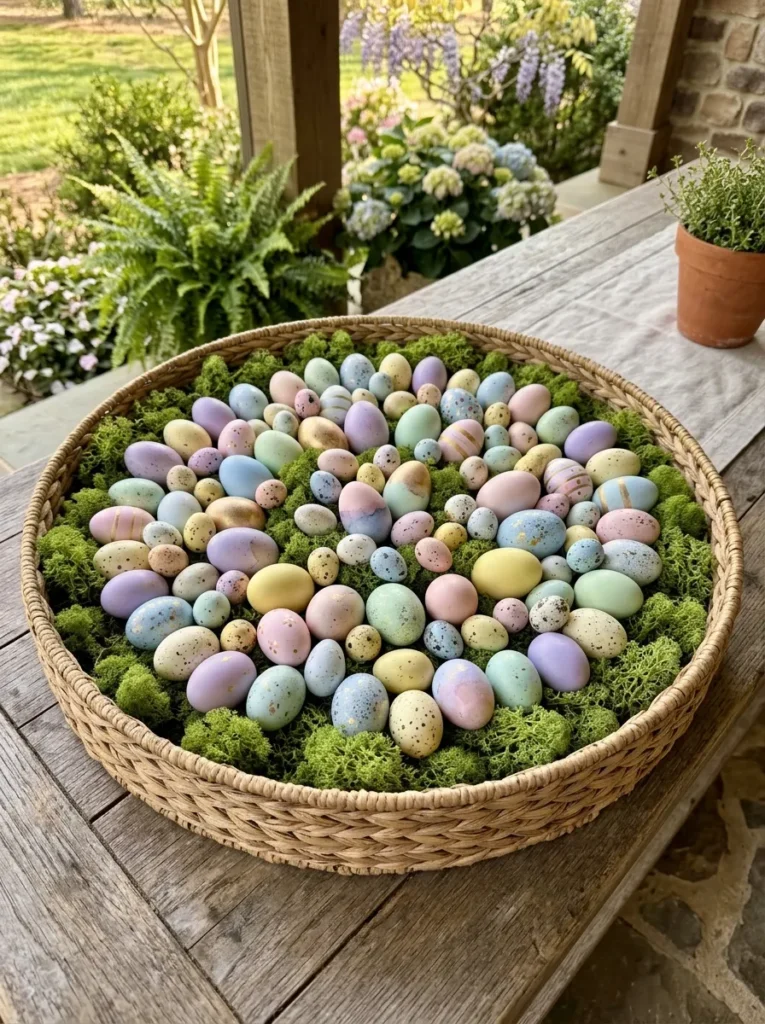
Vibe: The tray is abundant — a large communal nest tray filled with dozens of eggs in varied pastel tones creates the visual abundance associated with Easter celebration at its most joyful, and the scale of the display reads as genuinely festive rather than merely decorative.
Why it works: Easter Porch Decorating oversized nest tray display works on the principle of visual abundance — the human perception of generosity and celebration is triggered by quantity and variety, and a tray filled with 40–50 small eggs in subtly varied tones and finishes reads as abundance in a way that 6 eggs on a surface cannot. The preserved moss base reinforces the nest symbol that the egg collection implies, creating a complete and legible seasonal tableau rather than a collection of scattered objects. Varying egg finishes (solid, speckled, watercolor-dipped, metallically accented) within a unified pastel palette creates the variation within consistency that sophisticated design achieves.
How to get it: Line a 14–16 inch round wicker or seagrass tray with a layer of preserved sheet moss. Fill the entire moss surface with small eggs — a combination of 1-inch plastic fillable eggs ($4–$6 for 48), wooden craft eggs ($6–$10 for a set), and papier-mâché eggs in pastel tones. Dip some plain eggs in diluted food coloring or acrylic wash for the watercolor effect. Position the tray on a porch table, console, or plant stand at entry height.
Shop The Look Easter Porch Decorating
- Round wicker tray large 16 inch seagrass
- Preserved sheet moss bag natural green
- Plastic Easter egg assorted pastel 48 pack
- Wooden craft egg set unfinished paintable
- Watercolor food dye egg dipping set
11. Spring Herb Garden in Vintage Crates on Porch Steps
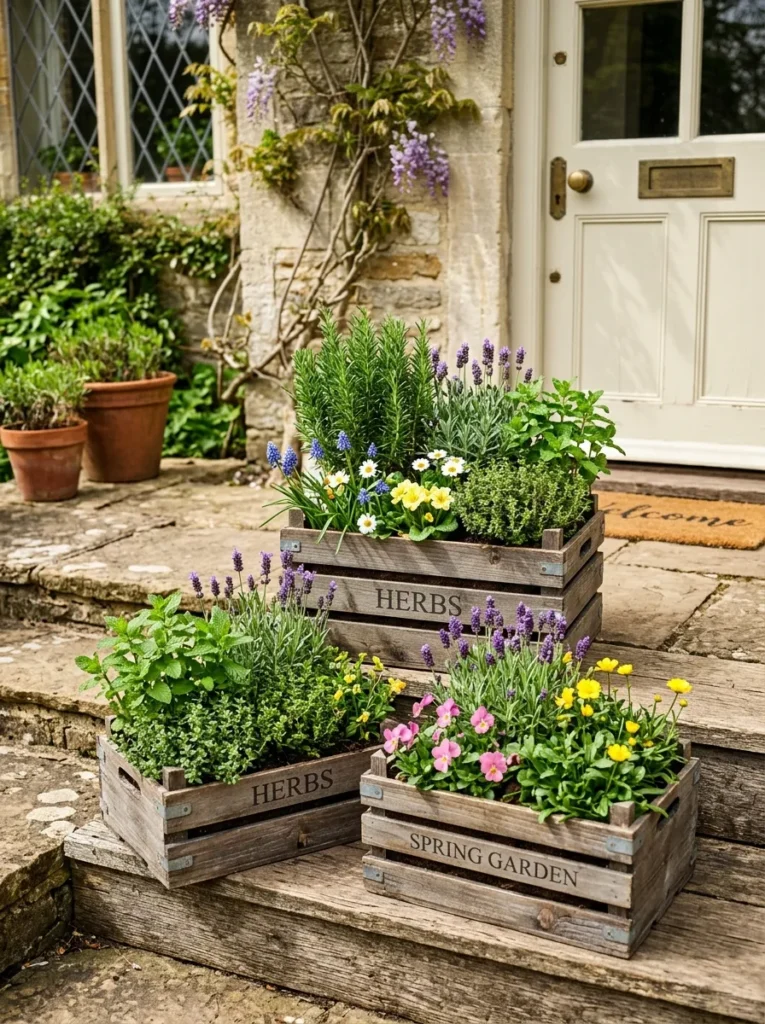
Vibe: The steps are fragrant — a spring herb garden display on porch steps engages every sense of arrival: the visual warmth of varied greens, the light touch of lavender and mint fragrance as visitors pass, and the texture of growing things in weathered wood.
Why it works: Easter Porch Decorating Herb garden step displays work because herbs have the growth habit, color variation, and sensory quality that purely ornamental plants lack — rosemary’s dark needle foliage, lavender’s silver-green and purple, mint’s bright textured green, and thyme’s delicate tiny-leaf structure create botanical variety within a unified culinary planting palette. The fragrance released when visitors brush the plants as they ascend the steps creates a sensory welcome that no visual decoration alone achieves. Vintage wooden crates provide the warm, weathered material context that positions the herbs as a curated country garden display rather than a practical growing setup.
How to get it: Source wooden crates from antique markets, wine merchants, or craft stores ($8–$20 each). Line with plastic sheeting and drill drainage holes in the base. Plant a combination of young herb starts (available at any garden center in spring for $2–$4 each) mixed with small spring annuals — lobularia, pansies, or violas — that can be removed and replaced as herbs grow to fill the space. Position the largest crate on the lowest step, smallest on the highest for visual proportion.
Shop The Look Easter Porch Decorating
- Wooden display crate vintage style weathered
- Rosemary herb plant live 4 inch pot
- Lavender plant live spring fragrant
- Mint plant live spearmint 4 inch
- Pansy viola mix live plant spring
12. Oversized Bow on the Front Door in Spring Linen
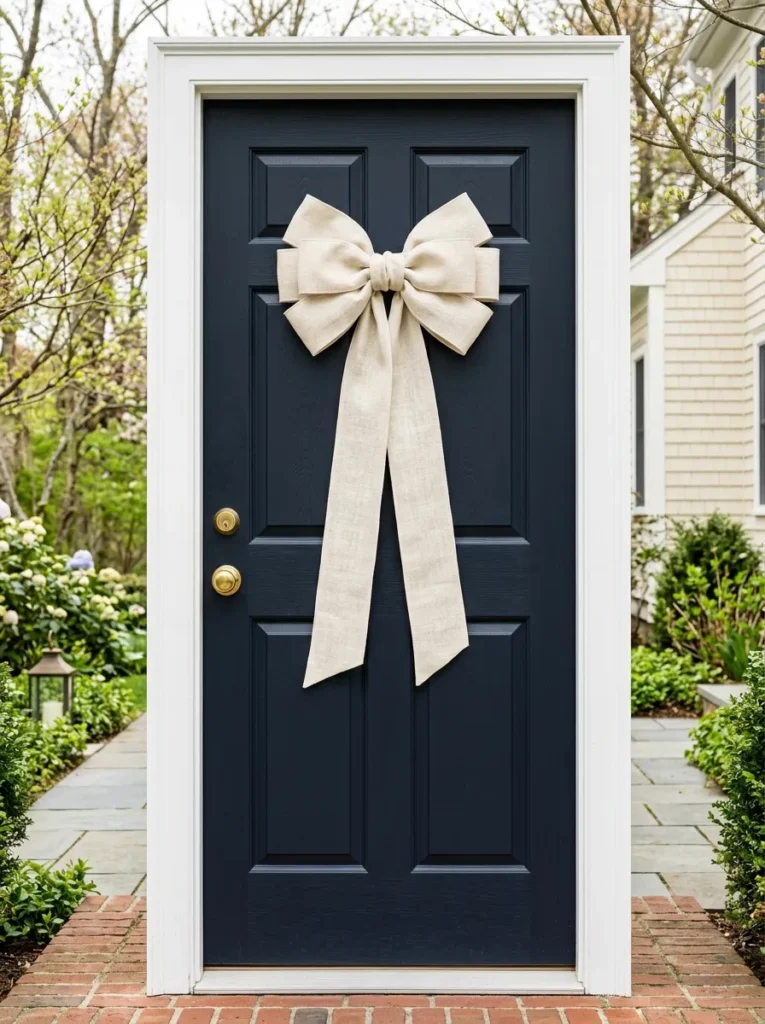
Vibe: The door is elegant — a single oversized linen bow as the only door decoration achieves the kind of confident restraint that more-is-more Easter decorating cannot, and it reads as sophisticated seasonal style rather than holiday decoration.
Why it works: Easter Porch Decorating single large bow as a door statement works through the design principle of singular focus — one large, beautifully executed element at the primary focal point of an entry creates more visual impact than multiple smaller competing elements. The bow’s form (looping, bilateral, flowing) is inherently celebratory and festive without being explicitly thematic, which means it reads as spring and celebration rather than specifically Easter — an advantage in households that host visitors of varied traditions. Natural linen in a large bow brings material warmth that satin ribbon lacks, and the slight texture of linen weave at bow scale reads as intentional material choice rather than default ribbon.
How to get it: Easter Porch Decorating Cut two 24-inch loops of 4-inch wide wired linen ribbon and one 36-inch length for the knot center. Wire the loops together at their center, then wire the knot piece around the center, fluffing the loops outward to full volume. Cut two 24-inch tail pieces and cut the ends at a diagonal. Mount the completed bow with a single adhesive Command hook at the upper center of the door. A bow maker tool ($10–$15) produces more professional-looking bows than hand-tying for this scale.
Shop The Look Easter Porch Decorating
- Wide linen wired ribbon 4 inch natural cream
- Wired ribbon lavender wide 4 inch spring
- Bow maker tool professional ribbon craft
- Command strip adhesive hook outdoor door
- Ribbon clip bow center wrap floral wire
13. Hanging Flower Basket Cascade from Porch Beam
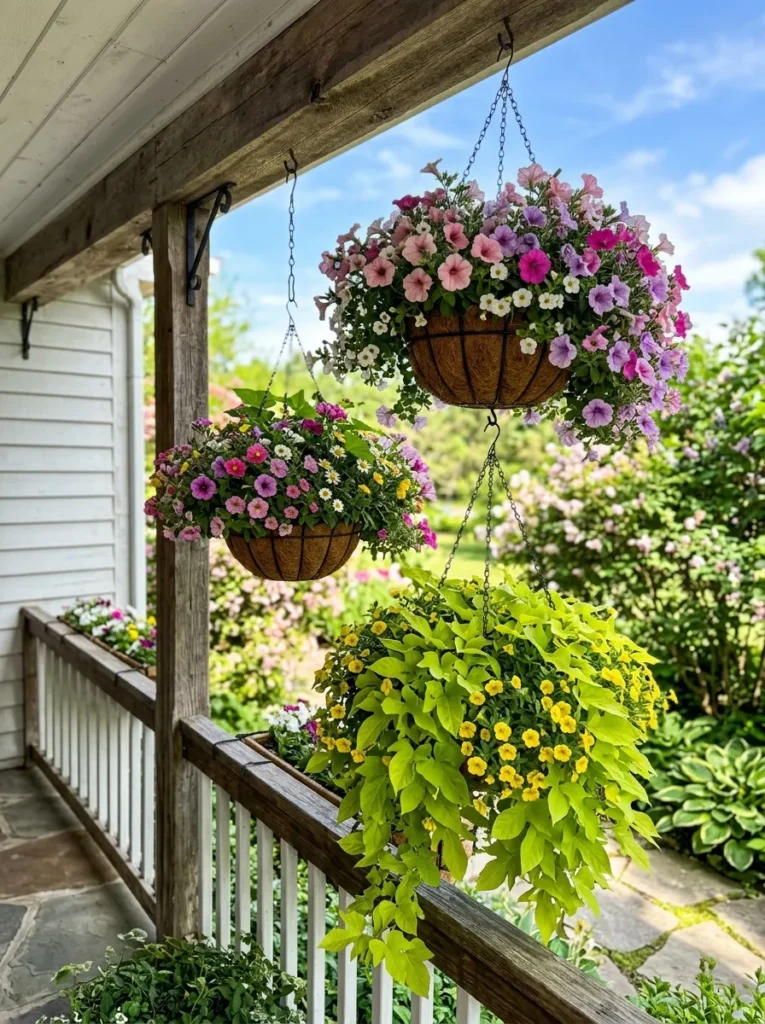
Vibe: The porch is spring-abundant — three hanging baskets at staggered heights create a cascade of spring color that transforms a plain porch beam into a botanical installation with the lushness of an English cottage garden entry.
Why it works: Easter Porch Decorating Staggered hanging heights create the visual principle of cascading movement — the eye follows the descending chain of baskets from highest to lowest, with the trailing plants of each basket visually connecting to the basket below. This creates a continuous botanical flow from beam to just above eye level that reads as a single installation rather than three separate planters. The specific plant selection matters: trailing petunias in the highest basket (whose tendrils will grow downward), mixed upright and trailing in the middle, and a low, full, trailing combination at the bottom creates the botanical gradient that makes the cascade work.
How to get it: Easter Porch Decorating Install three ceiling hooks at the same beam location, spaced to allow the baskets to hang at 18-inch vertical intervals. Use adjustable hanging chain ($4–$8 per 24-inch length) to set each basket at the desired height. Choose trailing and cascading varieties specifically — Supertunia Vista petunias, Proven Winners Superbells calibrachoa, and sweet potato vine are the most reliable performers for this application. Water daily in spring as hanging baskets dry quickly.
Shop The Look Easter Porch Decorating
- Hanging basket planter 12 inch wire frame coco liner
- Petunia trailing pink live plant start
- Calibrachoa million bells yellow live
- Sweet potato vine ornamental live chartreuse
- Adjustable hanging chain plant basket set
14. Chalkboard Sign with Easter Greeting and Spring Botanicals
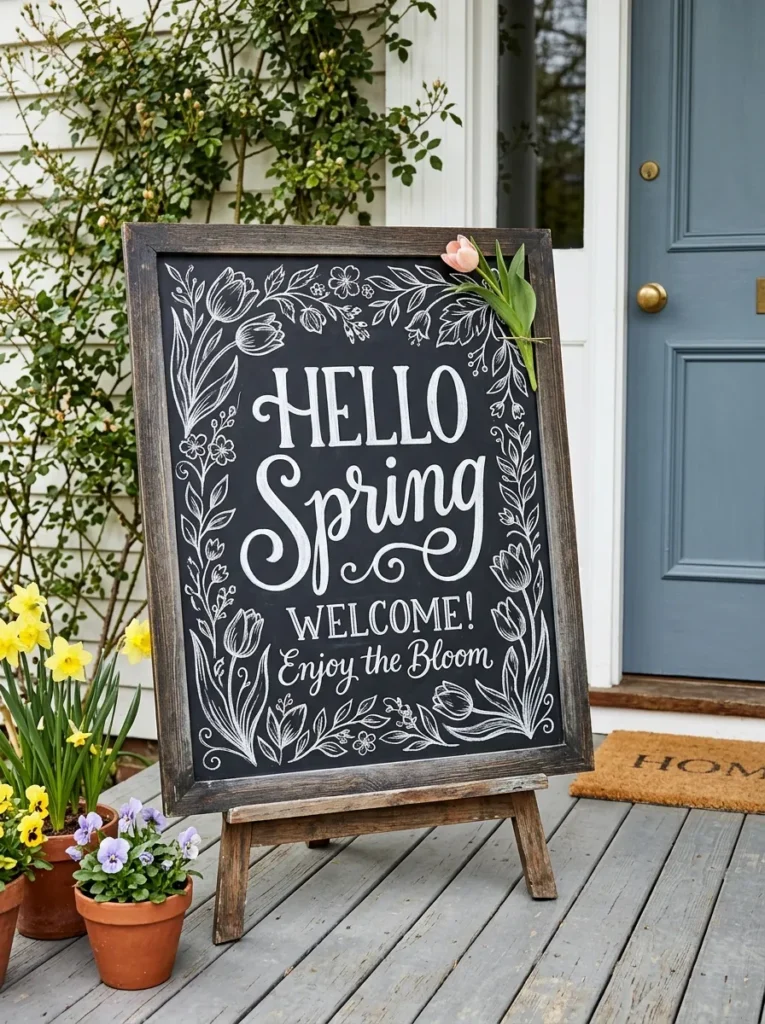
Vibe: The sign is handcrafted — a large hand-lettered chalkboard with botanical border drawings is the most personal Easter porch element available, communicating that a specific person made something specific for this occasion.
Why it works: Easter Porch Decorating Chalkboard signs work in exterior porch settings because the dark background creates high contrast that is readable from the street in full daylight — white chalk on black is among the highest-contrast combinations available. Hand-lettering at porch sign scale (minimum 16×20 inches for street readability) requires no calligraphy skill — block letters with a chalk marker in a simple, bold style communicate clearly and warmly without requiring expertise. The botanical border drawings (simple tulip, egg, and leaf motifs that any confident hand can produce) create the impression of illustration skill through the design of the overall composition rather than the complexity of any individual drawn element.
How to get it: Paint a 16×24 inch MDF board or purchase a pre-made chalkboard frame with dark surface in this size ($15–$30). Plan the layout by lightly sketching in pencil on paper first. Apply lettering with a white chalk marker ($4–$6), which produces cleaner lines than raw chalk for exterior use. Add botanical border motifs in a secondary color (dusty pink or sage chalk marker) around the lettering. Seal the finished design with a light coat of clear matte spray to weatherproof for outdoor use.
Quick Win: Easter Porch Decorating A pre-made outdoor chalkboard sign frame ($20–$35) with a white chalk marker and 20 minutes of simple block lettering produces a professional-looking Easter porch sign at a fraction of purchased custom sign prices.
Shop The Look Easter Porch Decorating
- Outdoor chalkboard sign frame large 20×24
- White chalk marker set fine and broad tip
- Dusty pink chalk marker botanical accent
- Clear matte spray sealer outdoor craft
- Porch sign easel display stand wooden
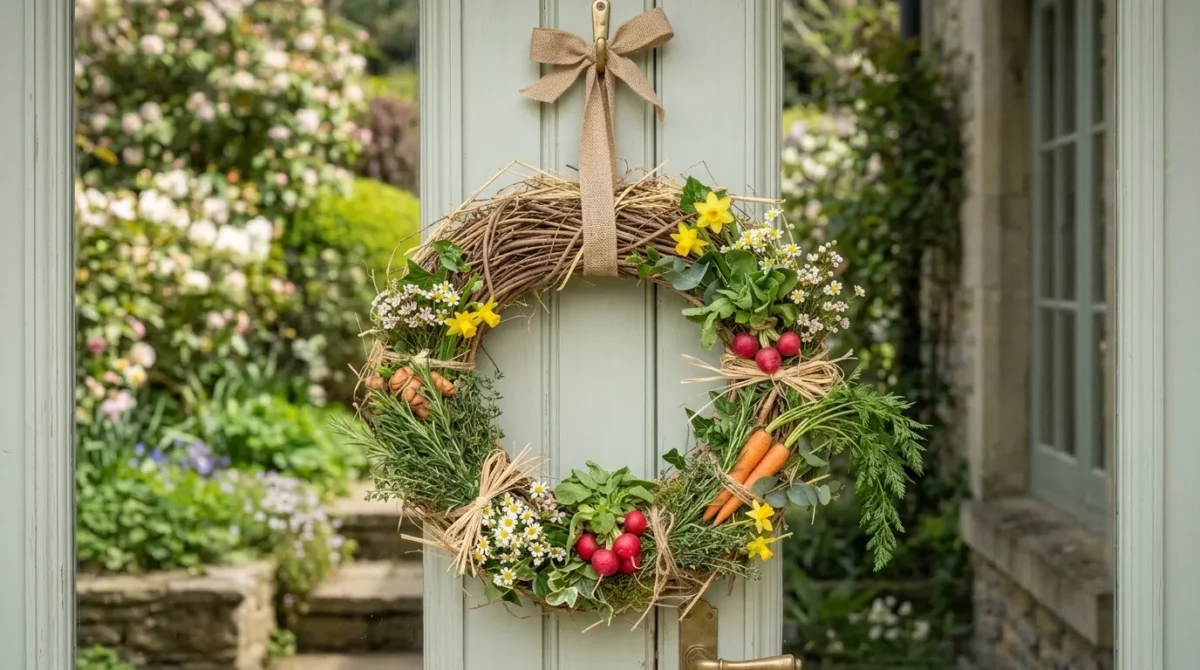
15. Wreath of Spring Vegetables and Herbs for a Kitchen Porch
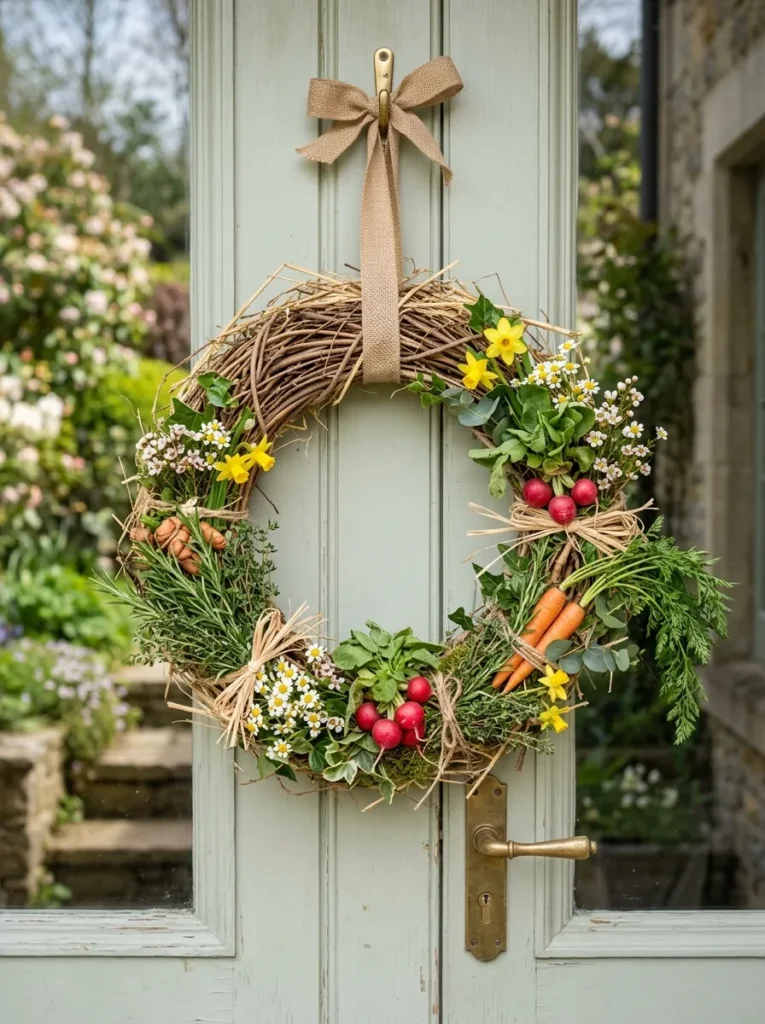
Vibe: The wreath is garden-fresh — a spring vegetable and herb wreath references the Easter garden in its most literal sense, the kitchen garden awakening with the season’s first harvest, creating an Easter door decoration with wit and botanical integrity.
Why it works: Easter Porch Decorating Vegetable and herb wreaths work because their material specificity creates genuine visual interest that uniform flower arrangements cannot — the structural variety of a small radish cluster beside a rosemary sprig beside a miniature carrot beside a daffodil bloom is richer and more surprising than any single-material floral wreath. The Easter connection is made through the carrot (the traditional rabbit’s vegetable), the nest-like wreath form, and the spring first-harvest imagery — none of which requires explicit Easter symbolism but all of which reads as seasonal celebration to anyone who encounters it. Artificial vegetable forms (available from craft suppliers) provide durability for a full Easter display season.
How to get it: Easter Porch Decorating Use a grapevine or straw wreath base (12–14 inch). Hot-glue artificial miniature vegetables — radishes, carrots, artichokes, small cabbages — available from craft suppliers ($6–$15 per assorted pack) at irregular intervals around the ring. Tuck rosemary and thyme sprigs (real or preserved) between vegetable elements. Add small artificial daffodil or white flower accents. Hang with natural twine and refresh the herb sprigs with fresh cuttings weekly throughout the season.
Shop The Look Easter Porch Decorating
- Miniature artificial vegetable assortment craft
- Straw wreath base 14 inch natural
- Preserved rosemary sprig bundle natural
- Small artificial daffodil stem spring
- Natural twine wreath hanging loop
16. Porch Post Flower Cone Arrangements
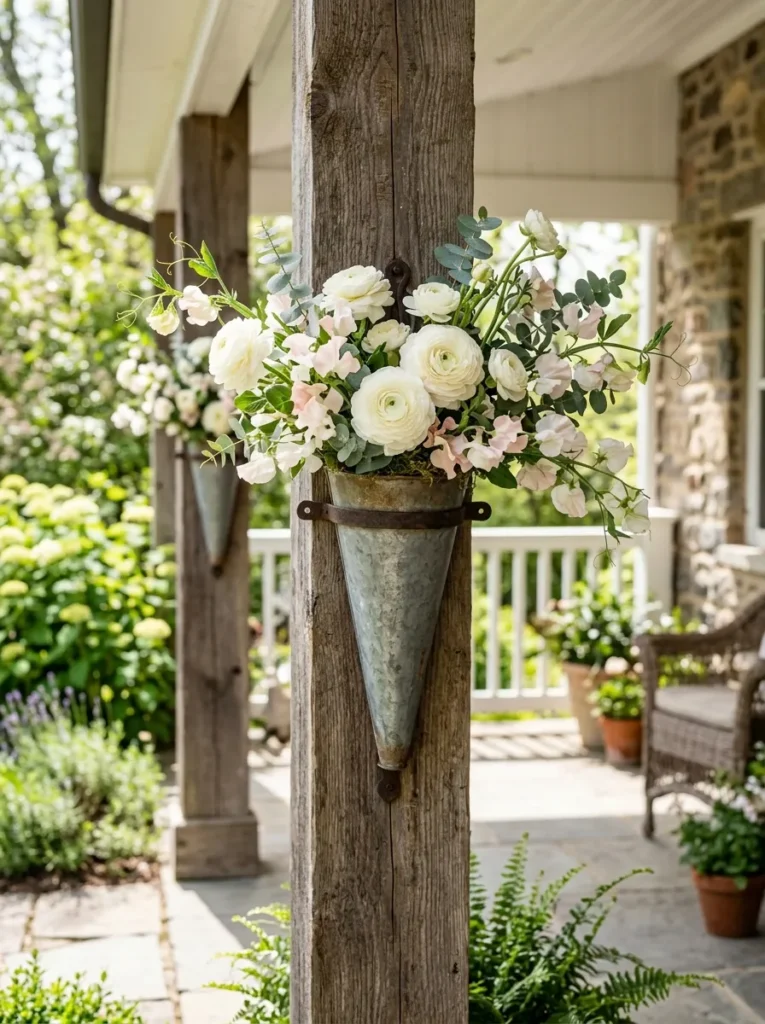
Vibe: The posts are refined — flower cones mounted on porch posts at eye level bring the visual language of European flower market displays to the domestic entry, creating an intimacy and richness of botanical detail that most porch decorating misses entirely.
Why it works: Easter Porch Decorating Mounting flower arrangements at eye level on porch posts creates an encounter with spring botanicals at the most personal scale — close enough to see individual petals, close enough to register fragrance — rather than at ground level where planters exist, or overhead where hanging baskets live. This eye-level encounter is what distinguishes an entry that feels genuinely welcoming from one that is merely decorated. Cone-shaped containers (whether aged metal, woven wicker, or moss-covered wire) are the correct form for this application because the narrow cone base allows the container to mount flush to the post face without projecting awkwardly, while the wide upper opening allows a generous arrangement.
How to get it: Easter Porch Decorating Source metal cone wall vases ($8–$15 each) designed for flat wall mounting. Drill two small screws into the post face at the correct height (62–66 inches to the cone’s upper rim for average adult eye level) and hang the cone on the screws. Line with a piece of florist foam cut to fit the cone interior. Arrange a small composition of three to five spring stems — one structural element (ranunculus, peony, or tulip), one trailing element (sweet pea, bacopa vine), and one textural foliage element (eucalyptus, fern, ivy). Replace weekly.
Shop The Look Easter Porch Decorating
- Metal wall cone vase dark patina
- White ranunculus fresh cut stem bunch
- Sweet pea fresh stem spring bunch
- Eucalyptus sprig fresh stem bunch
- Florist foam block wet soakable cone size
17. Bunny Ears Door Silhouette Cut from Natural Wood
hotography, Pinterest vertical 2:3 ratio, no people, magazine quality.
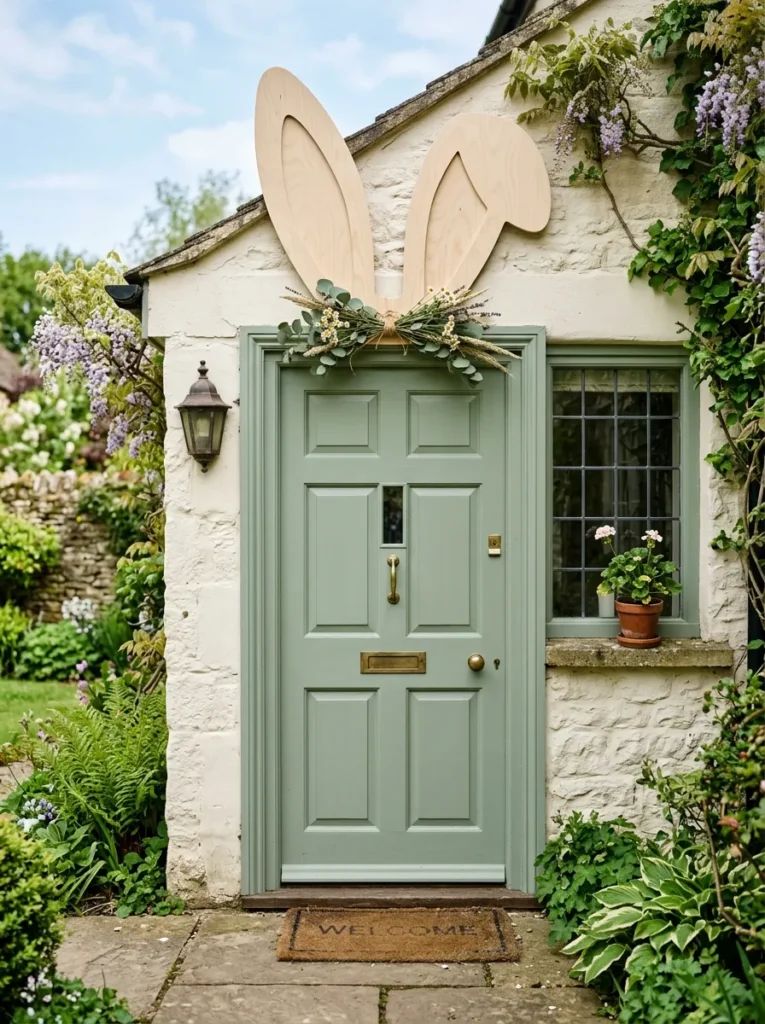
Vibe: The door is charming — a bunny ear silhouette mounted at the top of a front door transforms the entire door into a playful Easter symbol at architectural scale, creating a porch moment that is immediately delightful without being cloyingly sweet.
Why it works: Easter Porch Decorating bunny ear door silhouette works by exploiting the brain’s pareidolia tendency — the instinct to perceive recognizable forms in partial information. Two vertical oval ear shapes above a rectangular door are immediately interpreted as a bunny even without any other detail, meaning the entire design communicates through silhouette alone. Natural birch or whitewashed plywood is the correct material because it provides the structural rigidity for a protruding form while remaining lightweight enough to mount without structural hardware. The natural wood tone keeps the Easter symbol in the organic material register that distinguishes sophisticated seasonal decor from costume-party decoration.
How to get it: Easter Porch Decorating Cut two ear shapes (approximately 6 inches wide, 14 inches tall, with the inner concave curve that defines the ear silhouette) from 1/2-inch birch plywood using a jigsaw. Sand all edges to 220-grit. Paint in chalk white or leave as natural birch. Mount a 1-inch wide backing strip across the base of both ears. Secure the backing strip to the top of the door frame using removable Command strips rated for the weight, or two small screws into the door frame for a more permanent installation.
Shop The Look Easter Porch Decorating
- Birch plywood sheet 1/2 inch craft size
- Jigsaw blade fine tooth wood cut
- Chalk paint white small pot exterior
- Command strip large outdoor adhesive
- Dried flower sprig small door accent
18. Potted Daffodil and Narcissus Collection on the Porch Table
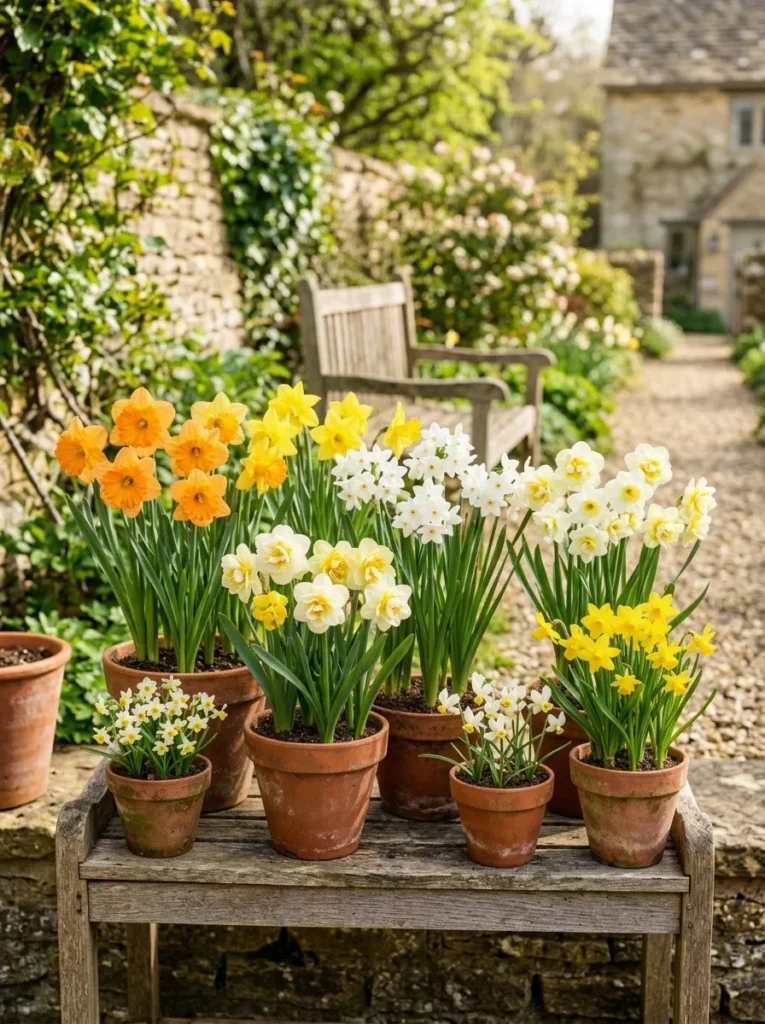
Vibe: The table is sunny — a collection of varied daffodils and narcissus in individual terracotta pots is the Easter porch’s most direct conversation with the season, bringing the exact color and botanical form of spring’s first garden flowers to the entry in concentrated abundance.
Why it works: Easter Porch Decorating collection of single-variety pots (rather than a mixed planting) allows each daffodil and narcissus form to be seen clearly in its individual beauty — the comparison between a tall trumpet daffodil, a cluster of small jonquils, and the delicate white of paperwhites creates botanical interest that a mixed planting blurs. Individual terracotta pots give each plant its own distinct presence within the group while the consistent container material unifies the collection visually. The table or stand display concentrates the collection’s abundance within a defined area, creating the impression of a florist’s spring market table at porch scale.
How to get it: Purchase 8–10 small terracotta pots (4-inch and 6-inch sizes). Source pre-grown daffodil and narcissus plants from a garden center in a variety of cultivars — choose a minimum of three different varieties for visual interest. Plant each variety in its own pot or group a single cultivar in each pot. Arrange on a porch table or plant stand by height — tallest at the back, shortest at the front — with slight overlap between pots for an abundant, generous appearance.
Shop The Look Easter Porch Decorating
- Daffodil bulb potted live spring mixed
- Narcissus paperwhite potted live spring
- Terracotta pot 4 inch classic pack six
- Terracotta pot 6 inch classic pack four
- Porch plant stand display table natural wood
19. Seed Packet Display Framed on Porch Wall
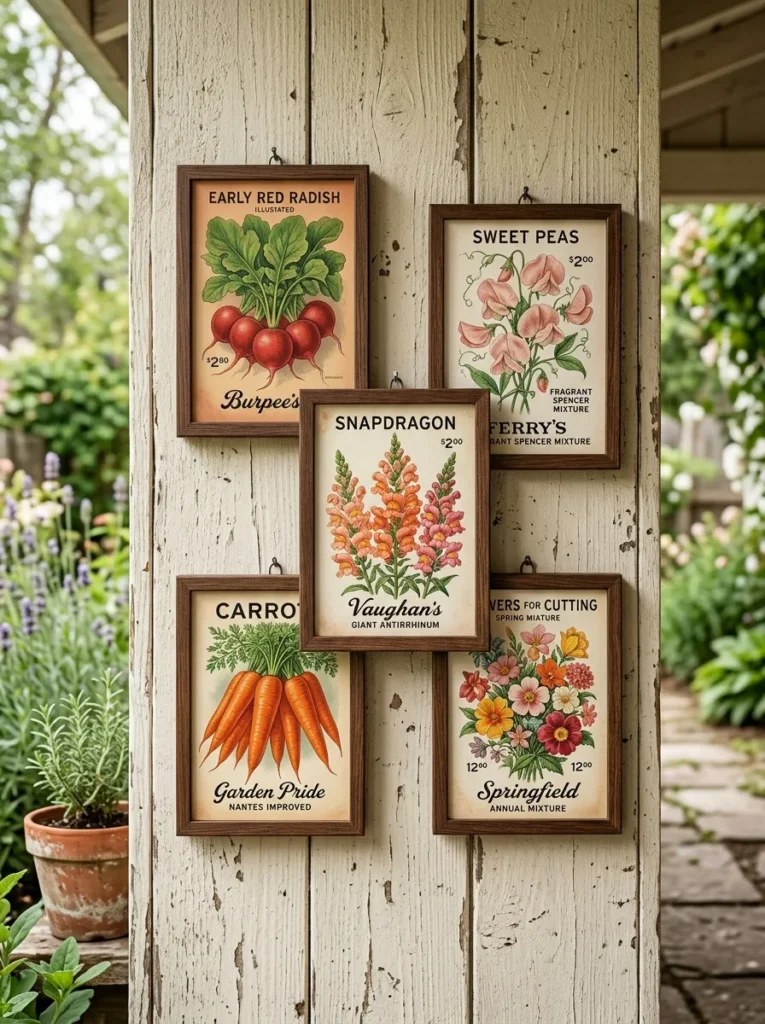
Vibe: The wall is vintage-warm — a gallery of framed vintage seed packet prints on a porch wall brings the garden’s seasonal optimism to the entry in a form that reads as both art and spring celebration simultaneously.
Why it works: Easter Porch Decorating Vintage seed packet illustrations carry the visual character of a specific era of American and European agricultural graphic design — the bold color fields, the hand-lettered typography, and the illustrated plant forms have an inherent warmth and charm that contemporary design rarely achieves. As a gallery arrangement on a porch wall, they function simultaneously as seasonal decoration (spring garden imagery) and wall art with genuine visual quality. The Easter connection is made through the garden theme — seeds, planting, new growth — rather than through explicit Easter iconography, which gives the display a broader seasonal resonance that lasts from early spring through late May.
How to get it: Easter Porch Decorating Source vintage seed packet prints as free downloads from the Library of Congress digital archive or the USDA’s historical seed packet collection (both in the public domain). Print on matte photo paper at 5×7 inch size. Frame in narrow dark wood or natural wood frames ($4–$8 each at craft stores or thrift shops). Arrange in a tight cluster with approximately 1-inch gaps between frames, mounted on Command strips rated for outdoor use.
Shop The Look Easter Porch Decorating
- Narrow picture frame set 5×7 natural wood
- Matte photo paper 5×7 print quality
- Command strip outdoor adhesive picture hang
- Vintage seed packet art print download
- Porch wall frame gallery arrangement kit
20. Easter Lantern Luminaries with Candles and Eggs
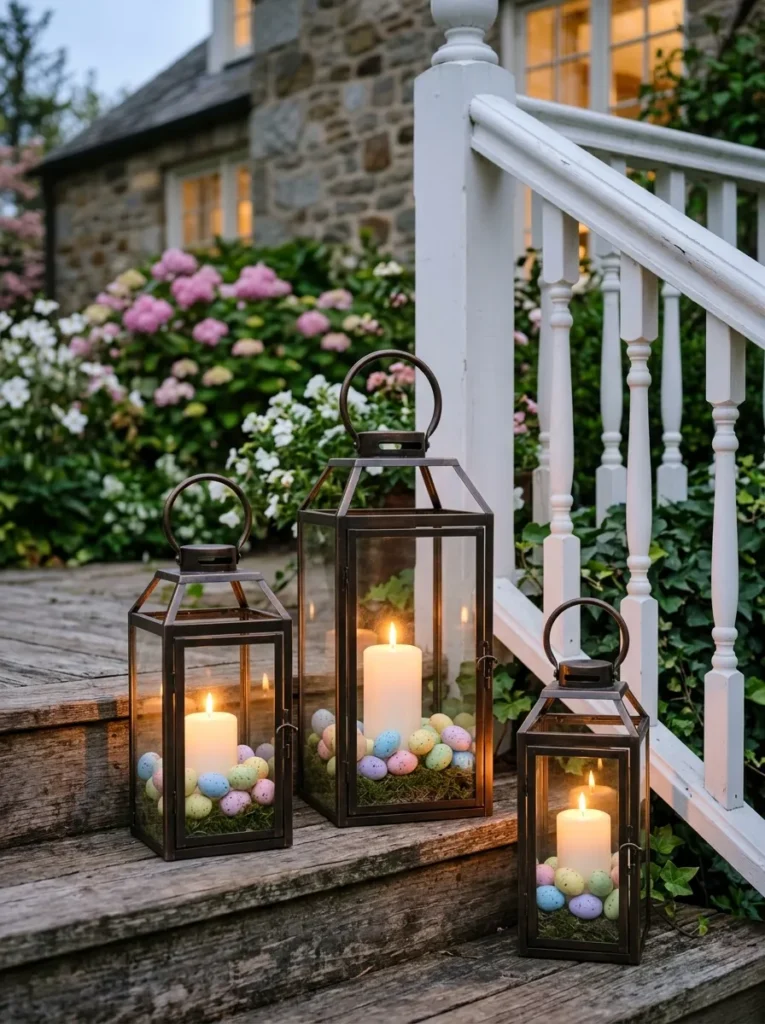
Vibe: The lanterns are festive — glass lanterns filled with Easter eggs and candlelight at the porch entry create the warmest possible evening Easter welcome, where the holiday’s colors glow from within rather than decorating from without.
Why it works: Easter Porch Decorating Glass lanterns as Easter egg displays work because the lantern’s enclosure transforms the contained Easter eggs from flat surface decorations into lit still-life compositions — the candle illuminates each egg from within the lantern’s glass walls, making the pastel colors appear luminous rather than matte. The graduated size arrangement of three lanterns (large, medium, small — the same visual principle as the galvanized bucket staircase in Idea 2) creates compositional weight that a single lantern cannot achieve. The preserved moss base inside each lantern completes the nest-and-egg tableau within a protected glass environment.
How to get it: Easter Porch Decorating Source three glass lanterns in graduated sizes ($12–$35 each from home decor stores). Place a battery-operated LED pillar candle (not a real wax candle, which is an outdoor fire risk) in each lantern. Arrange small plastic or papier-mâché Easter eggs in pastel tones around the base of each candle. Add a small handful of preserved moss to cover the lantern base between eggs. Position on steps, railing caps, or a porch table in a triangular or linear grouping.
Quick Win: A single large glass lantern with a battery LED candle and a handful of pastel Easter eggs at the base costs under $25 and creates a complete Easter lantern focal point for any porch step or console table.
Shop The Look Easter Porch Decorating
- Glass lantern set three sizes outdoor
- Battery LED pillar candle realistic flame
- Pastel Easter egg small set mixed
- Preserved sheet moss handful craft
- Lantern hanging hook adjustable outdoor
21. Vintage Wheelbarrow Planted Spring Display
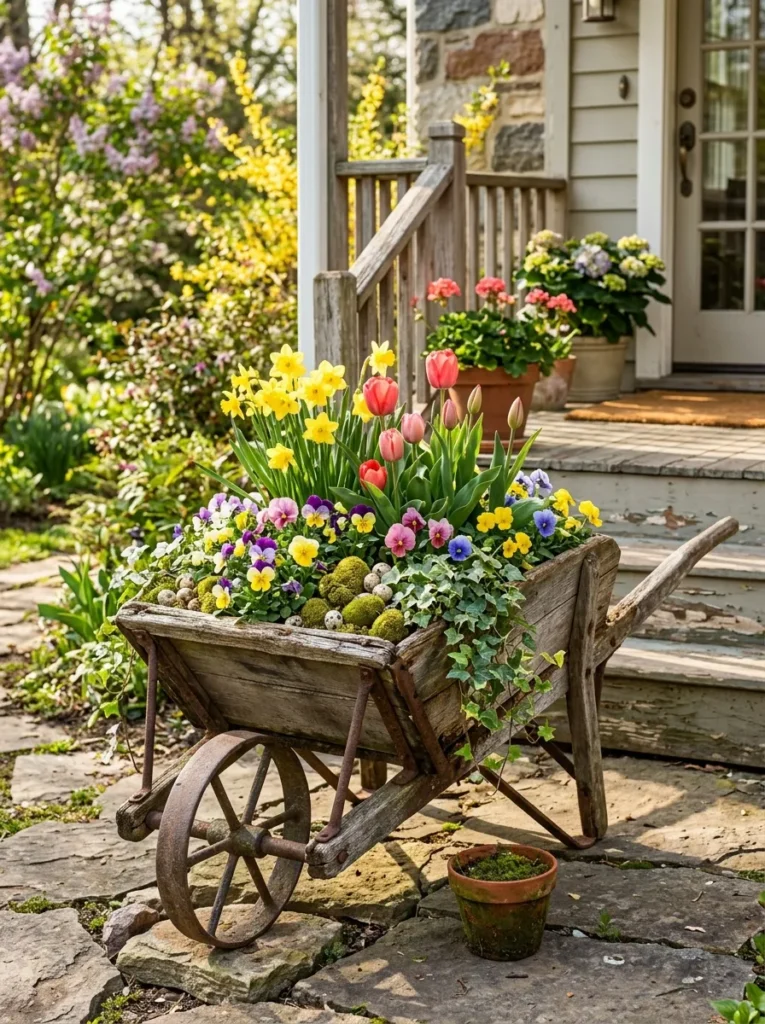
Vibe: The display is country-spring — a vintage wheelbarrow overflowing with spring flowers has the narrative quality of a gardener who stopped to deliver spring directly to the front door, which is the most welcoming seasonal story a porch can tell.
Why it works: Easter Porch Decorating wheelbarrow display works through the design principle of implied narrative — an object associated with active garden work (a wheelbarrow) positioned casually at a porch entry implies that the garden is actively being worked, that spring is actively arriving, that the home is in living relationship with its outdoor space. This narrative quality gives the display a warmth that purely static arrangements (matching planters in matching positions) cannot generate, because it suggests a story in progress rather than a decoration installed. The overflowing planted abundance within the wheelbarrow reinforces this narrative — a full wheelbarrow of spring flowers reads as a generous overflow of the season rather than a measured allocation.
How to get it: Easter Porch Decorating Source a vintage wooden or metal wheelbarrow from an antique market or garden supplier ($25–$80 for a genuine vintage piece, or $35–$60 for a reproduction). Line with plastic sheeting and drill drainage holes. Fill with potting mix and plant a dense combination of spring bulbs (tulips, daffodils) with trailing filler (ivy, sweet alyssum, bacopa) and a top layer of viola faces. Tuck a few preserved moss eggs among the plantings. Position the wheelbarrow at a slight angle at the porch base or beside the steps.
Shop The Look Easter Porch Decorating
- Vintage garden wheelbarrow metal small
- Tulip mixed spring bulb potted live
- Trailing ivy live plant spring
- Viola pansy live plant spring color mix
- Moss covered decorative egg set display
22. Eucalyptus and Wildflower Swag on the Porch Beam
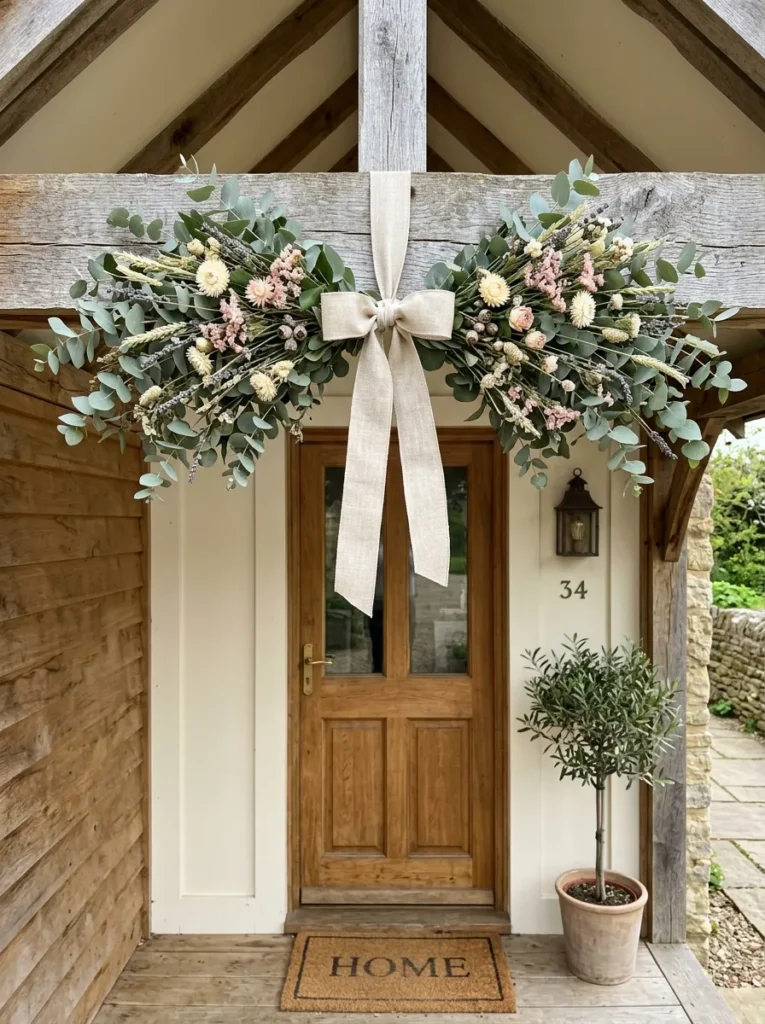
Vibe: The beam is botanical — a horizontal eucalyptus and wildflower swag mounted on a porch beam has the architectural presence of a permanent botanical installation and the seasonal relevance of a spring garden in full early growth.
Why it works: Easter Porch Decorating horizontal swag on a beam exploits the width of a porch as its primary decorative surface — most porch decorating addresses the vertical plane (door, posts, railings) and ignores the horizontal beam that often spans the full porch width. A eucalyptus swag across the full beam width creates a botanical threshold — a fragrant, textured horizontal line that visitors walk beneath on entry, experiencing the swag’s botanical character at close range as they pass. Eucalyptus is specifically effective for this application because it is fragrant (the volatile oils released by the foliage create a passive aromatherapy effect as air moves through the porch), durable (branches maintain their appearance for 3–4 weeks after cutting), and visually sophisticated (the silver-green of eucalyptus reads as naturalist botany rather than seasonal decoration).
How to get it: Purchase 4–5 eucalyptus branches (silver dollar, seeded, or preserved varieties, $8–$15 per bunch). Lay them in a loose overlapping row across the beam width, securing at each end and the center with floral wire or natural twine looped around the beam. Add dried wildflower stems (dried ranunculus, statice, dried daisy, or dried larkspur) tucked among the eucalyptus. Tie a wide natural linen ribbon in a loose bow at the center of the swag. Eucalyptus swags last 3–4 weeks and dry gracefully in place if left through the season.
Shop The Look Easter Porch Decorating
- Fresh eucalyptus branch bunch silver dollar
- Preserved eucalyptus stem bunch natural
- Dried wildflower assortment bunch spring
- Natural linen ribbon wide 4 inch craft
- Floral wire green 26 gauge pack
How to Start Your Easter Porch Transformation
Easter Porch Decorating single most important first move in an Easter porch transformation is to establish the color palette before purchasing a single item. Easter’s color story is wide — from the deep jewel-tone Easter eggs of traditional European dyeing to the soft pastel American candy palette to the botanical greens and naturals of a garden-inspired approach — and these palettes do not mix well. Choose one register: either soft pastels (lavender, blush, butter, sky blue) with white and cream, or naturals (moss green, warm cream, aged brown, weathered grey) with botanical accents, or a single bold spring color (daffodil yellow, hyacinth purple) carried through multiple elements. A porch that commits to one color story reads as designed; a porch that mixes all three reads as unsorted.
The most common beginner mistake in Easter porch decorating is confusing quantity with abundance. True abundance in porch decorating comes from density within a defined zone — many elements packed richly into a specific area (a planter overflowing with varied blooms, a basket filled to the brim with nested eggs) — rather than spreading a few elements thinly across the entire porch. Thin distribution creates a scattered, unresolved look that reads as decoration started but not finished. The fix is to choose two or three specific zones (the door, one planter pair, the steps) and invest fully in each rather than spreading effort and budget across the entire porch.
Easter Porch Decorating porch upgrades under $50 that make an immediate, significant visual difference: a 16-inch preserved moss wreath base with quail eggs and dried lavender ($18–$25 in materials) that reads as a $60–$80 boutique wreath; a pair of galvanized buckets on the top two steps filled with potted hyacinths ($20–$30 for the pair including plants) that creates immediate symmetry and fragrance at the entry; and a battery-powered LED string light strand ($8–$12) draped through a porch railing or wound around a post that adds warm evening ambiance to the entire porch decoration from dusk onward.
A complete Easter porch transformation — wreath, flanking planters, step arrangements, and one accent element — is a realistic single Saturday morning project for most entries. Total material budget for a complete, designed Easter porch ranges from $40–$80 for a restrained natural approach to $120–$200 for a full abundant botanical display with multiple flowering plant elements. Most elements last the full Easter season (3–4 weeks) with minimal maintenance — living plants need watering, fresh cut flowers need weekly replacing, and dried botanical elements need only an occasional fluffing and repositioning.
Frequently Asked Questions About Easter Porch Decorating
When should I put up Easter porch decorations and how long do they last?
Easter porch decorations are best installed 2–3 weeks before Easter Sunday, which gives the full display period without the earliest elements (particularly living spring bulb plants) declining before the holiday itself. Most Easter decorating elements last well through the full display period: preserved moss and dried botanical wreaths last 4–6 weeks without any maintenance; living potted spring bulbs (tulips, hyacinths, daffodils) last 2–3 weeks at outdoor temperatures between 45–65°F; fresh cut flower arrangements in water last 5–7 days and can be refreshed weekly. Artificial elements (egg garlands, ribbon wrapping, fabric banners) are unaffected by weather and can be installed at any point. After Easter, many natural elements (moss wreaths, herb plantings, galvanized bucket gardens) transition seamlessly into general spring porch decor that lasts through May without any modification.
What Easter porch decorations work best for an apartment with only a front door and a small stoop?
Easter Porch Decorating small stoop with no porch floor requires a vertical decorating strategy: the door surface and the immediate door surround become the primary decorating canvas. A single well-chosen wreath is the highest-impact single element for this context — a 16-inch preserved moss wreath with quail eggs and dried lavender reads as complete and generous for any front door regardless of the surrounding space. One or two small pots at the base of the door (terracotta with a single potted hyacinth or daffodil in each) add a ground-level botanical note that does not require porch floor area. A simple hanging egg garland from the door’s upper corner hook adds overhead visual interest without floor or stoop width. These three elements together (wreath, one or two small pots, one hanging element) create a complete Easter entry in a 2×4 foot stoop footprint for under $40.
How do I Easter-decorate a porch that faces a harsh climate in early spring?
In climates where early spring brings frost, wind, or late-season snow (USDA Zones 3–6), Easter porch decorating requires weather-resistant material choices. Preserved and dried botanical elements (preserved moss, dried lavender, dried wildflowers) withstand frost and light rain without damage. Galvanized metal containers are frost-proof; terracotta can crack in repeated freeze-thaw cycles and should be emptied of soil before overnight frost if temperatures will drop below 28°F. For living plants, choose cold-hardy spring varieties specifically — pansies and violas survive light frost; daffodils and tulips tolerate temperatures down to 28°F for brief periods; hyacinths are more frost-sensitive and should be brought indoors on forecast frost nights. Ribbon, linen banners, and fabric elements should be brought inside during rain or wind to prevent damage.
What is the most cost-effective Easter porch decoration that still looks high-end?
Easter Porch Decorating preserved moss door wreath is consistently the highest value-to-cost Easter porch decoration available. A 16-inch grapevine base ($5–$7) fully covered in preserved sheet moss ($8–$12 per bag, enough for two wreaths) with quail eggs ($4–$6) and dried lavender ($4–$6) produces a wreath that retails for $55–$85 at boutique home stores for a material cost of $21–$31. The preserved moss surface — dense, uniformly green, and texturally rich — reads as high-end botanical material rather than craft material because it is the same preserved moss used in professional floral and interior design installations. The three accents (quail eggs, lavender, and optionally a single dried flower) provide the compositional complexity that makes the wreath read as designed rather than assembled. No other Easter porch element delivers this ratio of visual sophistication to material cost.
Can Easter porch decorations be stored and reused next year?
Yes — the majority of natural Easter porch decorating elements store well for reuse. Preserved moss wreaths and botanical elements store in a sealed plastic bag or box in a cool, dry location for 2–3 years before the moss color begins to fade. Artificial egg garlands, ribbon, linen banners, wire topiary frames, glass lanterns, and galvanized metal containers all store indefinitely without degradation. Dried botanical elements (lavender, wildflowers, eucalyptus) are more fragile but can be carefully wrapped in tissue paper and stored in a box for 1–2 seasons. The elements that cannot be reused are living plants (which complete their bloom cycle and decline), fresh cut flowers (which dry or decay within 1–2 weeks), and fresh eucalyptus (which dries in place and can be kept as a dried element but loses fragrance). A well-chosen Easter porch collection of reusable elements (wreath base, wire forms, containers, garlands) represents a one-time investment that reduces each subsequent year’s Easter decorating cost to the fresh botanical elements only.
Ready to Decorate Your Easter Porch?
These 22 Easter Porch Decorating ideas cover the full range of what an Easter porch transformation can involve — from the naturalist sophistication of a moss and quail egg wreath and the country-spring abundance of a planted vintage wheelbarrow, to the architectural playfulness of a bunny ear door silhouette and the warm evening magic of lantern luminaries glowing with pastel eggs. You do not need all 22 to create a porch that feels genuinely festive — the most successful Easter entries are built from three or four elements chosen deliberately from the same color story and material register, installed with the density and care that communicates intention. Start this weekend by choosing your palette — naturals and botanicals, soft pastels, or a single bold spring color — and let that single decision guide every element you add. A well-decorated Easter porch does not simply announce the holiday to passersby — it announces that the people inside are paying attention to the season, that the threshold between home and world is a place worth marking, and that spring, after the long winter, is genuinely worth celebrating. Pin the ideas that made you want to go outside and start — those are the ones your porch is already ready for.