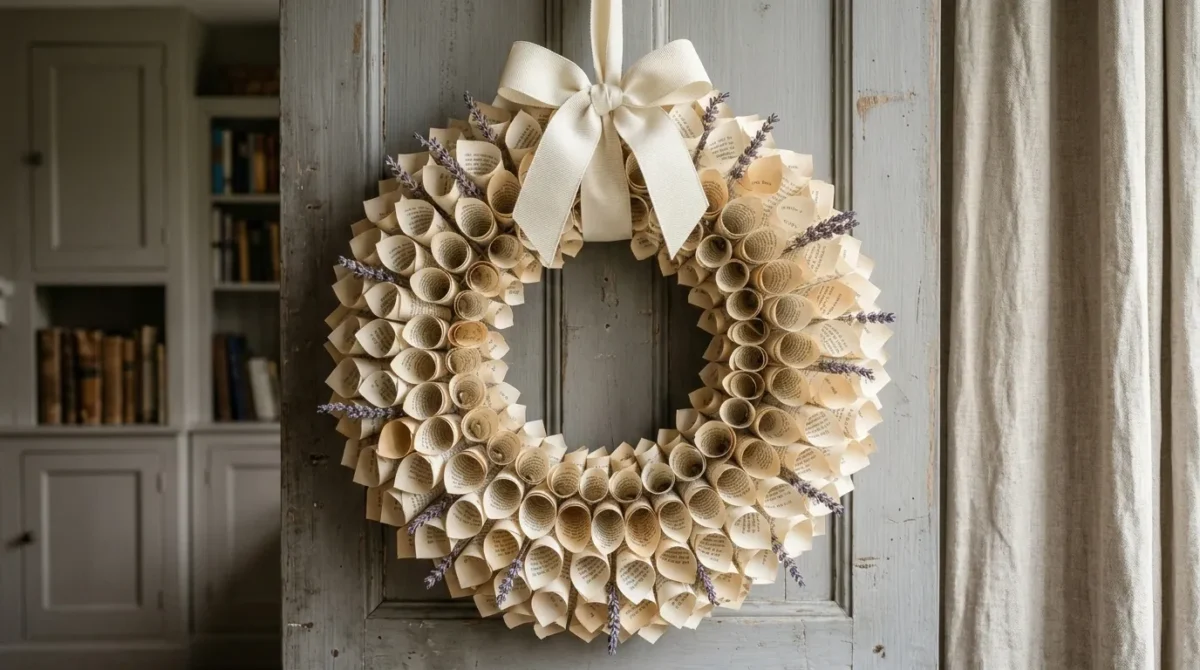
Book page crafts are DIY decorations made from the pages of vintage or repurposed books — torn, folded, rolled, or framed — to create textured, literary-inspired home accents. This article gives you exactly 15 book page craft ideas that range from wall art and sculptural centerpieces to gift wrap and tabletop vignettes, all styled to look intentional and elevated rather than crafty.
There’s something quietly compelling about a home that holds onto old words. Vintage typography on aged paper carries a warmth that no printed reproduction can replicate — a faint yellowing, a slightly uneven ink line, the ghost of a reader’s history. Book page crafts sit at the intersection of literary nostalgia and tactile elegance, where resourcefulness becomes an aesthetic. Here are 15 ideas worth saving — and stealing.
Why Book Page Crafts Work So Well
Book page crafts draw from a long tradition of paper arts — including Japanese origami, Victorian paper decoupage, and early 20th-century collage movements — but their current appeal is rooted firmly in the maximalist-meets-literary aesthetic that has surged across Pinterest and interior design over the last several years. Unlike purely modern minimalism, this style celebrates layering, imperfection, and the beauty of things that carry a story. It’s distinct from scrapbooking (which is about memory preservation) and from typographic art (which is about graphic precision) because it prizes the aged material itself as the medium.
The core material is aged or vintage book pages — cream, ivory, or warm tan in tone, with serif typefaces in black or faded brown ink. Surrounding materials lean into this palette: raw linen, unfinished wood, matte black iron, beeswax-dipped twine, and aged brass. Color pairings work best when they stay near the page itself — dusty sage, deep forest green, moody burgundy, warm sepia, and soft terracotta all feel at home alongside old paper without competing with its texture.
This style is trending now for reasons rooted in genuine cultural shift. The post-pandemic nesting impulse gave people permission to slow down and make things by hand again, and sustainability has reshaped how we view repurposed materials. Buying a $0.50 paperback at a thrift store and turning its pages into décor is both economically and environmentally aligned with how many people want to live. Pinterest searches for “book page wall art” and “vintage book crafts” have maintained consistent upward momentum since 2021.
Small spaces are particularly well-suited to book page crafts because the medium is inherently flat or small in scale. A single framed page with a botanical print layered over it can transform an empty wall corner. Folded-page sculptures sit comfortably on a narrow shelf. The key for compact rooms is to treat one or two book page pieces as deliberate focal points rather than scattering them everywhere — intentional placement reads as curated, not cluttered.
Style at a Glance
| Element | Trait |
|---|---|
| Philosophy | Repurposed beauty; nostalgia made intentional |
| Key Materials | Vintage book pages, raw linen, unfinished oak, matte iron, beeswax twine |
| Key Colors | Ivory, warm sepia, dusty sage, matte black, aged brass |
1. Vintage Botanical Print Layered on an Open Book Page
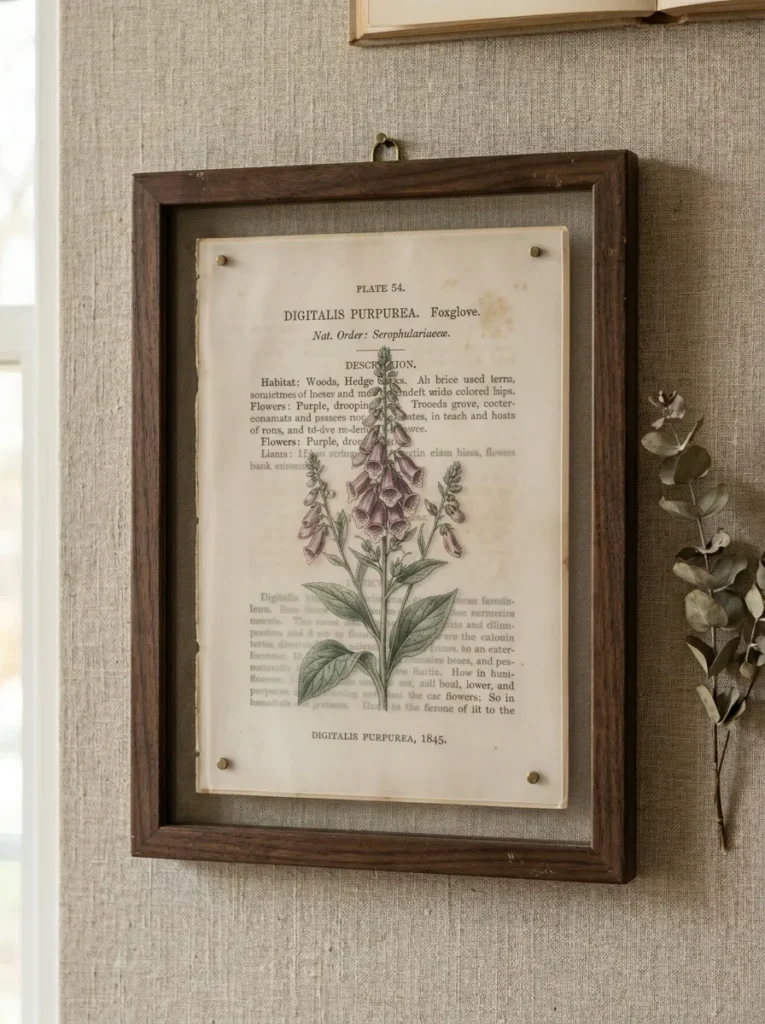
Vibe: This piece feels hushed — the kind of art that makes you lean in closer.
Why it works: Book Page Crafts Layering a botanical print on vellum over a full open book page creates visual depth through transparency — the text beneath reads faintly, adding a second layer of texture without visual clutter. The combination plays on the design principle of figure-ground contrast: the inked illustration pops while the underlying typography anchors it in the literary aesthetic. Dark walnut framing provides visual weight that prevents the pale palette from feeling washed out.
How to get it: Source a vintage botanical illustration (Thornton’s Temple of Flora and Redouté’s rose prints are public domain and printable at home). Print it onto translucent vellum paper at 70% opacity so the book page beneath remains legible. Mount both layers together under glass in a walnut float frame for a clean, gallery-ready finish.
Quick Win: Use Canva’s free “vintage botanical” template filters and print directly onto A4 vellum paper for under $5. A three-pack of vellum sheets costs about $4 at most craft stores.
Shop the Look
| Product |
|---|
| Dark walnut wood picture frame 8×10 gallery style |
| Botanical vintage wall art print set antique botanical |
| Vellum translucent paper A4 acid-free craft |
| Dried eucalyptus bunch wall decor natural |
| Linen gallery wall texture frame mat board neutral |
Also view: What is window film and why British homeowners are choosing film over window replacement
2. Book Page Decoupage Tray with Matte Black Trim
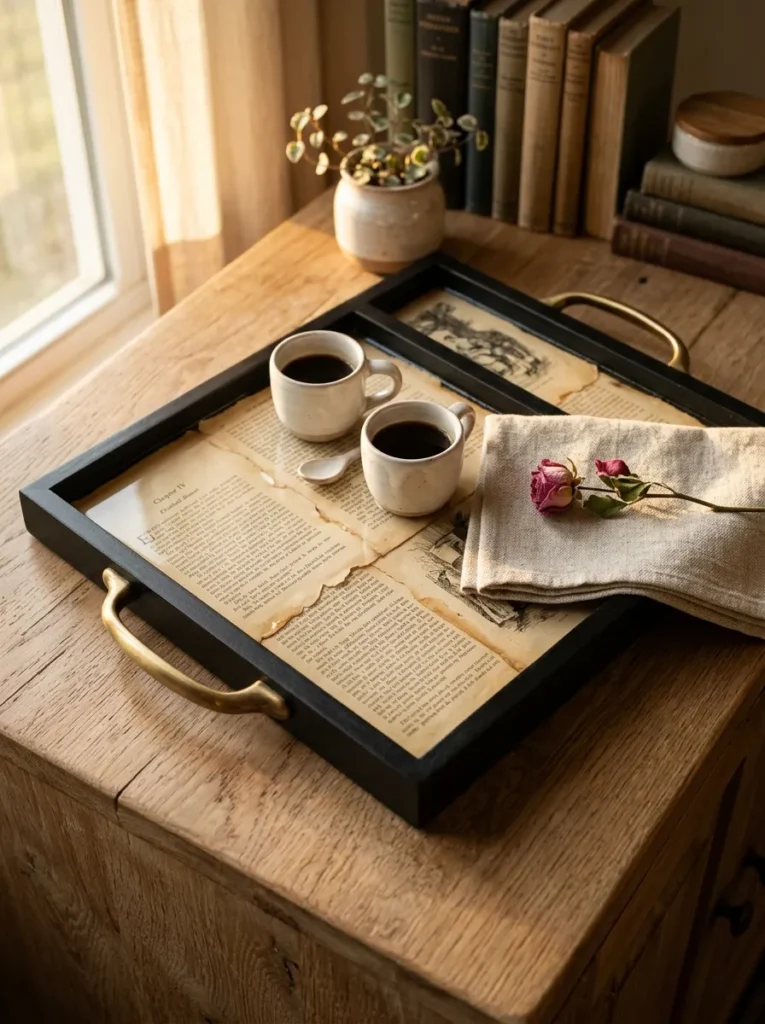
Vibe: Sun-warmed — the kind of object you put your morning coffee down next to.
Why it works: Book Page Crafts Decoupage applies the design principle of surface unification: by spreading pages across the tray floor and sealing them under varnish, you transform a disparate collection of text fragments into a continuous, cohesive texture. The matte black trim edge creates visual containment — it frames the chaos of the newsprint pattern and makes it feel deliberate. Brushed brass handles add material contrast without breaking the vintage palette.
How to get it: Use Mod Podge Hard Coat formula (not the standard matte) to seal book pages inside the tray — it dries to a wipeable, water-resistant finish that makes the tray genuinely functional. Apply three coats, letting each dry fully between applications. Paint the exterior in Rust-Oleum Matte Black spray paint for a clean, factory edge.
Shop the Look
| Product |
|---|
| Unfinished wood serving tray with handles rectangular craft |
| Mod Podge Hard Coat decoupage glue sealer 16oz |
| Matte black spray paint furniture multi-surface |
| Brushed brass cabinet drawer pull set |
| Oat linen table runner neutral modern |
Also: 13 IKEA Christmas Hacks That Look Surprisingly Luxe
3. Rolled Book Page Cone Wreath for a Front Door
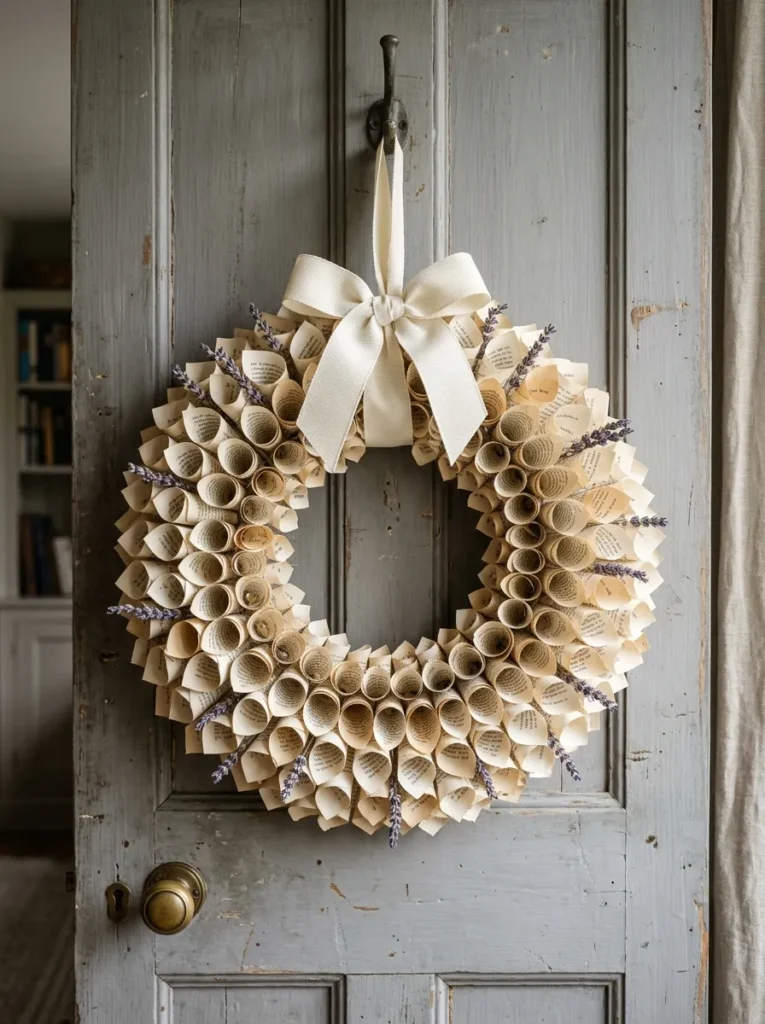
Vibe: Still — like something hung up in a country farmhouse that was never meant to be taken down.
Why it works: Book Page Crafts Repeating form creates rhythm, and a wreath made entirely of identically rolled paper cones delivers exactly that — the pattern itself becomes the visual interest. This is the principle of repetition-as-texture: each individual cone is unremarkable, but aligned en masse they create a sculptural surface with genuine depth and shadow play. The slight variation in page aging (some yellower, some creamier) adds organic irregularity that prevents it from looking manufactured.
How to get it: Tear pages into quarters and roll each piece diagonally around a pencil into a tight cone shape, securing the tip with a small dab of hot glue. Attach cones to a 12-inch straw wreath base using a glue gun, working in concentric rings from outer edge inward. Leave no base visible — density is everything.
Quick Win: Thrift stores almost always have Reader’s Digest condensed books (thick, inexpensive, pages the ideal weight and tone) — grab one for under $1 to fuel a full large wreath.
Shop the Look
| Product |
|---|
| Straw wreath base 12 inch craft floral |
| Dried lavender bundle wreath accent natural |
| Ivory grosgrain ribbon 2.5 inch wide spool |
| Hot glue gun craft heavy duty |
| Vintage book paper cardstock aged cream craft |
4. Book Page Folded Tree Sculpture on a Side Table
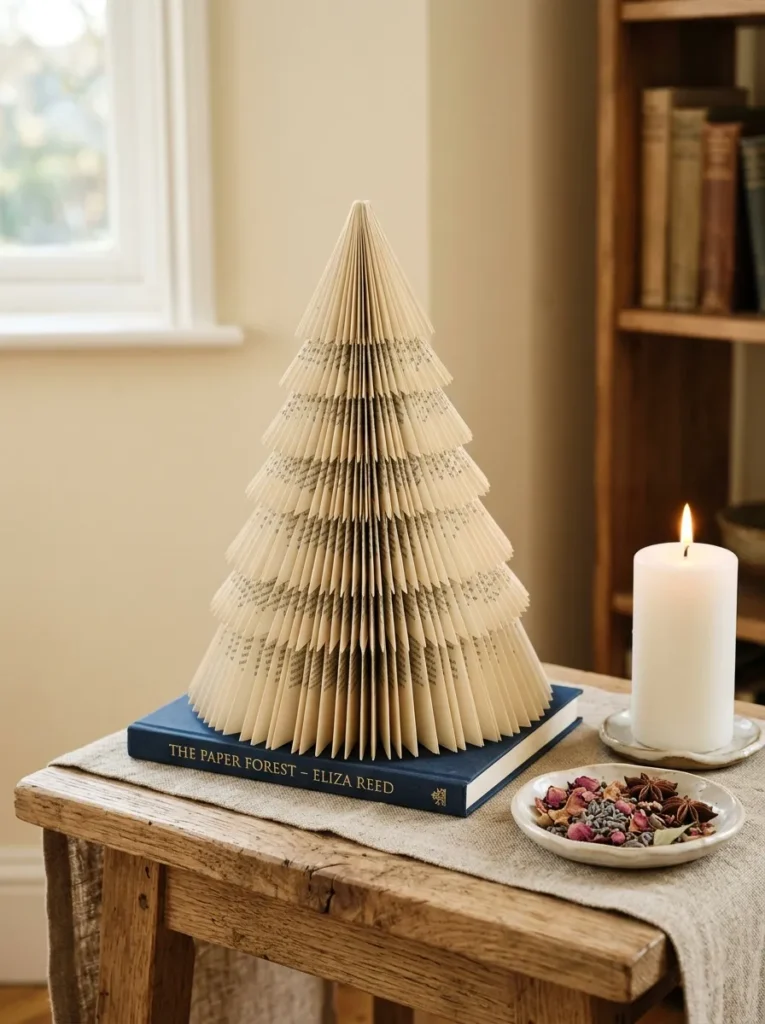
Vibe: Grounded — the kind of object that makes a side table feel like it was styled by someone who actually knew what they were doing.
Why it works: Book Page Crafts folded book tree uses structural origami principles — each page folds in a diagonal from corner to spine, building a pointed form that echoes a winter tree or topiary. The result is three-dimensional sculpture made from flat material, which creates visual surprise. Because the hardcover holds the base closed, the form is self-supporting and stable, requiring no armature. The dense layering of folded pages gives the piece remarkable visual weight for how lightweight it actually is.
How to get it: Use a hardback book of at least 200 pages — the more pages, the fuller the tree. Fold each page by bringing the top corner down to meet the spine, then folding the lower portion back under to create a triangular shape. Work from front to back consistently. The final 10–15 pages act as a stabilizing base — leave them unfolded.
Shop the Look
| Product |
|---|
| Unfinished solid oak small side accent table round |
| White unscented pillar candle set 3×6 inch |
| Raw linen table runner neutral modern farmhouse |
| Small ceramic trinket dish matte white handmade |
| Dried rose petal botanical potpourri natural |
5. Black-Framed Book Page with Hand-Lettered Quote Overlay
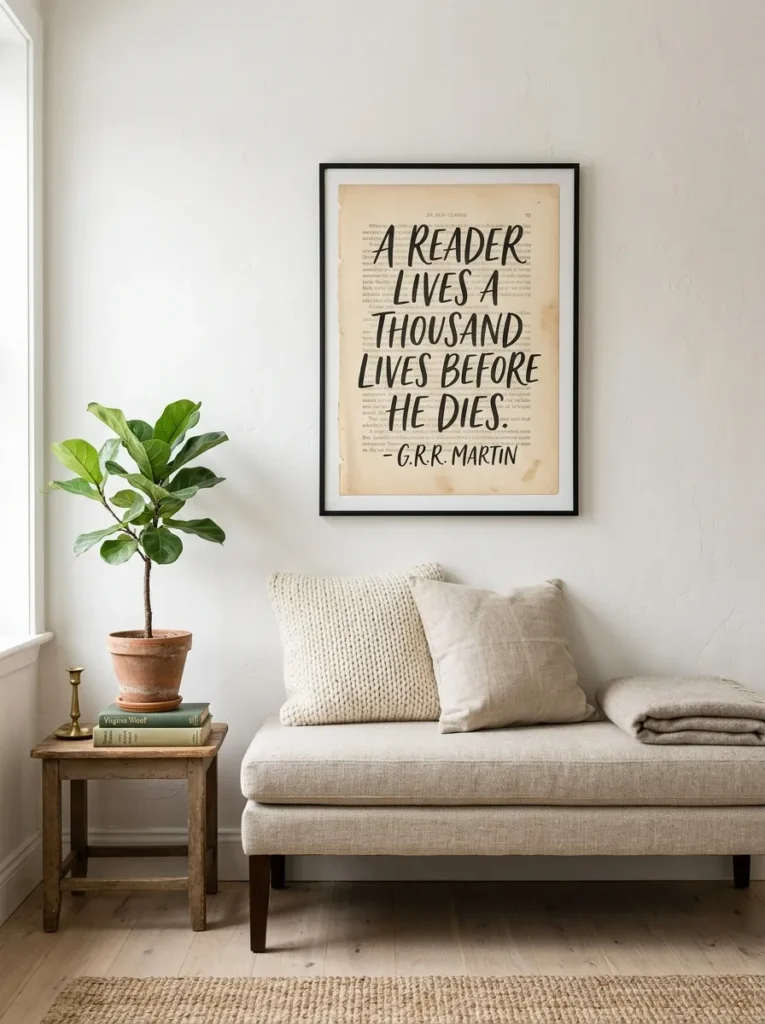
Vibe: Luminous — the white wall, pale page, and fine black frame create a breath of air around the piece.
Why it works: Book Page Crafts idea exploits typographic contrast: the mechanical serif text of the printed page versus the fluid organic lines of hand-lettering creates a tension that feels intentional rather than accidental. The rule of tonal layering applies here — both elements live in the same black-ink register, which unifies what could otherwise feel busy. Mounting the page directly (no mat board) in a thin matte black frame keeps the whole piece graphic and modern rather than traditionally framed.
How to get it: Write your chosen quote in a brush pen (Tombow Dual Brush in black is ideal) using large, relaxed lettering that floats across the columns of type — don’t try to align it with the printed text. Let it cross column lines freely. The contrast between rigid columns and freehand lettering is the visual point.
Quick Win: A Tombow Dual Brush Pen in black costs about $4 at most craft or office supply stores and gives you the same thick-thin stroke variation as professional calligraphy markers with zero learning curve.
Shop the Look
| Product |
|---|
| Matte black thin metal picture frame 8×10 modern |
| Tombow dual brush pen black calligraphy art |
| Oat linen bench cushion neutral modern |
| Small potted ficus artificial indoor plant |
| White plaster texture wall paint flat finish |
6. Book Page Lined Glass Lantern with LED Candle
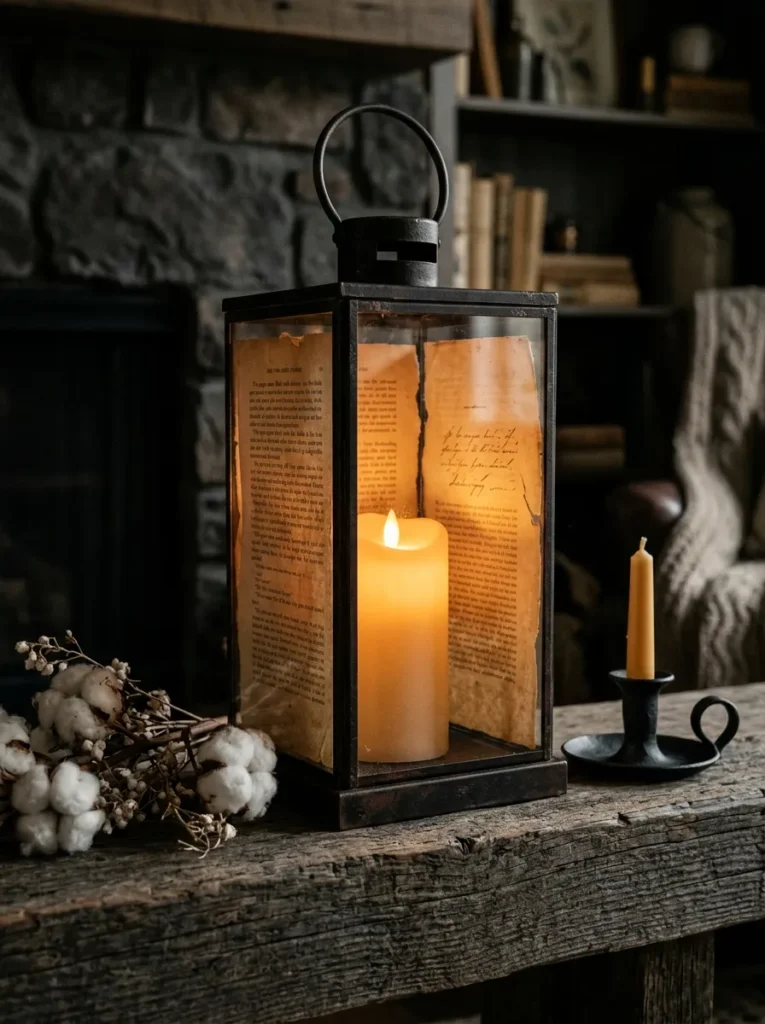
Vibe: Moody — like the lantern holds something more than light.
Why it works: Book Page Crafts Backlighting transforms paper from opaque to translucent, and inside a glass lantern, a book page becomes a warm, amber-glowing scrim. This is the principle of transmitted versus reflected light — the LED candle pushes light through the page fibers rather than bouncing it off the surface, revealing a completely different material quality. Text becomes shadow-readable, serifs glow faintly at their edges, and the whole piece takes on a quality closer to stained glass than craft paper.
How to get it: Tear or cut pages into rectangles slightly taller than the lantern’s glass panels. Press them flat inside against the glass using a small application of white school glue diluted with water (1:1 ratio) brushed onto the glass face — it dries invisible. Place a warm-white LED pillar candle (not a real flame — paper is flammable) in the center.
Shop the Look
| Product |
|---|
| Tall square glass hurricane candle lantern large |
| Warm white LED pillar candle battery operated flickering |
| Dried cotton stem bunch natural white |
| Reclaimed wood floating mantel shelf |
| Matte black iron taper candle holder pair |
7. Book Page Pendant Lampshade with Warm Edison Glow
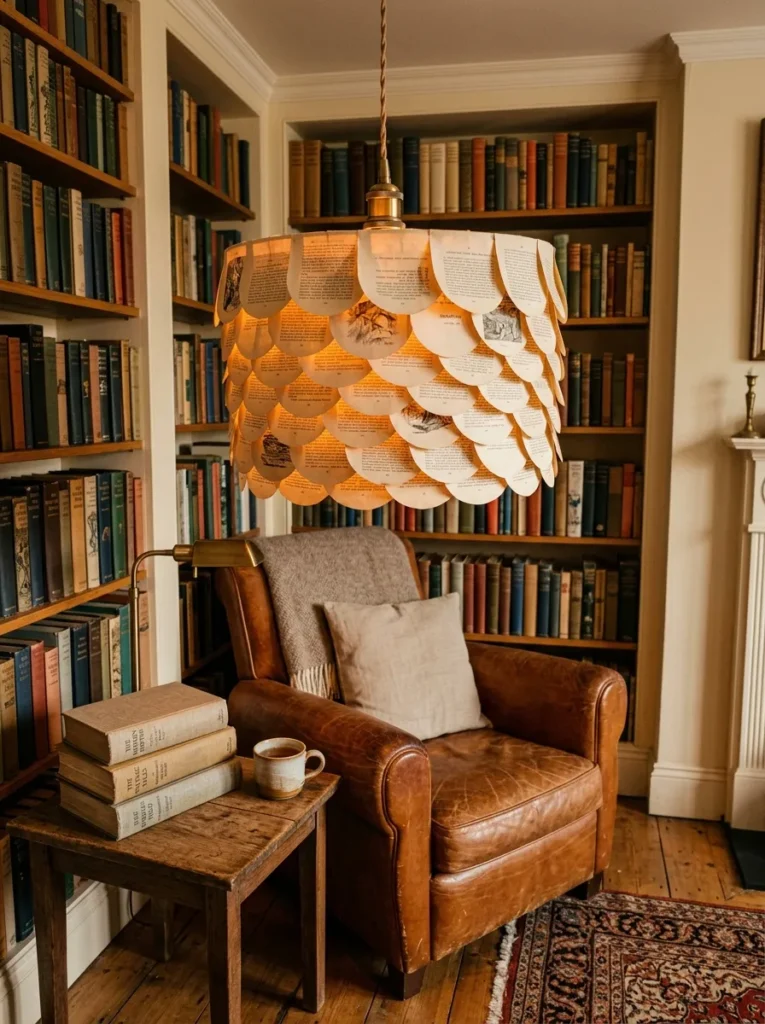
Vibe: Layered — like the light itself has been read.
Why it works: Book Page Crafts A lampshade made from overlapping book pages turns the lighting fixture itself into an art object, applying the design principle of material honesty — you don’t disguise what it is, you let the material’s translucency and texture become the point. Overlapping pages creates a fish-scale pattern that adds structural rigidity without adhesive framing, and the layered text creates a shadow-map effect across the room’s walls when lit. Critically, the warm spectrum of an Edison-style LED (2200K) enhances the aged-paper tone rather than bleaching it.
How to get it: Use a plain white self-adhesive lampshade frame (available at most craft retailers) as your base. Cut pages into uniform rectangles, score a gentle curve into each with a bone folder, and attach each piece in overlapping rows using a glue stick. Always use an LED bulb — paper shades require bulbs that produce minimal heat, and modern LED Edison-style bulbs stay cool enough for this use.
Quick Win: A Brightech pendant cord with a bulb socket costs about $18–22 and eliminates the need for any electrical work — it simply plugs into an outlet.
Shop the Look
| Product |
|---|
| Pendant light cord socket kit plug-in Edison style |
| Vintage Edison LED bulb 2200K warm white A19 |
| Cognac leather accent reading chair mid-century |
| Stacked hardcover books set decorative coffee table |
| Bone folder scoring tool bookbinding craft |
8. Deconstructed Book Page Wall Installation in a Grid
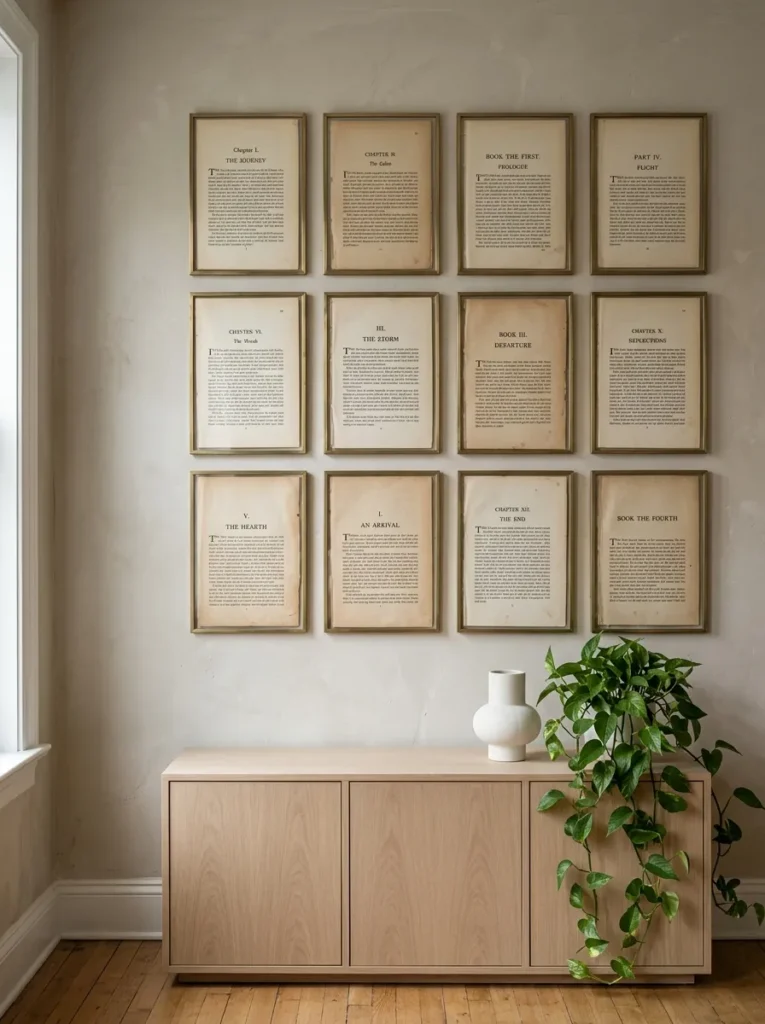
Vibe: Still — like a library wall distilled down to its most essential element.
Why it works: Book Page Crafts A grid installation applies the design principle of seriality — using repetition of identical frames to create a unified artwork from individual pieces. The slight natural variation in page aging (each page a subtly different tone of ivory, cream, or warm tan) means the grid has movement and life despite its rigid geometry. Choosing chapter opening pages — which typically feature large display type for the chapter title — gives each frame a graphic anchor that prevents the pieces from looking like random text.
How to get it: Source twelve matching thin-profile frames in brushed brass (IKEA’s RÖDALM or similar) and select chapter-opening pages that feature prominent display headings. Measure and tape your grid arrangement on the wall first using painter’s tape before committing to nails — a level and tape measure are essential for this one.
Shop the Look
| Product |
|---|
| Thin brass gallery picture frame 5×7 set of 4 |
| White oak low profile TV credenza sideboard modern |
| Ceramic sculptural bud vase matte white modern |
| Trailing pothos artificial plant hanging |
| Painter’s tape blue delicate surface multi-pack |
9. Book Page Gift Wrap with Wax Seal and Twine
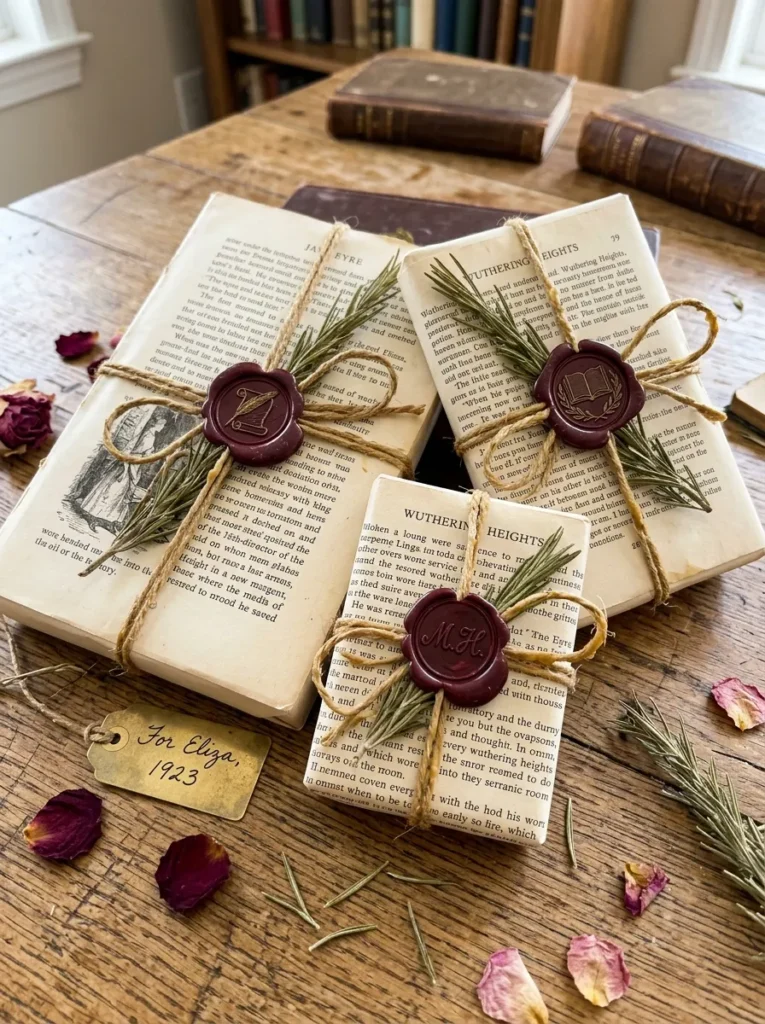
Vibe: Raw — the kind of wrapping that makes the recipient feel the gift was chosen for them specifically.
Why it works: Book Page Crafts Using book pages as wrapping paper is an exercise in material contrast: the rigidity of printed text against the soft informality of loose twine and a melted wax seal creates a tension between precision and handcraft that reads as extremely considered. The design principle at work is intentional imperfection — the page folds won’t be crisp commercial corners, and that’s the point. Burgundy wax seals against the ivory page create a strong accent color hit that prevents the wrap from disappearing into beige neutrality.
How to get it: Wrap your gift as you normally would, letting the text columns run diagonally rather than trying to align them — a slightly off-grain wrap looks more intentional than a perfectly aligned one. Use a natural jute or beeswax-dipped linen twine rather than ribbon. For the wax seal, a sealing wax kit (about $12–15) includes a stamp and wax sticks in multiple colors.
Shop the Look
| Product |
|---|
| Wax seal stamp kit with burgundy and navy wax sticks |
| Natural jute twine 3-ply 328 feet spool craft |
| Dried rosemary wreath herb bundle natural |
| Brass mini gift tag set with string |
| Beeswax sheet craft natural golden |
10. Book Page Matted and Stacked in a Deep Shadow Box
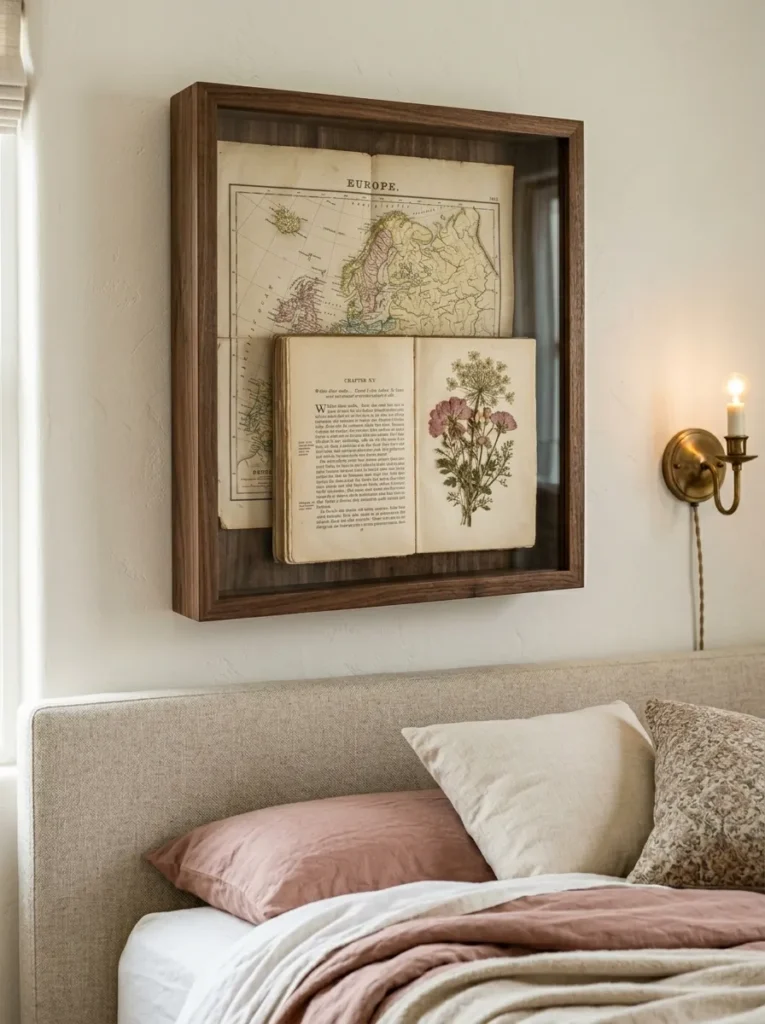
Vibe: Romantic — intimate in the way of a found object kept for reasons not quite explained.
Why it works: Book Page Crafts Shadow box depth introduces the third dimension into what is otherwise a flat medium. Layering a map page behind a book page behind a pressed flower creates genuine foreground-midground-background depth — a principle borrowed from landscape composition — which makes the piece feel more like a specimen display than a standard art print. The slight angle difference between the layers (each tipped a few degrees differently) adds dynamism within the still geometry of the frame.
How to get it: Layer using small foam mounting squares (the adhesive type used for scrapbooking) to create depth between each element — 3–4 stacked squares lifts each layer about 1/4 inch. Choose a shadow box with at least 1.5 inches of depth. A single pressed pansy or viola from a dried flower supplier creates the final organic layer that anchors the piece in natural material.
Quick Win: Buy a set of pre-pressed dried flowers on Etsy for about $8–12 — they’re far more consistent than pressing your own and arrive ready to mount.
Shop the Look
| Product |
|---|
| Deep shadow box frame 8×10 dark walnut wood |
| Foam adhesive mounting squares scrapbooking layering |
| Pressed dried flower set natural pansy viola |
| Vintage antique map print aged paper reproduction |
| Aged brass wall sconce set plug-in bedroom |
11. Accordion-Folded Book Page Table Number Cards
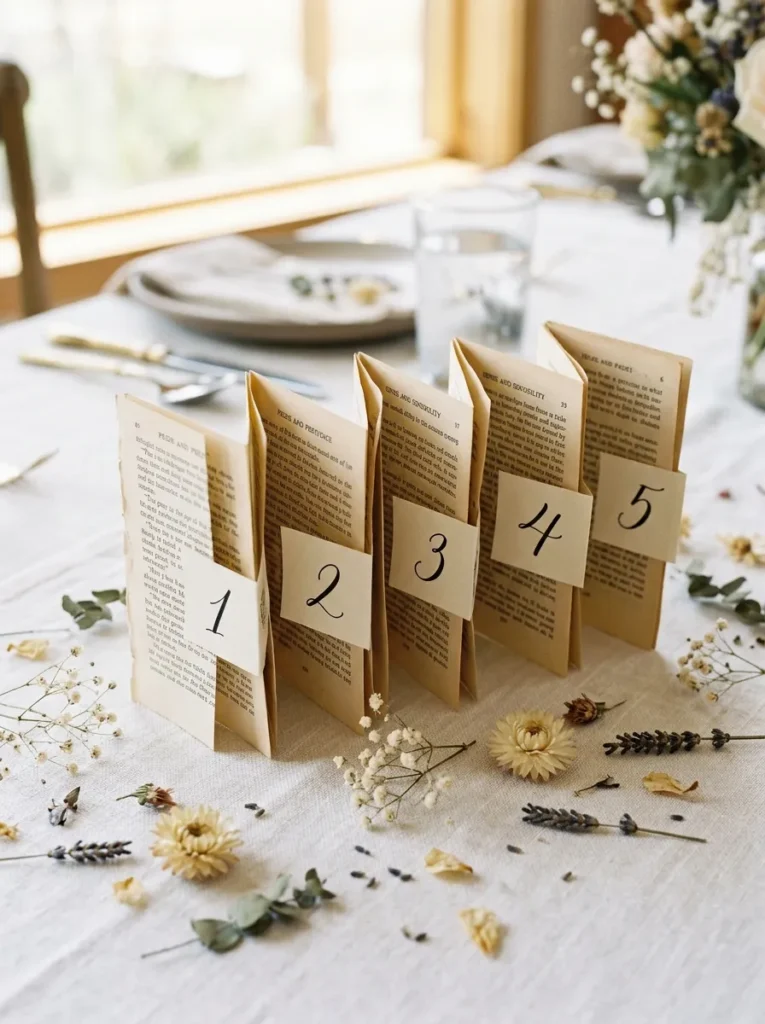
Vibe: Airy — the kind of detail that makes people pick them up and ask where they came from.
Why it works: Book Page Crafts accordion fold transforms a flat page into a three-dimensional form that stands without any support structure, which is an elegant application of structural origami. Fanned slightly open, each card creates a small architectural profile on the table — catching light along its pleated edges in a way that flat cards never could. The scale is important: these work because they’re small (about 4 inches tall), making the book page’s text just legible enough to read up close but abstract enough to function as texture from table distance.
How to get it: Cut pages into 3×9 inch strips. Accordion-fold each strip into 1/2-inch pleats, starting from one end and folding alternately forward and back. Pinch the base closed and secure with a thin strip of linen twine or a small dab of glue. Cut a 1×2 inch white cardstock number tag and slip it into the front fold.
Shop the Look
| Product |
|---|
| White linen tablecloth rectangular wedding farmhouse |
| Dried wildflower bunch natural mixed species |
| White blank cardstock mini tags kraft string |
| Fine tip black ink pen calligraphy journaling |
| Thin natural linen twine spool craft 100m |
12. Book Page Wallpaper Accent Panel in a Powder Room
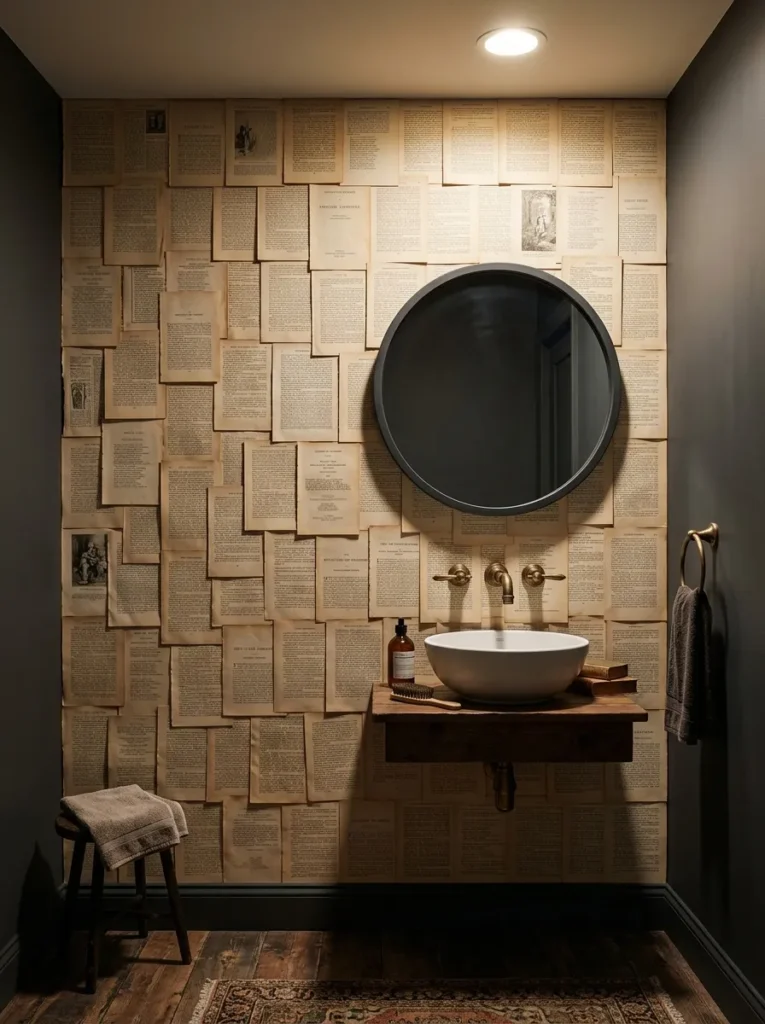
Vibe: Layered — theatrical in a room too small for anything less.
Why it works: Book Page Crafts Powder rooms are the single best application for this technique because their small scale makes a full wall treatment manageable (often only 30–50 sq ft) and their theatrical nature — visitors spend only minutes there but they look at everything — rewards the detail investment. Covering an entire wall in overlapping pages applies the wallpaper principle of pattern continuity: the eye reads it as texture first, text second. The pages should overlap slightly and be torn (not cut) at the edges so the seams disappear into the overall composition.
How to get it: Apply pages with a diluted PVA glue (also called white craft glue or Elmer’s Glue — mix 1 part glue to 2 parts water). Brush the wall section, apply the page, brush over the top. Work in roughly one-page sections, slightly overlapping. Finish with a matte water-based polyurethane sealer to protect the surface and make it wipeable — this step is non-optional in a bathroom.
Shop the Look
| Product |
|---|
| Matte water-based polyurethane sealer clear interior |
| Aged brass bathroom faucet vessel sink single hole |
| Round bathroom mirror dark walnut frame small |
| White ceramic vessel sink modern |
| PVA white craft glue large bottle decoupage |
13. Book Page Origami Stars in a Glass Bowl Centerpiece
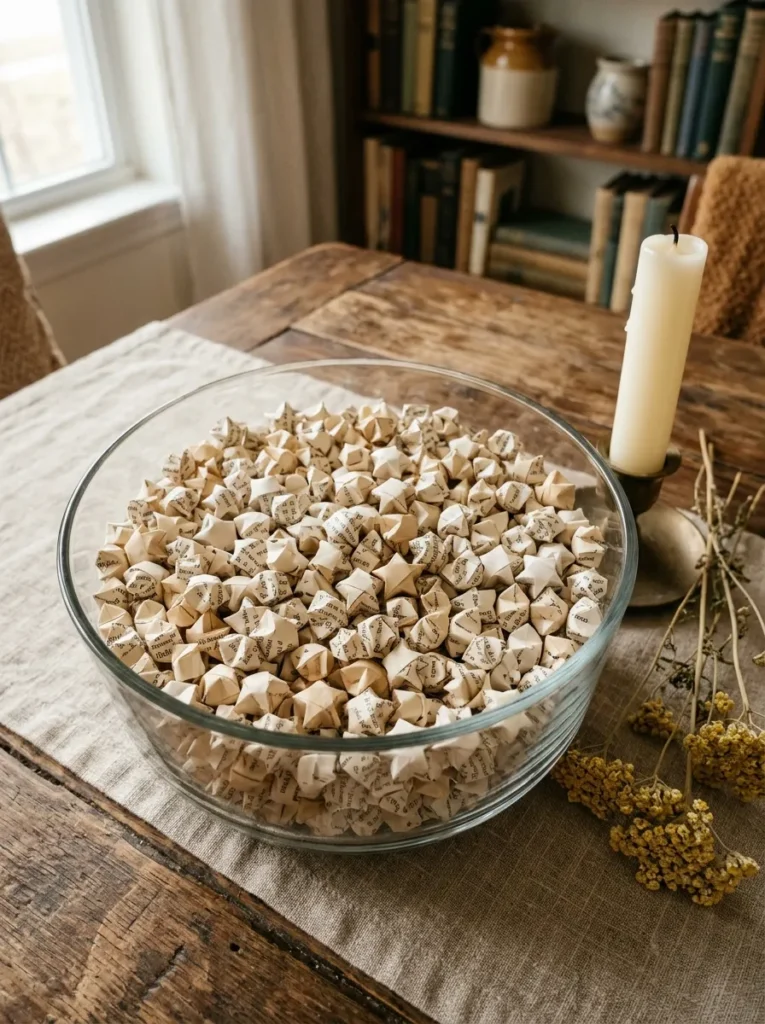
Vibe: Still — a bowl of paper stars that somehow looks like a considered design decision.
Why it works: Book Page Crafts Volume and repetition transform individual origami stars (each about the size of a marble) into a collective mass that behaves like a textured fill material in the bowl. This is the design principle of aggregate form — units too small to be interesting individually become a compelling whole when multiplied. The clear glass bowl is essential: it lets the volume read in full and shows the dimensional depth of the accumulated stars rather than hiding the layering. The slight variation in page aging between stars gives the bowl a natural gradient of cream to warm tan.
How to get it: Cut book pages into 1×11 inch strips. Fold each strip into a five-pointed origami lucky star by knotting one end and winding the remaining length around the pentagon — the final tuck puffs the star into its three-dimensional form. You need about 150–200 stars for a bowl of meaningful fullness; budget roughly 3 minutes per star and spread the project across a few evenings.
Quick Win: Put on an audiobook or podcast and fold stars during it — the repetitive motion becomes almost meditative and 45 minutes produces a satisfying pile of 15–20 stars.
Shop the Look
| Product |
|---|
| Large round clear glass bowl centerpiece apothecary |
| Dried yarrow bunch natural yellow botanical |
| Ivory unscented pillar candle set 3-inch |
| Bone folder origami scoring tool paper craft |
| Vintage cream paper strips book page craft pack |
14. Book Page Framed Map Replaced with Literary Excerpt
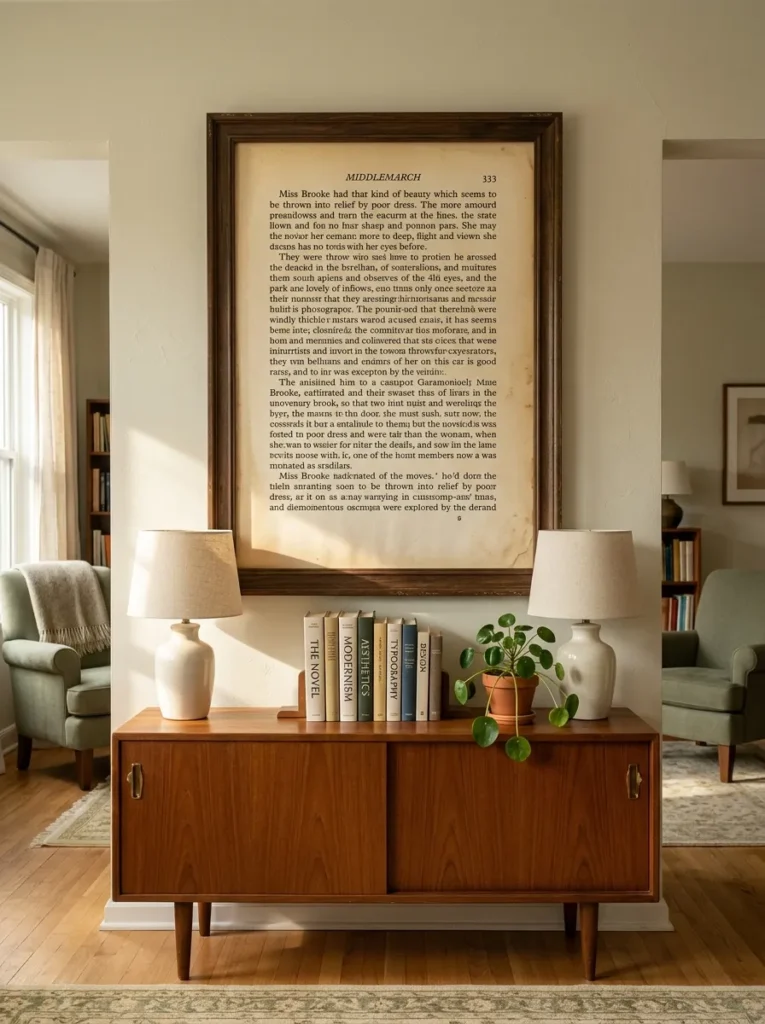
Vibe: Confident — the room doesn’t apologize for being literary.
Why it works: Book Page Crafts Scale transformation is the core principle here. When you take a book page — an object designed to be read at arm’s length — and enlarge it to poster scale (24×36 inches or larger), the text becomes simultaneously readable and abstract. From across a room it reads as a rich grey texture; up close it resolves into actual sentences. This dual-scale reading — pattern from far, meaning from near — gives the piece an unusual depth for something that costs almost nothing to produce. The key is using a clean, high-contrast serif font at the original printing resolution.
How to get it: Scan a page at 600 DPI and enlarge it to 24×36 inches in a free tool like GIMP or Photoshop — the quality of a good book’s original printing holds surprisingly well at this scale. Print at an online service like Printful or Canva Print on matte photo paper (not glossy) for under $25, then frame in a simple walnut or dark wood profile.
Shop the Look
| Product |
|---|
| Large dark walnut picture frame 24×36 poster size |
| Mid-century modern sideboard credenza white oak |
| Ceramic table lamp set white modern |
| Matte photo paper large format print poster |
| Coffee table art book set decorative neutral spine |
15. Book Page Washi-Style Tape Art in a Narrow Hallway
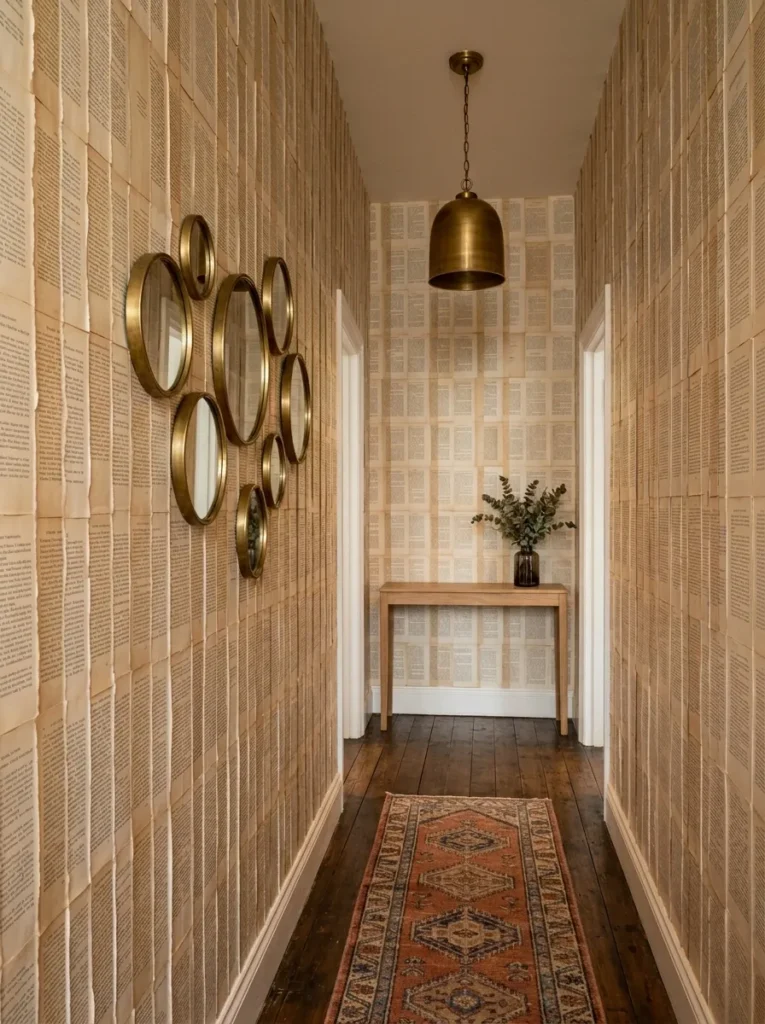
Vibe: Confident — narrow halls are the most underestimated canvas in the house.
Why it works: Book Page Crafts Narrow hallways are often dismissed as dead space, but their constraints — one focal wall, forced linear movement, close viewing distance — make them ideal for textural treatments. Vertical strips applied in alternating text-direction create a subtle plaid or basketweave pattern that the eye reads as geometric without any cutting precision required. This is directional contrast working at small scale. The layered brass mirror cluster above pulls the eye upward and adds reflective dimension that makes a dim hall feel alive.
How to get it: Tear (don’t cut) pages into vertical strips roughly 2 inches wide, keeping the torn edges for softness. Adhere with diluted PVA in alternating horizontal and vertical orientations — rotate every other strip 90 degrees before applying. The alternating text direction creates the pattern. Seal with a matte acrylic medium for durability.
Quick Win: This technique requires no measuring or leveling — the organic torn edges and alternating strips read as intentional precisely because they’re slightly irregular. Embrace imperfection as the design.
Shop the Look
| Product |
|---|
| Cluster round brass wall mirror set small varied sizes |
| Narrow white oak console hall table entryway |
| Matte acrylic medium sealer Mod Podge craft |
| Ceramic bud vase matte white tall narrow |
| Warm white LED overhead pendant hallway plug-in |
How to Start Your Book Page Craft Transformation
Book Page Crafts Your single, non-negotiable first move is this: buy three Reading Rainbow or Reader’s Digest condensed hardbacks at your local thrift store for $0.50–$1.00 each. Don’t start with a beloved book, a beautiful collectible, or anything that will create hesitation at the crucial moment of tearing the first page. Volume books — condensed multi-story compendiums, old encyclopedia supplements, outdated travel guides — give you hundreds of pages per dollar, and their paper weight and aging is ideal for almost every craft on this list. This starting move costs under $5 and removes the single biggest obstacle most people cite: reluctance to destroy a real book.
The most common mistake beginners make is using pages from modern mass-market paperbacks. Modern paperback pages are thin, bright white, and acid-pulped — they lack the warm ivory tone and smooth thickness that makes book page crafts read as luxe rather than crafty. White pages in any of these projects look like shredded printer paper. The fix is simple: look for books printed before approximately 1985, when paper formulations were heavier and warmer. The difference is visible immediately and is worth traveling to a second or third thrift store to find.
Three items under $50 that create immediate impact: a glass cloche or apothecary jar filled with the origami lucky stars from Idea 13 (materials cost under $3, the jar under $20); a set of four matching thin-profile 5×7 brass frames for the grid arrangement in Idea 8 (under $20 for a four-pack at IKEA); and a single matte black frame for the hand-lettered quote piece in Idea 5 (under $12 at most home goods stores). Any one of these produces a shelf or wall accent that looks like it was sourced, not made.
A starter book page vignette — one framed piece plus one sculptural object on a small side table — can be completed in a single weekend afternoon for under $30. A full wall installation (the powder room wallpaper panel) requires a weekend and $40–60 in materials. A maximalist approach covering multiple surfaces in one room would take 3–4 weekends spread over a month, with a realistic material budget of $80–150. The investment is almost entirely time, not money — which is precisely why this style rewards people who actually enjoy making things.
Frequently Asked Questions About Book Page Crafts
What is the difference between book page crafts and decoupage?
Book Page Crafts Decoupage is a specific technique — the process of adhering paper to a surface using a glue-and-sealer medium — while book page crafts is a broader category that includes decoupage but also encompasses origami, sculpture, framing, folding, and paper construction. Think of decoupage as one tool within the book page craft toolkit. The tray project (Idea 2) is decoupage; the folded tree (Idea 4) and the accordion table cards (Idea 11) are not. Both share the same core material — the book page — but produce very different results.
What color palette works best alongside book page crafts?
Aged book pages sit in a warm ivory-to-sepia range, which means they pair naturally with earthy, warm-toned palettes. Deep forest green, muted terracotta, dusty sage, burgundy, and warm charcoal all work as accent colors without competing with the page. What doesn’t work: cool greys, bright whites, and saturated primaries all make aged pages look yellowed rather than warmly vintage. A warm white paint (try Benjamin Moore “White Dove” OC-17 as a wall color) provides the ideal neutral backdrop.
How much does it cost to decorate a room with book page crafts?
Book Page Crafts Realistically, a curated living room vignette — one framed piece, one sculptural object, and one small installation — costs between $20 and $50 in total materials (frames, adhesives, and a few supporting décor items). A full accent wall treatment like the powder room panel project costs $40–80 including the PVA glue, sealant, and any fixture upgrades. The books themselves are almost free — aim to spend no more than $1 per book. This makes book page crafts one of the most budget-accessible decorating approaches available.
Can book page crafts work in a modern or minimalist interior?
Yes — with careful editing. The key in a minimalist space is to use book page crafts as a single, deliberate focal object rather than repeating the motif across multiple surfaces. One large-scale framed literary text (Idea 14), or a single deconstructed grid installation (Idea 8) in identical thin-profile frames, reads as curated and intentional in a modern interior. The frame choice matters enormously: thin brushed brass or matte black profiles keep the look contemporary, while ornate gold or heavy wood profiles will read as mismatched in a modern room.
Do I need a special type of glue for book page crafts?
Book Page Crafts glue depends on the project. For decoupage onto furniture or walls, use PVA glue (white craft glue like Elmer’s) diluted 2:1 (glue to water) and finish with a water-based matte polyurethane sealer for any surface that will be touched. For paper-only projects like origami or wrapping, a standard glue stick or small amount of hot glue is sufficient. Mod Podge Hard Coat is the best single-product option for most mixed surface decoupage projects because it acts as both adhesive and sealer in one — the Hard Coat formula specifically is worth the slight price premium over the standard formula for any functional surface.
Ready to Create Your Dream Book Page Craft Space?
Book Page Crafts From color-forward framed art and dimensional sculpture to small-space hallway treatments and functional décor like trays and lanterns, these 15 ideas demonstrate how wide the range of this medium actually is — it’s not a single look but a material that shapes itself to whatever intention you bring to it. Transformation through book page crafts is genuinely incremental: one framed page, one bowl of origami stars, one folded tree on a shelf — and suddenly a room has a point of view. A good concrete action for today: pull out any old hardback you no longer read and tear out just five pages to have on hand. That act of commitment Book Page Crafts pages in your hands, slightly warm from the book’s binding — is when the project actually starts. A room that holds onto old words holds onto something the algorithm can’t replicate: the sense that someone actually lives there, and thinks there. Save your favorites especially the ideas that made you imagine a specific wall or shelf in your own home.