Window film – construction and history
Window film is a thin laminated polyester-based material applied to glass from the inside or outside. It sounds straightforward, but there is serious engineering behind that simplicity. Modern window film is a multi-layer construction:
- one or more layers of PET polyester,
- a functional layer,
- an adhesive base,
- a scratch-resistant coating and a clear release liner.
Each layer of films for windows serves a specific purpose. The polyester provides clarity and strength. The functional layer contains dyes, metallic particles, carbon or ceramic, depending on the film type. The adhesive holds everything in place on the glass. And the scratch-resistant coating protects the film during everyday cleaning.
A history sixty years in the making
The idea is not new. 3M received its first patent for solar-control window film back in 1966. Those early films were dye-based – two layers, one absorbing sunlight, the other bonding to the glass. Over time they faded to a purple hue and bubbled. Since then, the technology has come an enormous way.
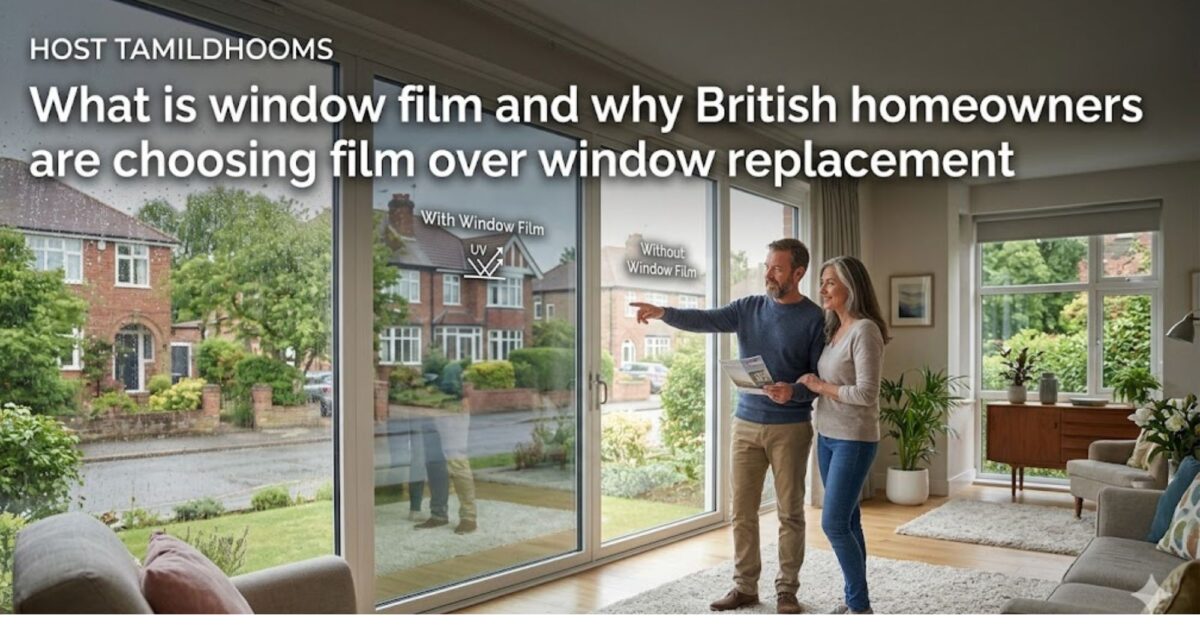
Window film – what the material is, what it does and how it works. Here is why thousands of homeowners across the UK prefer film to costly window replacement.
Window film – five core technologies
Today there are five principal types of window film, or more precisely five technologies on which they are based:
- dyed,
- metalized,
- carbon,
- ceramic,
- and hybrid.
Each type is a trade-off between cost, performance and side effects.
- Dyed films are the most affordable option. They block visible light effectively but do little about infrared heat and fade within three to five years.
- Metalized window glass film is more effective but creates a mirror-like sheen and, crucially, weakens mobile and WiFi signals by 30–50 %. If your reception is already poor, that is a real problem.
- Carbon window film uses carbon nanoparticles. It does not fade, does not block radio signals and reflects infrared radiation well.
- Ceramic film for window is the premium choice: microscopic ceramic particles deliver maximum heat rejection without any metal in the composition.
- Hybrid films combine two technologies and sit somewhere in the middle in terms of price and performance.
For most modern British homes, the optimal choice is metalized or spectrally selective window film. These deliver strong UV and infrared rejection without interfering with wireless signals. The range of window films https://www.window-film-solaris.co.uk/window-film/the-range represents the most extensive selection of glass tinting options available today.
Users on UK Reddit threads note that metalized window films deliver the greatest effect and offer the best value for money.
Why British homes need window film
Up to 35 % of a building’s energy is lost through its windows. In British homes with large casement windows and single glazing, that figure can be even higher. Replacing windows is expensive: ten new double-glazed units typically cost between £8,000 and £15,000. Window film addresses the same problem for 5–15 % of that sum.
On British homeowner forums, the same story comes up again and again: someone fits film to one window as a trial, and a week later they are covering every window in the house. The effect is immediate – the room stops overheating and sitting near the window becomes comfortable even on a hot day.
The numbers behind window film
According to the US Department of Energy, window films can reduce energy costs by up to 30 % per year. They block up to 78–80 % of solar heat passing through glass and cut out up to 99 % of ultraviolet radiation. The payback period is two to five years, after which the savings become pure gain.
Window film is one of those investments that genuinely pays for itself. According to IWFA research, homeowners save between 20 % and 40 % on electricity during the summer months. A quality film lasts 15–25 years and requires little maintenance – just a soft cloth and an ammonia-free cleaner.
Future developments
The global window film market is worth billions of pounds and is growing at 5–7 % per year. The construction segment accounts for more than half the market. The key trend is a shift from simple solar-control films to multi-functional ones.
Smart switchable films based on PDLC technology are emerging – they switch from transparent to frosted at the tap of a smartphone. But for the typical British home, classic window film remains the most practical and affordable solution.
UV protection for your interiors
Ultraviolet light is the invisible enemy of interior furnishings. It causes roughly 40 % of fading in furniture, fabrics and artwork. Some films, such as those from 3M, have even received a recommendation from the Skin Cancer Foundation as protection against UV exposure. For rooms with valuable furniture or collections, this is not a luxury – it is a necessity.
Window glass film – four functional categories
All window film falls into four categories by purpose. In practice, each category is made from different materials with different properties:
- Solar control – reduces heat gain, glare and UV radiation.
- Decorative – creates the effect of frosted, stained or textured glass.
- Safety and security – holds shards in place when glass breaks and slows down break-in attempts.
- Automotive films – coatings for vehicle glass.
- UV interior protection – certain UV-blocking films, such as those from 3M, have received a recommendation from the Skin Cancer Foundation. For rooms with valuable furniture or collections, this is a necessity rather than a luxury.
Every type of window film https://www.window-film-solaris.co.uk/window-film possesses unique characteristics. According to these features, glass films can be categorised into several primary types.
Self-adhesive window films and installation solution
Most modern films are self-adhesive. The PSA (pressure-sensitive adhesive) layer is permanently active, so the film bonds to glass on contact. This is precisely why an installation solution is essential – a mixture of water with a few drops of neutral washing-up liquid.
The solution performs three tasks simultaneously:
- it creates a slipping layer for accurate positioning,
- it displaces air between the film and the glass,
- and it slows down adhesive activation, giving the installer a few minutes to adjust.
Without the solution, window glass film bonds instantly, locking in every bubble and crease permanently. The standout advantage of a self-adhesive film for windows https://www.window-film-solaris.co.uk/window-film/self-adhesive is undoubtedly the sheer simplicity of the application process.
Self-adhesive or static glass film
There is an alternative – glass covering film held by static charge (static cling). This film contains no adhesive at all; it stays in place through molecular forces between smooth surfaces. It peels off easily and is ideal for rented accommodation.
If you live in a rented flat, static-cling glass film is the best option. It holds without adhesive and comes off in minutes without leaving any marks on the glass. On German rental forums, where the lettings market is particularly well developed, this type of film is described as a lifesaver for tenants – no disputes with the landlord when moving out.
However, it is worth noting that static films are problematic in rooms with high humidity. Static glass film detaches from the surface almost immediately in such conditions.
Window glass film – compatibility with glass types
Not every film can be applied to every type of glass. Stories about cracked panes appear on forums regularly: someone fits a dark film to a double-glazed unit and a couple of months later the glass splits. The cause is thermal stress. A dark (or black) film heats the glass unevenly, and the temperature differential between the centre and the edge causes a fracture.
Glass with Low-E coatings requires particular attention. Strongly reflective mirror window films are suitable for modern energy-efficient glazing units.
Three key figures when choosing film for window:
- SHGC (solar heat gain coefficient – the lower the figure, the better the heat rejection),
- VLT (visible light transmittance – the higher the figure, the brighter the room)
- percentage of UV rejection.
South- and west-facing windows call for films with a high TSER, whilst north-facing windows are well served by lighter, more transparent options.
One important rule: never apply film to only part of a pane. Uneven heating creates thermal stress that will cause a crack. Window manufacturers will void the guarantee in such cases.
Professional installation of window glass film or DIY?
Films for windows can be fitted by the homeowner. DIY kits cost from £1 to £5 per square foot. Professional installation ranges from £7 to £20. The price difference is considerable, but so is the difference in results.
On Home Depot and TintDude forums, experienced users share the typical mistakes beginners make when fitting window glass film.
- The most common is inadequate glass cleaning. Even a microscopic dust particle creates a visible defect.
- The second mistake is imprecise cutting: an error of 1–2 mm at the edges is clearly visible.
- The third is attempting to work alone on a large window: window glass film folds back on itself and sticks together.
After installation, window films go through a drying period of 7 to 30 days. Small water bubbles and slight haziness in the first few weeks are perfectly normal. Leave them alone – they will disappear on their own as the moisture evaporates.