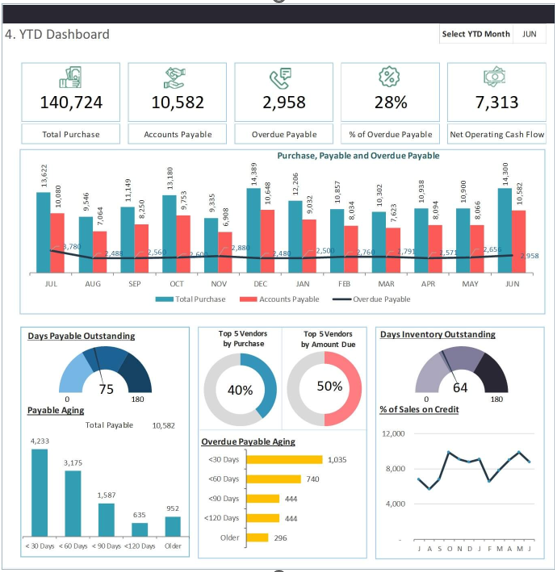
Introduction to Accounts Payable Dashboard and Accounts Payable Dashboard Template
What are an Accounts Payable Dashboard and Why It is Important
Accounts Payable Dashboard provides management with a complete and detailed view of open accounts, vendor balances and due dates. With all the company’s accounts payable information presented on one page, management – whether it be the entrepreneur, accountant or CFO – can always monitor the company’s accounts payable. Managing accounts payable in an effective way can prevent vendor disputes, late charges and penalties.
Accounts payable dashboard is a key tool to manage accounts payable liabilities, terms and due dates, late payment penalties, and cash outflows to ensure the company has enough liquidity. Without tracking and monitoring, companies can easily miss payments, get charged late fees by suppliers and be at risk of running out of cash.
Benefits of Using an Accounts Payable Dashboard Template
An Accounts Payable Startup Boosted Dashboard Template helps in efficient management of payables. It is an already prepared report used for presenting the Accounts Payable data. Instead of preparing Accounts Payable report manually from the beginning, the template can be used to present and analyze the data more efficiently.
An Accounts Payable Dashboard Template helps in efficient management of finances and makes sure that all the payable information is recorded on a single page in a very easy to understand format. Using an accounts payable template for tracking expenses and due dates can help in making timely and very important payments. This helps in bringing about an improvement in the cash flow and vendor relations and thus makes the task of accounts payable management, much easier and efficient.
Core Components of Accounts Payable Dashboard Excel
I like to use an Accounts Payable Dashboard Excel because the Excel software can be customized to meet the needs of my company. An accounts payable dashboard is a wonderful tool that helps you to track vendor invoices, as well as payments due and categorize your expenses. In Excel I can generate many reports that help me to determine current payables as well as historic trends of payables and payments.
Use an Accounts Payable Dashboard Excel to determine which invoices are due, overdue and the total amount due to each vendor. An AP dashboard in Excel is a great tool that will assist in maintaining good cash flow and can be altered to fit your business needs.
Advantages of Accounts Payable Dashboard Google Sheet for Collaboration
An Accounts Payable Dashboard Google Sheet provides the power of Excel with the collaboration benefits of the cloud. With a Google Sheet, your team can work from any location, at any time and have real time updates to others in the team. A great tool for remote or distributed teams.
Our Accounts Payable Dashboard Google Sheet is real time, so everyone is always up to speed on our financial position. No more costly miscommunications and hours arguing over the status of an invoice. No more sending around spreadsheets.
Accounts Payable Dashboard Power BI for Advanced Analytics and Visualization
Why Accounts Payable Dashboard Power BI is Essential for Expense Management
An Account Payable Dashboard Power BI can be a suite of tools used to assist with expense control and give a more in-depth and detailed view of your payable information. By using an Account Payable Dashboard Power BI, you will be able to produce hundreds of interactive, visually impressive reports and visuals, at lightning speed. These interactive reports and visuals can help with the analysis of your data.
The Account Payable Dashboard Power BI is a tool that gives you a simple way to look at the data and using the filters and drilling down you can get into more detail in order to identify for example that costs are increasing and payments are being delayed, which enables you to be more effective in your financial planning and decision making.
Integrating Accounts Payable Dashboard Power BI with Accounting Systems
A key benefit of our Accounts Payable Dashboard Power BI report is that it can link to your accounting system and other data sources. We can tie your A/P data to your accounting system, such as QuickBooks, ERP systems, and financial databases to make sure your data is always up to date.
The Account Payable Dashboard Power BI report utilizes data from a variety of sources and gives a summary overview of the account payable. The report is significantly more accurate and saves a lot less time to prepare than the current Excel version.
Key Metrics in an Accounts Payable Dashboard Template
Core Metrics in Accounts Payable Dashboard
An Accounts Payable Dashboard Template should contain the key performance metrics (KPIs) that help to determine the payables performance. These metrics significantly affect the measurement of the financial liabilities of the organization and have a direct bearing on the cash outflow management. Few of the key metrics required in an account payable performance report template are – Total Payables Aging Payables Due Dates
Reviewing and tracking key performance indicators (KPIs) will give you an understanding of where to spend your cash to avoid fines and fees. In addition, it will also ensure that you are not at risk of experiencing issues with your suppliers and therefore, your business relationships will not be compromised. An AP Dashboard is a key tool to assist in presenting and understanding the KPI’s.
Advanced Metrics in Account Payable Dashboard Power BI
3 days ago, I introduced an example of what an Account Payable (AP) Power BI Dashboard could look like and listed some advanced metrics that could be included to help gain a better understanding of the Account Payable spend and the resulting expense. Some other possible metrics to include are Days Payable Outstanding, Payment Cycle Time, Vendor Performance and many more.
Advanced metrics enable you to make more informed decisions daily. Learn more about individual payment patterns and cash flow management strategies with Advanced metrics.
How Account Payable Dashboard Template Improves Expense Management
Real-Time Monitoring Using Accounts Payable Dashboard
An Account Payable Dashboard is a tool to display real time information on outstanding account payable. Keeping track of due dates and making timely payments is a crucial component of managing company expenditures and is a critical factor in preventing late charges and penalties.
Best Practice is to monitor Account Payable (AP) on an ongoing basis to ensure that problems are identified and addressed quickly to ensure a highly efficient accounting process.
Budget vs Actual Analysis Using Account Payable Dashboard Excel
An Account Payable Dashboard Excel can be very helpful to organizations in that it enables them to compare their actual spending with their budgeted spending. With this data the management will have a better understanding of the budget and cost control. The management will be in a better position to establish where discrepancies have occurred.
Budget vs Actual analysis is an important tool in finance to help make sense of expenses. It enables an organisation to see the way in which it is spending money and can help with cost control.
Accounts Payable Dashboard for Cash Flow and Financial Control
Improving Cash Flow Using Account Payable Dashboard
Cash flow management is closely linked to the Account Payable (AP) management. The purpose of an AP Dashboard is to give visibility into AP to ensure timely payments and minimize cash outflows so that the company has sufficient liquid assets to meet its short-term needs.
Managing cash flow is an important aspect of any business and with an Account Payable (AP) Dashboard you can gain visibility and control into your cash flow, to ensure you have the right levels of funding available to meet your business requirements, enable you to plan for investments and for business growth.
Vendor Management Using Account Payable Dashboard Template
An Account Payable Dashboard Template helps in maintaining vendor relations. With real time vendor balance and vendor payment history, organizations can ensure timely payments which are helpful in maintaining a good relationship with the vendors.
Improving your vendor management processes can yield a variety of benefits, from negotiating better payment terms to achieving more reliable supply. An Accounts Payable Dashboard will help you to collect the right information in the right timeframe.
When to Use Accounts Payable Dashboard Excel
An Account Payable Dashboard Excel is ideal for small to medium size business who need a system that is flexible and cost effective. This account payable dashboard template is easy to use and can be adapted to suit your business needs. The Account Payable Dashboard Excel is ideal for companies that prefer to work offline with their accounting reports.
When to Use Accounts Payable Dashboard Google Sheet
Updated Aug 29, 2022, Accounts Payable Dashboard Google Sheet This is a good option if you are working with a remote team that requires immediate access to data. The Google Sheet can be shared with multiple users, all of whom will be able to access and edit the sheet in real time.
When to Use Accounts Payable Dashboard Power BI
An Account Payable Dashboard Power BI is more suited to larger organisations with more complex data sets. A Power BI offers a wide range of functionality from detailed analysis and the ability to produce reports automatically, and it can draw data from a broad range of sources. Power BI reports are usually used for strategic and executive level reporting.
Conclusion
An Accounts Payable (A/P) Dashboard is a financial tool that allows you to gain control of your company’s expenses and improve cash flow, which in turn improves your financial health. An A/P Dashboard provides you with key, real-time and actionable information to help you in managing your accounts payable effectively. Bizinfograph offers ready-to-use dashboard templates on Finance, Sales, HR and Manufacturing.